Good Days to Get Married: 2026 Astrology Date Guide
In this Article
The good days to get married are the dates you elect - chosen deliberately so the sky supports the union you're starting, rather than working against it. In Vedic astrology that's called a vivah muhurta; in Western astrology it's electional astrology. Both traditions do the same thing: they screen out the sky's rough patches and point you toward a clean, well-supported window. For 2026, that means leaning into the strong winter and spring months and stepping around the retrogrades in late October and early November. Ask your first question free on MyNitya if you want a date checked against your own chart.
This is a different question from "when will I get married." That one asks the chart to predict a life event. This one assumes you've already decided to marry, and asks: what's the best date for the wedding? The answer is practical, calendar-based, and - for 2026 - specific.
Your personal astrologer - Vedic + Western.
Reads all 10,000+ points of your birth chart to answer your question. First question free, no card needed.
Ask your question free →Key Takeaways: Good days to get married are elected, not guessed. Vedic picks a vivah muhurta using favorable nakshatras (Rohini, Mrigashira, Magha, Uttara Phalguni, Hasta, Swati, Anuradha, Uttara Ashadha, Revati), clean tithis, and a Jupiter/Venus that isn't combust or retrograde - while avoiding Chaturmas. Western elects a chart with a waxing Moon, strong Venus and Jupiter, and no Mercury or Venus retrograde. For 2026, the best months are January, February, May, and late November-December. Avoid the Mercury retrogrades (Feb 26-Mar 20, Jun 29-Jul 23, Oct 24-Nov 13) and Venus retrograde (Oct 3-Nov 14).
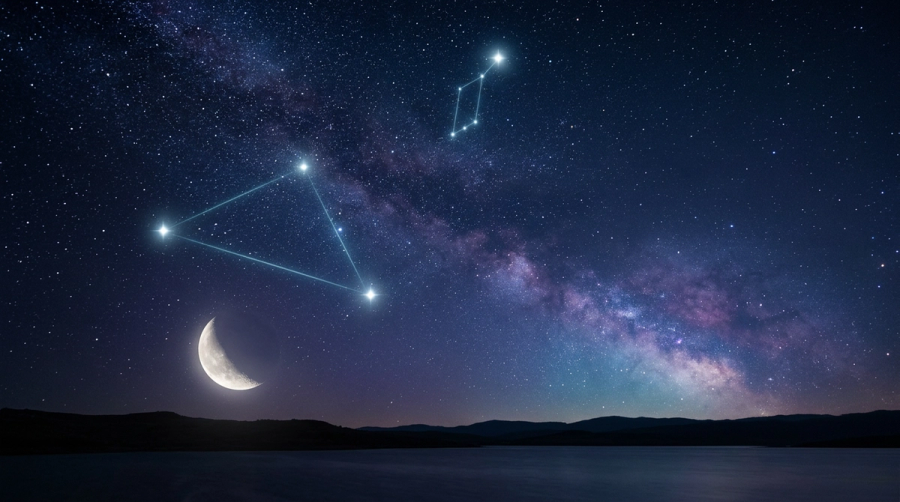
Waxing crescent Moon rising over a horizon with two bright stars linked in a glowing trine under the Milky Way
What Are the Good Days to Get Married in Astrology?
Good days to get married in astrology are dates elected so the planetary conditions of the ceremony chart support commitment, harmony, and growth. Astrologers don't predict a "lucky" day - they screen the calendar for a moment when the Moon, Venus, and Jupiter are well-placed and the disruptive influences are quiet. Both Vedic and Western traditions have a formal method for this.
The logic is that the wedding chart - the sky at the exact moment vows are exchanged - behaves like a birth chart for the marriage itself. A marriage "born" under a waxing Moon and a strong Venus starts with better structural conditions than one begun during Venus retrograde. It won't guarantee a happy marriage, and no honest astrologer claims it does. But electing a clean date removes a headwind, and that's worth doing.
Timing sets the stage; it doesn't write the play. If you'd like the prediction side - whether and roughly when partnership is indicated in your chart - the when will I get married astrology guide covers that, and the marriage date astrology guide goes deeper on the marriage window itself. This article is about the ceremony date once the decision is made.
Vedic Vivah Muhurta: How to Choose an Auspicious Wedding Date
A Vedic vivah muhurta is an auspicious wedding date chosen from the Panchang so the nakshatra, tithi, weekday, and planetary positions all favor a lasting marriage. The core rules: use a marriage-friendly nakshatra, avoid the Chaturmas months, and make sure Jupiter and Venus are neither combust nor retrograde. Get those right and you've cleared the biggest hurdles.
Start with the nakshatra - the Moon's lunar mansion on the day. Classical texts like the Muhurta Chintamani name a specific set of marriage-supporting nakshatras: Rohini, Mrigashira, Magha, Uttara Phalguni, Hasta, Swati, Anuradha, Moola, Uttara Ashadha, Uttara Bhadrapada, and Revati. Rohini, ruled by the Moon and associated with growth and fertility, is one of the most prized. A ceremony timed to one of these carries a gentler, more nourishing lunar signature than one set on a harsh or fixed-star nakshatra.
Then the tithi (lunar day). Waxing tithis are preferred; Rikta tithis (the 4th, 9th, 14th) are avoided. The weekday matters too - Monday, Wednesday, Thursday, and Friday are favored for their benefic rulers (Moon, Mercury, Jupiter, Venus).
The two make-or-break checks come from the Brihat Parashara Hora Shastra tradition. First, avoid Chaturmas - the roughly four-month window when Vishnu is said to sleep, running from Devshayani Ekadashi in July to Devuthani Ekadashi in November. No mainstream Hindu weddings are set here. Second, Guru and Shukra Tara must be "up" - meaning Jupiter (Guru) and Venus (Shukra) must not be combust (too close to the Sun) or retrograde. When Venus, the natural significator of marriage, is combust or retrograde, the muhurta is considered void no matter how good the nakshatra looks. This is why practitioners cross-check the whole sky, not just the day. AstroSage's marriage muhurat 2026 tables show how these factors combine into the accepted date lists.
Western Electional Astrology: Electing a Strong Wedding Chart
Western electional astrology chooses a wedding date by building the strongest possible event chart: a waxing Moon, a well-placed Venus and Jupiter, no Mercury or Venus retrograde, and no hard aspect from Mars or Saturn to the Moon, Venus, or the 7th house. The goal is a chart that "grows" - which is why the waxing Moon is the single most repeated rule.
The Moon is the heart of a wedding election. Use a waxing Moon (between the New and Full Moon) to symbolize a marriage that develops and expands. Avoid the exact Full Moon and the day before the New Moon - the first puts Sun and Moon in opposition (classical tension between partners), the second signifies endings. Beyond phase, prefer the Moon in Taurus, Cancer, Libra, or Pisces for stability, emotional depth, partnership, and tenderness, and steer clear of a void-of-course Moon at the ceremony time - in modern practice that's close to non-negotiable. Kerykeion's electional wedding guide lays out these Moon rules clearly.
Next, the benefics. Venus and Jupiter should be direct, dignified, and ideally making a soft aspect (sextile or trine) to the Moon. Venus rules love and Jupiter rules blessing and expansion - you want both awake and available. Just as important is what you avoid: a Moon squaring or opposing Mars (conflict, heat) or Saturn (coldness, delay, heaviness), and any wedding set during Mercury retrograde (miscommunication, do-overs) or Venus retrograde (revisiting old love themes, second-guessing).
This isn't new-age invention. Electional astrology is one of the four classical branches Ptolemy discusses in the Tetrabiblos, and the 17th-century English astrologer William Lilly gave detailed election rules in Christian Astrology. The tradition is centuries deep, and its wedding advice has stayed remarkably stable: grow the Moon, strengthen the benefics, silence the malefics.
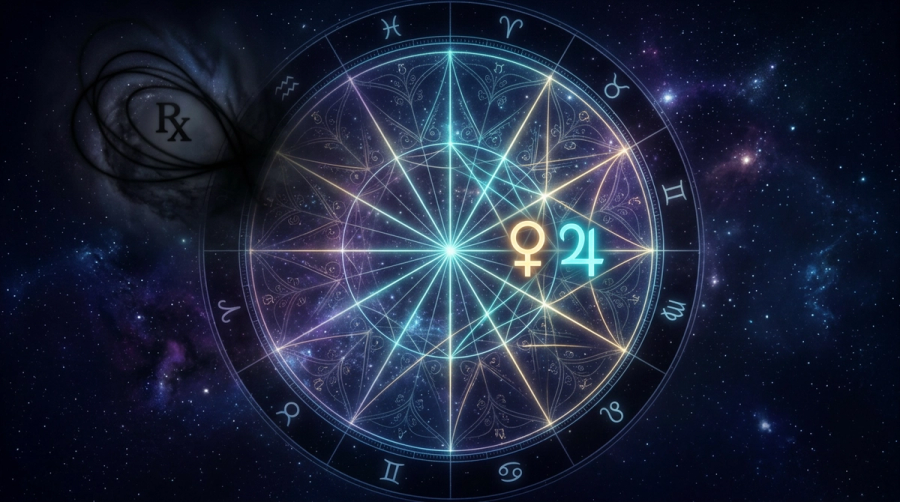
Electional wedding chart wheel with Venus and Jupiter glowing while a retrograde planet fades at the edge
Best Month to Get Married in Astrology 2026
The best month to get married in astrology in 2026 is February or May by the Vedic calendar (peak vivah muhurta clusters) and any clean window between the retrogrades by Western electional rules. January, late November, and December are also strong. The single window both systems reject is early October through mid-November, when Venus and Mercury are both retrograde and Chaturmas is still closing.
Here's the 2026 map, cross-checked between both systems. Vedic month quality follows the standard Panchang consensus; the retrograde dates are verified for 2026.
Month (2026) | Vedic vivah muhurta | Western electional | Verdict
- January: Strong winter muhurtas - Clean, no retrogrades - Favorable
- February: Peak (Feb 4-26, many dates) - Clean through Feb 25 - Favorable (best)
- March: Good early-mid month - Avoid Feb 26-Mar 20 (Mercury Rx); clean after - Mixed - pick after Mar 20
- April: Good, esp. 3rd-4th week - Clean - Favorable
- May: Peak (May 1-14) - Clean - Favorable (best)
Meet Nitya, your AI astrologer
She reads your birth chart to answer anything about your life. Your first complete answer is free, with no card required. Continued chat, Synastry, and Daily Guidance require Premium.
Questions you can ask about this topic
Tap any one below - or just write your own question in the form ↓
Nitya isn't a one-time horoscope. She's with you for the whole journey.
Understand yourself
Career, love, money, timing - any decision you are weighing. Answers read straight from your birth chart.
Understand any relationship
Add your partner, a parent, a friend, even a colleague. Nitya reads both charts together to explain the bond, the friction, and how to work through it.
Guidance for every day
Start each morning knowing what the day favors, what to watch for, and the best moments to act.
No card needed. Nitya just needs your birth details to read your chart.
Ask Nitya your first question - free →- June: Moderate, pre-Chaturmas - Clean through Jun 28 - Favorable early month
- July-mid Nov: Avoid (Chaturmas) - Multiple retrogrades - Avoid
- Late November: Strong (Nov 21, 24, 25, 26) - Clean after Nov 14 - Favorable after Nov 20
- December: Good - Clean - Favorable
A key 2026 note: Chaturmas ends at Devuthani Ekadashi on November 20, 2026, so the Vedic wedding season resumes the next day. Nov 21, 24, 25, and 26 carry favorable nakshatras (Revati, Rohini, Mrigashira) and are among the most-cited late-year dates.
Which 2026 Dates and Periods to Avoid
The 2026 periods to avoid for a wedding are the three Mercury retrogrades and the Venus retrograde - plus the entire Chaturmas stretch if you're following the Vedic calendar. These are the windows both a Vedic astrologer and a Western electional astrologer would flag before you book a venue.
Period to avoid (2026) | Dates | Why
- Mercury retrograde #1: Feb 26 - Mar 20 - Miscommunication, paperwork errors, cold feet
- Mercury retrograde #2: Jun 29 - Jul 23 - Overlaps early Chaturmas; logistics go sideways
- Venus retrograde: Oct 3 - Nov 14 - Love significator weak; reworking old relationship themes
- Mercury retrograde #3: Oct 24 - Nov 13 - Stacks directly on Venus retrograde
- Chaturmas (Vedic): Devshayani Ekadashi (Jul) - Nov 20 - No Hindu weddings; Guru/Shukra windows also limited
Notice how October 3 to November 13-14 is the worst stretch of the year for a wedding in either system. Venus is retrograde the whole time, Mercury joins it retrograde from October 24, and the Vedic calendar is still inside Chaturmas until November 20. Cafe Astrology's breakdown of the 2026 Venus retrograde in Scorpio explains why the love-planet's backward motion is the one most electional astrologers refuse to marry under.
Where Vedic and Western Timing Quietly Agree
Vedic and Western wedding timing agree far more than they differ. Both want the Moon strong and growing, both protect Venus as the marriage significator, and both reject the same 2026 dead zone in autumn. When two independent traditions converge on the same windows, the guidance gets more trustworthy.
The vocabulary differs. Vedic astrology screens by nakshatra, tithi, and the "Tara" status of Jupiter and Venus; Western astrology screens by Moon phase, sign, and aspects to the benefics. The underlying instinct is identical - a strong waxing Moon, an unafflicted Venus, no malefic interference. Among couples who bring wedding-date questions to MyNitya, those eyeing October-November 2026 slots are the most likely to be steered to an earlier or later window once the retrograde stack and Chaturmas are laid out.
MyNitya supports both Vedic and Western astrology, and you can switch between them mid-conversation. Vedic excels at precise timing - muhurtas, dashas, the Panchang. Western excels at the psychological texture of the chart and the electional aspect-work. Reading a date through both gives you the fullest picture.
How to Pick Your Own Best Wedding Date
Picking your own good day to get married means narrowing the calendar in three passes: cut the retrogrades and Chaturmas, keep only the strong-Moon days, then match the finalists against your own two birth charts. General "lucky dates" lists are a starting point, not an answer - the best date is the one that also agrees with the couple.
- Cut the no-go periods first. For 2026, remove Feb 26-Mar 20, Jun 29-Jul 23, and Oct 3-Nov 14 outright. If following the Vedic calendar, remove all of Chaturmas.
- Keep only strong-Moon days. Favor a waxing Moon in Taurus, Cancer, Libra, or Pisces (Western), or a marriage nakshatra like Rohini or Hasta on a clean tithi (Vedic).
- Confirm Venus and Jupiter are direct and well-placed on your shortlist - the one check that voids an otherwise-good date.
- Match finalists to both birth charts. A date that's universally auspicious can still clash with one partner's dasha or transits. This is the step generic lists skip.
- Consider the emotional shape of the day, not just the mechanics. The 7th house partnerships and marriage guide helps you read what your own partnership chart is asking for.
That fourth step is where a personalized reading earns its place. A public "best dates" list can't see your Ascendant, your Venus, or your current transits. To test a specific date against your own chart - or find one that fits both partners - ask Nitya to check an auspicious date against your birth chart, free on MyNitya. Nitya reads your full Vedic or Western chart, and Premium adds a synastry reading to compare both partners' charts and a daily guidance reading each morning as the date approaches. Your first question is free.
Still weighing whether the timing in your life is right at all? The love transits for 2026 guide maps the year's romantic windows, and the synastry compatibility guide shows how two charts fit together before you set a date.
Frequently Asked Questions
What are the best days to get married in 2026 according to astrology?
The best days to get married in 2026 fall in January, February (Feb 4-26), May (May 1-14), and late November through December. February and May hold the peak Vedic vivah muhurta clusters, and all four windows are clear of the year's Mercury and Venus retrogrades - making them strong in both systems.
What is the best month to get married in astrology in 2026?
February and May are the best months to get married in 2026. Both carry the year's densest vivah muhurta dates in the Vedic calendar and sit outside every 2026 retrograde. January, late November (after November 20), and December are also strong, low-risk months in both Vedic and Western timing.
Should I avoid Mercury or Venus retrograde for my wedding?
Yes - electional astrology avoids both. In 2026, avoid Mercury retrograde (Feb 26-Mar 20, Jun 29-Jul 23, Oct 24-Nov 13) and Venus retrograde (Oct 3-Nov 14). Venus retrograde is the stricter no: as the love significator moving backward, it's the period most Western astrologers refuse to marry under.
What is the difference between vivah muhurta and electional astrology?
Vivah muhurta is the Vedic method of choosing a wedding date from the Panchang using nakshatra, tithi, and the status of Jupiter and Venus. Electional astrology is the Western method, building a strong event chart with a waxing Moon and well-placed benefics. Different vocabulary, near-identical goal.
Do good wedding dates guarantee a happy marriage?
No. A well-elected date removes astrological headwinds - a weak Moon, a retrograde Venus, hard Saturn or Mars contacts - but it can't replace the work two people do together. Timing sets favorable conditions at the start; the marriage itself is built by the couple, not the sky.
Can astrology find a date that works for both partners?
Yes. Beyond a universally auspicious date, an astrologer checks the shortlist against both partners' birth charts - dashas, transits, and 7th-house factors - so the date agrees with the actual couple, not just the calendar. This personalized step is what separates a real election from a generic "lucky dates" list.
Choosing a Date the Sky Will Back
Good days to get married aren't handed down by luck - they're chosen with intention, and 2026 makes the choice unusually clear. Lean into the strong winter and spring windows, treat February and May as your peak options, welcome back late November and December after Chaturmas ends on November 20, and step firmly around the October-mid-November retrograde stack. Do that, and whichever system you follow, the sky is working with you instead of against you.
The last piece is personal. A universally auspicious date still has to fit your two charts. Chat with Nitya about your birth chart - try free, and check your shortlist against the timing that's actually yours. The wedding is one day. Choosing it well is one small way of honoring all the days that come after.