Planets on the Descendant in Astrology: What Each Planet Means
In this Article
Planets on the descendant in astrology reveal what you unconsciously seek in partners, how you behave in one-on-one relationships, and the qualities you project onto others. The descendant is the cusp of the 7th house - the point directly opposite your ascendant on the western horizon of your birth chart. Any planet sitting on or near this angle has an outsized influence on your marriage, close partnerships, and the hidden parts of yourself that only intimate relationships bring to the surface.
You know that feeling when you keep attracting the same type of person? Or when a partner brings out a side of you that surprises even you? That's your descendant at work. And if there's a planet sitting right on it, the effect is amplified dramatically.
Your personal astrologer - Vedic + Western.
Reads all 10,000+ points of your birth chart to answer your question. First question free, no card needed.
Key Takeaways: The descendant (7th house cusp) is the mirror of your ascendant - it shows what you attract in others. Planets conjunct the descendant have a stronger relational impact than planets merely in the 7th house. Each planet colors your partnership style differently: Venus brings harmony, Mars brings passion, Saturn brings karmic lessons. In Vedic astrology, the 7th house lord and planets aspecting it from other houses are equally important. Your exact descendant sign and any planets on it depend on your precise birth time.
What Is the Descendant in Astrology?
The descendant is the cusp of the 7th house in your birth chart, located on the western horizon at the exact moment of your birth. It sits directly opposite the ascendant (1st house cusp) and represents "the other" - the qualities you seek in partners, project onto others, and develop through relationships.
Think of it this way: your ascendant is how you present yourself to the world. Your descendant is what you look for in the world to complete you. If your ascendant is Aries (independent, self-starting, assertive), your descendant is Libra (partnership-oriented, diplomatic, harmony-seeking). You naturally gravitate toward people who embody those Libra qualities.
The descendant governs:
- Marriage and committed partnerships - the type of spouse you attract
- Business partnerships - how you collaborate one-on-one
- Open enemies - people who openly oppose you (a traditional 7th house signification)
- Shadow self - the parts of your personality you don't consciously identify with but project onto partners
In Vedic astrology (Jyotish), the 7th house carries similar weight. The Brihat Parashara Hora Shastra describes the 7th house as governing marriage, sexual union, travel, trade, and the spouse's nature. The 7th house lord's placement, dignity, and aspects tell a detailed story about your partnership karma.
The descendant's sign is always opposite your rising sign. If you're a Leo rising, your descendant is Aquarius. If you're a Virgo rising, your descendant is Pisces. This polarity creates a natural tension and attraction between what you are and what you need.
Why Planets on the Descendant Matter More Than Planets in the 7th House
Planets on the descendant in astrology carry more weight than planets simply placed in the 7th house. A planet conjunct the descendant (within 5-8 degrees of the exact cusp) acts like a spotlight on your relational patterns - it's angular, visible, and impossible to ignore.
Angular planets (on the ascendant, descendant, MC, or IC) are the loudest voices in a chart. They shape the most visible areas of your life. A planet at 15 degrees of your 7th house sign still influences partnerships, but a planet at 1-3 degrees of the 7th house - right on the descendant cusp - dominates them.
The orb matters. Most astrologers use a 5-8 degree orb for descendant conjunctions. A planet at 2 degrees from the exact descendant is more potent than one at 7 degrees. Some practitioners also count planets in the late degrees of the 6th house (within 3-5 degrees of the descendant) as conjunct, since their energy "bleeds" into the 7th house angle.
Among birth charts analyzed on MyNitya, users with planets tightly conjunct the descendant (within 3 degrees) consistently report that relationships are the central theme of their life - for better or worse.
Sun on the Descendant: Identity Through Partnership

Sunset on the western horizon with planetary symbols descending - astrology descendant concept
The Sun on the descendant means your core identity expresses most fully through one-on-one relationships. You don't just want a partner - you need one to feel complete. Partnerships aren't a nice addition to your life; they're central to your sense of self.
People with Sun conjunct the descendant often attract partners who are confident, charismatic, and sometimes dominating. The partner may take on a leadership role in the relationship. There's a risk of losing yourself in the other person's identity - defining who you are through who you're with.
The growth edge: learning that you already contain the solar qualities you admire in partners. The confidence, vitality, and creative self-expression you project onto others actually lives in you. Relationships become healthier when you own your Sun rather than outsourcing it.
In Vedic astrology, Sun in the 7th house can indicate a spouse with government connections, authority, or strong ego. If the Sun is the 7th lord placed in its own house, it strengthens marriage prospects. But Sun in the 7th can also create ego clashes - two strong personalities competing for dominance.
Moon on the Descendant: Emotional Mirroring in Relationships
Moon on the descendant creates deeply emotional, intuitive partnerships. You attract nurturing, sensitive people - or you become the nurturer in every relationship. Emotional security is your primary need from a partner, and you can sense your partner's moods before they speak.
This placement makes you highly responsive to others' emotional states. You absorb feelings like a sponge. The danger is emotional enmeshment - losing track of where your feelings end and your partner's begin. Codependency patterns are common with Moon conjunct the descendant.
Partners with this placement often have a strong maternal or caregiving quality. The relationship may revolve around home, family, and creating emotional safety. Moon here also suggests that your partnerships fluctuate with emotional tides - the relationship's temperature changes frequently.
In Jyotish, Moon in the 7th house is generally considered favorable for marriage. The Phala Deepika states that Moon in the 7th gives an attractive, passionate spouse. But if the Moon is waning or afflicted by malefics (Saturn, Rahu), emotional instability in partnerships increases.
Mercury on the Descendant: Communication as the Foundation
Mercury on the descendant means you need intellectual stimulation in partnerships above almost everything else. You attract witty, talkative, analytical people. Conversations are the glue that holds your relationships together - when communication breaks down, so does the bond.
This placement often shows up in people who marry writers, teachers, traders, or anyone whose work revolves around words and ideas. You might fall in love with someone's mind before anything else. The shadow side: overthinking relationships, analyzing feelings instead of feeling them, or choosing partners who are clever but emotionally unavailable.
Mercury conjunct the descendant can also indicate multiple significant partnerships or a partner who is younger or youthful in energy. Mercury's dual nature (it rules both Gemini and Virgo) means you might attract very different types of partners at different life stages.
In Vedic astrology, Mercury in the 7th house suggests a spouse involved in business, communication, or intellectual pursuits. Mercury is a natural benefic when associated with benefics, making this generally a positive placement for partnership harmony - especially if Mercury is in its own sign or exalted.
Venus on the Descendant: Natural Harmony in Love
Venus on the descendant is one of the most favorable placements for relationships in all of astrology. Venus is the natural significator of love, beauty, and partnership - and the 7th house is its domain. This planet on this angle is like a key fitting perfectly into a lock.
You attract beautiful, charming, artistic people. Relationships come easily to you. There's a natural grace in how you relate to others - you're diplomatic, accommodating, and genuinely enjoy partnership. People with Venus conjunct the descendant often marry early or have multiple admirers.
The shadow: over-compromising to maintain harmony, avoiding conflict at the cost of authenticity, or staying in relationships past their expiration date because you hate being alone. Venus here can also indicate vanity in partner selection - choosing someone for their appearance or social status.
In Jyotish, Venus in the 7th house is considered excellent for marriage. The Brihat Jataka describes Venus in the 7th as giving a beautiful, passionate spouse and a happy married life. Venus is the karaka (significator) of the 7th house, so its placement here strengthens all partnership matters. However, the "karaka in its own bhava" principle suggests that while the spouse is wonderful, there may be subtle challenges in fully appreciating what you have.
Curious what Venus's placement reveals about your relationships? Chat with Nitya about your birth chart - try your first question free.
Meet Nitya, your AI astrologer
She reads your birth chart to answer anything about your life - and she can go deep on any relationship you care about and guide your day ahead. First question free, no card needed.
Some questions our users ask Nitya
Tap any one below - or just write your own question in the form ↓
Mars on the Descendant: Passion, Conflict, and Drive
Mars on the descendant brings intensity to every close relationship. You attract assertive, competitive, sometimes aggressive partners. There's undeniable physical chemistry - Mars here creates magnetic sexual attraction. But it also creates friction, arguments, and power struggles.
This is the classic "can't live with them, can't live without them" placement. The passion that draws you together is the same energy that fuels conflicts. People with Mars conjunct the descendant often have dramatic relationship stories - intense beginnings, explosive arguments, passionate reconciliations.
Mars here can also indicate a partner who is athletic, entrepreneurial, or works in a Mars-ruled field (military, surgery, engineering, sports). The partner pushes you to be bolder, more direct, and more courageous.
In Vedic astrology, Mars in the 7th house is one of the key factors in Mangal Dosha (Kuja Dosha) - a condition that traditional texts say creates challenges in marriage. The Brihat Parashara Hora Shastra notes that Mars in the 1st, 4th, 7th, 8th, or 12th house from the ascendant creates this dosha. But context matters enormously: Mars's sign, aspects from benefics, and the partner's chart all modify the outcome. Many happy marriages exist with Mars in the 7th.
Jupiter on the Descendant: Growth Through Partnership
Jupiter on the descendant attracts generous, optimistic, wise partners who expand your worldview. Relationships feel like adventures - your partner introduces you to new philosophies, cultures, or spiritual paths. Marriage often brings material and spiritual abundance.
This is one of the most protective placements for partnerships. Jupiter's benefic nature shields relationships from the worst outcomes. Even difficult periods tend to resolve positively. People with Jupiter conjunct the descendant often marry someone from a different cultural or educational background.
The shadow: expecting too much from partners, idealizing relationships, or attracting partners who overpromise and underdeliver. Jupiter's expansive nature can also mean weight gain after marriage (a surprisingly common observation) or a partner who is generous to a fault.
In Jyotish, Jupiter aspecting or placed in the 7th house is considered one of the strongest protections for marriage. Jupiter's 5th, 7th, and 9th aspects mean it can influence the 7th house from multiple positions. Jupiter in the 7th specifically gives a dharmic, knowledgeable spouse and a marriage grounded in shared values.
Saturn on the Descendant: Karmic Lessons in Love
Saturn on the descendant is one of the most challenging - and ultimately rewarding - placements for relationships. Saturn here delays, tests, and matures your approach to partnership. Early relationships often feel heavy, restrictive, or disappointing. But Saturn rewards patience.
You attract older, more serious, or authority-figure partners. The relationship may feel like work - because it is. Saturn demands that you earn your partnership through commitment, responsibility, and emotional maturity. Marriages with Saturn on the descendant tend to be long-lasting once established, but they rarely come easily.
This placement often correlates with late marriage (after 28-30, around Saturn's first return). The first Saturn return is frequently when people with this placement finally find a partnership that works - because they've done the inner work Saturn requires.
In Vedic astrology, Saturn in the 7th house is a significant placement. Saturn is a natural malefic, and its presence in the 7th can indicate delays in marriage, a spouse who is older or more serious, or karmic debts being worked out through partnership. But Saturn also gives longevity to marriage - what takes longer to build lasts longer.
Rahu and Ketu on the Descendant: The Karmic Axis of Relationships
In Vedic astrology, Rahu (North Node) and Ketu (South Node) on the descendant create some of the most intense karmic relationship patterns. These shadow planets operate on the axis of desire (Rahu) and detachment (Ketu).
Rahu on the Descendant
Rahu conjunct the descendant creates an obsessive pull toward relationships. You're magnetically drawn to partnerships - sometimes to people who are unconventional, foreign, or outside your cultural norm. Rahu amplifies desire, so relationships feel all-consuming. There's a hunger for the "perfect partner" that can lead to idealization and eventual disillusionment.
Rahu in the 7th house can indicate a spouse from a different background, an unconventional marriage, or partnerships that involve deception or illusion. The lesson: relationships aren't meant to fill a void. The hunger Rahu creates can only be satisfied by inner work.
Ketu on the Descendant
Ketu conjunct the descendant creates detachment from partnerships. You may feel indifferent toward marriage, attract spiritually-oriented partners, or experience sudden separations. Ketu here suggests past-life mastery of relationships - you've "been there, done that" at a soul level, which can make current partnerships feel unsatisfying.
Ketu in the 7th house can indicate a spouse who is spiritual, introverted, or emotionally distant. The lesson: learning to be present in relationships rather than checking out. Your growth comes from engaging with partnership, not transcending it.
Outer Planets on the Descendant: Uranus, Neptune, and Pluto
The outer planets move slowly and affect entire generations, but when they land on your personal descendant, their influence becomes deeply individual.
Uranus on the Descendant
Uranus here attracts unconventional partners and creates relationships that defy tradition. You need freedom within partnership. Sudden beginnings and endings are common. The partner may be eccentric, brilliant, or emotionally unpredictable. Long-term relationships work only when both people have significant independence.
Neptune on the Descendant
Neptune on the descendant creates dreamy, idealized partnerships - and the risk of profound disillusionment. You see partners through rose-colored glasses. Boundaries dissolve. The connection feels spiritual, soulmate-level. But Neptune also brings deception, confusion, and the painful moment when the illusion shatters. The growth: learning to love real people, not projections.
Pluto on the Descendant
Pluto conjunct the descendant creates transformative, intense, sometimes obsessive relationships. Power dynamics dominate. The partner may be controlling, or you may unconsciously seek to control them. Relationships with Pluto here go through death-and-rebirth cycles - they either transform you completely or end dramatically. There's no casual dating with this placement.
How to Find Planets on Your Descendant
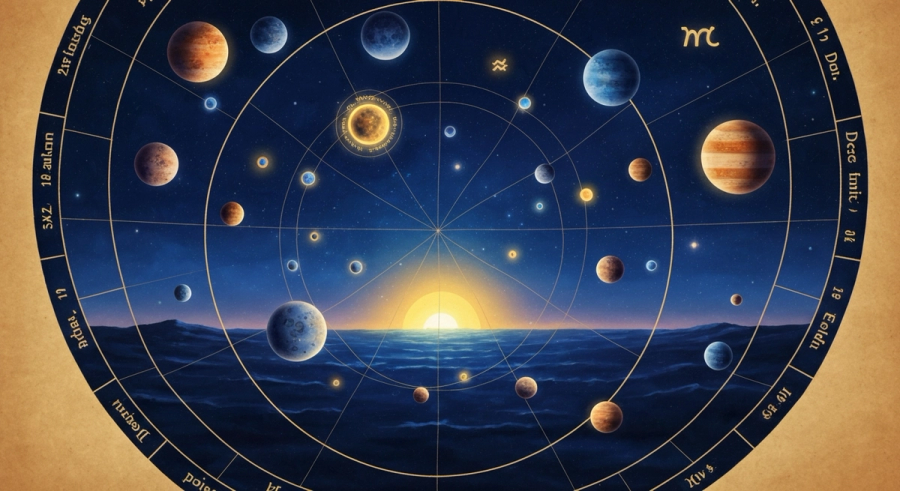
Astrological birth chart wheel with descendant angle highlighted on the western horizon
Finding planets on your descendant requires an accurate birth chart calculated with your exact birth time, date, and location. Even a 10-minute difference in birth time can shift the descendant by several degrees - potentially moving a planet on or off the angle.
- Get your exact birth time from your birth certificate or hospital records
- Calculate your birth chart using a reliable astrology software or service that shows house cusps
- Identify your descendant - it's the sign and degree on the cusp of your 7th house
- Check for planets within 5-8 degrees of the descendant cusp on either side
- Note the sign - the descendant's sign colors how those planetary energies express in relationships
On MyNitya, you enter your birth details and chat with Nitya - an AI astrologer who analyzes over 6,000 astrological data points from your Vedic birth chart, including planetary positions, houses, nakshatras, dashas, and navamsha. Ask Nitya about planets near your descendant and what they mean for your relationships - try your first question free.
Planets on the Descendant in Synastry
When another person's planet falls on your descendant in a synastry (relationship comparison) chart, the effect is electric. Their planet activates your partnership angle directly.
- Their Sun on your descendant: You see them as your ideal partner. They embody what you're looking for
- Their Moon on your descendant: Deep emotional recognition. Feels like coming home
- Their Venus on your descendant: Instant romantic attraction. They feel like "your type"
- Their Mars on your descendant: Intense physical chemistry. Can be passionate or combative
- Their Saturn on your descendant: Karmic bond. Feels fated but heavy. Long-term potential if both are mature
- Their Rahu on your descendant: Obsessive attraction. Feels destined but can be illusory
Synastry contacts to the descendant are among the strongest indicators of significant relationships. If someone's personal planet (Sun, Moon, Venus, Mars) conjuncts your descendant within 3 degrees, you'll feel it immediately upon meeting them.
Frequently Asked Questions
What does it mean to have planets on the descendant in astrology?
Planets on the descendant in astrology indicate that specific planetary energies strongly influence your partnerships, marriage, and one-on-one relationships. The descendant is the 7th house cusp, and any planet conjunct it (within 5-8 degrees) shapes the type of partner you attract and how you behave in close relationships.
Which planet is best on the descendant?
Venus and Jupiter are considered the most beneficial planets on the descendant. Venus brings natural harmony, attraction, and ease in partnerships. Jupiter brings growth, protection, and generous partners. However, every planet on the descendant offers valuable lessons - even challenging ones like Saturn or Pluto lead to deep relational wisdom over time.
Does the descendant show your soulmate?
The descendant shows the qualities you seek in a partner and the type of person you naturally attract. It doesn't point to one specific soulmate, but it reveals your relational blueprint. Planets on the descendant and the descendant's ruling planet give detailed information about your most significant partnerships.
How do I know if a planet is conjunct my descendant?
Calculate your birth chart with your exact birth time. Look at the degree on your 7th house cusp (descendant). Any planet within 5-8 degrees of that point - either in the late 6th house or early 7th house - is considered conjunct the descendant. Tighter orbs (1-3 degrees) produce stronger effects.
What is the difference between descendant and 7th house in astrology?
The descendant is the starting point (cusp) of the 7th house. The 7th house spans roughly 30 degrees of the zodiac. A planet conjunct the descendant (on the cusp) has a more powerful and visible influence on relationships than a planet deeper inside the 7th house. The descendant is the most sensitive point of the entire 7th house.
Do planets on the descendant affect career?
Indirectly, yes. The 7th house also governs business partnerships, negotiations, and public dealings. Mars on the descendant can indicate a career involving competition or conflict resolution. Venus on the descendant suits careers in diplomacy, counseling, or the arts. The 7th house's influence extends beyond romance to all one-on-one interactions.
Nitya isn't a one-time horoscope. She's with you for the whole journey.
Understand yourself
Career, love, money, timing - any decision you are weighing. Answers read straight from your birth chart.
Understand any relationship
Add your partner, a parent, a friend, even a colleague. Nitya reads both charts together to explain the bond, the friction, and how to work through it.
Guidance for every day
Start each morning knowing what the day favors, what to watch for, and the best moments to act.
No card needed. Nitya just needs your birth details to read your chart.