
Saturn Return Ages: When It Hits and What Each Phase Means
In this Article
Saturn return ages follow a precise astronomical pattern: Saturn hits major milestones in your chart at ages 7, 14, 21, 29, 36, 44, 51, 58, 65, 73, 80, and 87. These aren't random numbers. They correspond to Saturn's squares, oppositions, and conjunctions to its natal position - each one marking a distinct developmental phase that shapes who you become.
Key Takeaways: Saturn's 29.5-year cycle creates predictable life milestones through squares (90 degrees), oppositions (180 degrees), and returns (conjunction). The first square hits around age 7, the opposition at 14, the closing square at 21, and the full return at 29. Each phase builds on the previous one. Understanding these ages helps you recognize Saturn's influence throughout your entire life - not just during the famous return at 29.
Your personal astrologer - Vedic + Western.
Reads all 10,000+ points of your birth chart to answer your question. First question free, no card needed.
What Are Saturn Return Ages and Why Do They Matter?
Saturn return ages are the specific life milestones when transiting Saturn forms major aspects (geometric angles) to its position in your birth chart. The full Saturn return at age 29 gets the most attention, but Saturn actually checks in on your development every 7 years through squares and oppositions.
These ages matter because they align remarkably with developmental psychology. Erik Erikson's stages of psychosocial development, Jean Piaget's cognitive milestones, and even cultural rites of passage all cluster around the same ages Saturn activates. It's as if the planet's orbit maps the natural rhythm of human maturation.
Here's the complete Saturn cycle mapped to life ages:
- Age 7 - First waxing square (90 degrees)
- Age 14-15 - First opposition (180 degrees)
- Age 21-22 - Last quarter square (270 degrees)
- Age 29-30 - First Saturn return (conjunction, 0 degrees)
- Age 36-37 - Second waxing square
- Age 44-45 - Second opposition
- Age 51-52 - Third quarter square
- Age 58-60 - Second Saturn return
- Age 65-66 - Third waxing square
- Age 73-74 - Third opposition
- Age 80-81 - Fourth quarter square
- Age 87-88 - Third Saturn return
Each of these ages brings a specific type of challenge and growth opportunity. The squares create tension that demands action. The oppositions create awareness through confrontation with external reality. And the returns bring complete restructuring.

Seven life milestone stepping stones floating in cosmic space with Saturn overhead representing key ages
Age 7: The First Saturn Square - Learning Rules
The first Saturn square arrives around age 7, when transiting Saturn forms a 90-degree angle to your natal Saturn. This is when childhood innocence meets structure for the first time.
At 7, children enter what developmental psychologists call the "age of reason." They begin understanding rules not as arbitrary impositions but as structures that make social life possible. School becomes serious. Friendships develop expectations. The concept of fairness - Saturn's domain - becomes intensely important.
What happens at this age:
- School structure solidifies. Reading, writing, and arithmetic demand sustained effort. The child who could coast on charm now faces Saturn's demand for discipline.
- Social rules emerge. Friendships become more complex. Exclusion hurts more. The child learns that belonging requires effort and compromise.
- Authority figures multiply. Teachers, coaches, and other adults impose expectations beyond the family. The child's relationship with authority begins forming.
- Consequences become real. Actions have results that can't be undone with tears. The concept of responsibility takes root.
This square doesn't feel dramatic from the outside. But it's the foundation for everything that follows. How a child navigates this first encounter with Saturn's energy - whether they develop healthy discipline or rebel against all structure - sets patterns that echo through every subsequent Saturn phase.
Age 14: The First Saturn Opposition - Rebellion and Identity
The first Saturn opposition arrives around age 14-15, when transiting Saturn sits directly opposite its natal position. This is adolescent rebellion - and it's not random. It's Saturn's design.
An opposition in astrology creates awareness through confrontation. At 14, the confrontation is with authority itself. Everything the child accepted at 7 - rules, hierarchy, parental wisdom - now gets questioned. Not because teenagers are difficult, but because Saturn's opposition demands that you develop your own relationship with structure rather than simply inheriting someone else's.
What happens at this age:
- Identity crisis begins. "Who am I separate from my family?" becomes the central question. Saturn demands you start building your own identity rather than wearing your parents'.
- Authority gets challenged. Teachers, parents, and institutions face pushback. This isn't defiance for its own sake - it's the necessary testing of structures to see which ones are genuinely yours.
- Peer pressure peaks. The social structure of adolescence becomes its own Saturn system - with hierarchies, rules, and consequences that feel more real than adult-imposed ones.
- Future anxiety appears. For the first time, the question "What will I become?" carries weight. Saturn's timeline consciousness awakens.
- Physical maturation. The body itself restructures. Saturn governs bones, skin, and physical form - all of which transform dramatically at this age.
The opposition is a mirror. At 14, you see yourself reflected in the world's expectations and begin deciding which reflections are accurate and which need to be rejected. This is healthy. Saturn wants you to question authority - so you can eventually become your own.
Age 21: The Closing Square - Entering the Adult World
The closing square at age 21-22 is Saturn's final checkpoint before the full return. Transiting Saturn forms a 270-degree angle to its natal position, creating pressure to finalize your transition from adolescence to early adulthood.
This is the age of real-world entry. College ends or career begins. Financial independence becomes necessary rather than optional. The structures you've been building since 14 - your identity, your skills, your relationships - now face their first real-world test.
What happens at this age:
- Education culminates or pivots. University graduation, trade completion, or the decision to change direction entirely. Saturn asks: "Did you build something useful?"
- Financial reality arrives. Bills, rent, debt - the material world demands engagement. Saturn's lesson in resources begins in earnest.
- Relationships get serious. Casual dating gives way to questions about commitment. Friendships sort into those that will last and those that won't survive the transition.
- Career foundations form. First real jobs, internships, or business attempts. The gap between ambition and competence becomes painfully visible.
- Independence becomes non-negotiable. Whether you're ready or not, the world expects you to function as an adult. Saturn doesn't care if you feel ready.
Meet Nitya, your AI astrologer
She reads your birth chart to answer anything about your life - and she can go deep on any relationship you care about and guide your day ahead. First question free, no card needed.
Some questions our users ask Nitya
Tap any one below - or just write your own question in the form ↓
The closing square is often experienced as a crisis of competence. You know what you want (established during the opposition at 14) but you're not yet skilled enough to get it (that comes at the return at 29). This gap creates the productive frustration that drives the next 7 years of building.
Age 29: The First Saturn Return - Complete Restructuring
The first Saturn return at age 29-30 is the most famous and most intense Saturn milestone. Saturn completes its first full orbit and returns to the exact degree it occupied at your birth. Everything gets audited.
This isn't just another checkpoint - it's a complete cycle completion. Every lesson from ages 7, 14, and 21 converges. Every structure you've built gets tested. Every avoidance gets confronted. The return asks one fundamental question: Is the life you've built actually yours?
What happens at this age:
- Career crystallizes or collapses. Jobs that were "good enough" become intolerable. Careers that align with your authentic self get reinforced. Many people change professions entirely during this transit.
- Relationships face truth. Partnerships built on genuine compatibility deepen. Those built on convenience, fear, or habit end. Marriages happen. Divorces happen. Both are Saturn's work.
- Identity solidifies. The persona you built in your 20s either becomes your authentic self or gets stripped away. You stop performing and start being.
- Health demands attention. The body you could abuse in your early 20s now sends clear signals. Sustainable habits become necessary.
- Geographic shifts. Many people relocate during their Saturn return - moving to a place that matches who they're becoming rather than who they were.
The first Saturn return typically lasts 2-3 years due to retrograde motion, with 2-3 exact passes over your natal Saturn degree. For a detailed guide on calculating your exact dates, see our Saturn return calculator guide.
For personalized guidance on your Saturn return timing and meaning, chat with Nitya on MyNitya - your first question is free. MyNitya supports both Western and Vedic astrology, giving you psychological depth (Western) and precise timing (Vedic) in one platform.
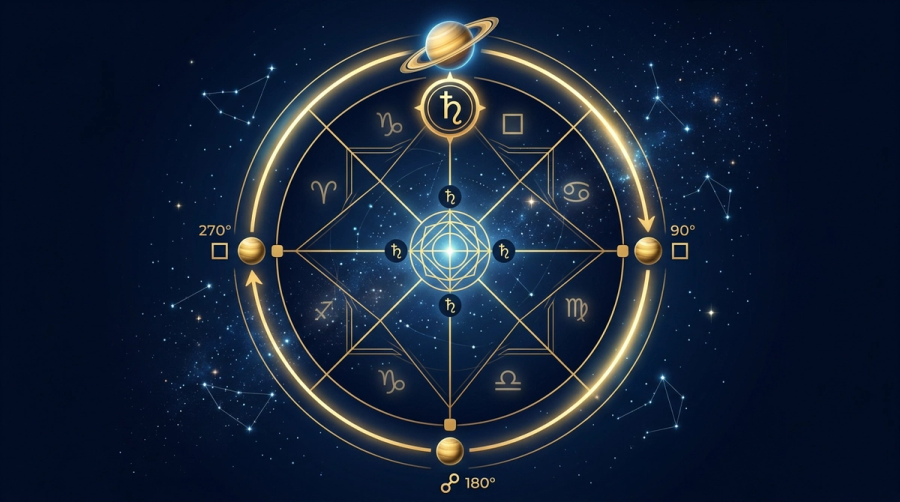
Saturn cycle wheel showing squares and oppositions at key life ages with geometric connections
Age 36: The Second Waxing Square - Testing What You Built
The waxing square at age 36-37 is Saturn's first major test of whatever you constructed during your Saturn return. Seven years after your life restructured at 29, Saturn asks: "Did you follow through?"
This square often coincides with what popular culture calls the "mid-30s crisis" - though it's less a crisis and more a pressure test. The career you chose at 29 now faces its first real challenge. The relationship you committed to now encounters its first serious friction. The identity you claimed now meets circumstances that test its authenticity.
What happens at this age:
- Career advancement or stagnation. If you built on solid foundations at 29, this square brings promotion, expansion, or recognition. If you compromised, it brings frustration and the urge to pivot again.
- Relationship deepening or strain. Partnerships that survived the return now face the reality of long-term commitment - children, mortgages, merged lives. The romance fades; the partnership must stand on its own.
- Parenting pressures. Many people have young children at 36. Saturn's square brings the weight of responsibility for another human's development.
- Body changes. The first undeniable signs of aging. Recovery takes longer. Energy management becomes a skill rather than an afterthought.
- Ambition recalibration. The dreams of 29 meet the reality of 36. Some dreams prove achievable. Others need revision. Saturn demands honesty about what's actually possible.
This square is less dramatic than the return but equally important. It determines whether your Saturn return was a genuine transformation or just a temporary disruption.
Age 44: The Second Opposition - The Midlife Mirror
The second Saturn opposition at age 44-45 mirrors the adolescent opposition at 14 - but with 30 years of experience behind it. Where the teenager questioned external authority, the 44-year-old questions their own.
This opposition often coincides with the classic "midlife crisis" - though Saturn's version is less about sports cars and more about meaning. You're halfway through your second Saturn cycle. The structures you built after your return are now 15 years old. Some have become prisons. Others have become homes. The opposition forces you to see which is which.
What happens at this age:
- Purpose questioning. "Is this all there is?" becomes a real question. Not from depression, but from Saturn's demand for authentic meaning.
- Authority reassessment. You've become an authority figure yourself - at work, in family, in community. The opposition asks whether you're wielding that authority well.
- Relationship mirror. Long-term partnerships reflect back who you've become. Sometimes the reflection is affirming. Sometimes it reveals how much you've grown apart.
- Legacy awareness. For the first time, you think seriously about what you're leaving behind. The second half of life begins.
- Health reckoning. The body at 44 sends unmistakable signals about sustainability. Habits that "worked fine" for 20 years suddenly don't.
The second opposition is Saturn's invitation to course-correct before the second return at 58. It's gentler than the return itself - more of a warning light than an alarm.
Age 51: The Third Quarter Square - Preparing for Wisdom
The closing square at age 51-52 mirrors the one at 21 - but instead of preparing for adult life, it prepares for elderhood. This is Saturn's final checkpoint before the second return.
At 51, you're consolidating. The frantic building of your 30s and 40s slows. Saturn asks you to assess what's worth keeping and what's become dead weight. It's a simplification phase - stripping away complexity to reveal what actually matters.
What happens at this age:
- Career peak or pivot. Many people reach their highest professional position around this age - or decide to step back from the climb entirely.
- Children launching. If you have kids, they're becoming independent. Your role as parent transforms from active management to advisory.
- Financial assessment. Retirement planning becomes concrete rather than abstract. Saturn demands you face the numbers honestly.
- Relationship maturation. Partnerships either reach a new depth of companionship or reveal that they've been running on autopilot.
- Wisdom accumulation. You begin recognizing patterns in your life - themes that repeat, lessons that took decades to learn. This awareness is Saturn's gift.
Ages 58-60: The Second Saturn Return - Legacy and Purpose
The second Saturn return arrives between ages 56 and 60, completing Saturn's second full orbit. Where the first return asked "Who am I?", the second asks "What have I built that matters?"
This return is less chaotic than the first but equally transformative. You have resources, experience, and self-knowledge that the 29-year-old lacked. The restructuring is more deliberate - less about survival and more about meaning.
For a complete guide to navigating the second Saturn return, see our article on what happens at age 58 and how to prepare.
Ages 65-87: The Third Cycle - Wisdom, Legacy, and Completion
The third Saturn cycle (ages 58-87) follows the same pattern of squares, oppositions, and return - but the themes shift toward wisdom integration, legacy completion, and spiritual maturation.
Age 65 (third waxing square): Retirement transitions. Redefining purpose beyond career. Health management becomes a primary focus.
Age 73 (third opposition): Reflection on life's meaning. Relationships with mortality. The desire to transmit wisdom to younger generations intensifies.
Age 80 (fourth quarter square): Simplification and acceptance. Letting go of what no longer serves. Finding peace with what was and wasn't accomplished.
Age 87 (third Saturn return): The rare third return. Those who reach it often experience profound acceptance or a final reckoning with unfinished business. It's Saturn's last invitation to make peace with the life you've lived.
How to Use Saturn's Ages for Life Planning
Understanding Saturn's cycle gives you a framework for anticipating life's natural pressure points - not to fear them, but to prepare.
In your 20s (approaching the return): Build deliberately. Every choice between 21 and 29 is laying foundations that Saturn will test. Choose authenticity over convenience.
In your 30s (post-return building): Execute on what you discovered during your return. The square at 36 will test whether you followed through. Build with discipline.
In your 40s (midlife opposition): Stay honest about what's working and what isn't. The opposition at 44 rewards those who course-correct early. Don't wait for the second return to address what the opposition reveals.
In your 50s (approaching second return): Simplify. Consolidate. Begin thinking about legacy and meaning. The second return rewards those who've already started this inner work.
Among users consulting Nitya on MyNitya, the most powerful insight is often recognizing which Saturn phase they're currently in. Knowing whether you're in a building phase (post-return), a testing phase (square), or a reflection phase (opposition) changes how you respond to life's pressures. Your first question is free.
Frequently Asked Questions
At what exact age does the Saturn return happen?
The Saturn return typically peaks between ages 28 and 30 for the first return, and 57 and 60 for the second. The exact age depends on Saturn's speed through your natal sign - it moves faster in some signs than others. Most people experience the most intense period around age 29 for the first return. Your precise dates require your birth chart calculation.
Why is age 7 significant in Saturn's cycle?
Age 7 marks Saturn's first waxing square - the first major tension point in the cycle. Developmentally, this aligns with the "age of reason" when children begin understanding rules, consequences, and social structure. It's when Saturn's themes of discipline and responsibility first become conscious, setting patterns for all future Saturn phases.
Is the Saturn opposition at 14 why teenagers rebel?
The Saturn opposition at 14-15 correlates strongly with adolescent rebellion, yes. Astrologically, an opposition creates awareness through confrontation with the opposite point. At 14, the child confronts the authority structures they accepted at 7 and begins developing their own relationship with rules and responsibility. This questioning is healthy and necessary for individuation.
Do Saturn's ages affect everyone the same way?
The ages are universal because Saturn's orbit is consistent - everyone experiences squares at 7, 14, 21, etc. But how each phase manifests depends entirely on your individual chart: Saturn's sign, house, and aspects. Someone with Saturn in the 10th house will feel career themes at every milestone. Someone with Saturn in the 7th will feel relationship themes. The timing is shared; the content is personal.
What happens if I missed the lessons of a previous Saturn phase?
Saturn is cumulative. Lessons not learned at one phase get carried forward with added intensity to the next. If you avoided the identity work of the opposition at 14, it shows up harder at the return at 29. If you didn't restructure at 29, the square at 36 feels more pressured. The good news: it's never too late. Saturn rewards conscious engagement at any age.
How do I know which Saturn phase I'm currently in?
Find your age and match it to the cycle: squares at 7, 14, 21, 36, 44, 51, 65, 73, 80; oppositions at 14, 44, 73; returns at 29, 58, 87. If you're between milestones, you're in a building or integration phase. On MyNitya, Nitya can tell you exactly where you are in your Saturn cycle and what's coming next based on your birth chart.
Saturn's ages aren't arbitrary - they're the rhythm of human development mapped onto planetary motion. Understanding where you are in the cycle helps you work with life's natural pressure points rather than against them. Ask your first question free on MyNitya.
Nitya isn't a one-time horoscope. She's with you for the whole journey.
Understand yourself
Career, love, money, timing - any decision you are weighing. Answers read straight from your birth chart.
Understand any relationship
Add your partner, a parent, a friend, even a colleague. Nitya reads both charts together to explain the bond, the friction, and how to work through it.
Guidance for every day
Start each morning knowing what the day favors, what to watch for, and the best moments to act.
No card needed. Nitya just needs your birth details to read your chart.