How Long Does Saturn Stay in a Sign? Timing Your Saturn Cycles
In this Article
Saturn stays in each zodiac sign for approximately 2.5 years, completing its full orbit through all twelve signs in 29.46 years. This makes Saturn the slowest-moving visible planet in astrology - and the reason its transits feel so weighty. When Saturn enters your sign or a sensitive area of your chart, you're not dealing with a brief disruption. You're living with its influence for over two years. That's enough time to rebuild a career, end a marriage, or transform your entire relationship with discipline. Ask your first question free on MyNitya.
Key Takeaways: Saturn takes 29.46 years to orbit the Sun, spending roughly 2.5 years in each zodiac sign. Its speed varies slightly due to orbital eccentricity - it moves faster through some signs than others. Saturn retrogrades for about 140 days annually, which can extend its time in a sign to nearly 3 years when retrograde motion causes it to dip back. Saturn is currently in Aries (February 2026 - April 2028). Everyone born within the same 2.5-year window shares the same Saturn sign - making it a generational marker.
Your personal astrologer - Vedic + Western.
Reads all 10,000+ points of your birth chart to answer your question. First question free, no card needed.
How Long Does Saturn Stay in Each Sign?
Saturn stays in each zodiac sign for approximately 2 to 3 years, with an average of about 2.5 years per sign. The exact duration varies because Saturn's orbit is slightly elliptical, causing it to move faster through some signs and slower through others.
Here's why the timing isn't perfectly uniform. Saturn's orbit around the Sun isn't a perfect circle - it's an ellipse. When Saturn is closer to the Sun (perihelion), it moves faster through the zodiac. When it's farther from the Sun (aphelion), it slows down. This means Saturn spends slightly less time in some signs and slightly more in others - though the difference is measured in months, not years.
The retrograde factor adds complexity. Every year, Saturn appears to move backward (retrograde) for approximately 140 days. During these retrograde periods, Saturn can dip back into the previous sign before moving forward again. This creates a "back and forth" pattern at sign boundaries that extends Saturn's total time influencing a particular sign.
For example, Saturn first entered Aries on May 25, 2025. It then retrograded back into Pisces on September 1, 2025, before re-entering Aries permanently on February 14, 2026. So while Saturn's "official" Aries transit runs from February 2026 to April 2028, people with late-degree Pisces placements felt Saturn's Aries energy as early as May 2025.
This 2.5-year duration is what makes Saturn transits so transformative. Compare it to the Moon (2.5 days per sign), Mercury (2-3 weeks), or even Jupiter (about 1 year). Saturn doesn't visit - it moves in. And by the time it leaves, the landscape of that life area has permanently changed.

Four seasons blending into panoramic landscape with Saturn visible in sky representing 2.5 year transit
Saturn's Complete Transit Timeline: 2020-2030
Saturn's transit through each sign follows a predictable pattern, though retrograde motion creates brief overlaps at sign boundaries. Here's the complete timeline for the current decade:
Saturn in Capricorn (December 2017 - March 2020)
- Final exit: December 17, 2020 (after brief retrograde return)
- Duration in Capricorn: approximately 2.5 years
- Saturn was in its own sign (domicile) - operating at full strength
Saturn in Aquarius (March 2020 - March 2023)
- First entry: March 22, 2020
- Retrograde back to Capricorn: July 2, 2020
- Permanent re-entry: December 17, 2020
- Final exit: March 7, 2023
- Duration: approximately 2.5 years (with initial dip)
Saturn in Pisces (March 2023 - May 2025)
- Entry: March 7, 2023
- First exit to Aries: May 25, 2025
- Duration: approximately 2.25 years
Saturn in Aries (February 2026 - April 2028)
- First entry: May 25, 2025
- Retrograde back to Pisces: September 1, 2025
- Permanent re-entry: February 14, 2026
- Final exit to Taurus: April 12, 2028
- Duration: approximately 2.5 years (from permanent entry)
Saturn in Taurus (April 2028 - June 2030)
- Entry: April 12, 2028
- Exit to Gemini: June 30, 2030
- Duration: approximately 2.25 years
Saturn in Gemini (June 2030 - onward)
- Entry: June 30, 2030
This timeline matters for tracking your personal Saturn cycles. If you know your natal Saturn sign, you can calculate when your Saturn return occurs by finding when Saturn next enters that sign. For a detailed calculator, see our Saturn return calculator guide.
Why Saturn's Slow Speed Matters for Your Life
Saturn's 2.5-year sign duration creates effects that faster planets simply can't produce. The slowness is the point. Saturn doesn't create quick disruptions - it creates lasting structural changes.
Think about what 2.5 years means in practical terms. That's long enough to:
- Complete a graduate degree
- Build a business from concept to profitability
- Have a child grow from newborn to toddler
- Transform your physical health through sustained habit change
- Watch a relationship deepen from dating to genuine partnership
- Recover from a major loss and rebuild
When Saturn transits a sensitive point in your chart, it's not asking for a weekend of reflection. It's asking for years of sustained effort, patience, and restructuring. The people who resist Saturn's pace - who try to rush through its lessons or avoid them entirely - tend to suffer more. The people who accept the timeline and work within it tend to emerge transformed.
This is also why Saturn's sign placement in your natal chart is considered a generational marker. Everyone born within the same 2.5-year window shares the same Saturn sign. You and your age-group peers share a collective relationship with discipline, authority, and responsibility - colored by whatever sign Saturn occupied during your birth years.
Among users consulting Nitya on MyNitya, the most common realization about Saturn's timing is that the transit they're experiencing isn't going to end quickly. Once they accept that - once they stop waiting for Saturn to "pass" and start working with it - the experience shifts from oppressive to productive.
Saturn's Speed Compared to Other Planets
Understanding Saturn's pace relative to other planets helps you appreciate why its transits feel so different from, say, a Mercury retrograde or a Venus transit.
Meet Nitya, your AI astrologer
She reads your birth chart to answer anything about your life - and she can go deep on any relationship you care about and guide your day ahead. First question free, no card needed.
Some questions our users ask Nitya
Tap any one below - or just write your own question in the form ↓
- Moon: 2.5 days per sign. Emotional shifts. Gone before you notice.
- Mercury: 14-30 days per sign (longer when retrograde). Mental adjustments. Brief.
- Venus: 23-60 days per sign. Relationship and aesthetic shifts. Noticeable but temporary.
- Mars: 6-7 weeks per sign (up to 6 months when retrograde). Energy and drive shifts. Moderate duration.
- Jupiter: About 1 year per sign. Growth and opportunity cycles. Significant but manageable.
- Saturn: 2.5 years per sign. Structural life changes. Transformative.
- Uranus: 7 years per sign. Generational revolution. Slow upheaval.
- Neptune: 14 years per sign. Collective dreams and illusions. Barely perceptible individually.
- Pluto: 12-31 years per sign (varies dramatically). Civilizational transformation.
Saturn sits at a critical threshold. It's slow enough to create permanent change but fast enough that you experience its full cycle (all 12 signs) within a single lifetime. You'll live through approximately 2.5 complete Saturn cycles if you reach age 73. This means you experience Saturn in every sign - and every sign's lessons - at least twice.
Jupiter and Saturn together form what astrologers call the "social planets" - bridging the personal planets (Sun through Mars) and the generational planets (Uranus, Neptune, Pluto). Saturn's 2.5-year sign duration is slow enough to shape your life structure but fast enough to create distinct chapters you can consciously navigate.
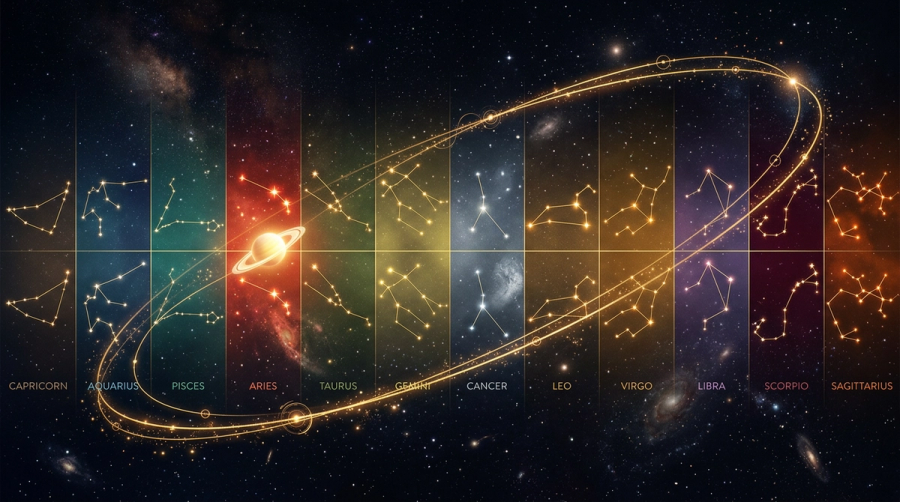
Saturn orbital path through zodiac constellations shown as golden line across deep space
How Saturn's Sign Duration Creates Your Saturn Return
Saturn's 29.46-year orbital period is the direct mathematical basis for the Saturn return - the most significant transit in personal astrology. Understanding the orbital mechanics helps you grasp why the return happens when it does.
The math is straightforward: 12 signs multiplied by approximately 2.46 years per sign equals 29.5 years. That's one complete orbit. When Saturn returns to the sign and degree it occupied at your birth, you experience your Saturn return.
But here's the nuance most people miss: your Saturn return doesn't begin the moment Saturn hits your exact natal degree. It begins when Saturn enters your natal Saturn's sign - which can be up to 2.5 years before the exact conjunction, depending on your natal Saturn's degree within that sign.
If your natal Saturn is at 2 degrees Aries, you start feeling your return almost immediately when Saturn enters Aries. If your natal Saturn is at 28 degrees Aries, you won't feel the full intensity until Saturn has been in Aries for over two years.
This is why some people report their Saturn return lasting "forever" while others say it was intense but brief. The sign duration determines the total window. The exact degree determines the peak.
For people currently experiencing their Saturn return in Aries (Saturn entered permanently in February 2026), the full transit window extends until April 2028. That's over two years of Saturn-in-Aries energy. Your specific experience within that window depends on your natal Saturn's degree. For more on navigating this specific transit, see our guide on Saturn return in Aries.
What Happens When Saturn Changes Signs
Saturn's ingress (entry) into a new sign marks a collective shift in how society relates to discipline, structure, and authority. The themes change for everyone - though the personal impact depends on your natal chart.
When Saturn changed from Pisces to Aries in 2025-2026, the collective shifted from:
- Pisces themes: Dissolving old structures, spiritual reckoning, compassion fatigue, institutional confusion, boundary dissolution
- Aries themes: Building new structures from scratch, individual initiative, courage under pressure, leadership accountability, identity-based discipline
You feel a Saturn sign change most intensely if:
- Saturn is entering your Sun sign, Moon sign, or Rising sign
- Saturn is entering the sign opposite your Sun, Moon, or Rising (creating an opposition)
- Saturn is entering the sign that squares your Sun, Moon, or Rising (creating a square)
- Saturn is entering the sign of your natal Saturn (beginning your Saturn return)
The sign change itself often feels like a gear shift. The last few degrees of the previous sign bring a sense of completion or exhaustion with those themes. The first few degrees of the new sign bring fresh pressure in a new direction. There's often a brief period of disorientation as you adjust to Saturn's new demands.
For a complete understanding of what Saturn represents and how it operates across all signs, see our guide on what Saturn represents in astrology.
Saturn's Retrograde Periods and How They Extend Sign Duration
Saturn retrogrades once per year for approximately 140 days (about 4.5 months). During retrograde, Saturn appears to move backward through the zodiac from Earth's perspective. This retrograde motion is what creates the "back and forth" pattern at sign boundaries.
Here's how it works in practice. Saturn enters a new sign moving forward (direct motion). A few months later, it stations retrograde - appearing to slow down, stop, and reverse direction. If Saturn hasn't moved far enough into the new sign, it can retrograde all the way back into the previous sign before stationing direct and moving forward again.
2025-2026 example:
- May 25, 2025: Saturn enters Aries (0 degrees) moving direct
- July 13, 2025: Saturn stations retrograde at approximately 2 degrees Aries
- September 1, 2025: Saturn retrogrades back into Pisces (29 degrees)
- November 28, 2025: Saturn stations direct at 25 degrees Pisces
- February 14, 2026: Saturn re-enters Aries permanently
This means Saturn spent time in both Pisces and Aries during 2025. People with planets at late degrees of Pisces got an extended Saturn transit. People with planets at early degrees of Aries got a preview of their Saturn transit before the full commitment.
The retrograde periods within a sign are equally important. Once Saturn is firmly in a sign, its annual retrograde creates a period of internal review and revision of that sign's themes. Saturn retrograde in Aries (happening each summer from 2026-2028) is a time to reassess your relationship with independence, initiative, and courage - the core Aries themes Saturn is restructuring.
Saturn Sign Duration and Generational Identity
Because Saturn stays in each sign for 2.5 years, everyone born within that window shares the same Saturn sign. This creates what astrologers call "Saturn generations" - cohorts of people who share a collective relationship with discipline, authority, and life structure.
Recent Saturn generations:
- Saturn in Sagittarius (Dec 2014 - Dec 2017): Born during a period of restructuring beliefs, education systems, and global perspectives. This generation's collective Saturn lesson involves building genuine wisdom through experience rather than ideology.
- Saturn in Capricorn (Dec 2017 - Mar 2020): Born during peak institutional pressure. This generation's collective lesson involves redefining success, career, and ambition in a world where traditional structures are crumbling.
- Saturn in Aquarius (Mar 2020 - Mar 2023): Born during the pandemic era. This generation's collective lesson involves building community, social structures, and collective responsibility in radically new ways.
- Saturn in Pisces (Mar 2023 - Feb 2026): Born during a period of spiritual and institutional dissolution. This generation's collective lesson involves finding structure within chaos and building compassionate systems.
- Saturn in Aries (Feb 2026 - Apr 2028): Being born now. This generation's collective lesson involves building individual courage, authentic leadership, and the discipline to start things from scratch.
Your Saturn sign connects you to your age-group peers in a way that Sun signs don't. When your entire generation hits their Saturn return simultaneously (around age 29), you're all processing the same collective themes - though each person's house placement and aspects create a unique individual experience within that shared framework.
How to Use Saturn's Sign Duration for Life Planning
Knowing how long Saturn stays in each sign gives you a practical planning tool. You can anticipate which life areas will be under Saturn's influence and for how long.
Track Saturn's current sign and house transit in your chart:
- Find which house in your natal chart corresponds to the sign Saturn is currently transiting. (If Saturn is in Aries and Aries rules your 7th house, Saturn is transiting your 7th house of partnerships.)
- Know that this transit will last approximately 2.5 years.
- Plan accordingly - this isn't a brief challenge. It's a multi-year restructuring of that life area.
Use the 2.5-year rhythm for goal-setting:
Saturn's sign changes create natural chapter breaks. Each new sign brings new themes. You can align major life projects with Saturn's rhythm:
- When Saturn enters a new sign in your chart, begin the restructuring work
- At the midpoint (about 15 months in), assess progress and adjust
- As Saturn prepares to leave, consolidate what you've built
Anticipate your Saturn return window:
If you know your natal Saturn sign, you know your return will last the entire duration Saturn spends in that sign - roughly 2.5 years. Your exact peak depends on your degree, but the full window of influence spans the entire sign transit.
Curious how Saturn's current transit through Aries affects your specific chart? On MyNitya, Nitya analyzes your natal chart and tells you exactly which house Saturn is transiting, what themes are active, and how long the current pressure will last. MyNitya supports both Western and Vedic astrology - Western excels at psychological interpretation of transits, while Vedic astrology offers precise timing through dasha periods. Your first question is free.
Frequently Asked Questions
Exactly how many years does Saturn spend in one sign?
Saturn spends approximately 2.46 years (about 2 years and 5-6 months) in each zodiac sign on average. The exact duration varies from about 2.25 to 2.75 years depending on Saturn's orbital speed at that point in its elliptical orbit. Retrograde motion can extend the apparent time Saturn influences a sign by several months when it dips back across a sign boundary.
Does Saturn spend the same amount of time in every sign?
No. Saturn's orbit is slightly elliptical, so it moves faster through some signs and slower through others. The difference is relatively small - a few months at most - but it means Saturn doesn't spend exactly 2.5 years in every sign. Additionally, retrograde motion at sign boundaries can extend Saturn's influence on a particular sign by 3-5 months beyond the simple average.
When does Saturn change signs next?
Saturn will leave Aries and enter Taurus on approximately April 12, 2028. Before that, Saturn will retrograde within Aries each summer (2026 and 2027) but won't dip back into Pisces again. After Taurus, Saturn enters Gemini around June 30, 2030. These dates can shift by a few days depending on the ephemeris source used.
How does Saturn's sign duration affect my Saturn return?
Your Saturn return lasts the entire time Saturn transits your natal Saturn's sign - approximately 2.5 years. The exact conjunction (when Saturn hits your precise natal degree) is the peak, but you'll feel the return's influence from the moment Saturn enters your natal sign until it leaves. If your natal Saturn is at an early degree, the peak comes early in the transit. If it's at a late degree, you wait longer for the peak but still feel the sign's energy throughout.
Why is Saturn called the slowest planet in traditional astrology?
Saturn is the slowest-moving planet visible to the naked eye. In ancient astrology (before the discovery of Uranus in 1781, Neptune in 1846, and Pluto in 1930), Saturn marked the outer boundary of the known solar system. Its slow orbit - taking nearly 30 years to complete one cycle - made it the planet of time, aging, and long-term consequences. The modern outer planets move even slower, but Saturn retains its traditional title because it's the slowest planet you can actually see in the night sky.
Can I feel Saturn's influence before it officially enters a new sign?
Yes. Astrologers call this the "orb of influence" or "shadow period." You may start feeling Saturn's new-sign themes when it's within the last 1-3 degrees of the previous sign - especially if you have natal planets at early degrees of the incoming sign. The retrograde dance at sign boundaries (where Saturn enters, retrogrades back, then re-enters) also creates an extended preview period. Many people report feeling the new Saturn sign's energy during that initial brief entry before the retrograde pulls Saturn back.
Saturn's 2.5-year sign duration is what gives its transits their transformative power. Quick planets create moods. Saturn creates structures. And structures - whether they're careers, relationships, or identities - take years to build properly. That's not a limitation. That's Saturn teaching you that anything worth having is worth building slowly. Get personalized guidance on your current Saturn transit - ask your first question free on MyNitya.
Nitya isn't a one-time horoscope. She's with you for the whole journey.
Understand yourself
Career, love, money, timing - any decision you are weighing. Answers read straight from your birth chart.
Understand any relationship
Add your partner, a parent, a friend, even a colleague. Nitya reads both charts together to explain the bond, the friction, and how to work through it.
Guidance for every day
Start each morning knowing what the day favors, what to watch for, and the best moments to act.
No card needed. Nitya just needs your birth details to read your chart.