
What Does Saturn Represent in Astrology? The Planet of Growth Through Challenge
In this Article
Saturn represents discipline, time, structure, and earned wisdom in astrology. It is the planet that shows where you'll face your greatest challenges - and where you'll develop your deepest strength. Unlike Jupiter's gifts of expansion and luck, Saturn's gifts come through effort, patience, and the willingness to confront what's difficult. Everything Saturn touches takes longer, costs more, and lasts forever.
Key Takeaways: Saturn is the planet of structure, discipline, boundaries, time, and maturity. It rules Capricorn and traditionally co-rules Aquarius. Saturn's position in your birth chart reveals where you'll face your hardest lessons and build your greatest achievements. Its 29.5-year orbit creates the Saturn return cycle at ages 29, 58, and 87. Saturn doesn't punish - it teaches through consequences and rewards through persistence.
Your personal astrologer - Vedic + Western.
Reads all 10,000+ points of your birth chart to answer your question. First question free, no card needed.
What Does Saturn Represent in Your Birth Chart?
Saturn represents the area of life where you must earn everything through sustained effort, face your deepest fears, and ultimately develop mastery. It shows where shortcuts don't work and where discipline becomes your greatest asset.
In your natal chart, Saturn's sign reveals how you approach responsibility and structure. Its house placement shows where in your life these themes play out most intensely. And its aspects to other planets reveal how easily or difficultly you integrate Saturn's lessons.
Think of Saturn as the strict teacher who refuses to grade on a curve. You might resent this teacher at 20. By 40, you realize they were the only one who actually prepared you for real life. That's Saturn's arc - frustrating in youth, invaluable in maturity.
Psychologically, Saturn represents your inner authority figure. It's the voice that says "not yet" when you want instant gratification. The voice that says "prove it" when you claim you're ready. And the voice that says "well done" - quietly, without fanfare - when you've genuinely earned something through years of work.

Young sapling growing through stone cracks with Saturn visible in sky representing growth through challenge
Saturn's Core Meanings: The Planet of Time and Consequences
Saturn governs several interconnected themes in astrology. Understanding these helps you recognize Saturn's influence in your own life - not as punishment, but as the architecture of lasting achievement.
Structure and Boundaries
Saturn is the planet of form. Where Jupiter expands without limit, Saturn defines edges. It builds walls - not to imprison you, but to give shape to what would otherwise remain formless potential.
In practical terms, this means Saturn governs:
- Physical structures - bones, teeth, skin, buildings, institutions
- Time structures - schedules, deadlines, long-term plans, aging
- Social structures - hierarchies, rules, laws, traditions, authority
- Psychological structures - boundaries, discipline, self-control, delayed gratification
Without Saturn, nothing would have form. Ideas would remain ideas. Talent would remain potential. Relationships would remain casual. Saturn is what turns possibility into reality - through the slow, unglamorous work of building.
Discipline and Mastery
Saturn doesn't believe in natural talent alone. It believes in the 10,000 hours. The daily practice. The unglamorous repetition that transforms a beginner into a master.
Every person with a strong Saturn placement in their chart knows this feeling: the thing that came hardest to them eventually became their greatest strength. The child who struggled with reading becomes the writer. The teenager who felt socially awkward becomes the leader who understands people deeply. Saturn's gifts arrive late - but they're permanent.
Time and Patience
Saturn is Chronos - the Greek god of time. Its 29.5-year orbit is the slowest of the visible planets, and its lessons unfold on that same unhurried timeline.
Saturn teaches that some things cannot be rushed. A career built over 20 years has foundations that a viral moment doesn't. A relationship that deepened through difficulty has resilience that infatuation lacks. Saturn's timeline feels agonizing when you're young. It feels wise when you're older.
Responsibility and Accountability
Saturn is the planet of consequences. Not punishment - consequences. There's a difference. Punishment is arbitrary. Consequences are the natural result of choices made over time.
When Saturn transits a sensitive point in your chart, it doesn't create problems from nothing. It reveals the consequences of what you've been building - or avoiding. If you've been doing the work, Saturn rewards you. If you've been cutting corners, Saturn presents the bill.
The Mythology Behind Saturn: Kronos and the Father Archetype
Saturn's astrological meaning is rooted in Greek and Roman mythology. Understanding the myth illuminates why Saturn operates the way it does in your chart.
In Greek mythology, Kronos (Saturn) was the youngest Titan, son of Uranus (sky) and Gaia (earth). He overthrew his father Uranus with a sickle - then, fearing the same fate, swallowed each of his children at birth. His wife Rhea hid Zeus, who eventually forced Kronos to release his siblings and overthrew him in turn.
This myth encodes Saturn's core psychological themes:
- The devouring father - Saturn represents the part of us that suppresses our own potential out of fear. The inner critic that "swallows" our creative impulses before they can threaten the status quo.
- The cycle of authority - Each generation must overthrow the previous one's limitations. Your Saturn return at 29 is your personal "overthrowing of the father" - claiming your own authority.
- Time consuming all things - Kronos literally means "time." Everything Saturn touches is subject to time's passage - aging, decay, but also maturation and ripening.
- The Golden Age - Before his overthrow, Kronos ruled during a mythical Golden Age of abundance. This hints at Saturn's positive face: when you work with Saturn rather than against it, life becomes structured, productive, and deeply satisfying.
The Romans celebrated Saturn during Saturnalia - a festival of reversal where masters served slaves and social rules dissolved. Even in celebration, Saturn's theme persists: structure must periodically be released and rebuilt.
Saturn in Each Zodiac Sign: How You Handle Responsibility
Saturn's sign in your birth chart reveals your particular style of dealing with discipline, authority, and life's hard lessons. It shows both your greatest fear and your path to mastery.
Saturn in Fire Signs
Saturn in Aries: Your lesson is learning to act with courage and patience. You fear being powerless or invisible, so you must develop the discipline to assert yourself without recklessness. Mastery comes through sustained initiative - starting things and actually finishing them. Saturn entered Aries in May 2025, making this placement active for current Saturn return cohorts.
Saturn in Leo: Your lesson is earning recognition through genuine substance rather than performance. You fear being unspecial or overlooked, so you must develop creative discipline. Mastery comes through building something that speaks for itself - art, leadership, or legacy that doesn't need applause to exist.
Saturn in Sagittarius: Your lesson is committing to a belief system through lived experience rather than theory. You fear being trapped or wrong, so you must develop intellectual discipline. Mastery comes through deep study and teaching what you've genuinely learned.
Saturn in Earth Signs
Saturn in Taurus: Your lesson is building genuine security through patience rather than hoarding from fear. You fear instability and loss, so you must develop financial and material discipline. Mastery comes through creating lasting value - slowly, methodically, brick by brick.
Saturn in Virgo: Your lesson is achieving excellence without perfectionism destroying your peace. You fear being inadequate or flawed, so you must develop practical discipline. Mastery comes through service - applying your exacting standards to help others rather than paralyze yourself.
Saturn in Capricorn (domicile): Saturn is strongest here. Your lesson is achieving ambition without losing your humanity. You fear failure and irrelevance, so you must develop professional discipline. Mastery comes through building institutions, careers, or legacies that outlast you. This is Saturn operating at full power - demanding, but deeply rewarding.
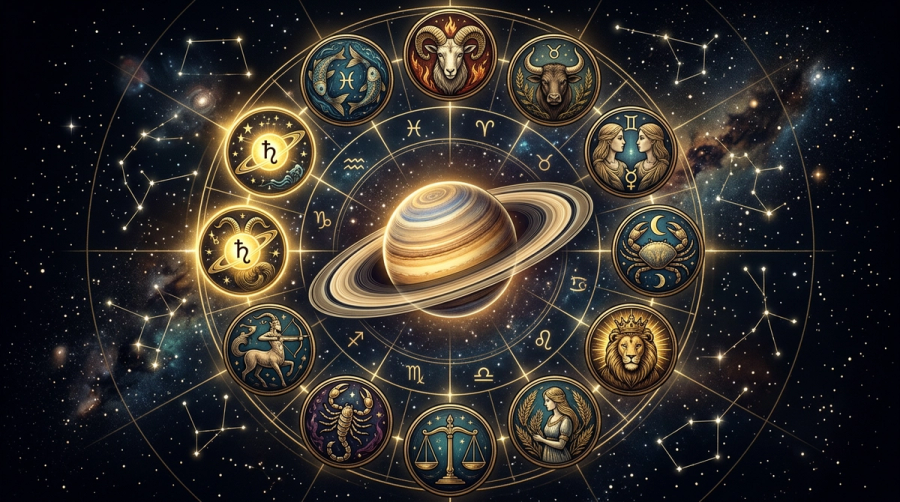
Saturn surrounded by twelve zodiac signs with Capricorn and Aquarius highlighted as ruling signs
Saturn in Air Signs
Meet Nitya, your AI astrologer
She reads your birth chart to answer anything about your life - and she can go deep on any relationship you care about and guide your day ahead. First question free, no card needed.
Some questions our users ask Nitya
Tap any one below - or just write your own question in the form ↓
Saturn in Gemini: Your lesson is thinking deeply rather than broadly. You fear being uninformed or inarticulate, so you must develop mental discipline. Mastery comes through focused communication - writing, teaching, or speaking with precision rather than volume.
Saturn in Libra (exaltation): Saturn is exalted here - meaning it operates with unusual grace. Your lesson is building fair, lasting partnerships through honest negotiation. You fear injustice and isolation, so you must develop relational discipline. Mastery comes through creating balance - in relationships, in aesthetics, in justice.
Saturn in Aquarius (traditional ruler): Your lesson is reforming systems through sustained effort rather than rebellion alone. You fear conformity and meaninglessness, so you must develop social discipline. Mastery comes through building communities and structures that serve the collective good.
Saturn in Water Signs
Saturn in Cancer (detriment): Saturn struggles here. Your lesson is building emotional security without walls that isolate you. You fear vulnerability and abandonment, so you must develop emotional discipline. Mastery comes through creating a stable inner foundation that doesn't depend on others' approval.
Saturn in Scorpio: Your lesson is facing the darkest truths without being consumed by them. You fear loss of control and betrayal, so you must develop psychological discipline. Mastery comes through transformation - using crisis as fuel for profound personal power.
Saturn in Pisces: Your lesson is giving structure to your spiritual and creative life without killing its magic. You fear meaninglessness and dissolution, so you must develop intuitive discipline. Mastery comes through grounding your sensitivity in practical expression - art, healing, or service.
Saturn in the Houses: Where Life Tests You Most
Saturn's house placement in your natal chart pinpoints the specific life area where you'll face your greatest challenges and develop your deepest competence. This requires your birth time to calculate accurately.
1st House - Identity: You appear serious, mature, and reserved. Life tests your sense of self. You may feel older than your peers in youth but age gracefully. Mastery: becoming an authority through personal integrity.
2nd House - Resources: Money and security come through hard work, never luck. Financial discipline develops early out of necessity. Mastery: building unshakeable material stability through patience.
3rd House - Communication: Learning feels difficult initially but leads to intellectual depth. You think carefully before speaking. Mastery: becoming a precise, authoritative communicator or writer.
4th House - Home and Family: Family life carries weight - strict parents, heavy responsibilities, or early independence. Mastery: creating the stable home foundation you may not have received.
5th House - Creativity and Joy: Fun and self-expression feel earned rather than spontaneous. Creative blocks yield to disciplined practice. Mastery: producing art or creative work with lasting substance.
6th House - Health and Work: Daily routines and health demand constant attention. Work ethic is exceptional but burnout is a risk. Mastery: building sustainable systems for productivity and wellbeing.
7th House - Partnerships: Relationships are serious business. You attract mature partners or face delays in commitment. Saturn square Venus in the natal chart often manifests as delayed romantic commitment in the late 20s. Mastery: building partnerships that deepen with time rather than fade.
8th House - Transformation: Deep psychological work is required. Shared resources and intimacy carry complexity. Mastery: developing profound resilience through facing what others avoid.
9th House - Beliefs: Your worldview forms slowly through experience rather than faith. Higher education may feel burdensome but yields expertise. Mastery: becoming a teacher or authority in your field of knowledge.
10th House - Career: Professional life is your primary Saturn arena. Success comes late but is substantial and lasting. Mastery: building a career legacy that defines your contribution to the world.
11th House - Community: Social belonging feels difficult. You may feel like an outsider before finding your true community. Mastery: becoming a pillar of groups and causes that matter.
12th House - Spirituality: The unconscious carries heavy material. Solitude is both feared and needed. Mastery: developing a disciplined spiritual practice that grounds your inner life.
Your exact Saturn placement - sign, house, and aspects combined - creates a unique blueprint for your growth path. On MyNitya, Nitya analyzes your complete Saturn picture and explains what it means for your specific life challenges. Your first question is free.
Saturn's Aspects: How It Interacts with Other Planets
Saturn doesn't operate in isolation. Its aspects (angular relationships) to other planets in your chart modify how its energy expresses. Hard aspects create tension that builds strength. Soft aspects create natural discipline.
Hard Aspects (Conjunction, Square, Opposition)
Sun conjunct/square/opposite Saturn: Your identity is tied to achievement and responsibility. You may have had a demanding or absent father figure. Self-worth develops slowly through accomplishment. The gift: once you internalize your authority, you become unshakeable.
Moon conjunct/square/opposite Saturn: Emotions feel heavy or suppressed. Nurturing may have been conditional in childhood. Emotional maturity develops through learning to parent yourself. The gift: emotional resilience that others rely on.
Venus conjunct/square/opposite Saturn: Love feels serious, delayed, or conditional. Relationships require work and commitment. Beauty standards may feel impossible. The gift: partnerships that deepen over decades rather than burning out.
Mars conjunct/square/opposite Saturn: Action meets resistance. Energy feels blocked or frustrated. Anger may be suppressed or explosive. The gift: once you learn to channel this tension, your persistence becomes unstoppable.
Soft Aspects (Trine, Sextile)
Saturn trine Sun: Natural authority and discipline. You integrate responsibility without resentment. Career success flows from genuine competence.
Saturn trine Moon: Emotional stability comes naturally. You handle difficulty with grace. Others see you as a rock.
Saturn trine Venus: Relationships mature beautifully. You attract committed partners. Aesthetic sense is refined and lasting.
Saturn trine Mars: Effort and discipline align. Physical endurance is exceptional. You accomplish goals through steady, sustained action.
Saturn Transits: When Saturn Activates Your Chart
Beyond your natal placement, Saturn's current position in the sky (transit) activates different parts of your chart over time. These transits are Saturn's way of checking in on specific life areas.
Saturn conjunct natal Sun (every 29.5 years): A defining moment for your identity and life direction. Major responsibilities arrive. You're tested on whether you've been living authentically.
Saturn conjunct natal Moon: Emotional reckoning. Feelings you've suppressed surface. Family dynamics demand attention. Loneliness may intensify before emotional clarity arrives.
Saturn square natal Saturn (ages ~7, 21, 36, 51): Quarter-life and mid-cycle checkpoints. At 21, you face early adult responsibilities. At 36, you assess what you built during your Saturn return. At 51, you prepare for the second return.
Saturn opposite natal Saturn (ages ~14-15, 44-45): The halfway points of each Saturn cycle. At 14, adolescent rebellion against authority. At 44, the midlife reassessment of whether your structures still serve you.
The Saturn return (ages ~29, 58, 87): The most significant Saturn transit. Saturn returns to its natal position, auditing your entire life structure. For a deep dive into this transit, see our guide on when your Saturn return happens and how to calculate your exact dates.
Among users who've consulted Nitya on MyNitya about Saturn transits, the most common realization is that Saturn's pressure always points toward authenticity. The discomfort isn't random - it's targeted at whatever in your life lacks genuine foundation.
Saturn vs. Jupiter: Understanding the Balance
Saturn and Jupiter form astrology's fundamental polarity. Understanding both helps you see Saturn's role more clearly.
Jupiter expands. Saturn contracts. Jupiter says "more." Saturn says "enough." Jupiter opens doors. Saturn tests whether you're ready to walk through them.
Jupiter gives gifts. Saturn gives earned rewards. Jupiter's blessings arrive easily - luck, opportunity, optimism. Saturn's blessings arrive after sustained effort - mastery, respect, lasting achievement.
Jupiter is the teacher who inspires. Saturn is the teacher who demands. You need both. Inspiration without discipline produces nothing lasting. Discipline without inspiration produces joyless achievement.
In your birth chart, the relationship between Jupiter and Saturn reveals your personal balance between expansion and contraction, optimism and realism, faith and effort. People with strong Jupiter but weak Saturn tend toward overcommitment and scattered energy. People with strong Saturn but weak Jupiter tend toward pessimism and excessive caution.
The healthiest expression integrates both: Jupiter's vision channeled through Saturn's discipline. Big dreams pursued with patient, structured effort. That's where lasting success lives.
How to Work with Saturn's Energy Constructively
Saturn isn't your enemy. It's the part of reality that demands you show up fully. Here's how to work with Saturn rather than against it:
- Embrace delayed gratification. Saturn rewards patience. If something worth having takes five years to build, commit to the five years. The shortcut will cost you more in the long run.
- Build structure before you need it. Don't wait for crisis to create routines, boundaries, and systems. Saturn rewards proactive discipline over reactive scrambling.
- Face your fears directly. Saturn's house and sign in your chart point to your core fears. Avoiding them makes Saturn harder. Confronting them - gradually, with self-compassion - transforms fear into competence.
- Respect time. Saturn teaches that some things cannot be rushed. Relationships need years to deepen. Skills need thousands of hours to mature. Careers need decades to peak. Honor the timeline.
- Take responsibility without martyrdom. Saturn asks you to own your choices and their consequences. But it doesn't ask you to carry everyone else's weight. Healthy Saturn energy knows the difference between responsibility and self-sacrifice.
- Find your authority. Saturn ultimately wants you to become your own authority - not dependent on external validation, not rebelling against rules, but standing in your own earned competence. That's Saturn's highest gift.
For personalized guidance on working with Saturn in your specific chart - including your sign, house, and aspects - chat with Nitya on MyNitya. She analyzes your full natal chart to show you exactly where Saturn's lessons and gifts live. MyNitya supports both Western and Vedic astrology, so you can explore Saturn through psychological depth (Western) or karmic timing systems (Vedic). Your first question is free.
Frequently Asked Questions
Is Saturn always negative in astrology?
No. Saturn has a reputation as the "Greater Malefic" from classical astrology, but modern psychological astrology recognizes Saturn as the planet of earned achievement and lasting success. Its challenges are real - delays, restrictions, hard lessons - but its rewards are equally real: mastery, respect, resilience, and structures that endure. People with well-aspected Saturn placements often become the most accomplished and respected individuals in their fields.
What does it mean if Saturn is strong in my chart?
A strong Saturn (in Capricorn, Aquarius, or Libra; in angular houses; well-aspected) means discipline and structure come relatively naturally to you. You're likely responsible, ambitious, and capable of sustained effort. The challenge is avoiding rigidity or excessive seriousness. A strong Saturn person's growth edge is learning to relax, play, and trust that not everything requires effort.
How does Saturn affect relationships?
Saturn in relationship houses (7th, 5th, 8th) or aspecting Venus brings seriousness to love. Relationships feel weighty and consequential. You may commit later than peers but more deeply. Saturn doesn't prevent love - it demands that love be real, tested, and built on genuine compatibility rather than infatuation. Long-term partnerships with Saturn involvement often become the most enduring and satisfying.
What's the difference between Saturn in Western and Vedic astrology?
In Western astrology, Saturn (the planet) focuses on psychological growth through challenge, structure-building, and earned authority. In Vedic astrology, Shani (Saturn) carries similar themes but emphasizes karma, duty, and specific timing through dasha periods. Both systems agree that Saturn rewards discipline and patience. The Western approach tends toward psychological interpretation; the Vedic approach tends toward predictive timing.
How long does Saturn stay in each sign?
Saturn spends approximately 2.5 years in each zodiac sign, completing its full orbit through all twelve signs in 29.46 years. This slow movement means Saturn's sign placement is generational - everyone born within the same 2.5-year window shares the same Saturn sign. What makes your Saturn unique is its house placement and aspects, which depend on your exact birth time and location.
Can I change how Saturn affects me?
You can't change Saturn's position in your chart, but you can change how you respond to its themes. Saturn rewards conscious engagement. People who actively work on their Saturn lessons - building discipline, facing fears, developing patience - experience Saturn as a demanding but fair teacher. Those who avoid Saturn's lessons experience it as an oppressive force. The planet doesn't change; your relationship to it can.
Saturn is the planet that turns potential into reality, dreams into achievements, and youth into wisdom. It asks more of you than any other planet - and gives more in return. Understanding your Saturn placement is understanding your path to mastery. Ask your first question free on MyNitya.
Nitya isn't a one-time horoscope. She's with you for the whole journey.
Understand yourself
Career, love, money, timing - any decision you are weighing. Answers read straight from your birth chart.
Understand any relationship
Add your partner, a parent, a friend, even a colleague. Nitya reads both charts together to explain the bond, the friction, and how to work through it.
Guidance for every day
Start each morning knowing what the day favors, what to watch for, and the best moments to act.
No card needed. Nitya just needs your birth details to read your chart.