7th House Astrology Meaning: Why You Attract Them
In this Article
The 7th house astrology meaning, when you strip away the wedding-cake imagery, is this: it describes the pattern of partner you keep choosing - the type, not the person. The 7th house cusp shows the qualities you meet in others. The planets inside the house show specific archetypes that arrive through partners. And the ruler of your 7th - the planet that rules the sign on your descendant - is the deeper engine, the one running underneath the surface, choosing for you long before your conscious self gets a vote. If you keep ending up with the same person in different bodies, this is where to look. Try MyNitya free.
You're probably here because something keeps happening. Same flavor of partner, different name. Same eight months in, same fight, same quiet exit. You've read the descendant articles. You've read the planets-in-7th lists. None of them quite explained why the pattern keeps producing itself, even when you swore this time you'd choose differently. The reason is that most articles stop at the surface - the sign on the cusp - and never get to the part of the chart that's actually doing the work. That part is the 7th house ruler, where it sits, and what it touches.
Your personal astrologer - Vedic + Western.
Reads all 10,000+ points of your birth chart to answer your question. First question free, no card needed.
Ask your question free →Key Takeaways: The 7th house astrology meaning, in practice, is your repeating attraction pattern. The sign on the 7th cusp is the surface; the 7th house ruler - placed wherever it is in your chart - is the engine. Aspects from Saturn, Pluto, Neptune, or Uranus to that ruler describe the flavor of the pattern (commitment fear, power dynamics, idealization, instability). Planets sitting inside the 7th add specific archetypes you'll keep meeting. Breaking the pattern starts with naming the ruler, then doing the inner work that planet was outsourced to carry. The chart doesn't change; your relationship to it does.
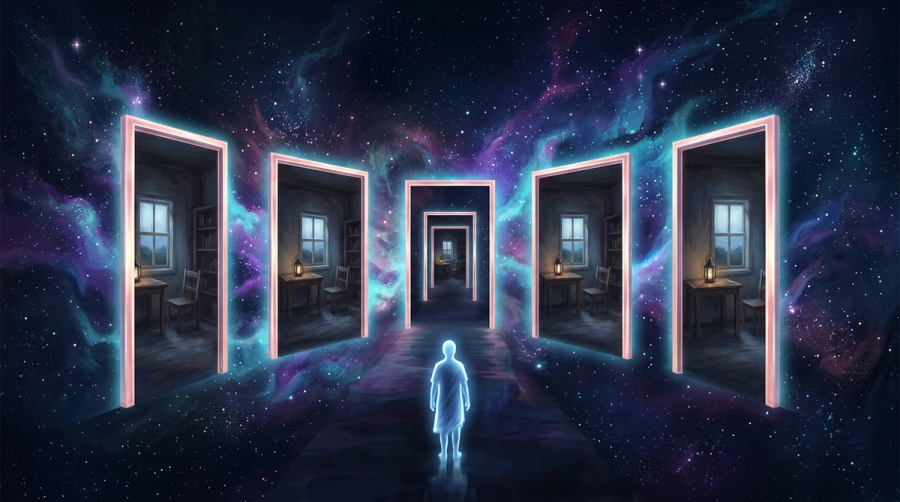
Lone luminous figure facing a row of identical glowing doorways each leading into the same dim room, symbolizing repeated relationship choices
For the foundation reading on what the 7th house actually is - the projection mechanism, Jung's shadow, the descendant as mirror - start with the 7th house astrology relationship blueprint sister piece. For traditional partnership and marriage indicators, the 7th house astrology partnerships and marriage guide covers that ground in detail. This article picks up where those leave off - at the practical question of why the pattern repeats and how to interrupt it.
The Practical 7th House - Less Theory, More Pattern Recognition
The 7th house astrology meaning, in practice, is the chart's repeating-relationship pattern: the kind of person you keep ending up with, the dynamic you keep recreating, and the lesson that keeps showing up wearing different clothes. Less a description of marriage. More a diagnostic tool for noticing what's been on autopilot in your love life.
Most blog posts about the 7th house stop at definitions. The 7th house is the house of partnerships. Cool. That's not why you're here. You're here because you can feel the pattern - the way every relationship somehow ends up in the same shape, like there's a template you can't see but keep filling in. And you want to know two things. What's running the template. And whether you can change it.
The technical answer to question one is the 7th house ruler. Not the sign on the cusp - that's the style of the pattern, the way it dresses. The ruler is the mechanism, the planet whose entire archetype gets handed to your partners to carry. Find the ruler, find the placement, find the aspects, and the pattern stops being mysterious. It starts being readable.
Astrologer Donna Cunningham, in her Healing Pluto Problems lineage, framed the 7th ruler as the partner-image - the unconscious blueprint the chart-holder hands to candidates the moment they walk in. Howard Sasportas, in The Twelve Houses, makes a similar argument: the 7th house describes what the I needs in order to become whole, and the ruler shows where in the chart that need is being routed. Robert Hand, in Horoscope Symbols, put it most clinically - the ruler of any house is the house's delegate, the planet that carries the house's affairs into whatever life-area it currently occupies. Your 7th ruler in your 4th house? Your relationships are about home. In your 10th? Reputation and career. In your 12th? Hidden, complicated, sometimes karmic.
Liz Greene, throughout Relating: An Astrological Guide to Living with Others on a Small Planet, keeps returning to the same point. The pattern isn't bad luck. It's the chart accurately describing a part of the psyche the chart-holder hasn't yet met - and the 7th house ruler is doing a precise job of organizing your relational life around that unmet need.
Why You Keep Attracting the Same Person in Different Bodies
You keep attracting the same person because the part of your chart that organizes partnership - primarily the 7th house ruler and its aspects - hasn't moved. Your taste hasn't changed. Your radar hasn't recalibrated. Until the inner pattern shifts, the outer one keeps producing identical partners with different first names. That's not a curse. It's mechanics.
It feels personal. Like the universe has a grudge or a sense of humor or both. The mechanism is more boring than that. You have a specific way of recognizing "partner energy" - built from your earliest models of love, refined by your nervous system, encoded in your chart - and you walk into rooms with that recognition system already running. It pings the people who match its template. The people who don't match are functionally invisible to it.
The chart isn't causing the pattern in some mystical sense. The chart is describing the same thing your nervous system already knows. Reading the 7th ruler doesn't make the pattern; it tells you what the pattern is, in a vocabulary specific enough to work with.
The frustrating part is that naming the pattern doesn't break it. You can know your 7th ruler is Saturn in the 12th house and still keep dating people who disappear emotionally. The information is the start of the work, not the work itself.
Among birth charts analyzed on MyNitya, users with the 7th house ruler placed in the 12th house most frequently describe a pattern of partners who are emotionally elusive, secretly addicted, married, or otherwise unavailable in some structurally hidden way. Users with the 7th ruler in the 8th house most frequently describe relationships that feel like crises - passionate, transformative, and at least once in their life, devastating. The placements aren't fortune-telling. They're naming patterns the users themselves are usually already aware of by the time they ask Nitya about them.
So before any astrology, this needs saying: the fact that you're tired of the pattern is the most useful information in this article. The exhaustion is the threshold the rest of the work depends on.
The 7th House Ruler - The Real Engine of Your Pattern
The 7th house ruler is the planet that rules the sign on your 7th house cusp. It's the chart's primary delegate for partnership: wherever it sits in your chart, that's the life-area where your relational pattern gets enacted, and whatever it touches by aspect, that's the flavor of the pattern. Find the ruler, and you've found the engine.
Quick mechanical definition. Your 7th house cusp is on a specific sign. That sign has a ruling planet. That planet - wherever it lives in your chart - is your 7th house ruler. It carries the affairs of the 7th into the life-area of the house it actually occupies.
7th House Cusp Sign | Traditional Ruler | Modern Ruler
- Aries: Mars - Mars
- Taurus: Venus - Venus
- Gemini: Mercury - Mercury
- Cancer: Moon - Moon
- Leo: Sun - Sun
- Virgo: Mercury - Mercury
- Libra: Venus - Venus
- Scorpio: Mars - Pluto
- Sagittarius: Jupiter - Jupiter
- Capricorn: Saturn - Saturn
- Aquarius: Saturn - Uranus
- Pisces: Jupiter - Neptune
Use both rulers for Scorpio, Aquarius, and Pisces - modern rulers describe the deeper psychological story, traditional rulers describe the practical mechanics. Sue Tompkins, in Aspects in Astrology, notes that for someone with Scorpio on the 7th cusp, looking only at Mars or only at Pluto gives a partial reading; the two together describe both the desire structure (Mars) and the underground transformation pull (Pluto) of the relational pattern.
The astrofix.net guide to the ruler of the 7th house in houses calls this planet the bearer of the mirror - the placement that shapes your attraction patterns, your way of meeting others, and the contracts (spoken and unspoken) you tend to enter. The Kerykeion guide to chart ruler in the 7th house extends the framework: the chart ruler in any house describes a life organized around the affairs of that house, and the same logic applies to the 7th ruler in any house - your love life gets organized around the meaning of wherever the ruler sits.

Astrology natal chart wheel with the 7th house highlighted and lines from its ruler to other houses showing 7th house ruler placement effects
Where Your 7th House Ruler Sits - and What It Means
Find the planet that rules your 7th cusp. Then find which house it's in. Then read the corresponding paragraph below. This single piece of information often explains more about your repeating pattern than any other reading you've ever had.
7th Ruler in the 1st House
Your relationships are entangled with your identity. You meet partners through the ordinary expression of who you are - by being seen, not by chasing - and the partners you choose tend to challenge or reshape your self-image more than most. The work is keeping a sense of self that isn't dependent on whoever you're currently with.
7th Ruler in the 2nd House
Money, values, and self-worth get tangled with relationships. You may be drawn to partners who change your financial life - sometimes for the better, sometimes by costing you. The pattern often involves over-giving materially or building self-worth through being needed. Stephen Arroyo, in Relationships and Life Cycles, describes this placement as one where the partner's values become a daily mirror.
7th Ruler in the 3rd House
Communication is the relationship's center of gravity. You meet partners through everyday environments - siblings, neighbors, classmates - and the dynamic often has a sibling-like quality. Talking is the love language. Silence is the breakdown. The pattern can include partners who are mentally restless or emotionally close but not always emotionally deep.
7th Ruler in the 4th House
Partners feel like family from the start. You're drawn to people who feel like home - sometimes literally inheriting family dynamics through them, sometimes recreating childhood emotional weather inside the partnership. Howard Sasportas notes this placement often produces a partner who mirrors one of the parents - for healing or for repetition, depending on the inner work.
7th Ruler in the 5th House
You meet through dating, creativity, romance, the spotlight. The pattern is often passionate and playful. The risk is that the relationship stays in the 5th-house mode of romance and never matures into the 7th-house mode of contract - partners can feel like lovers and never quite settle into partner.
7th Ruler in the 6th House
Work, health, daily routine, and service are the contexts where you meet your partners. Coworkers. Health-context relationships. The pattern often involves a caretaker dynamic - one of you is taking care of the other, sometimes excessively, sometimes one-sidedly. The work is making sure the partnership doesn't collapse into a job description.
7th Ruler in the 7th House
Partnership itself is the central life theme. Relationships aren't a side dish - they're the main course. The risk is losing yourself inside whoever you're with. The gift is a real talent for partnership when the I is intact enough to actually meet the You. Liz Greene calls this the placement of the born partner - for better and for worse.
7th Ruler in the 8th House
Intense, transformative, sometimes destabilizing bonds. Sex, money, shared resources, and psychological depth are the texture of the relationship. The pattern often involves a partner who arrives like a crisis and leaves you a different person. You may marry someone whose family inheritance or psychological underworld becomes part of your story. The work is depth without losing yourself in someone else's underworld.
7th Ruler in the 9th House
Foreigners, teachers, philosophers, big-vision partners. People from a different country, a different worldview, a different age range. The pattern often involves long-distance phases, cross-cultural relationships, or partners who shape your beliefs as much as your daily life. The risk is choosing partners more for their worldview than for their actual emotional availability.
7th Ruler in the 10th House
Career, public life, and reputation are intertwined with your love life. You may meet partners through work, choose partners whose social standing matters to you, or have your relationship be visible in a way that affects how it functions. The work is making sure the relationship has a private inside, not just a public outside.
7th Ruler in the 11th House
Friend-first partnerships. You meet partners through your social circle, in groups, through shared causes. The relationship often starts as friendship and becomes more - and that transition can be both the pattern's strength and its risk. The pattern can include partners who feel more like a chosen-family member than a lover, sometimes producing intimacy issues underneath very high companionship.
7th Ruler in the 12th House
Hidden, complicated, often fated bonds. Affairs. Long-distance relationships that exist mostly online. Partners with addictions, illness, or institutional involvement. People you can't fully have in the ordinary sense. The pattern can also include genuinely sacred unions, soul-bonds, partnerships with a spiritual texture. Howard Sasportas, in The Twelve Houses, notes this placement often produces a long arc of unavailable partners until the chart-holder learns to integrate solitude as not-loneliness.
If your pattern includes partners who consistently can't show up - emotionally, physically, structurally - the why you attract emotionally unavailable partners deep dive pairs naturally with this section. If you've been through several relationships that ended in the same way, the why your relationships keep failing piece walks the broader pattern.
Major Aspects to Your 7th House Ruler - What They Signal
Aspects to your 7th house ruler describe the flavor of your relational pattern. Saturn aspects bring fear and weight. Pluto aspects bring power and obsession. Neptune aspects bring idealization and confusion. Uranus aspects bring instability and surprise. Each gives the 7th ruler - and therefore your love life - a specific texture that keeps showing up across different partners.
A note on orbs first, because this matters. Sue Tompkins, in Aspects in Astrology, recommends tight orbs for the major aspects to angles and angle rulers - under 3 degrees for strong, 3 to 5 degrees for moderate, 5 to 8 degrees for present but background. An aspect under 3 degrees is the one that runs the show. An aspect at 6 degrees is real but quieter. An aspect at 9 degrees is essentially out of orb - it's there in the technical sense, but it's not actively producing the pattern.
Apply this to your 7th ruler. Look at the aspects that are under 3 degrees first. Those are the patterns. Then check the 3-to-5-degree aspects. Those are secondary themes. Beyond that, treat the aspects as background hum.
7th Ruler Conjunct or Square Saturn
Meet Nitya, your AI astrologer
She reads your birth chart to answer anything about your life - and she can go deep on any relationship you care about and guide your day ahead. First question free, no card needed.
Some questions our users ask Nitya
Tap any one below - or just write your own question in the form ↓
Nitya isn't a one-time horoscope. She's with you for the whole journey.
Understand yourself
Career, love, money, timing - any decision you are weighing. Answers read straight from your birth chart.
Understand any relationship
Add your partner, a parent, a friend, even a colleague. Nitya reads both charts together to explain the bond, the friction, and how to work through it.
Guidance for every day
Start each morning knowing what the day favors, what to watch for, and the best moments to act.
No card needed. Nitya just needs your birth details to read your chart.
Ask Nitya your first question - free →Saturn touching the 7th ruler describes a pattern of commitment fear, delayed marriage, age-gap partnerships, weight on the relationship, and one partner carrying responsibility the other won't. You may marry late. You may marry someone significantly older or significantly more burdened than you. You may keep choosing partners who are unavailable through duty - to a job, to a family, to an ex. The work is meeting the Saturn lesson - boundaries, structure, real commitment - inside yourself, so the partner stops having to enact it for you.
Liz Greene's Saturn: A New Look at an Old Devil describes Saturn-7th aspects as the place where the chart-holder learns what relationships actually cost, often the hard way. The cost can include loneliness inside the relationship - the partner is there, but emotionally distant, and the chart-holder learns slowly that distance was the very thing they unconsciously chose.
7th Ruler Conjunct or Square Pluto
Pluto touching the 7th ruler describes a pattern of power struggles, obsession, jealousy, fated-feeling bonds, and relationships that rebuild you from the inside. You may have one or two relationships in your life that feel like the ones that wrecked everything, in the precise sense that they reshaped you. The pattern can also include controlling partners, partners with serious psychological depth, or relationships with secrecy underneath them. The work is owning your own intensity, your own desire to merge, your own capacity to be transformed - instead of meeting all of it through someone else's gravitational pull.
Stephen Arroyo, in Relationships and Life Cycles, describes Pluto-7th aspects as the chart's transformation through partnership signature. The partner is the alchemical chamber. The chart-holder is the metal being remade.
7th Ruler Conjunct or Square Neptune
Neptune touching the 7th ruler describes a pattern of idealization, fantasy, sacrifice, confusion about who the partner actually is, and waking up years in to realize you were in love with a projection. The pattern can include falling for artists, addicts, mystics, rescuers and rescuees, and people who seem unfocused enough to let you fill in the gaps with your own imagination. You may marry someone you feel destined to marry. You may also discover, slowly, that destiny was a story you were telling yourself.
The work is sustained, slow, and disenchanting in the best sense - learning to see the partner who's actually there rather than the dream version. Howard Sasportas notes that Neptune-7th people often go through one major disillusionment in midlife, after which their love life finally shifts into something more grounded.
7th Ruler Conjunct or Square Uranus
Uranus touching the 7th ruler describes a pattern of instability, sudden endings, unconventional partners, fear of being trapped, and a lifelong oscillation between the desire for closeness and the need for freedom. The pattern can include partners who arrive suddenly and leave the same way. Long-distance bonds. Open relationships, polyamory, or relationships with unusual structures. The work is finding internal space inside committed partnership, so the need for freedom isn't outsourced to the partner constantly leaving.
Sue Tompkins, in Aspects in Astrology, notes that hard Uranus contacts to Venus and to angles often correspond to late marriage, multiple partnerships, or marriage that itself takes an unconventional form.
7th Ruler Conjunct Venus
Venus aspecting the 7th ruler - especially conjunction - adds grace, charm, ease of attraction, and a real talent for partnership. The risk isn't dysfunction; it's idealization. Venus can make the partner shimmer in a way that obscures their actual character. The pattern can be deeply rewarding - Venus-7th-ruler people often have genuinely loving partnerships - and can also include a slowness to see red flags because the 7th ruler is dressed in such pretty light.
7th Ruler in Square or Opposition to the Sun
A pattern of partners who challenge your identity, ego conflicts, or relationships that force you to define who you are. The work is developing your own clear identity so the partner stops having to be the wall you bump up against to find yourself.
7th Ruler in Aspect to the Moon
Aspects to the Moon describe the emotional needs in relationship. Trine or sextile produces emotional ease. Square or opposition produces ongoing emotional negotiation - the chart-holder's emotional needs and their partnership style aren't naturally aligned, and the relationship is the place where that misalignment gets worked on.
Planets in the 7th House - Each Adds a Specific Type to Your Pattern
Planets in your 7th house - distinct from your 7th ruler - describe specific archetypes you'll keep meeting through partners. Each planet adds a flavor to the pattern. Multiple planets in the 7th amplify the relational theme to the point that partnership becomes one of the central life arenas.
A planet in the 7th house is different from a planet aspecting the 7th ruler from elsewhere. Planets inside the 7th sit there permanently, casting their shadow on every committed bond you'll ever enter. Aspects to the ruler color the pattern from a distance. Both matter; they describe slightly different things.
Sun in the 7th - partnerships are central to your sense of self. You become more you through being in relationship. Risk: defining yourself entirely through who you're with.
Moon in the 7th - emotional safety and partnership are deeply intertwined. You need a partner to feel home in yourself, sometimes more than is sustainable.
Mercury in the 7th - talking is the bond. Partners are often communicative, mentally engaged. The relationship lives or dies on whether the conversation stays alive.
Venus in the 7th - natural talent for partnership, attractive to others, harmony-seeking. Risk: choosing aesthetic over substance.
Mars in the 7th - passion, conflict, sometimes contention. The relationship has friction by design - and the friction can be productive or corrosive depending on how it's worked with.
Jupiter in the 7th - partners who expand your worldview, often from different cultures or belief systems. Pattern can include marriage as a vehicle for growth, sometimes optimism that overlooks problems.
Saturn in the 7th - see Saturn-aspect notes above. Conjunction to descendant especially: serious, often delayed, often weighty partnerships. The Saturn 7th lesson is real commitment, real cost, real reward over time.
Uranus in the 7th - sudden endings, unconventional partners, fear of being held. The relationship that survives Uranus-7th is one where both partners build freedom into the structure rather than fighting against it.
Neptune in the 7th - idealization, fantasy, partners who shimmer. The dream of soul-merging. Risk: marrying the projection, not the person. The lesson is sustained disenchantment, in the best sense - the work of seeing.
Pluto in the 7th - power dynamics, obsession, transformation. Some of the deepest love stories and some of the most devastating ones. The partner is often a catalyst for psychological rebirth.
Chiron in the 7th - the wound around partnership itself. Fear of attachment, repeating attachment ruptures, healing work that happens through the relationships rather than around them. The full deep dive lives in the Chiron in the 7th house attachment issues guide.
For more on planets actually sitting on the descendant - the precise conjunction, within 3 degrees - the planets on the descendant in 7th house astrology piece extends this section in depth.
The "Why Do I Keep Choosing Them" Audit - A Step-by-Step Self-Read
Use this audit on your own chart. The whole point of this article is that you walk away with a usable map, not just an interesting read.
- Find your 7th house cusp sign. That sign's ruling planet is your 7th house ruler. (Use the table earlier in this article.) Use both modern and traditional rulers for Scorpio, Aquarius, and Pisces.
- Find what house your 7th ruler sits in. Read the corresponding paragraph in Where Your 7th House Ruler Sits. Write down the one or two sentences that describe your actual pattern most accurately.
- List the major aspects to your 7th ruler under 3 degrees orb. Conjunction, square, opposition, trine, sextile to Saturn, Pluto, Neptune, Uranus, Sun, Moon, Venus, Mars. The under-3-degree aspects are the ones running the pattern.
- List planets inside your 7th house. Anything from the cusp through the next 30 degrees of zodiac.
- Write a single sentence describing the partner type your 7th ruler placement plus aspects predict. Resist the urge to be poetic. Use concrete adjectives: unavailable. Older. Foreign. Volatile. Caretaker. Workaholic. Idealistic.
- Write a single sentence describing your last three partners. Same vocabulary.
- Compare.
Most readers, doing this exercise honestly, find their predicted partner-type sentence and their actual partner sentence are nearly the same sentence. That's the diagnostic. The pattern was readable from the chart all along.
The next question is what to do about it.
How to Actually Break the Pattern
Breaking the pattern requires three things at once: the chart work (knowing what's running), the inner work (claiming the energy your 7th ruler had been outsourcing), and the daily practice (interrupting the recognition system before it acts). One alone doesn't do it. All three do.
The Chart Work
Knowing your 7th house ruler, its placement, its aspects, and what archetype it's been handing to your partners. This article is most of the chart work for free. The personalized version - what your specific Saturn-Pluto trine to your Cancer 7th ruler actually means in your daily life - is what Nitya does on MyNitya, where the chart's specifics get translated into language about your actual relationships.
The Inner Work
The harder half. The 7th ruler describes a planetary archetype that's been disowned and then met through partners. Saturn 7th means boundaries, structure, real commitment have been outsourced. Pluto 7th means intensity, depth, transformative power have been outsourced. Neptune 7th means spiritual longing, soft surrender, idealization have been outsourced. Uranus 7th means freedom, individuality, unconventional truth have been outsourced.
The inner work is taking back the planet. If your 7th ruler is squared by Saturn, you build your own structure - boundaries, time discipline, the willingness to commit to something hard. If your 7th ruler is conjunct Pluto, you do the depth work. The partner stops having to be the only delivery mechanism for what's been missing.
This is slow. It takes years. Astrology can describe the work; only you can do it. The mental health disclaimer applies firmly here: astrology offers a framework for understanding - it doesn't replace professional mental health support. If your relationship pattern is rooted in trauma, attachment injury, or anything else that needs professional care, work with a licensed therapist or counselor.
The Daily Practice
Interrupting the recognition system before it does its automatic ping. Every time you feel the familiar magnetic pull toward someone who fits the old pattern, you ask one question: what is it about this person that's familiar? Familiar isn't the same as healthy. Familiar is just the old template re-activating. The question creates a half-second gap. In the gap, you get to choose differently.
Stephen Arroyo, in Relationships and Life Cycles, called this the moment of conscious refusal - the pivot point where the pattern can actually change.
Get personalized guidance based on your birth chart on MyNitya.
When the Pattern Doesn't Break - Should You Stay or Go?
Sometimes you do the work and the pattern still produces the same partner. That doesn't always mean you should leave. It might mean the relationship is the vehicle for the pattern's healing rather than the obstacle.
A useful distinction. If you keep choosing the same partner, that's the pattern producing repetitions. If you're inside one relationship that contains the pattern, the question is different - is this relationship the place where you grow into the work, or the place where you avoid it?
Some signs the relationship is the vehicle for the work:
- The partner is willing to grow with you
- Both of you can name the pattern out loud without defensiveness
- The conflict produces new understanding, not just exhaustion
- You feel more yourself in the relationship over time, not less
- The pattern softens, slowly, year over year
Some signs the relationship is the avoidance of the work:
- Naming the pattern produces denial, deflection, or anger from the partner
- The same fight has been recycled for years with no movement
- You feel less yourself than you did when you started
- You've noticed your physiological state deteriorating - sleep, appetite, energy, baseline mood - and the deterioration tracks the relationship
Both situations are real. Astrology can describe the chart's setup; only you can determine which side of the line your relationship sits on. Liz Greene, throughout Relating, keeps making one quietly devastating point: the chart's pattern doesn't require a specific person. The chart's pattern requires that the quality be met somewhere - through this partner, through a future partner, or through your own integration.
If the diagnostic part of this article has been useful, the synastry birth chart compatibility reading walks the next layer - what's happening between your chart and your current partner's chart specifically. The composite chart relationship astrology calculator guide covers the relationship-as-its-own-entity layer beyond that.
Real Examples - Three Common 7th-House Patterns Decoded
A short tour through three of the most common 7th-house signatures on MyNitya, and what the pattern actually looks like in real life. These aren't predictions. They're descriptions, generalized from what users with these placements report.
Pattern One: Saturn Conjunct Descendant Within 3 Degrees
The chart-holder spends their twenties dating people who are notably more responsible, older, or carry significant external duty (kids from a previous marriage, demanding careers, ill parents). Marriage, when it comes, often happens in the early thirties or later. The first long relationship sometimes ends in a draining caregiver dynamic. The lesson is always the same: learn to carry your own structure, your own commitment, your own discipline, so the partner stops having to be the parent in the dynamic.
By the late thirties, with the Saturn lesson met internally, this person often forms one of the most stable, durable partnerships in the room. Saturn rewards exactly the work it demands - with time.
Pattern Two: 7th Ruler in the 8th House With Tight Pluto Aspect
The chart-holder has at least one relationship in their early adulthood that feels like the one that broke them open. Often a partner with their own deep psychological complexity. Often involving sex, money, secrets, or an inherited family dynamic that becomes shared territory. The relationship may end dramatically. The next several relationships often carry pieces of the same intensity - the chart-holder is now trained in that frequency and walks toward it without thinking.
The work, classically, is owning their own depth - psychotherapy, shadow work, real engagement with the parts of themselves they once met only through partners. Pluto stops being a partner who burns the house down. Pluto becomes an internal compass for what's actually true here.
Pattern Three: 7th Ruler in the 12th House With Neptune Aspect
The chart-holder spends years in relationships with people who somehow can't fully be present. Long-distance. Married to someone else. Addicted. Spiritually elsewhere. Genuinely loving but never quite available in the way that allows the relationship to crystallize.
The 12th-house lesson is integrating solitude as not-loneliness - being whole on your own, including in love. When that integration happens, the partner who arrives is often noticeably different from the previous template: present, available, structurally in the same room. The chart's 12th-house texture remains, but it expresses now as spiritual depth shared rather than partner who can't show up.
Every 7th-house pattern has a developmental arc. The pattern isn't a sentence. It's an assignment. And the assignment is doable.
Frequently Asked Questions
What does the 7th house actually mean in astrology?
The 7th house astrology meaning is the chart sector for committed one-to-one partnerships - marriage, business contracts, declared adversaries, and the qualities you most consistently meet in close others. It begins at the descendant, sits opposite the 1st house of self, and is traditionally ruled by Libra and Venus. The deeper meaning is that it's the chart's projection field - the part of the psyche you tend to encounter through people rather than directly.
How do I find my 7th house ruler?
Find the sign on your 7th house cusp - the descendant - and identify that sign's ruling planet. That planet is your 7th house ruler. For Scorpio, Aquarius, and Pisces, use both the traditional and modern rulers. The ruler's house position and its tight aspects (under 3 degrees) describe the engine of your relational pattern.
Why do I keep attracting the same kind of partner?
You keep attracting the same kind of partner because your 7th house ruler placement, its aspects, and any planets sitting in your 7th house haven't moved. They describe a recognition system - a way your nervous system registers "partner energy" - that pings the same template until you do the inner work to change the template. The chart describes the pattern; the inner work changes your relationship to it.
Can I really break a 7th house pattern?
Yes, but slowly and through three layers at once: chart work (naming the placement and aspects), inner work (claiming the planetary energy you've been outsourcing to partners), and daily practice (interrupting the magnetic pull before it acts). The pattern doesn't break in a weekend. It softens over years. Every conscious refusal counts.
What does it mean if Saturn is in my 7th house?
Saturn in the 7th house describes a pattern of weighty, often-delayed, structurally serious partnerships. You may marry late. You may marry someone older or significantly burdened. The lesson is meeting Saturn - boundaries, real commitment, the willingness to do the long work - inside yourself, so the partner doesn't have to enact it for you. By midlife, well-met Saturn-7th is one of the most stable signatures in the chart.
What's the difference between the 7th house and Venus in my chart?
Venus describes how you give and receive love, what you find beautiful, your love nature. The 7th house describes the unconscious blueprint of who you keep choosing - the type of partner, not the love style. Venus is what you bring. The 7th is the room you keep walking partners into. Both matter. They describe different layers of the same life-area.
Do I read my 7th house using Western or Vedic astrology?
Both traditions use the same essential frame - the 7th house is the house of partnership in both - but the calculations differ. Vedic astrology uses the sidereal zodiac and dasha timing; Western astrology uses the tropical zodiac with transits and progressions. MyNitya supports both. Vedic excels at timing the when of major relationship events through dashas. Western excels at psychological depth - the why of the pattern. Most readers benefit from at least a glance at both. You can switch between the two on MyNitya from the chat dropdown.
What if my 7th house is empty?
An empty 7th house - meaning no planets sit inside it - doesn't mean no relationships or no pattern. It just means the ruler of the 7th does most of the work. With an empty 7th, the placement and aspects of your 7th ruler matter even more. Read the ruler carefully. The pattern is fully visible in the ruler, even when no planet sits in the house itself.
A Final Note
You're allowed to be tired of the pattern. That tiredness is the threshold. It's also the beginning of every real change a chart can describe. The 7th house astrology meaning is that the part of you that keeps choosing has been choosing - for years, mostly without your conscious involvement. Bringing it into awareness is the first step in handing the pen back to your conscious self. The chart doesn't change. But the way you walk into rooms can. And once it does, the pattern stops producing itself out of your blind spots and starts being something you can actually work with.
Chat with Nitya about your birth chart - try free.
Astrology offers a framework for understanding - it doesn't replace professional mental health support. If you're in crisis or your relationship pattern is rooted in trauma, attachment injury, or anything else that needs professional care, please reach out to a licensed therapist or counselor.