Astrology Compatibility Calculator: What Your Birth Charts Reveal About Love
In this Article
Compatibility Calculator
Check astrological compatibility by birth dates
An astrology compatibility calculator measures the actual geometric angles - called aspects - between planets in two people's birth charts. It's not about matching sun signs. It's about mapping how your Venus talks to their Mars, whether your Moons understand each other, and if Saturn's going to test you both or hold you together for decades.
I've been reading synastry charts for over fifteen years, and I can tell you this: the couples who last aren't always the ones with "easy" charts. They're the ones who understand what their charts are asking of them.
Your personal astrologer - Vedic + Western.
Reads all 10,000+ points of your birth chart to answer your question. First question free, no card needed.
Key Takeaways
>
- An astrology compatibility calculator compares two full natal charts, not just sun signs
- Synastry examines planet-to-planet aspects between partners; composite charts blend both charts into one
- Venus-Mars connections indicate attraction and sexual chemistry
- Moon aspects reveal emotional compatibility and daily comfort
- Saturn aspects show long-term staying power (even when they feel hard)
- "Difficult" aspects like squares and oppositions aren't dealbreakers - they're growth catalysts
- You need exact birth time, date, and location for accurate results
Couple under starlit sky with constellation patterns representing relationship astrology
What Does an Astrology Compatibility Calculator Actually Measure?
An astrology compatibility calculator measures the angular relationships (aspects) between planets in two separate birth charts, revealing areas of harmony, tension, attraction, and growth potential between two people.
Here's what most people get wrong. They type two birthdays into a website, get a percentage score, and either celebrate or panic. But a real compatibility reading isn't a pass/fail test. It's a map.
When an astrologer - or a well-built calculator - looks at two charts together, they're examining dozens of connections simultaneously. Your Moon might form a trine to their Venus. Beautiful. But your Mars might square their Saturn. That's friction. Both exist in the same relationship. Both matter.
The best calculators analyze these layers:
- Planet-to-planet aspects - How do your personal planets (Sun, Moon, Mercury, Venus, Mars) interact with theirs?
- House overlays - Which life areas (houses) do your partner's planets activate in your chart?
- Nodal connections - Do your North or South Nodes touch their personal planets? This often signals a karmic bond.
- The Descendant - Your 7th house cusp describes what you're drawn to in partnership. Does their chart match that description?
A percentage score can't capture all of this. But it can point you in the right direction - especially when the calculator shows you which aspects are driving the score up or down.
How Synastry Calculations Work (Comparing Two Natal Charts)
Synastry is the technique of overlaying one person's natal chart onto another's to identify where planets form aspects - conjunctions, trines, squares, sextiles, and oppositions - between the two charts.
Think of it like this. You have a birth chart. It's a snapshot of the sky at the exact moment you took your first breath. Your partner has one too. Synastry takes both snapshots and asks: "What happens when we put these side by side?"
The calculation itself is mathematical. If your Venus sits at 15 degrees Taurus and their Mars sits at 15 degrees Virgo, that's a trine - 120 degrees apart. Trines flow easily. If their Mars were at 15 degrees Leo instead, that's a square - 90 degrees apart. Squares create tension and push.
As Chris Brennan and John Green discussed on The Astrology Podcast, synastry isn't just about finding "good" aspects. It's about understanding the full dynamic between two people - what draws them together, where they'll struggle, and what the relationship is ultimately asking them to become.
Here's what a synastry reading typically examines:
- Luminaries - Sun-Moon connections between charts (identity meets emotion)
- Love planets - Venus and Mars interaspects (attraction, desire, affection style)
- Communication - Mercury aspects (how you think and talk together)
- Growth planets - Jupiter and Saturn connections (expansion vs. commitment)
- Outer planet contacts - Uranus, Neptune, Pluto touching personal planets (transformation, obsession, awakening)
The orb matters too. Tight aspects (within 1-3 degrees) hit harder than wide ones (6-8 degrees). A conjunction between your Moon and their Sun at 1 degree orb? You'll feel that person in your bones. The same aspect at 7 degrees orb? Still present, but softer.
Synastry vs. Composite Charts: What's the Difference?
Synastry shows how two individuals affect each other; a composite chart creates a single chart representing the relationship itself as its own entity - calculated by finding the midpoint between each pair of planets.
I get this question constantly. "Should I look at synastry or the composite?" The answer is both, but they tell you different things.
Synastry is about the dynamic between you. It shows how Person A experiences Person B, and vice versa. It's not always symmetrical - your Venus conjunct their Moon feels different from their Venus conjunct your Moon.
The composite chart takes the midpoint of your Sun and their Sun, your Moon and their Moon, and so on. It creates a third chart - the chart of the relationship itself. Where does this relationship want to go? What's its purpose? What challenges does it face as a unit?
Here's a real scenario. I once read for a couple whose synastry was electric - Venus-Mars conjunctions, Moon trines, the works. Attraction wasn't the problem. But their composite chart had Saturn conjunct the composite Moon in the 12th house. The relationship itself carried a heaviness, a sense of hidden emotional labor. Synastry said "you're drawn together." The composite said "this relationship will ask you to confront what you've been avoiding."
Both pieces of information mattered. Neither alone told the full story.
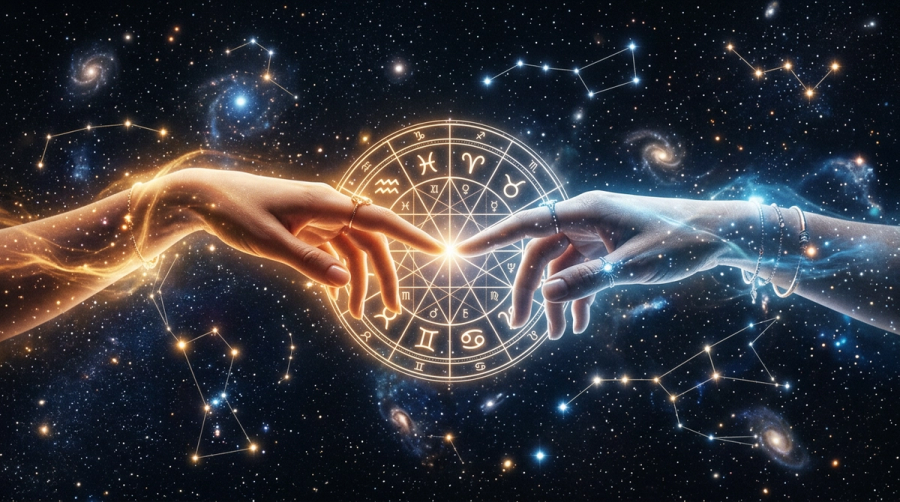
Hand-drawn synastry chart highlighting Venus and Mars planetary aspects for love compatibility
Venus-Mars Interaspects: The Chemistry You Can't Fake
Venus-Mars aspects between two charts are the primary indicators of sexual and romantic attraction - they show whether desire flows naturally or requires conscious effort between partners.
Let's be honest. This is what most people want to know first. "Is there chemistry?" And Venus-Mars connections are where you find that answer.
Venus represents what you find beautiful, how you express affection, what makes you feel loved. Mars represents desire, pursuit, physical energy, and how you go after what you want. When one person's Venus aspects the other's Mars, there's a magnetic pull.
The aspect type changes the flavor:
- Venus conjunct Mars - Instant attraction. Almost uncomfortably strong. You notice each other across a room.
- Venus trine Mars - Easy, flowing desire. The attraction feels natural, not forced. You're comfortable being physical together.
- Venus square Mars - Intense attraction with friction. The "I can't stand you but I can't stop thinking about you" dynamic. Passionate but sometimes combative.
- Venus opposite Mars - Polarizing magnetism. You're drawn together precisely because you're different. Can feel like completion or like constant push-pull.
- Venus sextile Mars - Gentle attraction that builds over time. Less fireworks, more warmth.
Here's a specific configuration I see often: when someone's Venus in Scorpio forms a square to their partner's Mars in Aquarius (say, Venus at 18 degrees Scorpio square Mars at 18 degrees Aquarius), the attraction is undeniable but the expression of desire clashes. Scorpio Venus wants depth, exclusivity, emotional merging. Aquarius Mars needs space, intellectual stimulation, freedom. The square forces both people to stretch - and that stretching, when done consciously, creates a relationship that's far more interesting than an "easy" match.
Among charts analyzed on MyNitya, couples with at least one Venus-Mars aspect within 3 degree orb report significantly higher initial attraction scores - but it's the Moon connections that predict whether they stay.
Moon Connections and Emotional Compatibility
Moon aspects between charts reveal emotional compatibility - how safe you feel together, whether your daily rhythms align, and if you can truly rest in each other's presence.
Venus-Mars gets you in the door. The Moon decides whether you stay.
Your Moon sign represents your emotional needs, your comfort zone, your instinctive reactions. It's how you are at 2 AM when the mask comes off. When two people's Moons connect well, there's a feeling of home. You don't have to perform. You can just... be.
Meet Nitya, your AI astrologer
She reads your birth chart to answer anything about your life - and she can go deep on any relationship you care about and guide your day ahead. First question free, no card needed.
Some questions our users ask Nitya
Tap any one below - or just write your own question in the form ↓
The most powerful Moon connections in synastry:
- Moon conjunct Moon - You feel the same things at the same time. Emotional synchronicity. Can be beautiful or suffocating depending on the sign.
- Moon trine Moon - Your emotional styles complement each other naturally. Different enough to be interesting, similar enough to feel safe.
- Moon conjunct the Descendant - This person feels like what you've been looking for. They embody your partnership ideal at an emotional level.
- Moon conjunct Venus - Tenderness. Genuine affection. The "I just like being around you" feeling.
- Moon square Moon - Your emotional needs clash. What soothes you irritates them. Workable, but requires conscious effort and communication.
I had a client once - let's call her Sarah - whose Moon in Cancer formed a perfect trine to her partner's Moon in Pisces. Both water Moons. She described the relationship as "feeling understood without having to explain myself." That's Moon compatibility at work. No amount of Venus-Mars fireworks can replace that quiet sense of being seen.
But here's the nuance. Moon-Moon squares aren't death sentences. They just mean you'll need to learn each other's emotional language deliberately rather than intuitively. Some of the strongest long-term couples I've worked with have Moon squares - they've simply done the work of understanding that their partner processes feelings differently.
Saturn Aspects: The Glue That Holds Relationships Together (or Breaks Them)
Saturn aspects in synastry indicate long-term relationship potential - they show where commitment, responsibility, and staying power exist, though they often feel restrictive before they feel stabilizing.
Nobody gets excited about Saturn in a love reading. I get it. Saturn's not sexy. But after fifteen years of doing this work, I'll tell you what I've noticed: relationships without any Saturn contacts between charts rarely last. They're fun. They're light. And they dissolve when life gets hard.
Saturn is the planet of commitment, structure, time, and maturity. In synastry, Saturn aspects say: "This relationship has weight. It means something. It's going somewhere."
As William Lilly noted in his 17th-century text Christian Astrology, Saturn's influence in relationship charts speaks to bonds that endure through difficulty - the kind of love that's built rather than simply felt.
Key Saturn aspects to watch:
- Saturn conjunct Sun - The Saturn person stabilizes (or restricts) the Sun person's identity. Can feel like a mentor-student dynamic. Works best when both are mature.
- Saturn conjunct Venus - Love that takes time to develop. Often feels like "not enough" early on, then deepens into something unshakeable. Saturn square Venus in the natal chart often manifests as delayed romantic commitment in the late 20s - and when this shows up in synastry, the same theme plays out between partners.
- Saturn trine Moon - Emotional security. The Saturn person makes the Moon person feel safe and grounded. One of the best aspects for long-term domestic happiness.
- Saturn square Mars - Frustration. The Saturn person feels like a brake on the Mars person's drive. Requires patience and mutual respect to navigate.
If you're curious about how Saturn's cycles affect your relationship timing, understanding when your Saturn return hits can reveal why certain years feel like relationship pressure cookers. Your Saturn return - which happens around ages 28-30 and again at 57-59 - often coincides with major relationship decisions: committing, leaving, or completely restructuring how you approach partnership.
You can calculate your exact Saturn return dates to see when these windows open for you.
Why Sun Sign Compatibility Alone Is Misleading
Sun sign compatibility represents only one of dozens of planetary connections between two charts - roughly 5-10% of the full compatibility picture - and can't account for Venus, Mars, Moon, or house placements that drive actual relationship dynamics.
I need to say this clearly: if someone tells you "Leos and Scorpios don't work," they're oversimplifying to the point of being wrong.
Your Sun sign is your core identity, yes. But it's one planet out of ten. It occupies one house out of twelve. It forms maybe 4-5 aspects out of the 40+ connections that exist between two full charts.
Here's what sun sign compatibility misses entirely:
- Your Venus sign - How you love and what you need in love (could be completely different from your Sun sign)
- Your Mars sign - How you pursue, fight, and express desire
- Your Moon sign - Your emotional core and daily needs
- Your 7th house and Descendant - What you're specifically attracted to in partnership
- Your North Node - The growth direction that a partner might activate
A Scorpio Sun with Venus in Sagittarius and Moon in Gemini is going to show up very differently in relationships than a Scorpio Sun with Venus in Scorpio and Moon in Cancer. Same Sun sign. Completely different love nature.
This is exactly why a proper natal chart analysis for love compatibility matters so much more than any sun sign matching quiz. The full chart tells the full story.
Curious what your complete compatibility picture looks like? Chat with Nitya about your birth chart - try free. Nitya analyzes your full Western natal chart including houses, aspects, and transits to give you personalized relationship guidance.
How to Interpret "Difficult" Aspects as Growth Opportunities
Squares and oppositions in synastry aren't indicators of incompatibility - they're indicators of where a relationship will push both people to grow, evolve, and develop qualities they wouldn't develop alone.
I want to reframe something. In astrology communities, there's this tendency to see squares and oppositions as "bad" and trines and sextiles as "good." That's a beginner's framework, and it leads people to panic over perfectly workable charts.
Here's the truth: every long-term relationship has difficult aspects. Every single one. If you only had trines and sextiles, you'd have a pleasant friendship with zero growth potential. Squares create the friction that forces evolution.
Think about it this way:
- A square (90 degrees) is like two people pulling in different directions. It creates tension - but tension is what builds muscle. Squares demand that you develop new skills, communicate more clearly, and stop assuming your way is the only way.
- An opposition (180 degrees) is like looking in a mirror. Your partner embodies something you've rejected or haven't developed in yourself. It can feel threatening. It can also be the most illuminating experience of your life.
The key question isn't "do we have difficult aspects?" It's "are we both willing to grow?"
Cafe Astrology's guide to interaspects offers a useful framework for understanding how each aspect type manifests differently depending on which planets are involved. A Venus-Jupiter square plays out very differently from a Mars-Pluto square.
Some squares I actually like seeing in synastry:
- Sun square Moon - Forces both people to balance identity with emotional needs. Creates a dynamic, never-boring relationship.
- Venus square Mars - Keeps attraction alive long-term. The tension prevents the relationship from going flat.
- Mercury square Mercury - You think differently. This means you'll never run out of things to debate and discuss.
The aspects I watch more carefully are Saturn square personal planets (can feel controlling) and Pluto conjunct or square Venus/Moon (intensity that can tip into obsession). These aren't dealbreakers either - but they require more self-awareness from both people.
What Birth Data Do You Need for Accurate Compatibility Results?
For accurate synastry results, you need the exact birth date, birth time (ideally to the minute), and birth location for both people - the birth time determines house cusps, the Ascendant, and the Descendant, which are critical for relationship analysis.
This is where a lot of online calculators fall short. They ask for birthdays and maybe sun signs. But without birth time, you're missing:
- The Ascendant (Rising sign) - How you present yourself and what first impression you make
- The Descendant (7th house cusp) - Literally describes your ideal partner and relationship style
- House placements - Which life areas your partner's planets activate for you
- The Moon's exact degree - The Moon moves about 12 degrees per day, so without birth time, you might have the wrong Moon sign entirely
Here's my honest advice: if you don't have your partner's birth time, a synastry reading is still useful - you'll get planet-to-planet aspects accurately. But you'll miss the house overlay information, which is where a lot of the "daily life together" compatibility lives.
What to gather before running a compatibility chart:
- Both people's birth dates (day, month, year)
- Both people's birth times (check birth certificates - hospital records are most accurate)
- Both people's birth locations (city and country - this determines the local sidereal time)
With the Sun entering Gemini on May 20, 2026, and Venus moving into Cancer on May 30, 2026, this is actually an excellent window for relationship reflection. The Gemini Sun encourages honest communication about what you've discovered in your charts, while Venus in Cancer softens the conversation with emotional warmth.
How MyNitya's AI Astrologer Analyzes Compatibility
On MyNitya, you enter your birth details and chat with Nitya - an AI astrologer who deeply understands your Western natal chart. Nitya analyzes planetary positions, house placements, aspects, and transits to give you personalized guidance on relationships, timing, and life patterns.
What makes this different from a static compatibility calculator? Nitya doesn't just spit out a score. You can ask follow-up questions. "What does my Venus square his Saturn mean for us long-term?" "Why do I keep attracting partners with strong Pluto energy?" "When's the best time this year to have a serious relationship conversation?"
MyNitya supports both Vedic and Western astrology - so whether you resonate more with Western psychological astrology (which excels at relationship dynamics and personality insights) or Vedic Jyotish (which excels at timing, karmic patterns, and life-purpose questions), you can get guidance from either system.
The platform calculates your full birth chart using NASA planetary positions, analyzing thousands of astrological data points. Then Nitya interprets those data points in the context of your specific question - not a generic horoscope, but a personalized reading based on your chart.
Get personalized guidance based on your birth chart on MyNitya. Your first question is free - no credit card required.
Putting It All Together: Reading Your Compatibility Chart
Here's a practical framework for interpreting what an astrology compatibility calculator shows you:
Step 1: Check the Moon connections first. Can you live together day-to-day? Do your emotional needs align or clash?
Step 2: Look at Venus-Mars interaspects. Is there genuine attraction? Does desire flow or does it require constant effort?
Step 3: Examine Saturn contacts. Is there staying power? Will this relationship endure when life gets difficult?
Step 4: Note the Descendant. Does your partner's Sun, Moon, or Venus fall in or near your 7th house? If so, they naturally embody what you seek in partnership.
Step 5: Don't fear the squares. Look at them as the curriculum of your relationship. What are they asking you both to learn?
Step 6: Consider the composite chart. What's the relationship's purpose? Where does it want to grow?
No single aspect makes or breaks a relationship. It's the full pattern - the weave of easy and challenging connections - that tells the story. And that story isn't fixed. It's an invitation.
Ask your first question free on MyNitya - and find out what your birth chart reveals about the love you're building.
Frequently Asked Questions
How accurate is an astrology compatibility calculator?
An astrology compatibility calculator is as accurate as the birth data you provide. With exact birth times for both people, the planetary positions and house cusps are calculated to precise degrees using ephemeris data. The interpretation layer - what those aspects mean - depends on the quality of the system reading them. A percentage score is a simplification; the real value is in understanding individual aspects.
Can astrology really predict relationship compatibility?
Astrology doesn't predict whether a relationship will "work" - that depends on the people involved. What it does is map the energetic dynamics between two charts: where connection flows easily, where friction exists, and what growth opportunities the relationship offers. Think of it as a weather forecast for your relationship landscape, not a verdict.
What's more important - synastry or the composite chart?
Both serve different purposes. Synastry shows how two individuals affect each other - the dynamic between you. The composite chart reveals the relationship's own identity, purpose, and challenges as a unit. For understanding day-to-day interactions, start with synastry. For understanding where the relationship is headed long-term, look at the composite.
Do I need my partner's exact birth time for a compatibility reading?
You don't need it, but you'll get a more complete picture with it. Without birth time, you can still analyze planet-to-planet aspects accurately (Sun, Venus, Mars positions are reliable with just the birth date). But you'll miss house overlays, the Ascendant/Descendant axis, and potentially the Moon's exact degree - all of which add significant depth to a compatibility reading.
What are the best aspects to have in synastry?
There's no single "best" aspect, but consistently positive indicators include: Moon trine Moon (emotional harmony), Venus conjunct or trine Mars (natural attraction), Sun conjunct or trine Moon (identity-emotion balance), and Jupiter conjunct Venus (joy and generosity in love). Saturn trine Moon is underrated - it provides the emotional security that keeps couples together through difficult seasons.
Can two people with "bad" synastry have a good relationship?
Absolutely. "Bad" synastry usually means challenging aspects - squares, oppositions, or heavy Saturn/Pluto contacts. These indicate a relationship that requires more conscious effort, better communication, and willingness to grow. Many deeply fulfilling long-term relationships have challenging synastry. The aspects don't determine your fate - they describe the terrain you'll navigate together.
Nitya isn't a one-time horoscope. She's with you for the whole journey.
Understand yourself
Career, love, money, timing - any decision you are weighing. Answers read straight from your birth chart.
Understand any relationship
Add your partner, a parent, a friend, even a colleague. Nitya reads both charts together to explain the bond, the friction, and how to work through it.
Guidance for every day
Start each morning knowing what the day favors, what to watch for, and the best moments to act.
No card needed. Nitya just needs your birth details to read your chart.