Natal Chart Love Compatibility: How to Compare Birth Charts for Relationships
In this Article
Compatibility Calculator
Check astrological compatibility by birth dates
Natal chart love compatibility isn't about matching Sun signs on a magazine quiz. It's the practice of laying two complete birth charts side by side - every planet, every house, every angle - and reading the conversation between them. When you compare charts properly, you see dozens of connections that reveal attraction, emotional safety, friction points, and long-term staying power.
I've been reading synastry charts for over fifteen years, and I can tell you this: the couples who last aren't always the ones with "easy" charts. Sometimes a well-placed square does more for a relationship than a dozen trines. But you need to know what you're looking at.
Your personal astrologer - Vedic + Western.
Reads all 10,000+ points of your birth chart to answer your question. First question free, no card needed.
Key Takeaways
>
- Synastry compares two natal charts to reveal relationship dynamics - it's far more accurate than Sun sign matching
- Venus-Mars aspects show physical and romantic chemistry; Moon connections reveal emotional compatibility
- The 7th house and Descendant describe what you need in a partner at a soul level
- "Difficult" aspects (squares, oppositions) often create passion and growth - they're not dealbreakers
- A composite chart shows the relationship itself as its own entity
- Your exact birth time matters - it determines house placements that shape how you experience love
Venus and Mars planetary symbols connected by aspect line in synastry chart
What Is Synastry in Natal Chart Love Compatibility?
Synastry is the astrological technique of comparing two birth charts to assess relationship compatibility. It examines how one person's planets aspect (form geometric angles with) another person's planets, revealing areas of harmony, tension, attraction, and growth.
Here's what actually happens when an astrologer does a synastry reading. They take your natal chart - the exact snapshot of the sky when you were born - and overlay it with your partner's chart. Every planet in your chart forms relationships with every planet in theirs. Your Venus might sit right on top of their Mars. Your Moon might square their Saturn. Each connection tells a story.
The word "synastry" comes from the Greek syn (together) and astron (star). It's been practiced in some form since Ptolemy wrote about marriage indicators in Book IV of the Tetrabiblos around 150 CE, where he examined Venus and Mars placements as markers of romantic temperament. The technique has evolved enormously since then, but the core idea remains: planets don't exist in isolation, and neither do people.
What makes synastry different from just comparing Sun signs? Everything. Your Sun sign is one placement out of dozens. When I look at a synastry chart, I'm examining at least 40-50 individual connections. Some are loud. Some are quiet. Together, they paint a picture no zodiac compatibility grid could ever capture.
Among charts analyzed on MyNitya, couples who report high relationship satisfaction tend to have at least three strong interaspects between personal planets (Sun, Moon, Venus, Mars, Mercury) - not just one "perfect" connection.
How Venus-Mars Aspects Shape Romantic Chemistry
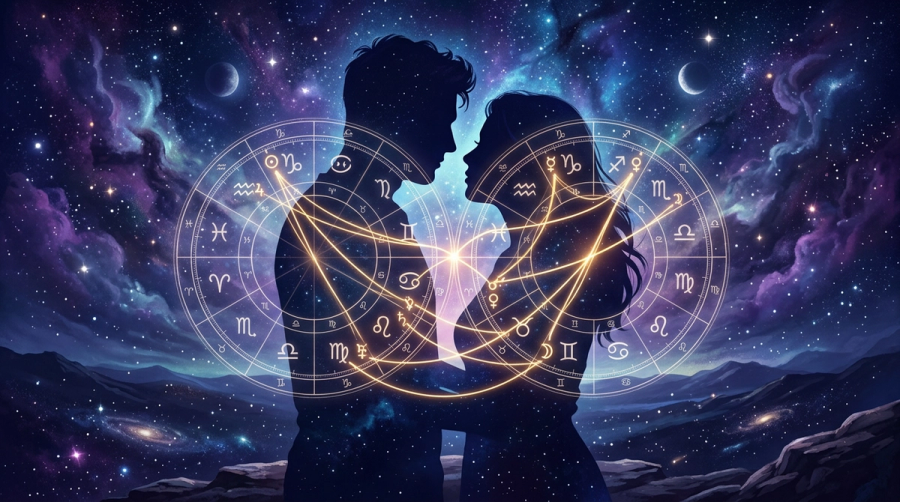
Venus-Mars connections between two charts are the single strongest indicator of physical and romantic attraction. When one person's Venus touches the other's Mars by conjunction, trine, or opposition, the chemistry is almost always palpable.
Let me break this down simply. Venus represents what you find beautiful, how you express affection, and what makes you feel loved. Mars represents desire, drive, and how you pursue what you want. When your Venus lands on someone's Mars - or vice versa - it's like a lock meeting its key.
The conjunction (0 degrees): This is the most intense. If your Venus conjuncts their Mars, you're drawn to each other magnetically. There's an almost physical pull. I've seen this in charts of couples who describe their first meeting as electric - like they couldn't look away.
The trine (120 degrees): Easy, flowing attraction. You find each other appealing without effort. The chemistry is there, but it doesn't overwhelm. These couples often describe their connection as "natural" or "comfortable from day one."
The square (90 degrees): Here's where it gets interesting. Venus square Mars creates friction - but it's the kind of friction that generates heat. These couples argue, make up, and can't stay away from each other. It's passionate but requires maturity to sustain.
The opposition (180 degrees): A magnetic pull with a push-pull dynamic. You're attracted to qualities in each other that are different from your own. It can feel like looking in a mirror that shows your opposite - fascinating and sometimes frustrating.
Saturn square Venus in a synastry chart often manifests as a feeling of restriction around affection - one partner may feel they can't fully express love without judgment. But here's the thing: this same aspect, when worked through consciously, builds the kind of loyalty that lasts decades. It's not glamorous. It's real.
If you're curious how your Venus and Mars interact with a partner's chart, chat with Nitya about your birth chart - try free. Nitya analyzes your full Western natal chart including all planetary aspects and house placements.
Moon Sign Compatibility: The Emotional Foundation
Moon sign compatibility determines whether two people can truly feel safe with each other. It's the difference between a relationship that looks good on paper and one that actually feels like home.
Your Moon sign governs your emotional needs, your instinctive reactions, and how you process feelings. In synastry, Moon connections are what keep couples together after the initial Venus-Mars spark fades. I've seen plenty of relationships with incredible Venus-Mars chemistry that fell apart within a year because the Moon connections were absent. The passion was there. The emotional safety wasn't.
Moon conjunct Moon: You feel things the same way. When one of you is sad, the other instinctively understands without explanation. This is rare and deeply comforting.
Moon trine or sextile Moon: Your emotional rhythms are compatible. You might not process feelings identically, but you respect each other's emotional language. There's a natural give-and-take.
Moon square Moon: Your emotional needs clash. One person might need space to process while the other needs to talk immediately. This isn't fatal - but it requires conscious effort and communication.
Moon conjunct Venus (cross-chart): One of the sweetest aspects in synastry. The Venus person makes the Moon person feel adored, and the Moon person provides the emotional depth that Venus craves. It's tender.
Moon conjunct or trine Saturn (cross-chart): This gets a bad reputation, but I've seen it in enduring marriages. Saturn provides structure and commitment to the Moon's emotional world. It can feel heavy at first - like the Saturn person is too serious - but over time, it creates a container where vulnerability feels safe.
Pay attention to which element your Moons fall in. Two water Moons (Cancer, Scorpio, Pisces) understand each other's emotional intensity. A fire Moon paired with an earth Moon might struggle - one wants excitement, the other wants stability. Neither is wrong. They speak different emotional languages.
Couple silhouetted against night sky with 7th house and zodiac constellations highlighted
The 7th House and Descendant: What You Actually Need in a Partner
The 7th house cusp - also called the Descendant - describes the qualities you seek in a committed partner. It's the sign directly opposite your Ascendant, and it reveals what you need to feel complete in partnership.
Think of it this way. Your Ascendant (Rising sign) is how you show up in the world. Your Descendant is what you're looking for across the table. If you have Aries rising, your Descendant is in Libra - you naturally seek partners who bring harmony, diplomacy, and aesthetic beauty into your life. If you have Cancer rising, your Descendant is Capricorn - you're drawn to people who are grounded, ambitious, and emotionally steady.
In synastry, when someone's personal planets (especially Sun, Moon, or Venus) fall in your 7th house, it triggers a deep recognition. You see them as "partner material" almost immediately. It's not always logical. It's visceral.
Here's what to look for:
- Their Sun in your 7th house: You see them as an ideal partner. They embody qualities you admire and want in your life.
Meet Nitya, your AI astrologer
She reads your birth chart to answer anything about your life - and she can go deep on any relationship you care about and guide your day ahead. First question free, no card needed.
Some questions our users ask Nitya
Tap any one below - or just write your own question in the form ↓
- Their Moon in your 7th house: Emotional partnership feels natural. You want to build a home with this person.
- Their Venus in your 7th house: Romance and affection flow easily. This is a classic "love at first sight" placement.
- Their Saturn in your 7th house: This one's heavy but significant. It often indicates a karmic or fated connection - someone who teaches you about commitment, sometimes through challenge.
Your Descendant sign also tells you about patterns. If you keep attracting the same type of partner - and it's not working - look at your 7th house. The sign on that cusp, plus any planets sitting inside it, reveals your unconscious relationship blueprint.
Understanding your Saturn placement adds another layer here. Saturn's house and sign in your natal chart show where you face your biggest lessons - and when Saturn aspects the 7th house, those lessons often arrive through relationships.
Sun-Moon Connections Between Partners
Sun-Moon interaspects between two charts create a sense of mutual recognition and emotional balance that sustains relationships through difficult seasons.
The Sun represents your core identity - who you are at your most essential. The Moon represents your emotional self - who you are when no one's watching. When one person's Sun connects with the other's Moon, there's a beautiful complementarity. The Sun person feels seen and appreciated. The Moon person feels warmed and supported.
His Sun conjunct her Moon (or vice versa): This is considered one of the strongest indicators of marriage potential in traditional synastry. The Sun person provides direction and vitality; the Moon person provides nurturing and emotional understanding. It's not about gender roles - it's about energetic exchange.
Sun trine Moon (cross-chart): Effortless understanding. You "get" each other without trying too hard. The relationship feels supportive rather than draining.
Sun square Moon (cross-chart): Tension between identity and emotions. One person's way of being might inadvertently trigger the other's insecurities. But this aspect also creates growth - it pushes both people to become more self-aware.
I want to be honest: no single aspect makes or breaks a relationship. I've read charts for couples with "perfect" Sun-Moon connections who split up, and couples with challenging aspects who've been together thirty years. Astrology shows potential and patterns. What you do with that information is up to you.
How to Actually Compare Two Birth Charts Step by Step
Comparing two natal charts for love compatibility requires both people's exact birth data - date, time, and location. Here's the process a professional astrologer follows, simplified so you can start exploring on your own.
Step 1: Get accurate birth times. This is non-negotiable. Without a birth time, you can't calculate houses or the Ascendant/Descendant axis. And as we've discussed, the 7th house is crucial for relationship analysis. Even a 15-minute difference can shift house cusps into different signs.
Step 2: Generate both natal charts. You need each person's complete chart with all planets, houses, and major angles (Ascendant, Descendant, Midheaven, IC).
Step 3: Look at personal planet connections first. Start with Sun, Moon, Venus, Mars, and Mercury interaspects. These govern day-to-day relating. Use an orb of 6-8 degrees for conjunctions and oppositions, 5-6 degrees for trines and squares.
Step 4: Check house overlays. Where do your partner's planets fall in your houses? Their planets in your 1st, 5th, 7th, or 8th house are particularly significant for romance.
Step 5: Examine the Nodes. The North and South Nodes in synastry often indicate karmic connections. If someone's planets conjunct your South Node, you may feel an instant familiarity.
Step 6: Look at the composite chart. Calculate the midpoints between both charts to create a single "relationship chart." The composite shows the relationship as its own entity - its purpose, challenges, and potential.
Step 7: Consider the whole picture. Don't fixate on one difficult aspect. A single square doesn't doom a relationship, just like a single trine doesn't guarantee bliss. Look at the overall pattern.
If this feels overwhelming, that's normal. Professional astrologers spend years learning to synthesize these factors. On MyNitya, Nitya analyzes your full Western natal chart - including houses, aspects, and transits - and can walk you through your relationship patterns in plain language. Ask your first question free on MyNitya.
Common Misconceptions About Natal Chart Compatibility
Many people approach chart comparison with assumptions that lead them astray. The biggest misconception is that "compatible" means "easy" - and that's simply not how relationships work.
Misconception #1: Same Sun sign = great match. Two Leos together might understand each other's need for attention, but they might also compete for the spotlight. Same-sign pairings can work beautifully or create echo chambers. It depends entirely on the rest of the chart.
Misconception #2: Squares and oppositions mean the relationship is doomed. I can't stress this enough - challenging aspects create growth. A relationship with only trines and sextiles might feel pleasant but stagnant. Squares push you to evolve. Oppositions create polarity that keeps attraction alive.
Misconception #3: You need a "perfect" chart match to have a good relationship. There's no such thing as a perfect synastry chart. Every couple has friction points. The question isn't whether challenges exist - it's whether both people are willing to work with them consciously.
Misconception #4: Synastry predicts whether you'll stay together. It doesn't. Synastry shows the nature of the connection - where it flows, where it catches. Free will, emotional maturity, and effort determine whether a relationship lasts.
Misconception #5: You only need to check Venus. Venus matters enormously, but it's one piece. I've seen couples with no Venus interaspects who have deeply satisfying relationships because their Moon connections and house overlays create intimacy through other channels.
If you've been through a Saturn return - that period between ages 27-30 when Saturn completes its first orbit back to its natal position - you probably already know that relationships that survive that transit are built on something deeper than surface compatibility. Saturn return periods, particularly the current Saturn return in Aries running from 2025-2028, often trigger major relationship shifts.
When "Difficult" Aspects Actually Strengthen Relationships
Squares and oppositions in synastry aren't red flags - they're often the very aspects that keep a relationship alive, passionate, and growing over decades.
Here's something I've noticed after reading thousands of charts: the couples who describe their relationship as "never boring" almost always have significant squares or oppositions between personal planets. The couples who say "comfortable but we've grown apart" often have charts dominated by trines with few challenging aspects.
Mars square Mars: Both people are strong-willed. Arguments happen. But so does incredible passion and mutual respect for each other's independence. This aspect works when both partners have healthy outlets for their Mars energy.
Venus opposite Pluto: Intense, transformative love. It can veer into obsession if unconscious, but when both people are self-aware, it creates a bond that transforms them both at a soul level.
Moon square Saturn (cross-chart): The Saturn person might seem cold or critical to the Moon person at first. But over time, this aspect builds emotional resilience and trust. Saturn says: "I'm not going anywhere, even when things get hard." That's not romantic in a movie sense. It's romantic in a real-life sense.
Sun opposite Sun: You're fundamentally different people. But those differences create fascination. You see the world from opposite angles, and that perspective enriches both of you - if you let it.
The key with difficult aspects isn't avoiding them. It's awareness. When you know your partner's Saturn squares your Moon, you can recognize the dynamic when it shows up and communicate what you need instead of withdrawing. Awareness transforms friction into fuel.
Knowing when your Saturn return hits can also help you understand relationship timing - Saturn transits often coincide with periods where relationships are tested and either deepen or dissolve.
The Composite Chart: Your Relationship as Its Own Entity
A composite chart calculates the midpoint between each pair of planets in two natal charts, creating a single chart that represents the relationship itself - its purpose, energy, and trajectory.
Think of it this way: synastry shows how two individuals interact. The composite shows what they create together. It's the difference between watching two musicians play and listening to the song they make.
The composite Sun shows the relationship's core identity - what it's "about." A composite Sun in the 10th house might indicate a power couple focused on shared ambitions. A composite Sun in the 4th house suggests a relationship centered on home, family, and emotional security.
Composite Venus shows how love is expressed within the relationship. And composite Saturn - often feared - shows where the relationship faces its biggest tests and where it builds lasting structure.
I find composite charts especially useful for couples who've been together a while and feel stuck. The composite often reveals the relationship's deeper purpose - something both people might have lost sight of in the daily grind.
MyNitya supports both Vedic and Western astrology, so whether you want to explore synastry through Western aspects and houses or through Vedic techniques like navamsha comparison and dasha compatibility, Nitya can guide you through either system. Get personalized guidance based on your birth chart on MyNitya.
Putting It All Together: What Really Matters
After fifteen years of reading relationship charts, here's what I've learned matters most. It's not any single aspect. It's the overall balance.
A relationship needs attraction (Venus-Mars connections), emotional safety (Moon interaspects), mutual respect (Sun connections), and commitment capacity (Saturn aspects). If all four are present - even through challenging aspects - the relationship has strong bones.
The couples I worry about aren't the ones with squares. They're the ones with no significant interaspects at all. When two charts barely "talk" to each other, there's often a feeling of living parallel lives - pleasant enough, but without the pull that keeps people choosing each other day after day.
Your natal chart is deeply personal. The way your planets interact with another person's chart creates a story that's unique to the two of you. No compatibility article - including this one - can replace the experience of seeing your specific patterns laid out clearly.
And remember: astrology illuminates. It doesn't dictate. The most "incompatible" charts can't stop two people committed to understanding each other. What astrology can do is give you language for dynamics you've felt but couldn't name - and show you where love asks you to become more than you were before.
Frequently Asked Questions
Can you determine love compatibility from natal charts alone?
Natal chart comparison through synastry reveals the nature of a connection - where chemistry exists, where friction lives, and what emotional patterns emerge. It can't predict whether a relationship will succeed because that depends on both people's emotional maturity, communication skills, and willingness to grow. Charts show potential; humans determine outcomes.
What's the difference between a synastry chart and a composite chart?
A synastry chart overlays two individual natal charts to examine how each person's planets aspect the other's - it shows the dynamic between two separate people. A composite chart calculates midpoints between both charts to create a single new chart representing the relationship as its own entity. Most astrologers use both techniques together for a complete picture, as Cafe Astrology's synastry guide explains in detail.
Which planets matter most for romantic compatibility?
Venus and Mars govern attraction and desire. The Moon determines emotional compatibility and whether you feel safe together. The Sun shows whether your core identities support each other. Mercury affects communication style. And Saturn - often overlooked - reveals whether the relationship can endure long-term. All five matter, but Venus-Mars and Moon connections tend to be felt most immediately.
Do I need my exact birth time for synastry?
Yes, ideally. Without a birth time, you can't calculate houses or the Ascendant/Descendant axis - and the 7th house (partnerships) is critical for relationship analysis. You can still examine planet-to-planet aspects without a birth time, but you'll miss roughly 40% of the picture. Even an approximate time (within 30 minutes) is better than none. The Astro.com educational wiki on synastry provides additional context on what's needed for accurate chart comparison.
Are "bad" aspects in synastry actually bad?
Not necessarily. Squares (90 degrees) and oppositions (180 degrees) create tension, but tension generates energy, passion, and growth. Many long-lasting couples have significant challenging aspects - these keep the relationship dynamic rather than stagnant. The truly concerning pattern isn't difficult aspects; it's the absence of any strong connections at all. Context matters: a Venus-Mars square creates exciting friction, while a Moon-Saturn square requires more conscious work.
How often should I check synastry with a new partner?
Once is enough for the natal synastry - your birth charts don't change. However, transits to your synastry points do shift over time. For example, when transiting Saturn crosses a sensitive synastry point (like conjuncting one person's Venus in the other's 7th house), the relationship may face a test or deepening. On June 14, 2026, Saturn at 3 degrees Aries will be forming challenging aspects to charts with early Cardinal sign placements - a period when many relationships will face defining moments.
Nitya isn't a one-time horoscope. She's with you for the whole journey.
Understand yourself
Career, love, money, timing - any decision you are weighing. Answers read straight from your birth chart.
Understand any relationship
Add your partner, a parent, a friend, even a colleague. Nitya reads both charts together to explain the bond, the friction, and how to work through it.
Guidance for every day
Start each morning knowing what the day favors, what to watch for, and the best moments to act.
No card needed. Nitya just needs your birth details to read your chart.


