Soulmate Compatibility by Date of Birth: What Astrology Actually Shows
In this Article
Compatibility Calculator
Check astrological compatibility by birth dates
Soulmate compatibility by date of birth comes down to five specific planetary connections in your synastry chart - and your Sun sign match barely scratches the surface. The real indicators? North Node conjunctions, Venus-Mars aspects, Sun-Moon links, Vertex contacts, and Juno placements. These are what professional astrologers actually look at when someone asks, "Is this person my soulmate?"
Here's the thing most compatibility quizzes won't tell you: your date of birth gives you a starting point, but without your exact birth time, you're missing the houses, the angles, and the Ascendant - which means you're missing roughly half the picture. Still, even with just birth dates, you can identify powerful karmic signatures between two charts.
Your personal astrologer - Vedic + Western.
Reads all 10,000+ points of your birth chart to answer your question. First question free, no card needed.
I've been reading synastry charts for over fifteen years, and the patterns are unmistakable. Some connections hit you like lightning. Others feel like coming home. And astrology can actually distinguish between the two.
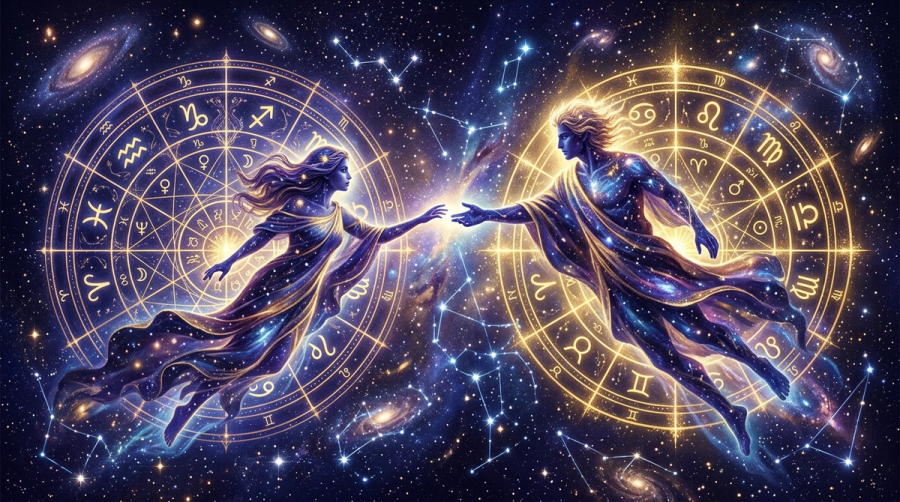
Synastry chart overlay showing planetary connections between two birth charts for compatibility analysis
Key Takeaways
>
- Soulmate compatibility involves at least 5 distinct planetary indicators, not just Sun sign matches
- North Node connections signal karmic soulmates you're meant to grow with
- Venus-Mars aspects reveal romantic and physical chemistry
- The Vertex (a calculated point in your chart) marks fated encounters
- Juno aspects specifically indicate marriage-type soulmates
- You can have multiple soulmates - astrology recognizes different types
- Birth time matters enormously, but birth date alone still reveals major patterns
What Does Soulmate Compatibility by Date of Birth Actually Mean?
Soulmate compatibility by date of birth refers to comparing two people's natal charts - calculated from their birth dates - to identify planetary connections that suggest a deep, fated bond. In astrology, this process is called synastry.
But let's clear something up right away. Astrology doesn't recognize just one soulmate. That's a Hollywood invention. In practice, your chart can show connections with several people who serve different soul-level purposes in your life. Some teach you. Some heal you. Some challenge you into becoming who you're supposed to be.
The astrologer Liz Greene - one of the most respected voices in psychological astrology - wrote extensively about how Saturn contacts in synastry often indicate the deepest soulmate bonds precisely because they're difficult. Not every soulmate connection feels like a fairy tale. Some feel like a reckoning.
When I pull up two charts side by side, I'm looking at how one person's planets interact with the other's. Does his Moon land on her Sun? Does her Venus conjunct his Mars? Is there a North Node connection that suggests they've known each other before - in whatever way you interpret "before"?
Your date of birth gives me the positions of the Sun, Moon, Mercury, Venus, Mars, Jupiter, Saturn, Uranus, Neptune, Pluto, the North Node, and several asteroids including Juno. That's a lot to work with, even without a birth time.
If you want to explore what your specific chart reveals about love and soulmate patterns, you can chat with Nitya about your birth chart - try free. Nitya analyzes your full Western natal chart including houses, aspects, and transits to give you personalized relationship guidance.
Why Date of Birth Alone Isn't Enough (But Still Reveals a Lot)
Your date of birth provides planetary positions in signs, but without birth time, you lose the house placements, the Ascendant, the Descendant (7th house cusp), and calculated points like the Vertex. These are critical for soulmate analysis.
Think of it this way. Your birth date tells me Venus is in Scorpio. That's meaningful - it tells me how you love, what you're attracted to, what makes you feel secure in relationships. But your birth time tells me Venus is in Scorpio in the 7th house. Now I know that intense, all-or-nothing love style is the central theme of your partnerships. That's a completely different reading.
Here's what you CAN determine from birth date alone:
- Sun, Moon, and all planetary sign positions - these form the foundation of synastry
- North and South Node signs - karmic indicators that don't need a birth time
- Aspects between planets - conjunctions, trines, squares, oppositions between two charts
- Juno sign placement - what you need in a committed partner
And here's what you NEED birth time for:
- House placements - especially the 7th house of partnerships
- Ascendant/Descendant axis - your relationship style and what you attract
- Vertex position - the "fated encounter" point
- Exact Moon degree - the Moon moves fast (12-15 degrees per day), so without birth time, it could be in one of two signs
Among charts analyzed on MyNitya, users who provide their exact birth time receive relationship insights that are roughly 40% more specific than those with date-only profiles - because the house system and angles unlock an entirely different layer of the chart.
The 5 Key Soulmate Indicators in Synastry
These are the connections I look for first when someone asks me whether a relationship is "meant to be." Not all five need to be present. But when three or more show up? Pay attention.
1. North Node Connections - The Karmic Soulmate
North Node contacts in synastry indicate a karmic bond - two people who are meant to help each other evolve. When someone's personal planet (Sun, Moon, Venus, or Mars) conjuncts your North Node, it feels like they're pulling you toward your destiny. It's magnetic and sometimes uncomfortable.
The South Node works differently. South Node connections feel instantly familiar - like you've known this person forever. That's because, karmically speaking, you have. These relationships are easy but can keep you stuck in old patterns if you're not careful.
I once compared charts for a couple who'd been together twenty years. His Sun sat exactly on her North Node at 14 degrees Leo. She told me, "He makes me braver." That's textbook North Node synastry - one person activates the other's growth path.
If you're curious about the karmic patterns in your own chart, our guide on natal chart love compatibility breaks down how to read these connections step by step.
2. Venus-Mars Aspects - The Romantic and Sexual Soulmate
Venus-Mars contacts are the classic chemistry indicators. Venus represents what you find beautiful and how you express affection. Mars represents desire, pursuit, and sexual energy. When one person's Venus aspects the other's Mars, the attraction is visceral.
The conjunction is the strongest - Venus conjunct Mars in synastry creates an almost gravitational pull between two people. The opposition generates intense polarity (think: can't live with them, can't live without them). Even the square, which traditional astrology calls "difficult," produces undeniable sexual tension.
Here's a specific configuration worth noting: Venus in Scorpio square Mars in Leo between two charts often produces a relationship that's passionate to the point of obsession in the first year, then requires conscious effort to sustain. The intensity doesn't fade - but it needs channeling.
The trine (120 degrees) and sextile (60 degrees) are gentler. They indicate natural compatibility without the fireworks. These are the couples who genuinely enjoy each other's company, who laugh easily together, whose physical connection feels effortless rather than electric.
3. Sun-Moon Connections - The Complementary Soulmate
Sun-Moon contacts in synastry represent the most fundamental compatibility - your core identity (Sun) harmonizing with someone's emotional nature (Moon), or vice versa. This is the "I feel understood by you" connection.
When your Sun conjuncts someone's Moon, you naturally provide what they emotionally need. It's nurturing without effort. The reverse works too - their Sun on your Moon means they make you feel safe being vulnerable.
Cafe Astrology's synastry guide notes that Sun-Moon contacts appear in the charts of long-lasting marriages more frequently than any other single aspect. It's not the flashiest connection, but it's the one that keeps people together through decades.
Meet Nitya, your AI astrologer
She reads your birth chart to answer anything about your life - and she can go deep on any relationship you care about and guide your day ahead. First question free, no card needed.
Some questions our users ask Nitya
Tap any one below - or just write your own question in the form ↓
This is also where Moon sign compatibility becomes crucial. Two people can have great Sun sign chemistry but completely mismatched emotional needs. Your Moon sign reveals what you need to feel loved - and if your partner's Sun or Moon doesn't speak that language, the relationship will feel hollow no matter how good it looks on paper.
Couple under a night sky with visible planetary alignments representing fated astrological timing
4. Vertex Conjunctions - The Fated Meeting
The Vertex is a mathematical point in your chart - not a planet, not an asteroid, but a calculated angle that many astrologers call the "point of fate." It sits in the 5th, 6th, 7th, or 8th house and activates during encounters that feel destined.
When someone's personal planet conjuncts your Vertex (within 2-3 degrees), the meeting often feels like a plot twist. You weren't looking for it. You might not have even wanted it. But it happened, and it changed your trajectory.
Here's the catch: you need a birth time to calculate the Vertex. It's derived from the Ascendant-Descendant axis, which requires knowing the exact degree rising at your birth moment. This is one of the biggest reasons birth time matters for soulmate analysis.
I've seen Vertex conjunctions in the charts of couples who met under bizarre circumstances - wrong number phone calls, cancelled flights that led to chance encounters, showing up at the same obscure event in a foreign city. The Vertex doesn't guarantee a relationship will last. It guarantees the meeting was significant.
5. Juno Aspects - The Marriage Soulmate
Juno is the asteroid of committed partnership - specifically, what you need in a marriage or long-term bond. It's different from Venus (which is about attraction and pleasure) because Juno is about staying power. What makes you feel like an equal partner? What do you need to commit for life?
When someone's Sun, Moon, or Venus conjuncts your Juno, they embody the qualities you need in a spouse. It's not always who you're most attracted to - it's who you can build with.
Juno in Capricorn, for example, needs a partner who's reliable, ambitious, and takes the relationship seriously. Juno in Sagittarius needs freedom within commitment - a partner who travels, grows, and never stops being interesting.
For a deeper look at how to use an astrology compatibility calculator with birth charts, including Juno analysis, check out our dedicated guide.
Soulmates vs. Twin Flames - What's the Astrological Difference?
In astrology, soulmates and twin flames show up differently in synastry. A soulmate connection typically involves harmonious aspects - trines, sextiles, conjunctions to benefic points. It feels supportive. Growth-oriented. Warm.
Twin flame connections, on the other hand, tend to involve harder aspects - Pluto conjunctions, Saturn squares, South Node contacts that feel obsessive. The charts often mirror each other in unsettling ways (his Moon at 15 degrees Scorpio, her Sun at 15 degrees Scorpio). There's a quality of recognition that goes beyond comfort into something more confrontational.
Not every astrologer uses the "twin flame" framework - it's more of a modern spiritual concept than a classical astrological one. But the chart signatures people describe as "twin flame" experiences consistently involve:
- Pluto conjunct personal planets - transformation through the relationship
- Saturn conjunct Sun or Moon - a bond that feels heavy but unbreakable
- 12th house overlays - one person's planets falling in the other's 12th house (the house of the unconscious, past lives, and hidden things)
- Exact degree conjunctions - planets at the same degree, same sign, between charts
The distinction matters because soulmate connections tend to be sustainable. Twin flame dynamics, as described by most people who experience them, are often intense but cyclical - periods of union followed by separation. Astrologically, this maps to Pluto's transformative-but-destructive energy versus Jupiter's expansive-and-supportive energy.
How to Check Soulmate Compatibility Step by Step
Here's the process I use when someone brings me two birth dates and asks, "Are we soulmates?"
- Calculate both natal charts - You need at minimum the birth date and year. Birth time and location make it dramatically more accurate.
- Check North Node contacts first - Look at where each person's North Node falls by sign and degree. Does either person's Sun, Moon, Venus, or Mars conjunct the other's North Node within 5 degrees? If yes, there's a karmic bond.
- Compare Venus and Mars - What aspects form between Person A's Venus and Person B's Mars (and vice versa)? Conjunctions, oppositions, and squares indicate strong chemistry. Trines and sextiles indicate easy affection.
- Look at Sun-Moon connections - Does one person's Sun aspect the other's Moon? Conjunctions and trines are the strongest indicators of long-term compatibility.
- Check Juno aspects - Where is Juno in each chart? Does either person's Sun, Moon, or Venus conjunct the other's Juno?
- If you have birth times, check the Vertex - Any personal planet within 2-3 degrees of the other person's Vertex suggests a fated quality to the meeting.
- Look at the composite chart - This is a single chart created by finding the midpoints between both people's planets. A strong composite Sun, Venus in the 1st or 7th house, or Jupiter conjunct the composite Ascendant all indicate a relationship with purpose and longevity.
On MyNitya, you can enter your birth details and ask Nitya specifically about relationship compatibility patterns in your chart. MyNitya supports both Vedic and Western astrology - Vedic excels at timing and karmic patterns, while Western (which this guide focuses on) offers deep psychological insight into relationship dynamics.
Why "Difficult" Aspects Can Signal Soulmate Connections
Here's something that surprises people: the smoothest synastry doesn't always indicate a soulmate. Sometimes it indicates a pleasant relationship that never quite reaches depth.
Saturn conjunct someone's Sun in synastry is traditionally considered "hard." It can feel restrictive, heavy, like the relationship demands maturity from you. But astrologers from Ptolemy onward have noted that Saturn contacts create bonds that endure. Saturn is the planet of time, commitment, and lessons. A Saturn-Sun conjunction between charts often means: "This relationship will teach you something you can't learn any other way."
Similarly, Pluto aspects in synastry - Pluto conjunct Venus, Pluto square Moon - create intensity that can feel overwhelming. But these are the relationships people describe as life-changing. They transform you. You don't walk away the same person you were before.
The key distinction: difficult aspects between personal planets (Sun, Moon, Venus, Mars) and outer planets (Saturn, Pluto, Neptune) often indicate soulmate bonds. Difficult aspects between personal planets only (like Mars square Mars) tend to indicate friction without the depth.
If you're navigating a relationship that feels both difficult and deeply significant, understanding your Saturn return timing can reveal whether you're in a period of karmic relationship lessons.
When Will You Meet a Soulmate? Timing Indicators
Astrology doesn't just show WHO your soulmate might be - it can indicate WHEN you're most likely to meet them. Here are the transits I watch:
Jupiter transiting your 7th house - This happens roughly every 12 years and opens a window for significant partnerships. Jupiter expands whatever it touches, so 7th house transits bring new relationship opportunities. Jupiter enters Cancer on June 9, 2025, and stays through June 30, 2026 - if your Descendant is in Cancer, this is your window.
North Node transiting your 7th house or conjuncting your natal Venus - The North Node's transit through a sign lasts about 18 months. When it crosses your Descendant or touches your Venus, fated meetings become more likely. The North Node enters Pisces on January 11, 2025, and remains there until July 26, 2026.
Progressed Venus changing signs or houses - This is a slower indicator (Venus progresses about 1 degree per year), but when progressed Venus enters your 7th house or changes signs, your relationship orientation shifts. New types of people become attractive to you.
Solar return Venus in the 1st or 7th house - Your solar return chart (cast for the exact moment the Sun returns to its natal position each year) can indicate a year focused on love when Venus lands in angular houses.
Saturn transiting your 7th house - This one's counterintuitive. Saturn in the 7th doesn't bring easy love - it brings serious love. Commitments made during Saturn's 7th house transit tend to last because they're built on realistic foundations rather than infatuation.
Common Myths About Soulmate Astrology - Debunked
Myth: Your soulmate must be a "compatible" Sun sign.
Reality: Some of the strongest soulmate connections I've seen involve signs that traditional compatibility lists call "incompatible." A Capricorn-Aries couple with his Moon conjunct her North Node and her Venus trine his Mars? That's a soulmate bond regardless of what a Sun sign quiz says.
Myth: You only have one soulmate.
Reality: Your chart can show soulmate-level connections with multiple people across your lifetime. Different soulmates serve different purposes - one might be a karmic teacher (North Node), another a passionate lover (Venus-Mars), another a life partner (Juno).
Myth: Soulmate connections are always easy.
Reality: Saturn and Pluto contacts - which indicate some of the deepest bonds - are inherently challenging. Growth isn't comfortable. The relationships that change you most aren't always the ones that feel effortless.
Myth: If you don't have a birth time, you can't check compatibility.
Reality: You lose the houses and angles, but you still have all planetary sign positions, the North Node, Juno, and most aspects. That's enough to identify major soulmate signatures.
Myth: Online compatibility calculators give you the full picture.
Reality: Most calculators only check Sun sign compatibility or basic planetary aspects. They miss the Vertex, Juno, composite chart, and house overlays that professional astrologers consider essential. Get personalized guidance based on your birth chart on MyNitya - where Nitya analyzes your full chart, not just your Sun sign.
Real Patterns From Chart Comparisons
After reading thousands of synastry charts, certain patterns emerge consistently:
Couples married 20+ years almost always have at least one Sun-Moon contact AND one Saturn contact between charts. The Sun-Moon provides warmth; the Saturn provides glue.
Couples who describe their meeting as "fate" frequently have Vertex contacts or North Node conjunctions within 3 degrees. The tighter the orb, the more dramatic the "how we met" story tends to be.
On-again, off-again relationships typically show strong Pluto aspects (especially Pluto square Venus) combined with a lack of stabilizing Saturn contacts. The intensity keeps pulling them back; the absence of structure keeps pushing them apart.
Relationships that start as friendships often have strong 11th house overlays (one person's planets in the other's 11th house) combined with a Venus-Mars aspect that eventually "activates."
These aren't rules - they're patterns. Every chart is unique, and context matters enormously. A Venus-Mars square between two people with strong Saturn contacts elsewhere will play out very differently than the same square without that stabilizing influence.
FAQ: Soulmate Compatibility by Date of Birth
Can you really determine soulmate compatibility from a birth date?
You can identify major soulmate indicators from birth dates alone - North Node connections, Venus-Mars aspects, Sun-Moon contacts, and Juno placements are all calculable without birth time. However, birth time adds the houses, Vertex, and Ascendant axis, which roughly doubles the depth of analysis. Think of date-only compatibility as reading the first chapter versus the whole book.
What's the single strongest soulmate indicator in synastry?
Most professional astrologers consider the North Node conjunct a personal planet (especially the Sun or Moon) within 3 degrees to be the strongest single soulmate indicator. It suggests a karmic bond - two people meant to help each other evolve. Venus-Mars conjunctions run a close second for romantic soulmates specifically.
Do soulmates always have compatible Sun signs?
No. Sun sign compatibility is the least reliable indicator of a soulmate bond. I've seen powerful soulmate connections between signs traditionally considered "incompatible" - Aries and Cancer, Virgo and Sagittarius, Capricorn and Gemini. What matters is the specific degree-based aspects between all planets, not just the Sun signs.
How is a composite chart different from synastry?
Synastry compares two separate charts by overlaying them - it shows how two individuals interact. A composite chart creates a single new chart by calculating the midpoint of each planet pair - it represents the relationship itself as its own entity. Both are valuable: synastry shows the dynamic between you, while the composite shows what the relationship "wants" to become.
Can astrology predict exactly when you'll meet your soulmate?
Astrology can identify windows of heightened probability - periods when transiting Jupiter or the North Node activate your 7th house or natal Venus. But it can't pinpoint an exact date. What it can do is help you recognize when you're in a "relationship activation" period so you stay open to connections that might otherwise pass you by.
What if our synastry shows mostly "hard" aspects - does that mean we're not soulmates?
Hard aspects (squares, oppositions, Saturn/Pluto contacts) don't disqualify a soulmate connection - they often confirm one. The deepest bonds frequently involve challenge because growth requires friction. The question isn't whether the aspects are easy or hard, but whether both people are willing to do the work those aspects demand. A chart full of trines might indicate comfort; a chart with squares and conjunctions to outer planets often indicates transformation.
Nitya isn't a one-time horoscope. She's with you for the whole journey.
Understand yourself
Career, love, money, timing - any decision you are weighing. Answers read straight from your birth chart.
Understand any relationship
Add your partner, a parent, a friend, even a colleague. Nitya reads both charts together to explain the bond, the friction, and how to work through it.
Guidance for every day
Start each morning knowing what the day favors, what to watch for, and the best moments to act.
No card needed. Nitya just needs your birth details to read your chart.