Gemini Symbol & Mythology: The Twin's Complete Astrology Guide
In this Article
The Gemini symbol ♊ is one of the most immediately recognizable in the zodiac - two vertical lines joined by horizontal bars, the Roman numeral II compressed into a single glyph. It represents the twins Castor and Pollux, the mythological brothers whose story of divided mortality and shared devotion became the foundation of everything Western astrology means when it calls someone a Gemini. That story is 3,000 years old, stretches across Greek, Roman, and Babylonian traditions, and maps with surprising precision onto the curiosity, duality, and restless intelligence that define the Gemini personality. Ask your first question free on MyNitya.
Key Takeaways: The Gemini glyph ♊ represents the Roman numeral II - two parallel pillars joined top and bottom, symbolizing the twins and the bond between them. The Gemini constellation is anchored by Castor and Pollux, its two brightest stars, with Pollux (magnitude 1.14) actually outshining Castor (magnitude 1.58). Castor is physically one of the most complex star systems visible to the naked eye - six individual stars in three binary pairs. In Western astrology, Gemini is a mutable air sign ruled by Mercury, governing communication, curiosity, and the fluid exchange of ideas. The Sun passes through the Gemini region of the sky from roughly May 21 to June 21. Your specific Gemini placement - Sun, Moon, or Rising - and Mercury's position in your chart determine how this mythology actually expresses in your life.
Your personal astrologer - Vedic + Western.
Reads all 10,000+ points of your birth chart to answer your question. First question free, no card needed.
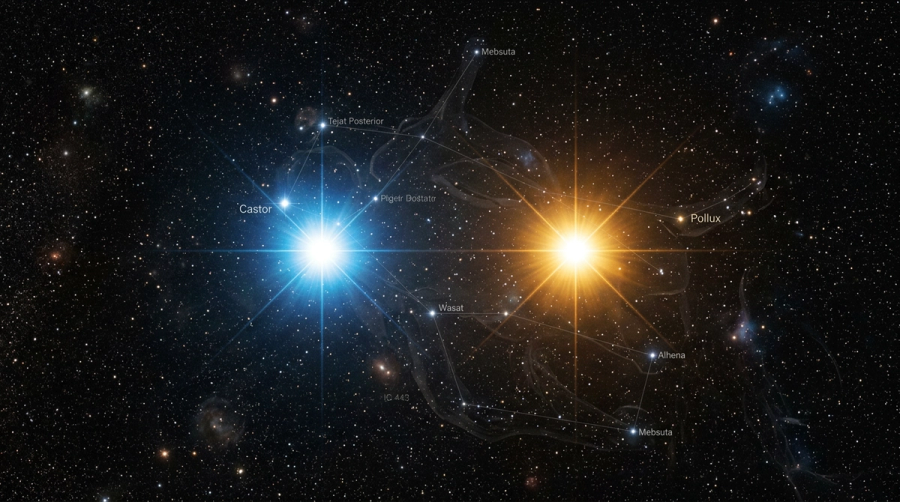
Castor and Pollux — the twin stars of Gemini constellation, one mortal gold, one immortal blue-white
What Is the Gemini Symbol? (The ♊ Glyph Explained)
The Gemini symbol ♊ is a stylized representation of the Roman numeral II - two vertical pillars connected by curved horizontal strokes at the top and bottom. The shape encodes the sign's core meaning directly: two distinct forces, joined. Not merged, not identical, but connected across a shared structure.
The two pillars are read as the twin brothers themselves - Castor and Pollux standing side by side. The curved connectors at top and bottom represent the bond between them, the shared fate that linked a mortal man to an immortal god. In more esoteric interpretations, the glyph reads as a gateway or portal: two pillars framing a threshold between worlds, one side mortal existence and one side the divine. This reading captures something real about Gemini energy - the sign that lives comfortably in the space between things, translating one world to another.
As Cafe Astrology's symbol guide notes, the glyph also connects to Mercury, Gemini's ruling planet. Mercury's own glyph - a circle of spirit over a cross of matter, topped with a crescent of receptivity - suggests the evaluation of sensation through rational thought. The combination encodes what Gemini actually does: it takes in raw experience and runs it through an active, curious mind before anything else happens.
The Glyph vs. the Sign Symbol
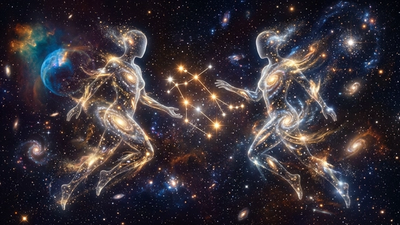
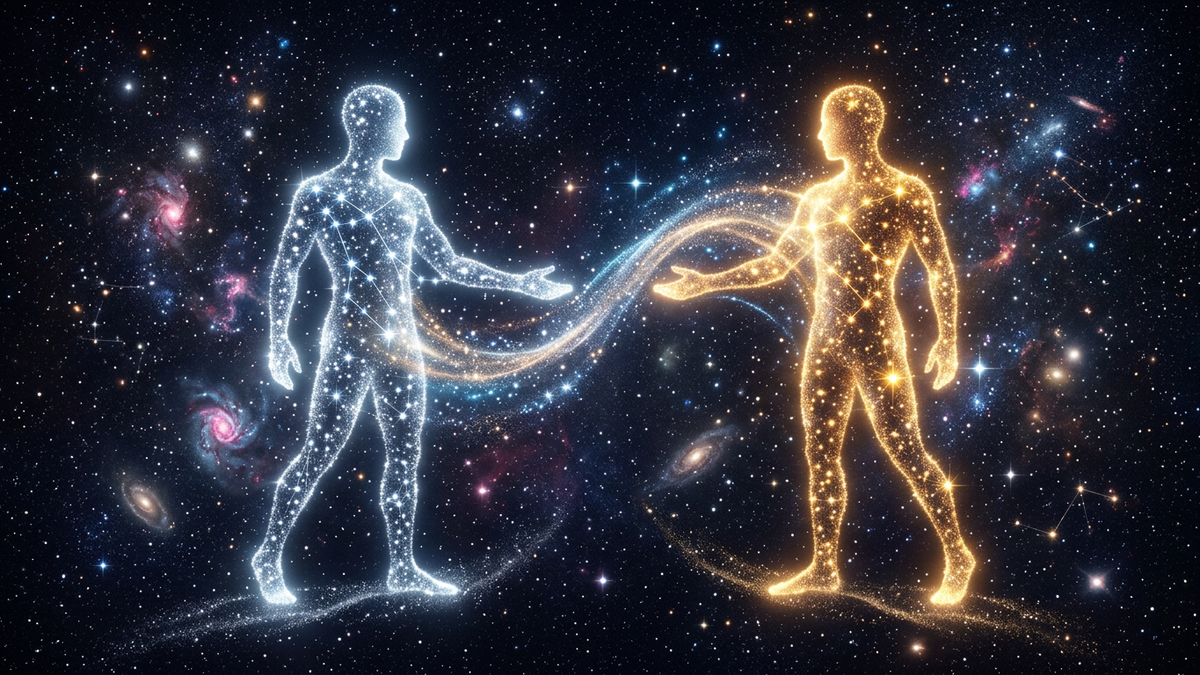
Worth distinguishing: the Gemini symbol can refer both to the glyph (♊) and to the image of the twins - two human figures, usually shown holding hands or standing side by side. Almost uniquely among zodiac signs, Gemini is represented by human figures rather than an animal. The only other purely human symbols in the Western zodiac are Virgo and Aquarius. This matters: it signals that Gemini's core nature is fundamentally social and relational, not instinctual. The twins aren't two forces of nature. They're two people, in conversation.
The gemini symbolism at every level - glyph, figure, mythology - returns to the same idea: two, in dialogue. Not conflict, not fusion. Dialogue.
The Gemini Constellation: Location, Stars, and Facts
The Gemini constellation is a zodiac constellation in the northern sky, spanning approximately 514 square degrees. It's the 30th largest constellation overall and is best observed from the Northern Hemisphere between December and February, when it rides high in the winter sky. Its two brightest stars, Castor and Pollux, mark the heads of the twin figures and are among the most recognizable pairs in the night sky.
Finding Gemini is straightforward. Start from Orion - one of the most conspicuous constellations in winter skies - draw a line from Rigel through Betelgeuse, and extend it upward. That line carries you directly between Castor and Pollux, the two bright stars that mark the constellation's most prominent feature. As NASA's constellation guide confirms, this Orion-to-Gemini navigation method works reliably even for casual observers.
Castor and Pollux: The Twin Stars
The two brightest stars in Gemini tell the twin story in their very light. Pollux (Beta Geminorum) is the brighter of the pair, with an apparent magnitude of approximately 1.14 - making it the 17th brightest star visible from Earth. It's a golden-orange giant, an evolved red giant star sitting about 34 light-years away. Pollux has a confirmed exoplanet orbiting it, one of the first ever detected around a giant star.
Castor (Alpha Geminorum) shines at magnitude 1.58 - the 23rd brightest star in the sky - and appears noticeably whiter and slightly fainter than its golden twin. But Castor's apparent simplicity is deeply misleading. As EarthSky's detailed star profile explains, Castor is actually a sextuple star system - six individual stars in three binary pairs, all gravitationally bound to each other and orbiting a common center. What the naked eye sees as one point of light is, in reality, three binary pairs performing an elaborate gravitational dance at about 51 light-years' distance.
In the tropical zodiac, Castor sits at approximately 20°14' Cancer and Pollux at 23°13' Cancer. Like the fixed stars associated with Virgo (Spica being the most famous example), both Gemini stars have precessed forward from the constellation that carries their name - a result of the same slow wobble in Earth's rotational axis that separates tropical zodiac signs from their original constellations.
Key Facts at a Glance
- Size: ~514 square degrees - 30th largest constellation
- Brightest star: Pollux (Beta Geminorum), magnitude 1.14
- Second brightest: Castor (Alpha Geminorum), magnitude 1.58 - a sextuple star system
- Notable deep-sky objects: Messier 35 (M35), an open star cluster at roughly 2,800 light-years
- Best viewing months: December through February
- Neighboring constellations: Taurus, Orion, Monoceros, Cancer, Auriga, Lynx
- Constellation type: Zodiac - the Sun passes through it roughly May 21 to June 21
The Mythology Behind Gemini: Castor, Pollux, and the Choice Between Mortality and Immortality
The Gemini mythology is one of the most emotionally resonant in the entire zodiac - a story not about power or conquest, but about what someone chooses to sacrifice when they love another person more than they value what they have.
Castor and Pollux were the Dioscuri - the divine twins of Greek myth, sons of the Spartan queen Leda. Their origins are already complicated by duality: in the most common version, Castor was fathered by the mortal king Tyndareus, while Pollux was the son of Zeus, who had visited Leda in the form of a swan. This made Castor mortal and Pollux immortal - two brothers, one destiny, radically different natures.
Meet Nitya, your AI astrologer
She reads your birth chart to answer anything about your life - and she can go deep on any relationship you care about and guide your day ahead. First question free, no card needed.
Some questions our users ask Nitya
Tap any one below - or just write your own question in the form ↓
In life, the twins were inseparable. Castor was celebrated as a horseman of extraordinary skill; Pollux was a boxer so gifted that he was considered undefeatable. They sailed with the Argonauts, participated in the Calydonian Boar Hunt, and served as protectors of sailors - their appearance as St. Elmo's fire (the electrical phenomenon in ships' rigging during storms) was taken as a sign of their divine protection.
When Castor was killed in a cattle raid dispute - mortal, as his nature required - Pollux faced a choice that became the mythological core of Gemini. As an immortal son of Zeus, he could have ascended to Olympus and lived out eternity. Instead, he refused to accept immortality while his brother was dead. He went to Zeus and asked to share his immortality with Castor. Zeus's compromise was characteristically divine: the brothers would alternate between Olympus and the underworld, spending one day among the gods and one day in Hades, together, in perpetual alternation.
The scholar Nick Campion, in his research on the cultural history of astrology, notes that the Dioscuri were among the most widely venerated figures in the ancient Mediterranean world - their cult extended through Greece, Rome, Egypt, and even into early Christianity, where their paired imagery influenced the iconography of twin saints. The constellation's consistent mythological identification across multiple cultures points to how deeply the twin archetype resonated: the idea that two opposing forces - mortal and divine, practical and inspired, earthly and celestial - could be not just reconciled but held in permanent creative tension.
How the Twin Mythology Shaped Gemini Personality
The Castor-Pollux story doesn't just explain where Gemini got its name. It explains how the sign actually operates in a birth chart - the patterns that astrologers have documented across thousands of charts, the qualities that feel paradoxical from the outside but make complete sense when you understand the myth.
The mortality-immortality divide is the key. Gemini is a sign that permanently inhabits both registers at once: the mundane and the conceptual, the everyday and the abstract, the practical facts of a situation and the ten different ways of framing those facts. This isn't instability. It's the native condition of a sign that was mythologically built from two different kinds of being. A Gemini mind doesn't choose between the earthly and the ideal - it moves between them constantly, the way Castor and Pollux moved between Olympus and the underworld.
The communication drive follows directly. The twins were messengers in both directions - between the human world and the divine, between sailors and the gods who protected them. Mercury, Gemini's ruling planet, is literally the divine messenger - the figure who moves between worlds and translates what he finds. Gemini people don't communicate because they're extroverted; they communicate because translation is how their minds work. They're processing by talking, explaining by comparing, and understanding by finding the bridge between two different ways of seeing the same thing.
The quality most often misread as a flaw - inconsistency, the "two-faced" reputation - has its clearest mythological explanation here. Pollux didn't become inconsistent or unreliable when he chose to share his immortality with Castor. He demonstrated a different kind of loyalty: not to a fixed position, but to a relationship. Gemini's famous changeability is often exactly this - an unwillingness to hold a position at the cost of the connection. The twins chose each other over the permanence of their respective natures. Gemini often chooses the exchange over the conclusion.
A Gemini Sun with Mercury in Gemini in its home sign and tightly conjunct Mars produces someone whose thinking and communication run at almost dangerous speed - the insight is faster than the filter, the ideas more numerous than the capacity to develop any single one, and the social intelligence is formidable. The Castor energy (mortal, skilled, practical) and the Pollux energy (inspired, swift, connected to something larger) run simultaneously at full intensity.
Gemini in Western Astrology: Mercury, Mutable Air, and the Sign's Meaning
Gemini in the Western astrological tradition is defined by three coordinates that combine into a specific and coherent personality structure: mutable modality, air element, and Mercury rulership.
Mercury governs information, language, reasoning, short-distance travel, and exchange. In Gemini, Mercury is in its home sign - meaning the planet operates at full strength, without the friction of an incompatible element or modality. Ptolemy, in his Tetrabiblos, codified Gemini's essential nature as intellectual, communicative, and oriented toward the exchange of knowledge - drawing on Hellenistic sources that themselves drew on Babylonian astronomical tradition. This framing has remained remarkably stable across 2,000 years of Western astrological practice: Gemini is the sign of the mind in motion.
Air as an element operates in the realm of ideas, concepts, and social connection. Air signs think before they feel (or instead of feeling, in less developed expressions of the energy). They process experience through language - by describing it, framing it, debating it, naming it. This gives Gemini its well-documented love of conversation, its social fluency, and its genuine intellectual curiosity. But air also means detachment - the capacity to observe experience from a slight distance, to see multiple perspectives simultaneously rather than being overwhelmed by a single point of view.
Mutable is the modality of transition - the signs that fall at the end of each season, tasked with preparing the shift to the next. Mutable signs don't hold fixed positions; they flex, adapt, and redistribute. Among air signs, Gemini is the only mutable one. Libra is cardinal (initiating), Aquarius is fixed (sustaining), and Gemini is mutable - the air sign that's constantly in motion, constantly generating new connections and following new threads. The mutable quality is why Gemini can seem scattered: it's a sign built for distributed attention, not sustained focus.
Gemini governs the 3rd house in the natural wheel - the house of communication, siblings, short-distance travel, writing, and the immediate neighborhood. This house placement locks in the mythology: the 3rd house is where we translate our inner experience into language and exchange it with the world around us. The twins are always in conversation, always moving between registers, always serving as the bridge.
Chat with Nitya about your Gemini placements and Mercury's position in your chart - try free on MyNitya.
The Gemini Duality: What It Really Means to Be "Two-Faced"
Gemini's duality reputation is the most misunderstood quality in the sign, and the mythology corrects the misreading almost completely. Being "two-faced" implies deception - presenting one self while hiding another. But the actual Gemini dynamic is something different: genuinely having more than one mode, and moving between them fluidly rather than committing to a single fixed expression.
Castor and Pollux weren't two faces of the same person. They were two distinct individuals sharing one fate. The sign of Gemini contains that same structure: two genuine parts, neither of which is the "real" one and the other the mask. A Gemini who is serious and focused in the morning and playful and scattered by the afternoon isn't performing a deception. They're being two things that are both true.
The philosophical tradition in astrology that Nick Campion traces back through Renaissance scholars to the original Hellenistic sources consistently identifies Gemini's duality not as duplicity but as range - the capacity to inhabit multiple registers, speak multiple languages (literal and figurative), and serve as a translator between people who can't otherwise reach each other.
Where the duality becomes genuinely difficult is in commitment - to positions, projects, relationships. The myth's resolution (Castor and Pollux alternating between Olympus and Hades) is notably not a permanent settlement. It's a permanent arrangement of alternation. Gemini doesn't always get to settle. The energy asks for ongoing movement, ongoing exchange, ongoing bridging of opposites. This works brilliantly for communication, creativity, and intellectual work. It requires conscious attention in contexts where sustained, deep commitment to one thing is what's actually needed.
Among Gemini Sun charts analyzed on MyNitya, individuals with Mercury in Gemini in tight conjunction with their Sun consistently report both the highest intellectual productivity and the most difficulty with sustained focus - the mind that generates fastest is not always the mind that finishes. The Dioscuri mythology is present even in the data: brilliant in motion, complicated at rest.
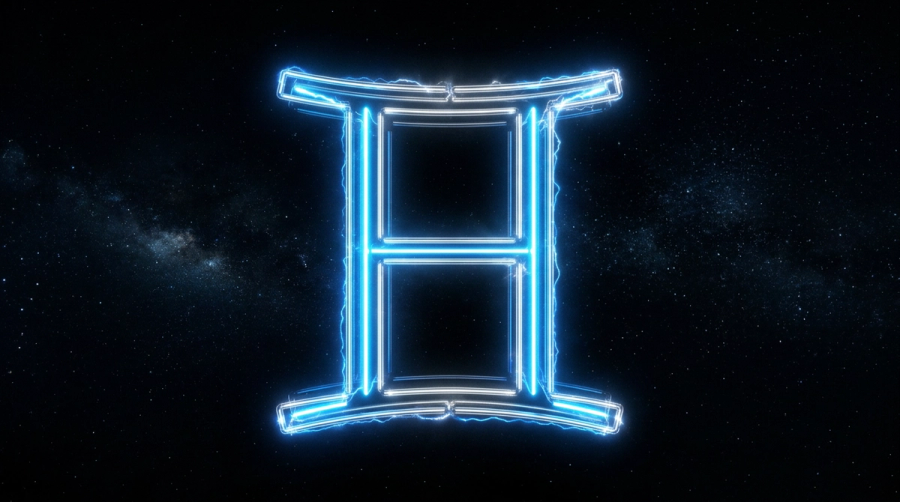
Gemini glyph — the II symbol representing the twins and duality at the heart of Gemini energy
What Your Gemini Placement Means in Your Birth Chart
Having Gemini in your chart doesn't produce one single personality type. It means Gemini energy is present, and which planet or point it governs determines everything about how that energy actually shows up in your life.
Gemini Sun is your core identity and the way you fundamentally understand yourself. Sun-in-Gemini people tend to experience themselves as thinkers, communicators, translators - people whose sense of self is grounded in mental engagement and social exchange. The internal story often centers on being interesting, informed, and able to connect with anyone. The challenge is the flip side of the sign's greatest gift: a mind that generates ideas faster than it completes them, and a self-narrative that can shift so quickly that others (and sometimes the person themselves) don't know which version is the real one. The answer is that both are.
Gemini Moon is your emotional architecture - what you need to feel safe and settled. Moon in Gemini people typically process emotions through language. They need to talk about what they feel before they can feel it clearly. Silence and emotional solitude are harder for this placement than for most. They also tend to intellectualize feelings rather than sit with them, which can look like detachment but is usually a form of self-protection: translating the feeling into words makes it manageable. They show love through communication - texts, conversations, information, jokes - and feel unloved when people go quiet.
Gemini Rising shapes your first impression and the surface self that others encounter first. Gemini Rising people come across as quick, curious, and socially fluent. They tend to put people at ease almost immediately - there's a lightness, a playfulness, an evident interest in whoever they're talking to. They may seem like they're always slightly in motion. First impressions lean toward witty and engaged, and the depth - the Castor-and-Pollux emotional loyalty, the genuine intellectual seriousness - reveals itself only over time.
Mercury's position is the story underneath all three. Since Mercury rules Gemini, its sign and house placement shape the entire picture. A Gemini Sun with Mercury in Cancer brings emotional intuition and memory to the analytical drive. A Gemini Sun with Mercury in Taurus slows the processing and grounds it, sometimes to the point of stubbornness. And a Gemini Sun with Mercury in Gemini itself - especially conjunct the Sun - is the configuration most likely to embody the full Dioscuri energy: brilliant, fast, perpetually in motion, and genuinely extraordinary in conversation.
For a complete picture of how Gemini energy plays out in love, relationships, and personality, see the detailed profiles of the Gemini man and the Gemini woman. To understand how your rising sign shapes the surface self that others encounter first, this guide to finding your Rising sign walks through the calculation step by step.
MyNitya supports both Western astrology - the system explored throughout this article - and Vedic (Jyotish) astrology. Western astrology excels at psychological depth and personality insight: exactly the lens this article applies to the Gemini symbol and mythology. Vedic astrology adds a different layer - precise life timing through its dasha system, karmic patterns through the lunar mansions (nakshatras), and a sidereal zodiac that stays anchored to the actual star positions. The Gemini constellation stars Castor and Pollux, for instance, sit in Cancer in the tropical zodiac due to precession - Vedic sidereal charts place them differently, closer to their physical position. Both systems are available through Nitya. Get personalized guidance based on your birth chart on MyNitya.
FAQ
What is the Gemini symbol and what does it mean?
The Gemini symbol is ♊ - a glyph resembling the Roman numeral II, showing two vertical pillars connected by curved horizontal bars at the top and bottom. It represents the mythological twins Castor and Pollux, and encodes the sign's core meaning: two distinct forces in permanent dialogue. The symbol of a Gemini is also depicted as two human figures holding hands, the only twin representation in the Western zodiac.
What is the Gemini glyph and how do you interpret it?
The Gemini glyph ♊ is most commonly read as the Roman numeral for two - a direct reference to the twins. The two vertical lines represent Castor and Pollux as individuals; the curved strokes connecting them represent the bond that joins them. Some interpretations read the shape as a doorway or portal, with the twins standing on either side of a threshold between the mortal world and the divine - capturing the sign's native comfort with moving between different registers of experience.
Who are Castor and Pollux in Gemini mythology?
Castor and Pollux are the Dioscuri - the divine twins of Greek mythology and the figures behind the Gemini constellation. Castor was mortal, fathered by the Spartan king Tyndareus; Pollux was immortal, son of Zeus. When Castor was killed, Pollux refused to accept eternal life without his brother and asked Zeus to share his immortality. The compromise - alternating between Olympus and the underworld, forever - became the mythological core of Gemini symbolism: two natures, permanently bound, in constant alternation.
What does Gemini symbolism mean in astrology?
Gemini symbolism in Western astrology centers on duality, communication, and the movement of ideas. As a mutable air sign ruled by Mercury, Gemini is the zodiac's communicator and translator - the energy that moves between worlds, registers, and perspectives. The Gemini zodiac meaning isn't inconsistency, as the sign's detractors suggest, but range: the genuine capacity to hold two truths simultaneously and to bridge the gap between them. The twin mythology encodes this perfectly.
What are Castor and Pollux as stars, and where are they in the tropical zodiac?
Castor (Alpha Geminorum) has an apparent magnitude of about 1.58 and is physically a sextuple star system - six stars in three binary pairs, orbiting a common gravitational center at roughly 51 light-years from Earth. Pollux (Beta Geminorum), despite being labeled "Beta," is actually the brighter twin at magnitude 1.14. Both sit in Cancer in the tropical zodiac due to the precession of the equinoxes: Castor at approximately 20°14' Cancer, Pollux at approximately 23°13' Cancer. A natal planet conjunct either star carries the traditional fixed-star influence associated with the Dioscuri.
The Gemini symbol compresses 3,000 years of twin mythology into a single glyph - two pillars, one bond, permanent alternation. Understanding the constellation, the myth, and the astrological mechanics together gives you a far clearer picture of why Gemini operates the way it does. But the mythology describes the archetype. Your Mercury's sign and house, your 3rd house placements, your chart's specific configurations - those details tell your particular version of the twin story. Ask your first question free on MyNitya.
Nitya isn't a one-time horoscope. She's with you for the whole journey.
Understand yourself
Career, love, money, timing - any decision you are weighing. Answers read straight from your birth chart.
Understand any relationship
Add your partner, a parent, a friend, even a colleague. Nitya reads both charts together to explain the bond, the friction, and how to work through it.
Guidance for every day
Start each morning knowing what the day favors, what to watch for, and the best moments to act.
No card needed. Nitya just needs your birth details to read your chart.