Virgo Constellation: Mythology, Stars & What It Reveals About Virgo
In this Article
The Virgo constellation is one of the largest and most storied groupings of stars in the night sky - a zodiac figure that has been mapped, mythologized, and interpreted for over 4,000 years. It depicts a maiden holding a sheaf of grain, and its brightest star, Spica, marks exactly what she carries in her left hand. In Western astrology, the Sun passes through the Virgo region of the sky from roughly August 23 to September 22. The constellation's 4,000-year mythology isn't separate from the zodiac sign - it's the foundation of everything astrologers mean when they call someone a Virgo. Ask your first question free on MyNitya.
Key Takeaways: The Virgo constellation spans roughly 1,294 square degrees - the second-largest constellation in the sky. Spica (Alpha Virginis) is the 15th brightest star visible from Earth and sits at 23°50' Libra in the tropical zodiac due to precession. Virgo is associated with goddess figures including Demeter, Persephone, and Astraea across multiple ancient cultures. In Western astrology, Virgo is a mutable earth sign ruled by Mercury. Your Virgo placement - Sun, Moon, or Rising - expresses this mythology in a distinct way that only your full birth chart can reveal.
Your personal astrologer - Vedic + Western.
Reads all 10,000+ points of your birth chart to answer your question. First question free, no card needed.
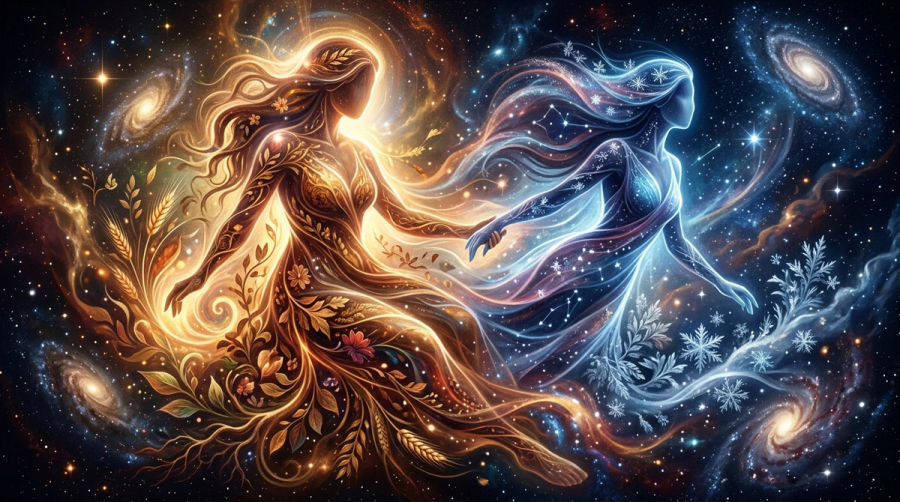
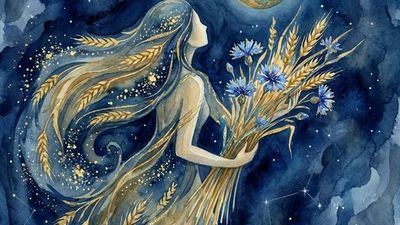
Virgo mythology — the Demeter-Persephone cycle of harvest and return represented in cosmic imagery
What Is the Virgo Constellation? (Facts and Location)
The Virgo constellation is the second-largest constellation in the entire sky, spanning approximately 1,294 square degrees. It occupies the third quadrant of the southern hemisphere but is visible at latitudes between +80° and −80°, making it accessible to observers across most of the world. Its brightest star, Spica, is your entry point for finding it.
The classic way to locate Virgo follows a mnemonic that observers have used for centuries: "follow the arc to Arcturus, and speed on to Spica." Start from the curved handle of the Big Dipper, arc outward to the bright orange star Arcturus in Boötes, then continue in the same direction until you hit Spica - the blue-white beacon that anchors the entire maiden figure. As EarthSky's constellation guide explains, this two-step navigation method works reliably even for first-time observers.
Virgo hosts the Virgo Galaxy Cluster, one of the most significant gravitational structures visible from Earth - containing over 1,300 galaxies, including the massive elliptical M87, which made history when astronomers captured the first-ever image of a black hole at its center. The Sombrero Galaxy (M104) also sits within Virgo's bounds, recognizable by its prominent dust lane across a bright nucleus.
The constellation is best observed in the Northern Hemisphere from April through June, when it rides high in the spring sky. Its neighboring constellations include Leo to the west, Libra to the east, Corvus to the south, and Boötes to the north.
Key Facts at a Glance
- Size: 1,294 square degrees - 2nd largest constellation in the sky
- Brightest star: Spica (Alpha Virginis), apparent magnitude 1.04
- Notable deep-sky objects: Virgo Cluster, M87, M49, M104 (Sombrero Galaxy)
- Best viewing months: April through June
- Neighboring constellations: Leo, Libra, Corvus, Hydra, Boötes
- Constellation type: Zodiac - the Sun passes through it roughly August 23 to September 22
The Mythology Behind Virgo: Demeter, Persephone, and the Harvest
Virgo's mythology reaches back to ancient Mesopotamia, with its roots documented as far as the third millennium BC. Across Babylonian, Greek, Roman, and Syrian traditions, something consistent appears: a maiden figure associated with grain, harvest, and the cycle of seasons.
The Babylonians documented Virgo in their Mul.Apin astronomical tablets around 1000 BC, calling the constellation "The Furrow" in honor of Shala, their goddess of grain. In ancient Syria, a figure named Atargatis - a corn goddess - occupied the same region of sky. The theme was already ancient before the Greeks inherited it.
In the Greek tradition, Virgo carries two primary mythological identities. The more agriculturally resonant is the Demeter-Persephone cycle. Demeter, goddess of grain and harvest, is the divine force that makes the earth fertile. When her daughter Persephone is taken to the underworld by Hades, Demeter's grief halts all growth - no crops rise, no fields bloom. When Persephone returns (for the warm months), Demeter's joy restores the earth's fertility. The constellation's behavior maps onto this story with precision: Virgo rises in spring as growth begins, reaches its highest point at the summer harvest, and disappears from the evening sky in autumn as the season ends. The maiden's descent is winter.
The second Greek identification connects Virgo to Astraea, the goddess of justice - the last divine being to abandon Earth as humanity descended into moral chaos. She rose to the heavens and became the constellation Virgo. This interpretation explains the astronomical neighborhood: as Constellation Guide documents, Virgo sits directly beside Libra - the scales of justice - in the zodiac. In older traditions, Astraea held the scales herself before they became a separate constellation.
What unifies every version of this myth, across thousands of years of separate cultural development, is the same core symbol: a maiden who carries grain, who tends abundance with precision, and who embodies the careful work that turns nature's raw growth into something useful. The harvest doesn't just happen. Someone has to do the sorting, the gathering, the separating of wheat from chaff.
Spica: The Brightest Star in Virgo
Spica is the 15th brightest star visible from Earth and the luminous anchor of the Virgo constellation. Its name comes directly from the Latin for "ear of grain" - the literal thing the maiden holds in her hand.
Physically, Spica is a blue-white binary star system. Its two components orbit each other at a distance of roughly 11 million miles - so close that their mutual gravity distorts both into ellipsoidal shapes rather than spheres. The primary star is approximately 10 times the mass of the Sun and around 12,000 times more luminous. The orbital period is only about 4 days. Because the two stars can't be separated visually even through a telescope, Spica is classified as a spectroscopic binary - its dual nature revealed only through Doppler shifts in its light spectrum.
Historically, Spica occupies a remarkable place in the story of astronomy itself. Around 127 BC, the Greek astronomer Hipparchus compared his observations of Spica's position against records made roughly 150 years earlier by Timocharis. The discrepancy he found led him to the discovery of the precession of the equinoxes - the slow wobble of Earth's rotational axis that causes the equinoxes to drift backward through the star field at roughly 1° every 72 years. It's one of the greatest observational discoveries in ancient astronomy, and Spica made it possible.
Because of that same precession, Spica no longer occupies the tropical zodiac sign of Virgo. In modern Western astrology, Spica sits at 23°50' Libra in the tropical zodiac. Tropical astrology anchors signs to the seasons (the Sun enters Aries at the spring equinox), not to the physical constellation positions - and two millennia of precession has shifted the constellations roughly 24° from their seasonal anchor points.
Bernadette Brady, in her foundational work Brady's Book of Fixed Stars, classifies Spica as one of the most benefic stars in the entire catalogue. She describes its influence as associated with brilliance, gifts of a spiritual or creative nature, and the rare combination of genuine talent and the discipline to actually develop it. In traditional fixed star practice, a natal planet or angle at 23°-24° Libra carries Spica's influence. Ptolemy, in his Almagest star catalogue, classified Spica as essentially Venusian and Martian in nature - beauty and precision combined.
How the Constellation's Mythology Shaped the Virgo Personality
The 4,000-year story of Virgo as a maiden of harvest, grain, and justice doesn't just make for interesting astronomy history. It maps with unusual precision onto how the Virgo zodiac sign actually operates in a natal chart.
The harvest theme explains Virgo's most defining characteristic: the drive to make things useful. A harvest isn't growth for its own sake - it's growth processed, organized, and distributed. The grain gets gathered, sorted, separated from chaff, stored correctly. Raw material becomes food. This is precisely how Virgo minds work: information, projects, systems, and relationship problems all pass through a Virgo's discriminating intelligence and emerge refined, organized, and functional. They can't leave the crop unattended.
Meet Nitya, your AI astrologer
She reads your birth chart to answer anything about your life - and she can go deep on any relationship you care about and guide your day ahead. First question free, no card needed.
Some questions our users ask Nitya
Tap any one below - or just write your own question in the form ↓
The Astraea identification adds the justice and integrity layer. Virgo is a sign with a strong internal moral compass - not because it enjoys being critical, but because the maiden of justice has a very clear sense of what "right" actually looks like. The eye for discrepancy that makes Virgo a brilliant editor, analyst, or diagnostician is the same quality that makes them quietly uncompromising about certain things.
The Persephone descent adds something subtler: the understanding that transformation requires something to be lost. Virgo carries a quiet awareness that things need to end before they can renew - which contributes both to their productive realism and to their well-documented tendency toward worry when dissolution feels out of control.
Virgo Sun with Mercury in Virgo in its home sign produces a mind of extraordinary analytical precision - the pattern-recognition runs so fast and deep that these individuals often know something is wrong before they can articulate exactly what. The harvest goddess analogy holds: they can scan a field and intuit which stalks aren't ready before performing any formal analysis.
Among Virgo Sun charts on MyNitya, individuals with Mercury in Virgo report the highest rates of self-critical inner dialogue - the sign's discriminating intelligence turned inward, often making their own standards the hardest to meet. This is the harvest maiden examining her own field with the same precision she'd apply to everything else, and finding it perpetually ready for improvement.
Virgo Symbol and Glyph: What the ♍ Means
The Virgo symbol ♍ is one of the more discussed glyphs in Western astrology, and its precise origin isn't fully settled. The most widely accepted reading interprets it as a stylized letter "M" with an inward-turned final stroke - a closed loop rather than an outward-pointing arrow.
That closing detail carries meaning. Where the Scorpio glyph (♏) ends with an arrow pointing outward, Virgo's curls back inward. This inward turn is typically read as representing the maiden's self-possession - she belongs to herself. The "virgin" quality in astrology has nothing to do with sexuality; it refers to autonomy, wholeness, and self-containment. A Virgo, in the archetypal sense, hasn't given herself away. She holds her own energy.
The symbol for Virgo zodiac also connects visually to the maiden figure with arms slightly lowered, the wheat sheaf held close to the body rather than extended outward. Some scholars connect the "M" shape to the Latin Mater (mother) or even to the name Maria in medieval astronomical manuscripts, though this interpretation is speculative.
As Space.com's guide to Virgo notes, the wheat sheaf is the most consistent symbol across all cultures that depicted this constellation - Babylonian, Greek, Roman, medieval European. Demeter holds grain. Spica means grain. The maiden is shown holding grain in stellar maps spanning 3,000 years of different traditions. The glyph, whatever its precise origin, compresses that ancient repeated image into a single mark.
The Wheat Sheaf as Core Symbol
The wheat sheaf isn't incidental to the Virgo symbol - it's the whole point. Grain represents the end product of careful labor: planting, tending, waiting, harvesting. It doesn't happen without attention, patience, and the willingness to do repetitive detailed work over a long season. Then it must be processed - threshed, winnowed, ground, stored - before it becomes food.
This is a precise symbolic description of how Virgo operates: the sign of labor that transforms raw material into something nourishing. Not glamorous labor. Not dramatic labor. Steady, skilled, attentive labor. And at its best, profoundly useful.
Virgo in Western Astrology: How the Constellation Became a Sign
The virgo constellation and the Virgo zodiac sign are related but not the same - and understanding the difference clarifies a lot of common confusion about how astrology works.
Western astrology uses the tropical zodiac, which anchors the 12 signs to the seasons rather than to the physical star groups. The Sun enters Aries at the spring equinox (around March 20-21), and each sign covers exactly 30° of arc, cycling through the year. In this system, the Sun passes through Virgo from roughly August 23 to September 22. The physical Virgo constellation no longer aligns with those calendar dates - it's drifted backward by roughly 24° due to the precession of the equinoxes over two millennia. The sign and the constellation share a name and a mythology, but they occupy different slices of sky.
The sign of Virgo was formalized in the Western astrological tradition primarily through Ptolemy's 2nd-century work. In his Almagest, Ptolemy catalogued the constellation's stars in detail. In his astrological text Tetrabiblos, he codified the sign's attributes drawing on Hellenistic and Babylonian sources: earth element, mutable modality, association with intelligence, analysis, and service. Mercury was assigned as Virgo's ruling planet - the same planet that rules Gemini, but operating at a very different register. Where Gemini's Mercury is quick, social, and generative, Virgo's Mercury is precise, systematic, and discriminating.
The mutable earth combination is worth sitting with. Earth grounds and materializes; mutable shifts and refines. Most earth signs hold firm (Taurus is fixed, Capricorn is cardinal). Virgo's mutable quality makes it the earth sign that edits - that keeps returning to the work to refine, adjust, and improve. This is the craftsperson who puts the piece down and comes back to it the next day with fresh eyes, not because the work isn't good enough, but because they can always see exactly where it could be better.
Virgo also governs the 6th house in the natural wheel - the house of daily routines, health, work habits, and service. This house placement locks in the mythology: the 6th house is where we show up every day and do the unglamorous but necessary work that keeps life functioning. The harvest maiden, tending her field through the long season.
What Being a Virgo Actually Means in Your Chart
Having Virgo in your chart doesn't automatically produce one type of person - it means Virgo energy is present, and which planet or point it governs determines everything about how it expresses.
The key is Mercury's position. Since Mercury rules Virgo, where Mercury sits in a Virgo person's chart shapes the entire picture. A Virgo Sun with Mercury in its home sign operates very differently from a Virgo Sun with Mercury in Libra (where it softens and socializes the analytical drive) or Mercury in Leo (where it broadens and dramatizes it). The ruling planet's condition is always the story behind the sign.
Virgo is also the sign of service in the most archetypal sense - not servility, but the genuine satisfaction of useful work done well. Many Virgo-dominant people find their deepest meaning through work that is concretely helpful: healing, teaching, craftsmanship, editing, research, caregiving. The mythology supports this completely. The harvest maiden's entire purpose is to tend the crop and ensure the food supply. Not to be admired. To make something nourishing available.
The anxiety pattern Virgo is known for also has clear mythological roots. Demeter in grief is the harvest stopped - the productive force frozen by loss. Virgo's tendency to worry, over-analyze, and loop through potential failures mirrors that image: a mind built for discernment and improvement, applied to what might go wrong rather than what's actually broken. The fix isn't to stop analyzing. It's to point the analytical faculty at real problems rather than imagined ones.
A Virgo Sun with Saturn in the 6th house often manifests as someone who takes health, daily habits, and work obligations with almost crushing seriousness - and who pushes toward exhaustion before asking for help. The same maiden who tends the harvest can forget to stop and eat. Your Mercury placement, Saturn position, and 6th house ruler tell you far more than the Sun sign alone. Explore your full birth chart on MyNitya to see where Virgo's energy actually concentrates in your life.
Chat with Nitya about your Virgo placements - try free.
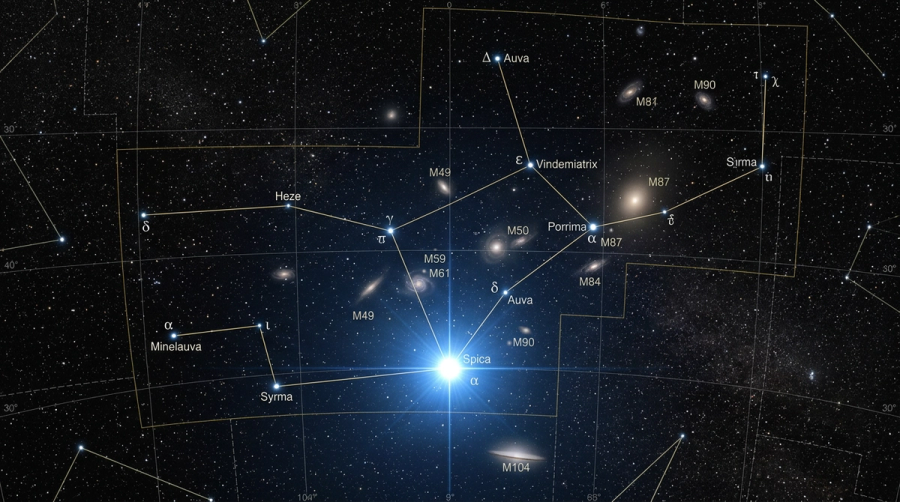
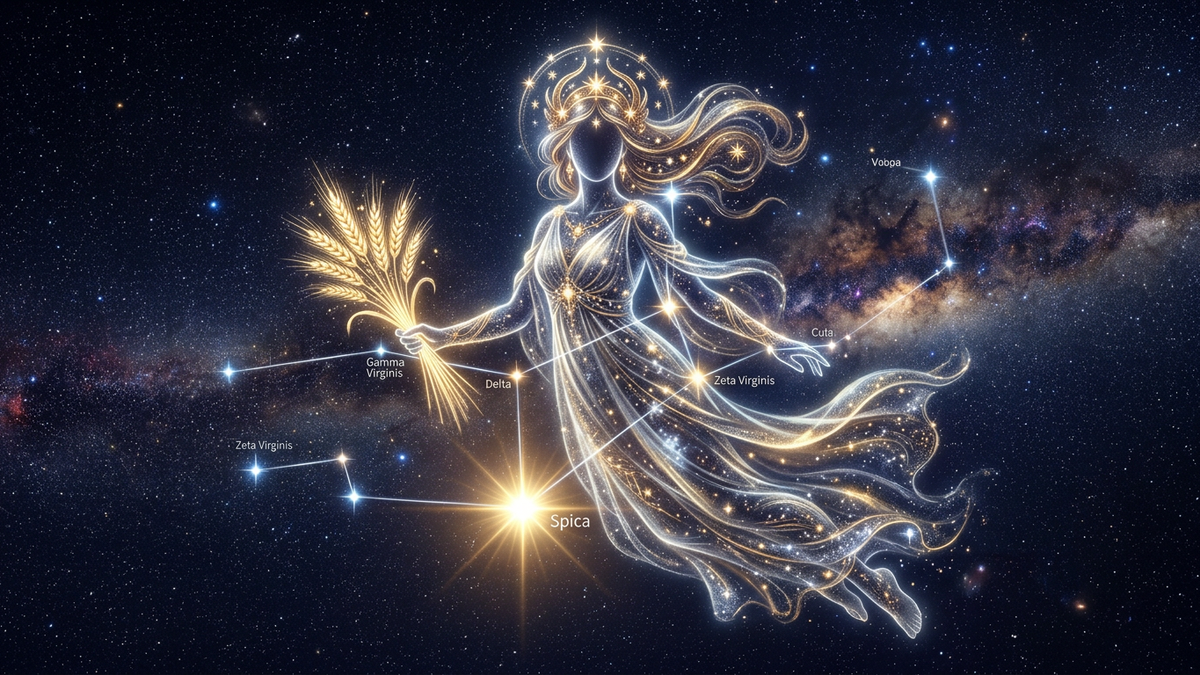
Spica star in Virgo constellation — the brightest star marking the goddess's wheat sheaf in the night sky
The Difference Between Virgo Sun, Moon, and Rising
The same Virgo constellation energy feels entirely different depending on which placement it governs in your natal chart. Knowing which one applies to you changes the interpretation considerably.
Virgo Sun is your core identity and the way you fundamentally experience yourself. Sun-in-Virgo people tend to see themselves as workers, editors, analysts, healers - people whose sense of self is grounded in being useful and doing things well. The internal story often centers on becoming worthy through competence and contribution. The challenge: tying self-worth entirely to productivity leaves nothing to fall back on when the work isn't going well. The harvest maiden doesn't stop being who she is when the season ends.
Virgo Moon is your emotional architecture - what you need to feel safe, settled, and at home. Moon in Virgo people typically need order and clear structures to regulate emotionally. Chaos, mess, or open-ended uncertainty tends to produce real anxiety rather than adaptability. They show love through doing - fixing, organizing, preparing - rather than through words or emotional demonstration. When someone with Moon in Virgo cleans your kitchen after you've had a hard week, that's not just helpfulness. That's intimacy. Emotional overwhelm often gets processed by finding something to organize or improve.
Virgo Rising shapes your first impression and the surface self that others meet before they know you. Virgo Rising people often come across as put-together, careful, and precise. They tend to dress with more intention than flamboyance. They speak with specificity. First impressions lean toward the reserved: not cold, but measured - the sense that they're paying close attention and won't be easily fooled. Over time, as people get past the careful exterior, the warmth and genuine concern for others becomes clear.
Understanding all three layers - and how they interact - gives you a far more accurate picture of how Virgo actually shows up in your life. A Virgo Sun with a Sagittarius Moon operates very differently from a Virgo Sun with a Scorpio Moon, even though both are technically "Virgos." The Sun sign is the starting point, not the whole story.
For a complete guide to how your Virgo energy operates in love, career, and relationships, see the detailed profiles of the Virgo man and the Virgo woman. And to understand how your Rising sign shapes first impressions across all placements, this guide to finding your Rising sign walks you through the calculation.
MyNitya supports both Western astrology - the system explored throughout this article - and Vedic (Jyotish) astrology. Western astrology excels at psychological depth and personality insight: exactly the kind of analysis this article covers. Vedic astrology adds something different - precise life timing through its dasha system, karmic patterns through the lunar mansions (nakshatras), and a sidereal zodiac that stays anchored to the actual star positions. If you want to understand what's happening now in your life, Vedic timing tools are among the most precise available. Both systems are available through Nitya. Get personalized guidance based on your birth chart on MyNitya.
FAQ
What is the Virgo constellation?
The Virgo constellation is the second-largest constellation in the night sky, spanning about 1,294 square degrees. It depicts a maiden holding an ear of grain and is best visible from April through June. Virgo contains the bright star Spica, the Virgo Galaxy Cluster, and the famous M87 galaxy. It's been documented in astronomical records for over 4,000 years across Babylonian, Greek, Roman, and other ancient cultures - always connected to harvest, grain, and a maiden figure.
What mythology is associated with Virgo?
Virgo's primary mythological association is with the Demeter-Persephone cycle: Demeter (goddess of grain) mourns Persephone's descent to the underworld, causing winter, and celebrates her return each spring. The constellation's appearance and disappearance from the sky mirrors this cycle precisely. A second tradition identifies Virgo with Astraea, the goddess of justice - the last divine being to leave Earth - which explains why Virgo sits adjacent to Libra (the scales of justice) in the zodiac.
What does the Spica star represent in astrology?
Spica is Alpha Virginis - the brightest star in the Virgo constellation, currently positioned at 23°50' Libra in the tropical zodiac due to the precession of the equinoxes. In traditional fixed star astrology, Bernadette Brady in Brady's Book of Fixed Stars describes Spica as one of the most benefic stars in the sky - associated with brilliance, creative or spiritual gifts, and rare talent paired with genuine discipline. Ptolemy classified its nature as Venusian and Martian: beauty and precision. A natal planet conjunct Spica within 1° is considered fortunate.
What is the difference between the Virgo constellation and the Virgo zodiac sign?
The Virgo constellation is the physical grouping of stars in that region of sky, observable with a telescope. The Virgo zodiac sign is a 30° arc of the Western tropical zodiac, anchored to the seasons, running from approximately August 23 to September 22. Due to the precession of the equinoxes - the slow wobble in Earth's axis first measured by Hipparchus using Spica around 127 BC - the physical constellation and the zodiac sign no longer align. They share a name, a mythology, and symbolic meaning, but occupy different parts of the actual sky.
What does the Virgo symbol ♍ mean?
The Virgo glyph ♍ is most commonly interpreted as a stylized "M" with an inward-curling final stroke, representing the maiden's self-containment and autonomy. In astrology, the "virgin" quality doesn't refer to sexuality - it refers to wholeness and self-possession: belonging fully to oneself. The closed loop distinguishes Virgo's glyph from Scorpio's similar form (which ends in an outward arrow), and points to Virgo's tendency to hold, refine, and internalize rather than project outward. The wheat sheaf that Virgo carries across thousands of years of astronomical imagery is the glyph's deepest reference.
Your Virgo placement is one piece of a larger chart. The constellation's 4,000-year mythology describes the archetype - the harvest maiden who refines, discerns, and serves with precision - but your Mercury's sign and house, your 6th house placements, your Saturn position: those details tell your specific story. Ask your first question free on MyNitya.
Nitya isn't a one-time horoscope. She's with you for the whole journey.
Understand yourself
Career, love, money, timing - any decision you are weighing. Answers read straight from your birth chart.
Understand any relationship
Add your partner, a parent, a friend, even a colleague. Nitya reads both charts together to explain the bond, the friction, and how to work through it.
Guidance for every day
Start each morning knowing what the day favors, what to watch for, and the best moments to act.
No card needed. Nitya just needs your birth details to read your chart.