Twin Flame Calculator: Can Astrology Reveal Your Twin Flame?
In this Article
Twin Flame Calculator
Check astrological twin flame indicators between two charts
A twin flame calculator uses your birth chart data - date, time, and place of birth - to identify astrological indicators of a deep soul-level connection with another person. Twin flame astrology looks for specific patterns in synastry (chart comparison) like North Node conjunctions, Pluto aspects to personal planets, and mirrored placements across the 7th, 8th, and 12th houses. These patterns suggest two people share an intense, transformative bond that goes beyond ordinary compatibility.
Maybe you met someone and the recognition was instant. Not attraction - recognition. Like you'd known them before you ever spoke. Or maybe the connection was so intense it scared you, and one of you ran. That push-pull, that feeling of looking into a mirror that shows you everything you've been avoiding - that's what people mean when they say twin flame.
Your personal astrologer - Vedic + Western.
Reads all 10,000+ points of your birth chart to answer your question. First question free, no card needed.
Ask your question free →Key Takeaways: Twin flame astrology identifies soul-level connections through birth chart analysis, synastry, and composite charts. Key indicators include North Node conjunctions with personal planets, Pluto or Neptune aspects to Sun/Moon/Venus, Vertex contacts, 12th house overlays, and mirrored or opposite sign placements. A twin flame connection differs from a soulmate bond - soulmates bring comfort, twin flames bring transformation. Your exact birth time matters because house placements and degree-level aspects determine whether a connection is truly twin flame or simply intense chemistry.
What Is a Twin Flame in Astrology?
A twin flame in astrology is a soul-level connection identified through specific birth chart patterns that suggest two people mirror each other's deepest wounds, gifts, and spiritual purpose. It's not a traditional astrological concept - it's a modern framework mapped onto classical chart techniques.
The idea comes from the belief that a single soul splits into two bodies before incarnation, and those two halves spend lifetimes finding their way back to each other. Whether you take that literally or metaphorically, the astrological signatures are real and measurable. When two charts show the specific patterns astrologers associate with twin flames - heavy nodal contacts, Pluto intensity, 12th house overlays - the relationship dynamic that follows is unmistakable.
In Vedic astrology (Jyotish), the twin flame concept doesn't exist in classical texts like the Brihat Parashara Hora Shastra or Jaimini Sutras. But the underlying mechanics translate. Vedic astrologers look at the Rahu-Ketu axis (lunar nodes) for karmic soul connections, the 7th house and its lord for partnership destiny, and the Navamsa chart (D9) for the deeper truth of relationships. The patterns that Western astrologers call "twin flame indicators" map closely to what Vedic astrologers call intense Rahu-Ketu karmic bonds.
What makes a twin flame different from a regular intense relationship? The mirroring. Your twin flame doesn't just complement you - they reflect you. Your strengths, your shadows, your unhealed wounds. That's why these connections feel simultaneously like coming home and being set on fire.
How Does a Twin Flame Calculator Work?
A twin flame calculator analyzes the synastry between two birth charts, looking for a cluster of specific astrological patterns that together suggest a twin flame bond. No single aspect makes a twin flame - it's the accumulation of multiple indicators.
Most twin flame calculators online use simplified methods - comparing sun signs, life path numbers, or basic zodiac compatibility. These are entertaining but astrologically shallow. A real twin flame analysis requires complete birth charts for both people, including exact birth times, because the house placements and degree-level aspects are what separate a genuine twin flame signature from ordinary attraction.
Here's what a thorough twin flame analysis examines:
- Synastry aspects between personal planets (Sun, Moon, Venus, Mars) and outer planets (Pluto, Neptune, Uranus)
- Nodal contacts - conjunctions or oppositions between one person's planets and the other's North or South Node
- House overlays - where your planets fall in your partner's houses, especially the 7th, 8th, and 12th
- Composite chart - the blended chart of the relationship itself, revealing its purpose and challenges
- Vertex and Chiron contacts - fated meeting points and shared wound-healing patterns
On MyNitya, your Vedic birth chart is calculated using NASA-grade planetary positions with over 6,000 data points. Nitya can analyze your chart's relationship indicators - including your 7th house lord, Venus placement, Rahu-Ketu axis, and Navamsa patterns - to help you understand the nature of your deepest connections.
Twin Flame Indicators in a Birth Chart
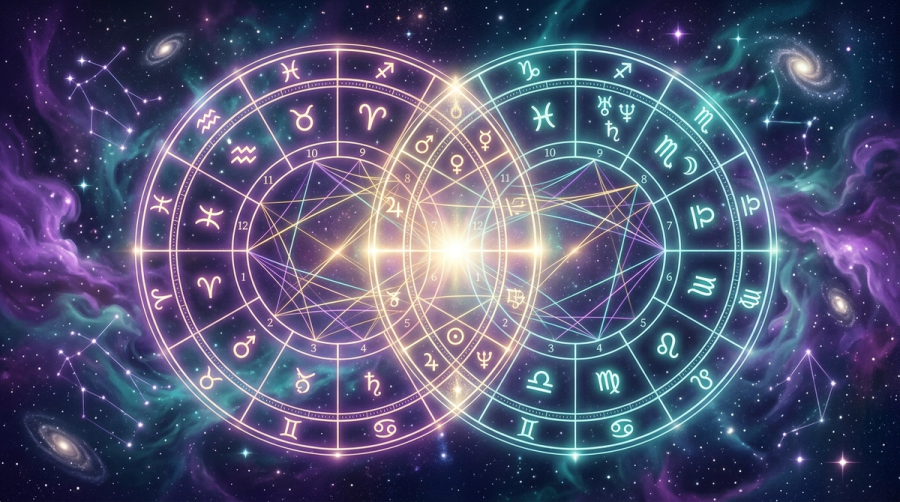
Two overlapping synastry birth charts with glowing planetary connections in cosmic space
Twin flame indicators in a birth chart are specific synastry patterns that, taken together, suggest a deep soul-level bond between two people. Astrologers look for a cluster of these - not just one or two isolated aspects.
North Node Conjunctions
The North Node (Rahu in Vedic astrology) represents your soul's direction - where you're headed in this lifetime. When one person's Sun, Moon, or Venus conjuncts the other's North Node within a tight orb (0-5 degrees), it creates a feeling of destiny. You feel pulled toward this person as if they're part of your life's purpose.
South Node (Ketu) conjunctions work differently. They create instant familiarity - the "I've known you forever" feeling - but can also pull you backward into old patterns. Twin flame connections often show both North and South Node contacts, creating that signature tension between comfort and growth.
Pluto Aspects to Personal Planets
Pluto is the planet of transformation, death, and rebirth. When one person's Pluto makes hard aspects (conjunction, square, opposition) to the other's Sun, Moon, Venus, or Mars, the connection is volcanic. You can't be casual with each other. Every interaction strips away pretense and forces raw honesty.
As Cosmopolitan's twin flame astrology guide notes, Pluto and Neptune aspects to personal planets are among the most consistent markers astrologers find in confirmed twin flame synastry charts. These aren't gentle aspects - they're the ones that crack you open.
12th House Overlays
The 12th house is the house of the unconscious, past lives, and spiritual dissolution. When your partner's planets fall in your 12th house (or vice versa), the connection operates on a level that's hard to articulate. You sense each other's moods without speaking. Dreams about each other are common. The bond feels transcendent - and sometimes overwhelming.
In Vedic astrology, the 12th house (Vyaya Bhava) represents loss, liberation, and the unseen world. Heavy 12th house contacts in synastry suggest a connection that transcends the material plane - exactly what twin flame seekers describe.
Vertex and Chiron Contacts
The Vertex is a calculated point in the chart associated with fated encounters - moments that feel destined rather than chosen. When one person's Vertex conjuncts the other's personal planets or angles, the meeting itself often has an uncanny, "meant to be" quality.
Chiron contacts are equally significant. Chiron represents your deepest wound and your capacity to heal others. When Chiron aspects are strong in synastry, both people trigger each other's core wounds - not to cause pain, but to bring those wounds into consciousness where they can finally heal. This is the "mirror" quality that defines twin flame dynamics.
Sun-Moon Contacts
Sun conjunct Moon (or Moon conjunct Sun) between two charts is one of the oldest compatibility indicators in astrology. In twin flame synastry, you'll often see the Sun of one person conjunct or opposing the Moon of the other. This creates a yin-yang dynamic - one person embodies the conscious identity the other needs to integrate, and vice versa.
Among charts analyzed on MyNitya, users who describe their most transformative relationships consistently show tight Sun-Moon contacts combined with at least one outer planet (Pluto, Neptune, or Uranus) aspect to a personal planet.
Twin Flame Zodiac Sign Pairs
Twin flame zodiac sign pairs are often opposite signs on the zodiac wheel, creating a polarity that mirrors and completes each other. While sun sign alone can't confirm a twin flame connection, these pairings show up frequently in twin flame synastry.
The Six Twin Flame Polarities
- Aries and Libra - The self vs. the partnership. Aries teaches Libra to fight for themselves; Libra teaches Aries that strength includes compromise.
- Taurus and Scorpio - Surface stability vs. hidden depths. Taurus grounds Scorpio's intensity; Scorpio forces Taurus to confront what's buried beneath comfort.
- Gemini and Sagittarius - Local knowledge vs. universal truth. Gemini brings curiosity; Sagittarius brings meaning. Together they cover every question worth asking.
- Cancer and Capricorn - Emotional security vs. worldly achievement. Cancer softens Capricorn's armor; Capricorn gives Cancer's feelings a structure to live in.
- Leo and Aquarius - Personal expression vs. collective vision. Leo demands to be seen as an individual; Aquarius demands that individuality serve something larger.
- Virgo and Pisces - Practical service vs. spiritual surrender. Virgo organizes what Pisces dreams; Pisces reminds Virgo that not everything needs fixing.
These polarities work because twin flames aren't about finding someone identical to you. They're about finding someone who holds the qualities you've suppressed or haven't yet developed. The opposite sign carries your shadow - and your potential.
That said, twin flames don't have to be opposite signs. Same-sign twin flames exist too, and they create a different dynamic - an amplification effect where both people's strengths and weaknesses are magnified. If you want to understand how your specific zodiac compatibility works at a deeper level, your full birth chart tells a much richer story than sun signs alone.
Twin Flame vs Soulmate: What's the Difference?
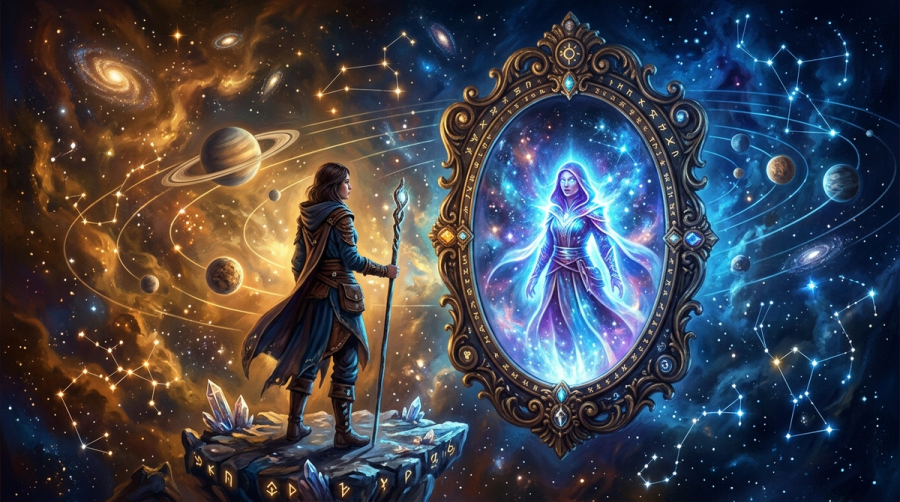
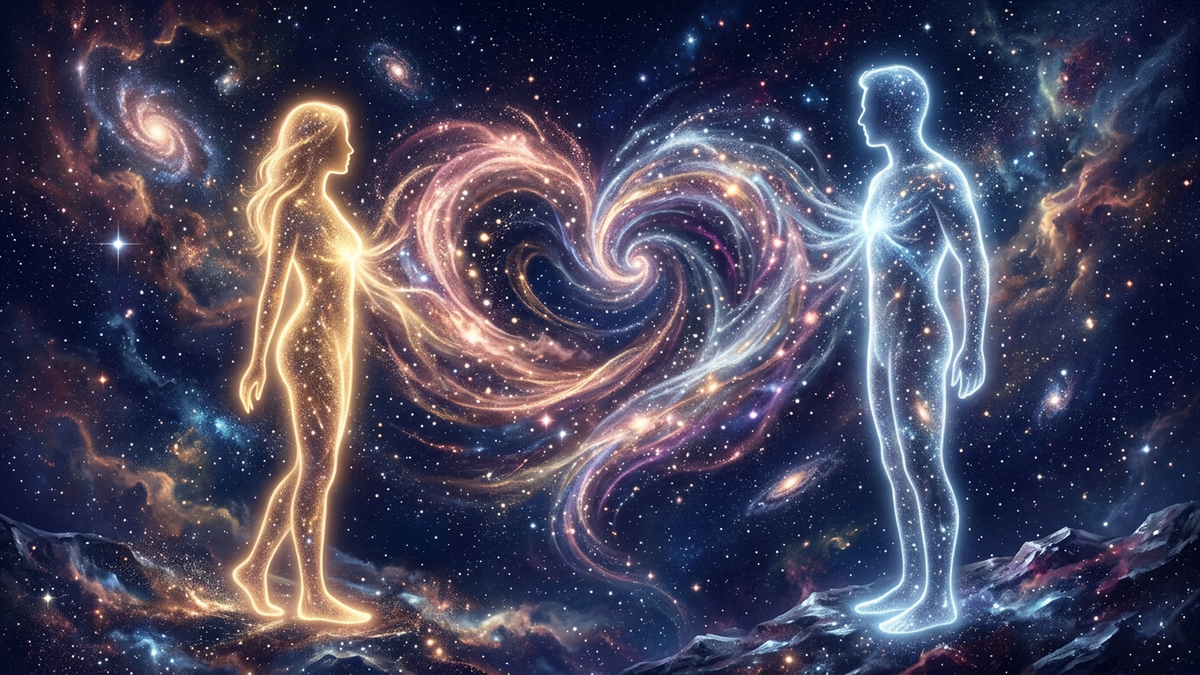
Cosmic mirror scene showing a figure and their twin flame reflection with zodiac constellations
Twin flame and soulmate connections both show up in birth chart synastry, but they serve fundamentally different purposes and create very different relationship experiences. Understanding the distinction matters because confusing the two leads to staying in painful dynamics that aren't serving you.
Soulmate Connections
Soulmates bring comfort, growth, and mutual support. In synastry, soulmate connections typically show:
- Strong Venus and Jupiter aspects - ease, affection, generosity
- Moon conjunct Moon or Moon trine Moon - emotional attunement
- Harmonious 7th house contacts - natural partnership energy
- Saturn trines or sextiles - stability and long-term commitment
In Vedic astrology, soulmate indicators include a strong 7th house lord in the Navamsa chart, benefic planets (Venus, Jupiter) aspecting the 7th house, and compatible Moon nakshatras. The Brihat Parashara Hora Shastra emphasizes the 7th house lord's dignity as the primary indicator of spousal harmony.
Soulmates feel like home. The relationship has challenges, but the foundation is stable. You can build a life together without constantly feeling like the ground is shifting.
Meet Nitya, your AI astrologer
She reads your birth chart to answer anything about your life. Your first complete answer is free, with no card required. Continued chat, Synastry, and Daily Guidance require Premium.
Questions you can ask about this topic
Tap any one below - or just write your own question in the form ↓
Twin Flame Connections
Twin flames bring transformation through intensity. In synastry, twin flame connections typically show:
- Heavy Pluto and Neptune aspects to personal planets - obsession, dissolution of boundaries
- North/South Node conjunctions - karmic destiny, past-life recognition
- 12th house overlays - psychic connection, unconscious bonding
- Chiron contacts - mutual wound activation and healing
- Saturn squares or oppositions - tests, restrictions, forced growth
Twin flames feel like a earthquake. The connection is undeniable, but it's not always comfortable. The "runner-chaser" dynamic - where one person pulls away because the intensity is too much - is a hallmark of twin flame relationships, not soulmate ones.
Can Someone Be Both?
Rarely. The energetic signatures are different. A soulmate relationship can deepen over time into something profoundly transformative, and a twin flame connection can eventually stabilize into something sustainable. But the initial chart signatures tend to be distinct.
The real question isn't "is this person my twin flame or my soulmate?" It's "what is this connection teaching me, and am I growing from it?" Your synastry birth chart reveals the specific dynamics at play - whether the connection is meant to comfort you, challenge you, or both.
The Vedic Astrology Perspective on Twin Flames
Vedic astrology doesn't use the term "twin flame," but its framework for analyzing soul-level connections is arguably more precise than Western approaches. The Rahu-Ketu axis, Navamsa chart, and nakshatra compatibility system offer layers of insight that sun-sign-based twin flame calculators can't touch.
Rahu-Ketu Axis: The Karmic Soul Connection
Rahu (North Node) and Ketu (South Node) represent the soul's karmic trajectory - where you're coming from and where you're headed. When one person's Rahu conjuncts the other's personal planets, the pull is magnetic and feels fated. Ketu conjunctions bring instant recognition but also a sense of something unfinished from a past life.
In twin flame dynamics, you'll often see Rahu-Ketu contacts going both ways - each person's nodes touching the other's chart. This creates a karmic loop where both people are simultaneously teacher and student, healer and wounded.
Navamsa Chart (D9): The Truth of Relationships
The Navamsa chart is the divisional chart Vedic astrologers use specifically for relationships and marriage. While the birth chart (Rasi) shows your life's surface, the Navamsa reveals the deeper truth - especially about partnerships.
A strong Navamsa connection between two people - matching Venus signs, compatible 7th house lords, or the same ascendant - suggests a bond that operates on a soul level, not just a personality level. This is where Vedic astrology gets more specific than Western twin flame analysis.
Nakshatra Compatibility
The 27 nakshatras (lunar mansions) add a precision layer that Western astrology lacks. Two people might both have Moon in Scorpio, but if one has Moon in Anuradha nakshatra and the other in Jyeshtha, their emotional dynamics will differ significantly.
Certain nakshatra pairings are considered deeply karmic - Ashlesha and Magha, for instance, sit at the gandanta (karmic knot) point between Cancer and Leo, and connections between people with planets at these points often carry the intensity associated with twin flames.
Chat with Nitya about your birth chart to understand your relationship patterns, karmic connections, and what your Navamsa reveals about your deepest bonds - try free on MyNitya.
How to Use Astrology to Find Your Twin Flame
Using astrology to find your twin flame starts with understanding your own chart first. You can't recognize your mirror if you don't know what you look like.
Step 1: Know Your Own Chart
Before analyzing compatibility with anyone, understand your own relationship signatures:
- Your 7th house - the sign on the cusp and any planets inside it describe what you attract in partnerships
- Your Venus placement - sign, house, and aspects reveal how you love and what you need
- Your Moon placement - your emotional nature and what makes you feel safe
- Your Rahu-Ketu axis - your karmic direction and what past-life patterns you're working through
- Your Navamsa ascendant and Venus - the deeper truth of your relationship destiny
If you're not sure where to start, our guide on how to read your birth chart breaks down each component step by step.
Step 2: Look for the Cluster
Don't fixate on a single aspect. Twin flame connections show a cluster of indicators - typically 4 or more of the following in synastry:
- North or South Node conjunct a personal planet (within 5 degrees)
- Pluto conjunct, square, or opposing Sun, Moon, Venus, or Mars
- Planets falling in each other's 12th house
- Vertex conjunct a personal planet or angle
- Chiron conjunct or opposing a personal planet
- Sun-Moon conjunction or opposition between charts
- Matching or opposite rising signs
- Neptune aspects to personal planets (especially Moon)
Three or fewer of these? You might have a strong soulmate connection or intense chemistry, but probably not a twin flame signature. Five or more? The connection is likely operating on a level that goes beyond ordinary compatibility.
Step 3: Check the Composite Chart
The composite chart (the midpoint chart of two people) reveals the relationship's own identity - its purpose, challenges, and trajectory. Twin flame composite charts often show:
- Sun or Moon in angular houses (1st, 4th, 7th, 10th)
- Pluto conjunct an angle or personal planet
- Stelliums (3+ planets) in water signs or houses
- Strong 8th or 12th house emphasis
According to AstroBhava's twin flame astrology analysis, checking house overlays in the 7th, 8th, and 12th houses alongside Node and Vertex connections provides the most reliable twin flame identification in synastry.
Twin Flame Stages and Astrology Timing
Twin flame connections unfold in recognizable stages, and planetary transits often trigger each phase. Understanding the timing helps you stop fighting the process and start working with it.
Stage 1: Recognition (Triggered by Nodal Transits)
The initial meeting or recognition often coincides with a North Node transit to your natal Venus, 7th house cusp, or descendant. You feel an instant, inexplicable pull. The connection doesn't make logical sense - it just is.
In Vedic astrology, Rahu transits to the 7th house or over natal Venus frequently coincide with meeting someone who feels fated. The intensity of Rahu's desire energy creates that "I need to know this person" compulsion.
Stage 2: The Honeymoon (Venus and Jupiter Transits)
The early phase of a twin flame connection often feels euphoric. Venus or Jupiter transiting your 5th or 7th house amplifies romance, attraction, and the feeling that you've found "the one." Everything clicks. The mirroring feels magical rather than threatening.
Stage 3: The Crisis (Saturn and Pluto Transits)
This is where twin flame connections diverge from soulmate ones. Saturn transiting your 7th house or squaring natal Venus brings the relationship's structural weaknesses to the surface. Pluto transits trigger power struggles, jealousy, and the exposure of everything both people have been hiding.
The "runner-chaser" dynamic typically activates during this phase. One person (usually the one experiencing heavier Saturn or Pluto transits) pulls away because the intensity threatens their sense of control. The other pursues, which only increases the pressure.
Stage 4: Separation and Growth (Saturn Return or Nodal Return)
Many twin flame connections include a period of separation. This isn't failure - it's necessary. Both people need to do individual work before the connection can function at its highest level. Saturn returns (around ages 27-30) and nodal returns (around ages 18-19 and 37-38) are common timing triggers for twin flame separations and reunions.
Stage 5: Reunion and Integration
Reunion happens when both people have done enough individual growth that the mirroring no longer triggers crisis - it triggers expansion. Jupiter transiting the 7th house or North Node transiting over natal Venus often coincides with this phase.
Not every twin flame connection reaches reunion in this lifetime. And that's okay. The purpose of the connection is growth, not necessarily a permanent partnership.
Warning Signs: When "Twin Flame" Is Actually Toxic
Not every intense connection is a twin flame. Some relationships are simply unhealthy, and the twin flame label can become a justification for staying in dynamics that are causing real harm.
Red Flags to Watch For
- Using "twin flame" to excuse abuse - Intensity is not the same as toxicity. If someone is manipulating, gaslighting, or physically harming you, that's not a spiritual connection. That's abuse.
- Chronic runner-chaser with no growth - The separation phase should produce individual growth. If you've been in the same push-pull cycle for years with no evolution on either side, the connection may be karmic rather than twin flame.
- Obsession disguised as destiny - Feeling unable to function without someone isn't spiritual connection. It's codependency. Twin flames enhance your life - they don't replace your ability to live it.
- Ignoring other relationships - If the twin flame pursuit is destroying your friendships, family bonds, or mental health, step back. No single relationship is worth your entire wellbeing.
The healthiest approach to twin flame astrology is curiosity without attachment. Your birth chart can reveal the nature of your connections, but it can't tell you what to do with that information. That part is up to you.
Frequently Asked Questions
How do I calculate my twin flame connection?
Calculate your twin flame connection by generating complete birth charts for both people (requiring exact birth date, time, and location) and running a synastry analysis. Look for a cluster of indicators: North Node conjunctions with personal planets, Pluto aspects to Sun/Moon/Venus, 12th house overlays, Vertex contacts, and Sun-Moon connections. A single aspect doesn't confirm a twin flame - you need 4 or more indicators.
What zodiac signs are twin flames?
Twin flame zodiac sign pairs are often opposite signs: Aries-Libra, Taurus-Scorpio, Gemini-Sagittarius, Cancer-Capricorn, Leo-Aquarius, and Virgo-Pisces. These polarities create the mirroring dynamic central to twin flame connections. But sun sign alone can't confirm a twin flame bond - the full birth chart, including Moon, Venus, Nodes, and house placements, determines the true nature of the connection.
What is the difference between a twin flame and a soulmate?
A soulmate brings comfort, stability, and mutual growth - shown in synastry through Venus-Jupiter aspects, harmonious Moon contacts, and supportive Saturn aspects. A twin flame brings transformation through intensity - shown through Pluto aspects to personal planets, North/South Node conjunctions, 12th house overlays, and Chiron contacts. Soulmates feel like home; twin flames feel like an earthquake that rebuilds you.
Can astrology really identify a twin flame?
Astrology can identify the specific synastry patterns associated with twin flame dynamics - nodal contacts, Pluto intensity, 12th house connections, and mirrored placements. Whether these patterns prove the existence of twin flames as a spiritual concept is a matter of belief. What's measurable is that charts showing these patterns consistently correlate with relationships that are unusually intense, transformative, and psychologically significant.
Do twin flames have the same birth chart?
Twin flames don't have identical birth charts, but they often show striking similarities or mirror patterns. Common features include matching Moon signs, opposite Sun signs, the same rising sign, or planets in the same degrees across different signs. The charts complement and reflect each other rather than duplicate. Identical charts would suggest identical people - twin flames are mirrors, not copies.
What does the 12th house mean in twin flame astrology?
The 12th house in twin flame astrology represents the unconscious, past lives, and transcendent connection. When your partner's planets fall in your 12th house, the bond operates below conscious awareness - you sense each other's emotions, share vivid dreams, and feel connected even at a distance. Heavy 12th house overlays in synastry are one of the strongest twin flame indicators, suggesting a connection that transcends ordinary physical reality.
Nitya isn't a one-time horoscope. She's with you for the whole journey.
Understand yourself
Career, love, money, timing - any decision you are weighing. Answers read straight from your birth chart.
Understand any relationship
Add your partner, a parent, a friend, even a colleague. Nitya reads both charts together to explain the bond, the friction, and how to work through it.
Guidance for every day
Start each morning knowing what the day favors, what to watch for, and the best moments to act.
No card needed. Nitya just needs your birth details to read your chart.
Ask Nitya your first question - free →