Compatibility Horoscope: What Birth Charts Really Reveal About Love
In this Article
A compatibility horoscope compares two complete birth charts - not just your sun signs - to map exactly how two people's planetary energies interact. It examines ten planets, twelve houses, and dozens of aspects across both charts to reveal chemistry, emotional rhythm, long-term staying power, and the fault lines where friction will always live. And it does this with a level of specificity that no sun-sign quiz can come close to matching. Ask your first question free on MyNitya.
If you've ever had a relationship that looked perfect on paper but felt all wrong in practice - or one that made no sense to anyone else but felt completely real to you - your birth chart comparison probably explains why. The sun sign is one piece. The full chart tells the actual story.
Your personal astrologer - Vedic + Western.
Reads all 10,000+ points of your birth chart to answer your question. First question free, no card needed.
Key Takeaways: A compatibility horoscope reads two full natal charts across 8 dimensions - Sun-Moon contacts, Venus-Mars chemistry, Saturn staying power, Moon emotional rhythm, house overlays, and the composite chart. The strongest indicator of lasting partnership is at least one Sun-Moon contact AND one Saturn contact. Sun signs alone predict none of this accurately. Your birth time, date, and place are all required for a full reading.
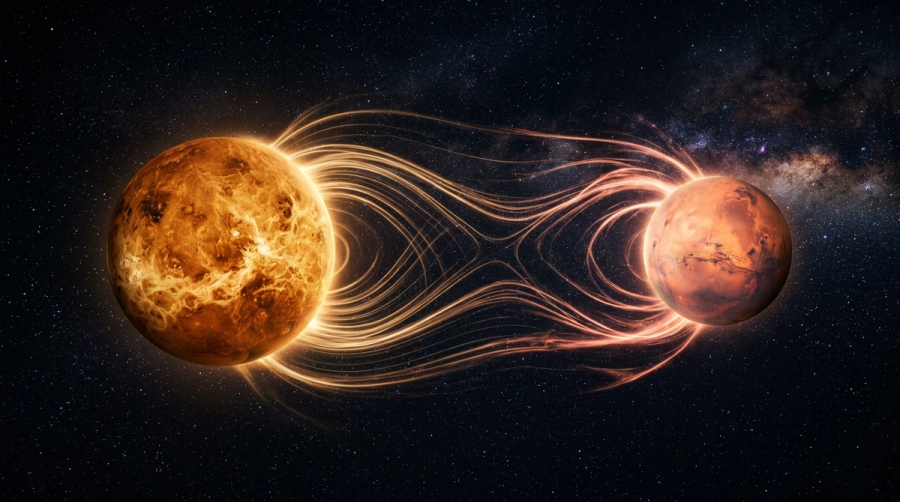
Venus and Mars planetary aspects in compatibility horoscope — the chemistry signature in synastry
What Is a Compatibility Horoscope? (Beyond the Sun Sign Quiz)
A compatibility horoscope - also called a synastry reading - is a comparison of two full natal charts that shows how each person's planets interact with the other's. It's not a match percentage. It's a map of a relationship's actual terrain: where it flows, where it sparks, where it strains, and what holds it together over years.
The sun sign compatibility you find in magazines ("Are Aries and Scorpio compatible?") looks at one planet out of ten and applies it to every person born in a six-week window. That's not astrology. It's pattern recognition with the resolution turned all the way down.
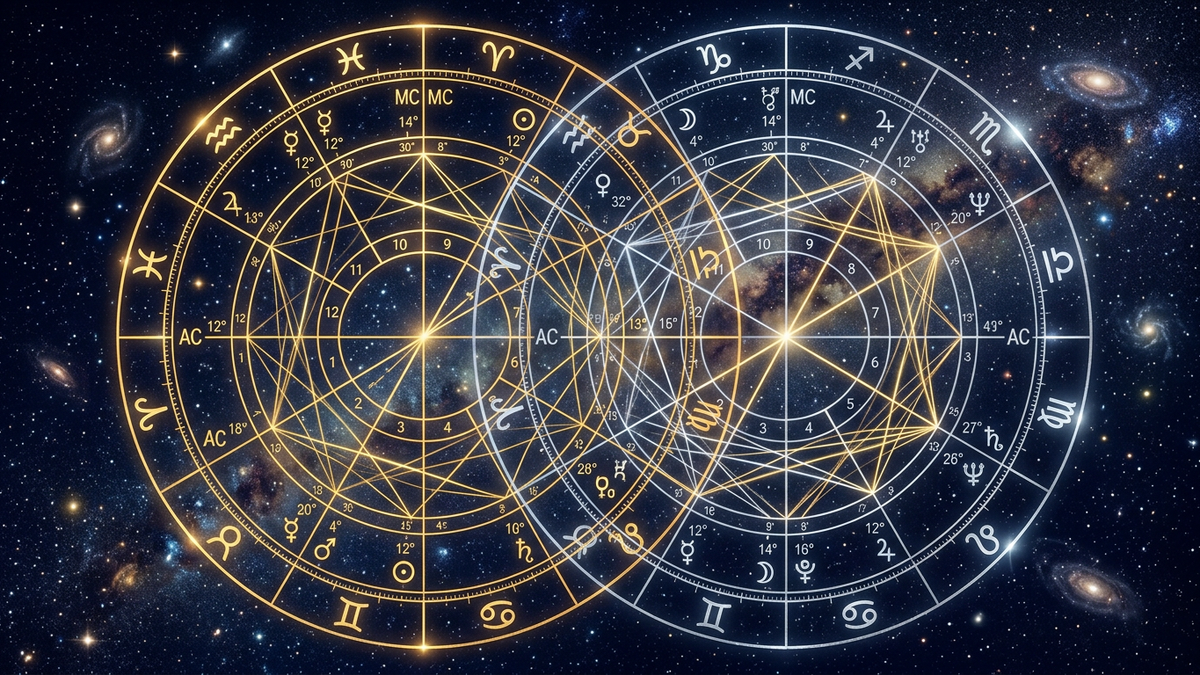
A real synastry chart relationship reading places both charts together and examines where your planets fall in each other's charts, what aspects they form across the two charts, and what those contacts activate in each person. Two people might have "bad" sun sign compatibility and yet have their Sun conjunct the other's Moon - one of the strongest indicators of deep compatibility in all of Western astrology.
That difference matters. Especially if you've ever written off a connection because someone told you two Leos can't work together. Or stayed too long in something because Libra-Gemini is "supposed to be" perfect.
According to SynastryChart.org, synastry examines the complete interaction of planetary energies - angles, houses, and aspects - to build a full picture of how two people function together. That full picture is what a compatibility horoscope actually delivers.
What makes it genuinely powerful isn't the complexity. It's the precision. The compatibility test beyond sun signs always comes down to specific planetary contacts. Those contacts are either there or they're not. And when they're there, you feel them - you just haven't always known what to call them.
The 8 Things a Real Compatibility Horoscope Checks
A real compatibility horoscope examines 8 core dimensions of a relationship, each revealing a different layer of how two people connect, conflict, and stay together over time.
Here's what gets analyzed:
- Sun-Moon contacts - core identity meets emotional need; the recognition signature
- Venus-Mars aspects - physical and romantic chemistry; the spark and the pull
- Saturn contacts - commitment, structure, and long-term staying power
- Moon-Moon compatibility - shared emotional language and daily rhythm
- Mercury aspects - how easily you think and communicate together
- House overlays - which areas of each other's life you naturally activate
- Composite chart - the relationship's own birth chart and purpose
- Outer planet contacts - Pluto, Neptune, and Uranus adding intensity, idealization, or disruption
No single factor makes or breaks compatibility. A chart with no Saturn contacts might burn bright and fade within two years. One with only Saturn and no Venus-Mars chemistry can feel stable but emotionally cold. What matters is the complete pattern across all eight dimensions.
Orbs matter enormously in synastry - and this is where most casual compatibility readings go wrong. A tight orb of under 3° is considered highly significant. A standard orb of 5-7° applies for major aspects like conjunctions, trines, squares, and oppositions. Anything beyond 8° starts to lose precision in synastry, though contacts involving the Sun, Moon, or Ascendant can carry a slightly wider allowance up to 10°. The closer the orb, the more defining the contact is in the relationship's actual experience.
The synastry guide at ZodiacRoots covers the general framework well. But the emotional depth of what these contacts actually feel like in practice - especially the harder aspects - goes much further than most introductory treatments.
Sun-Moon Contacts: The Marriage Signature
Sun conjunct Moon in synastry within 3° is the strongest single compatibility indicator in the entire technique - one person's core identity directly illuminates the other's emotional nature, creating a profound sense of being seen and nurtured at the same time.
This is sometimes called the "marriage signature" in classical synastry analysis. When Person A's Sun lands on Person B's Moon (or vice versa), there's something almost effortless about the core resonance. The Sun person feels deeply recognized by the Moon person. The Moon person feels brought to life by the Sun person's presence. Neither has to explain themselves the way they do with most people. It's a quality of basic comfort that shows up in the first conversation and doesn't erode over decades.
It doesn't have to be a conjunction to be significant. A Sun-Moon trine (within 6°) creates ease and natural flow - you support each other without effort or negotiation. A Sun-Moon square produces tension that can be generative or exhausting depending on the maturity of both people. An opposition is often the most electrically charged: the Sun illuminates exactly what the Moon person needs, even as it challenges them.
What's easy to miss: this contact works regardless of gender or orientation. It's not about one person being "the Sun type" and the other "the Moon type" in any traditional sense. It's about specific planetary frequencies creating resonance. And when it's present, most people feel it right away - they just don't have a name for it.
Robert Hand's foundational work Planets in Composite identifies Sun-Moon contacts across two charts as among the most lasting connective tissue in long-term relationships. His argument is that these contacts create a quality of basic comfort - of genuine recognition - that chemistry alone can't replicate and that time doesn't wear down the way early attraction does.
Venus-Mars: The Chemistry Test
Venus-Mars contacts in synastry are the classic chemistry signature - they describe the spark, the pull, and the specific texture of romantic and physical attraction between two people.
Venus represents how you love: your aesthetic, what you find beautiful, and how you give and receive affection. Mars represents how you desire: your drive, your pursuit energy, and your sexual nature. When one person's Venus aspects the other's Mars, there's a quality of "I see exactly what I want, and it wants me back." It's reciprocal and directional at once.
The aspects each carry their own character:
- Conjunction (under 3°): Intense, immediate, consuming. This is the "can't stop thinking about you" contact. The chemistry is real but it needs emotional grounding to not burn through itself fast.
- Trine (within 6°): Smooth and sustained. The attraction is real but not destabilizing. This is the contact that makes chemistry feel comfortable rather than chaotic - and it tends to age well.
- Sextile (within 5°): Flirtatious and gradually deepening. Often the contact that makes a friendship shift into something more, once both people allow it.
- Square (within 5°): High tension, hot chemistry, and a push-pull dynamic that can be incredibly compelling or exhausting depending on how each person handles frustration and desire.
- Opposition (within 7°): Polarizing attraction - you're different in exactly the ways that make each other magnetic. Deeply complementary when both people are secure; destabilizing when they're not.
As LookUpTheStars covers in their synastry aspects guide, Venus-Mars contacts consistently rank among the top chemistry indicators in any chart comparison.
Here's what often gets missed: Venus-Mars contacts tell you about initial chemistry and sustained desire. They don't tell you about emotional safety or whether the relationship has structural staying power. Two people can have a Venus-Mars conjunction within 1° - undeniable, all-consuming chemistry - and nothing else in the chart to support long-term partnership. That's where Saturn does its work.
Meet Nitya, your AI astrologer
She reads your birth chart to answer anything about your life - and she can go deep on any relationship you care about and guide your day ahead. First question free, no card needed.
Some questions our users ask Nitya
Tap any one below - or just write your own question in the form ↓
Saturn Contacts: Does It Last?
Saturn contacts in synastry describe the commitment factor - the weight, the seriousness, and the long-term staying power that determines whether a relationship outlasts its initial chemistry and becomes something durable.
Saturn isn't glamorous. In a culture that romanticizes sparks and butterflies, Saturn-heavy synastry doesn't get the attention it deserves. But ask anyone in a genuine 20-year partnership what kept them together through the hard years, and you'll usually find a Saturn contact somewhere in the comparison chart.
When Person A's Saturn touches Person B's Sun, Moon, Venus, or Mars, it introduces a quality of weight and definition. The Saturn person often stabilizes, grounds, or - in harder contacts - tests the other. The planet person feels either supported by that structure or constrained by it, depending on the aspect and both people's maturity.
The contacts break down like this:
- Saturn conjunct Sun: The Saturn person gives the Sun person definition and discipline. This can feel profoundly enabling or quietly constraining. Long-lasting when both people genuinely respect the structure between them.
- Saturn trine Venus: One of the most reliable indicators of enduring commitment. The ease of the trine means the structure feels supportive rather than limiting - it holds the relationship without rigidity.
- Saturn square Moon: Emotionally demanding. The Moon person may feel unseen or criticized. Requires real self-awareness from both people. Often present in relationships where both grow significantly through the friction.
- Saturn opposite Mars: Creates power dynamics and friction. The Saturn person can feel like an immovable wall; the Mars person can feel suppressed. When both are mature, it channels enormous shared ambition. When they're not, it becomes a control dynamic.
Saturn contacts also carry karmic weight. Many people in long-term partnerships - including painful ones - have Saturn contacts that explain why leaving feels structurally impossible, not just emotionally hard. There's a bond that goes beyond preference.
Among compatibility readings on MyNitya, the charts that consistently produce lasting partnerships have at least one Sun-Moon contact AND at least one Saturn contact - chemistry without structure, or structure without chemistry, both show clearly in the data. One burns fast; the other holds form but generates no warmth. The partnerships that last tend to have both.
Moon-Moon: Emotional Rhythm
Moon-Moon contacts reveal whether two people's emotional natures are naturally in sync - whether you feel safe, at home, and genuinely understood at the level of feeling rather than logic.
The Moon governs daily emotional needs, instinctive reactions, and the texture of inner life. When two Moons are in harmony, there's an unspoken recognition that's hard to articulate but impossible to miss: "You feel the way I feel." That's not a small thing. It's the difference between a relationship where emotional repair happens organically and one where every conflict leaves both people feeling chronically misunderstood.
Moon trine Moon (within 6°) is one of the most quietly powerful contacts in synastry. You don't feel like you have to explain your moods or justify your need for space. The rhythm of daily life together - how you both handle stress, what you need when you're low, how much alone time feels right - tends to align without effort.
Moon conjunct Moon can be intensely resonant or overwhelming, depending on the signs involved. Two people with Moon in Scorpio will understand each other's depth with no translation needed - but they'll also amplify each other's emotional intensity in ways that need conscious management.
Moon square Moon is common and workable, but it requires active emotional intelligence rather than assumption. The default reactions don't match. You process stress differently. What soothes one person can inadvertently trigger the other. When both people are self-aware, this contact drives genuine emotional growth. When they're not, it reads as a persistent gap in understanding.
The moon sign compatibility and emotional connection guide goes deep on how Moon placements shape emotional needs - and why two people can share strong Venus-Mars chemistry but constantly struggle to feel emotionally at home with each other if their Moons are at odds.
House Overlays: What You Activate in Each Other
House overlays show which area of each person's life the other person's energy naturally lands in - and what that activates in them on a structural level.
When your partner's Sun falls in your 7th house, it directly activates your partnership zone. You experience them as quintessentially what a partner should be. Their presence makes your 7th house - commitment, one-on-one relationship, the quality of a true equal - come alive in a way nothing else does. This is why some people feel immediately "partner-brained" around a particular person before they can rationally explain it.
Some of the most significant overlays:
- Personal planet in the 1st house: You see them as deeply connected to your own identity. Inspiring or destabilizing depending on how secure you are in yourself.
- Personal planet in the 4th house: Deep belonging. Their presence activates your need for home, roots, and emotional safety. Often present in long-term domestic partnerships.
- Personal planet in the 5th house: Romance, play, and creative activation. Everything feels exciting and alive when they're around. Strong early-stage chemistry.
- Personal planet in the 7th house: Classic partnership activation. They feel like what a partner is supposed to feel like - almost immediately.
- Personal planet in the 8th house: Intensity, transformation, and deep merging. These relationships tend to be all-or-nothing: profoundly connecting or consuming.
- Personal planet in the 12th house: Hidden, spiritual, or unconscious activation. These connections often feel fated and are hard to explain to anyone outside them. They can be deeply nourishing or deeply disorienting.
Understanding 7th house astrology and what it means for relationships is worth doing in depth - because it's the house whose activations most reliably explain why someone feels like a natural partner to you, even before you know them well enough to rationally justify that feeling.
The Composite Chart: Your Relationship's Own Identity
The composite chart is a third chart created from the midpoints of both people's planets - it's not either person's chart, but the birth chart of the relationship itself as a separate entity.
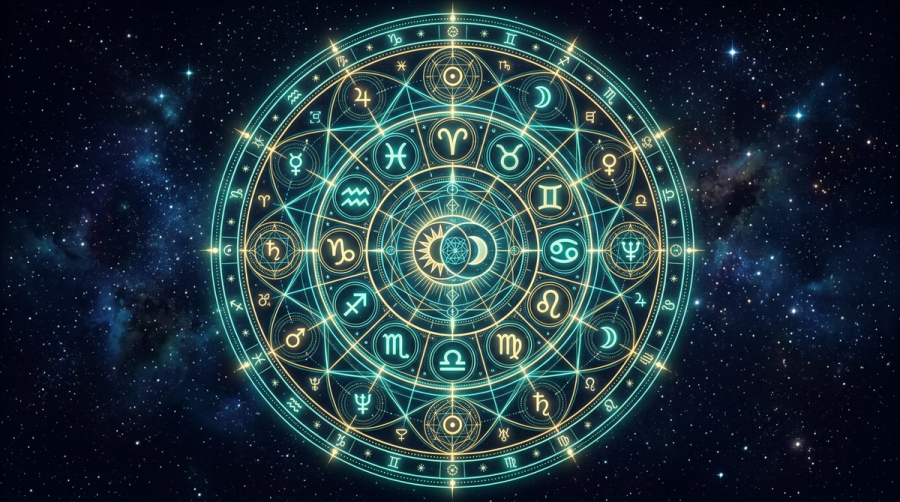
Composite chart in compatibility horoscope — the relationship as its own entity
This is one of the most practically useful tools in a compatibility horoscope because it answers a different question than synastry does. Synastry asks: "How do these two people affect each other?" The composite asks: "What kind of entity is this relationship? What is it here to do? What does it want from both of us?"
Robert Hand's Planets in Composite is the definitive text on this technique. His core insight is that the composite chart reveals the relationship's purpose and character independent of either individual - it has its own Sun (the relationship's identity and direction), its own Moon (its emotional baseline), its own Saturn (its structural tests), and so on. Those placements describe the relationship's native qualities, not just the interaction of two people's personalities.
Practically, this matters a great deal. A composite Sun in the 12th house produces a relationship with a private, hidden, or spiritually oriented quality - it may thrive in intimate settings and struggle with public definition or external validation. A composite Sun in the 7th house describes a relationship fundamentally oriented toward partnership - it will push both people toward commitment and formal recognition of what they are to each other.
A composite chart calculator and full reading gives you this layer alongside the synastry, and the combination of both is how experienced astrologers assess compatibility most accurately.
Composite Saturn's house placement is particularly telling. Saturn in the composite 4th house creates a relationship that builds slowly toward a shared home or foundation - the structure is real but takes patience. Saturn in the composite 8th describes a relationship that tests both people's capacity for deep trust and vulnerability around shared resources, finances, or intimacy. Neither placement is a warning. Both are specific. And specificity is what makes a compatibility reading genuinely useful rather than generically reassuring.
How to Read Your Compatibility Horoscope (Practical Steps)
Reading a compatibility horoscope involves four concrete steps: generating both charts accurately, running the synastry comparison, identifying the major contacts, and reading the composite chart alongside it.
Step 1: Get accurate birth data for both people.
Date, exact time, and place of birth for both partners. The birth time matters enormously - it determines the Ascendant, all house cusps, and the Moon's precise position. The Moon moves about 12° per day, so even an approximate birth time can shift its house placement significantly. If you don't know an exact time, use what you have and treat house-based interpretations as directional rather than definitive.
Step 2: Generate the synastry chart.
This overlays both charts and shows all inter-chart aspects. What to look for first: any Sun-Moon contacts, Venus-Mars aspects, and Saturn contacts to personal planets (Sun, Moon, Venus, Mars, Ascendant). These are your highest-signal indicators. Everything else adds texture and nuance.
Step 3: Check the orbs carefully.
The closer the orb, the stronger the contact. For synastry, tight means under 3°. Standard means 5-7° for major aspects. An aspect within 1° operates at full intensity and is almost always felt as a defining feature of the relationship by both people, whether or not they can name it. An aspect at 8° is present but subtle - worth noting, not the lead story.
Step 4: Read the composite chart separately.
After synastry, examine the composite as its own complete chart. The composite Sun's house and sign describe the relationship's core identity and direction. The composite Moon describes its emotional baseline and what both people need to feel nourished by it. Composite Saturn's house placement shows where the relationship's hardest work lives - and where its most durable structure will eventually form.
This is a lot to hold simultaneously, especially when you're looking at your own relationship and you're emotionally invested in the answer. That's exactly what a tool like MyNitya is built for. On MyNitya, you enter your birth details and chat with Nitya - an AI astrologer who deeply understands your Western natal chart. Nitya analyzes planetary positions, house placements, aspects, and transits to give you personalized guidance on relationships, timing, and life patterns. Chat with Nitya about your birth chart - try free.
MyNitya supports both Western astrology - the approach used throughout this article - and Vedic (Jyotish) astrology. Western excels at psychological depth, personality insight, and relationship dynamics. Vedic goes deeper on timing, karmic patterns, and life-purpose questions through its dasha system. Both are available through Nitya, and both illuminate different dimensions of the same relationship.
FAQ
What is a compatibility horoscope?
A compatibility horoscope is a side-by-side comparison of two complete natal birth charts, also called a synastry reading. It examines how each person's planets aspect the other's and where their planets fall in each other's houses. It reveals chemistry, emotional fit, long-term staying power, and areas of friction - far beyond what any sun sign comparison can show.
What's the most important indicator in a compatibility horoscope?
Sun-Moon contacts are generally considered the most significant single indicator in synastry. When one person's Sun conjuncts or trines the other's Moon within a 5° orb, there's a quality of deep recognition and emotional resonance that tends to sustain a relationship long after initial chemistry fades. Saturn contacts to personal planets come second - they describe whether the relationship has durable structure beneath the attraction.
What's the difference between synastry and a composite chart?
Synastry compares two individual natal charts to show how the two people interact - where their planets form aspects across the two charts. A composite chart creates a third, entirely new chart from the midpoints of both people's planets. It represents the relationship itself as its own entity with its own identity, emotional nature, and purpose. Synastry answers "how do you affect each other?" The composite answers "what is this relationship here to do?" Most complete compatibility readings use both.
Can a compatibility horoscope predict if a relationship will last?
Astrology describes tendencies, not certainties. A compatibility horoscope with strong Saturn contacts and a Sun-Moon connection tends to produce lasting relationships - but the people still have to choose it and work it. A chart with challenging aspects like Saturn square Moon or Mars opposite Mars doesn't doom a relationship; it describes where the real work lives. And charts with no Saturn contacts at all sometimes show relationships that feel wonderful for two years and then simply stop holding without either person understanding why.
What does a "good" compatibility horoscope look like?
There's no numeric compatibility score in serious synastry analysis. What you're looking for is a pattern: at least one Sun-Moon contact for core recognition, a Venus-Mars aspect for sustained attraction, and at least one Saturn contact somewhere for structural staying power. A chart with five easy trines but no Saturn may feel wonderful initially and then dissolve without explanation. A chart with hard squares and a tight Saturn trine can be the most enduring relationship both people ever have.
Do you need an exact birth time for a compatibility horoscope?
You need at least an approximate birth time for a fully accurate reading. Without a birth time, you lose the Ascendant, all house cusps, and the Moon's precise position - which together account for a significant portion of the house overlay analysis. That said, a partial synastry reading using Sun, Venus, Mars, and Saturn (without house overlays) still reveals the most important inter-chart contacts and gives you meaningful information about chemistry, emotional rhythm, and structural staying power.
A compatibility horoscope is ultimately about one thing: understanding the specific texture of a particular relationship's potential. Not "are we compatible in general?" - but "what is actually happening between these two charts, and what does it ask of each person to work?"
That's a question the birth chart answers better than any quiz or sun sign pairing ever could. The contacts are either there or they're not. The orbs are tight or they're wide. The composite chart tells its own story, separate from either person's individual nature. All of it is readable - and all of it is yours to understand.
Get personalized guidance based on your birth chart on MyNitya.
Nitya isn't a one-time horoscope. She's with you for the whole journey.
Understand yourself
Career, love, money, timing - any decision you are weighing. Answers read straight from your birth chart.
Understand any relationship
Add your partner, a parent, a friend, even a colleague. Nitya reads both charts together to explain the bond, the friction, and how to work through it.
Guidance for every day
Start each morning knowing what the day favors, what to watch for, and the best moments to act.
No card needed. Nitya just needs your birth details to read your chart.