Synastry Chart: What Your Relationship Chart Reveals
In this Article
Sun Sign Compatibility by Birth Date
A quick Sun-element comparison. This does not calculate the Moon, Venus, houses, or synastry aspects.
A synastry chart is the comparison of two birth charts placed on top of each other to reveal what actually happens between two people - the chemistry, the emotional fit, the friction points, the staying power, and the patterns each person activates in the other. It's the most precise tool astrology has for understanding a relationship, and it answers the questions that sun-sign matching can't: why this person, why this intensity, why this exact ache. Try MyNitya free.
If you're reading this because you're trying to understand a relationship that feels bigger than logic, or a connection that won't release you, or a person you keep choosing across different lifetimes of evidence - you're in the right place. Synastry isn't a verdict. It's a map. And what the map shows is rarely what people first hope it'll show. It's better than that, and harder, and more useful.
Your personal astrologer - Vedic + Western.
Reads all 10,000+ points of your birth chart to answer your question. First question free, no card needed.
Ask your question free →Key Takeaways: A synastry chart is the side-by-side comparison of two natal charts that reveals how two people actually affect each other. It shows chemistry through Venus-Mars contacts, emotional fit through Sun-Moon and Moon-Moon aspects, long-term sustainability through Saturn contacts, karmic pull through North Node and Vertex aspects, and which life areas each person activates through house overlays. Synastry tells you the potential, the texture, and the work. It doesn't tell you the outcome.
Two luminous figures separated by a starlit gap with golden and cyan threads of light reaching between them
What Is a Synastry Chart?
A synastry chart is a relationship astrology technique that overlays two people's birth charts to show the aspects between their planets and the houses each person's planets fall into in the other person's chart. It maps the dynamics, attractions, frictions, and themes that arise when these two specific psyches interact - not in the abstract, but as a precise pattern of energies you can read.
Technically, a synastry chart is built like this. You take Person A's full natal chart - every planet, the Ascendant, the Midheaven, the lunar nodes, sometimes Chiron and the asteroids - and you place Person B's natal chart in a second concentric ring around it. Then you measure the angles between every planet in chart A and every planet in chart B. Those angles are the synastry aspects. A trine, a square, a conjunction, an opposition - each one describes a live relationship between one part of Person A's psyche and one part of Person B's.
You also note where Person B's planets fall in the houses of Person A's chart. If Person B's Venus lands in Person A's 7th house, that says something specific. If it lands in the 8th, that says something different. The houses are the rooms of life. The overlay tells you which room each person is most vivid in for the other.
Emotionally, a synastry chart is the answer to the question what are we to each other, beneath the surface? It's not about whether the relationship will work. It's about what it actually is. The two charts in conversation reveal the real shape of the bond - the gravity that keeps pulling you back, the friction you can't argue away, the tenderness that surprises you, the wound that activates whenever you try to leave.
The Inner Wheel's introduction to synastry houses frames it in psychological language - synastry isn't a compatibility scorecard, it's "two psyches in interaction," each one bringing its own complexes, projections, and gifts to the meeting point. That framing matters. Because once you stop asking "is this person right for me" and start asking "what's actually happening between us, and what's it asking from us," synastry becomes useful in a way it never can while you're chasing a verdict.
Liz Greene, the Jungian astrologer who founded the Centre for Psychological Astrology in London with Howard Sasportas in 1983, has written extensively about synastry as the chart of mutual projection. Her book Relating: An Astrological Guide to Living with Others on a Small Planet is one of the foundational psychological synastry texts. In her framework, the aspects between two charts don't just show attraction - they show which parts of yourself you'll inevitably project onto your partner, which parts they'll project onto you, and where the real growth lives once those projections start coming home.
So when someone asks "what is a synastry chart" and you want a clean answer: a synastry chart is the precise astronomical-psychological map of how two people activate each other, what their connection makes possible, and what it requires from them.
How Synastry Differs from Composite, Compatibility Calculators, and Sun-Sign Matching
Synastry is one of several relationship-astrology tools, and confusing them is the single most common mistake readers make. Synastry shows the chemistry between you. A composite chart shows the relationship as a third entity. Compatibility calculators output a score. Sun-sign matching ignores most of the chart entirely. Each answers a different question.
Here's the cleanest distinction.
Synastry compares two natal charts directly. Aspect by aspect, planet by planet. It answers: how do we affect each other? It's about the live exchange of energy - what your Venus does to my Mars, what my Saturn does to your Sun. Synastry is dynamic. It describes the in-the-moment reality of being in this person's presence.
The composite chart is a single chart created from the mathematical midpoints between every pair of planets in two natal charts. The midpoint between your Sun and theirs becomes the composite Sun. Same for the Moon, Venus, Mars, and so on. The result is one chart that represents the relationship itself as a separate being. It answers: what is this connection becoming? What's its purpose, its tone, its life path? Read the deeper guide on composite charts and relationship astrology for the full distinction.
A useful way to hold the pair: synastry is the chemistry between you. The composite is the relationship's own birth chart. You need both to fully understand a partnership, and they often tell different stories. Strong synastry with weak composite means the chemistry is real but the relationship as an entity has no foundation. Strong composite with weak synastry means the relationship has purpose but the daily lived reality feels flat. Both matter. Neither alone is enough.
Compatibility calculators are the surface-level version of all this. They output a percentage, sometimes with a few sentences. They're often based on sun-sign matching with maybe Moon and Venus thrown in. They're not wrong, exactly - they're just incomplete. A 92% compatibility score says nothing about whether his Saturn squares your Venus, which would be the actual story of the relationship. Use them as a starting point, not an answer. Our astrology compatibility calculator using birth charts walks through what a real chart-based compatibility reading involves and what calculators leave out.
Sun-sign matching - the version where someone says "Cancer and Capricorn don't work" - uses 1/12th of one chart to predict everything about a relationship. It's the astrological equivalent of judging a book by the first letter of the title. The Sun is one placement of about ten that matter for love. The Moon, Venus, Mars, the 7th house ruler, the Ascendant, Saturn - all of these influence relationship dynamics, often more than the Sun does. Sun-sign compatibility is fun party material. It's not a tool for understanding actual partnerships. The deeper guide at natal chart love compatibility beyond sun signs covers what to look at instead.
A simple decision rule for which tool to use:
Question | Use
- *Why does this specific person affect me this way?*: Synastry
- *What is this relationship as its own thing?*: Composite
- *What kind of partner do I attract?*: Your own natal chart, especially Venus, Mars, and the 7th house
- *Are our sun signs compatible?*: Probably the wrong question
This article is about synastry - the chart of the connection itself. The rest of the toolkit is referenced where it's useful. But if you want to read what's actually happening between you and a specific person, synastry is where you start.
The Five Most Important Things a Synastry Chart Reveals
A synastry chart reveals five distinct dimensions of a relationship, each with its own astrological signature. Reading synastry well means understanding which aspects govern which dimension and refusing to collapse them into a single yes-or-no answer. Most relationships are strong in some dimensions and weak in others. The map shows you which.
These five dimensions, in the order most practitioners read them.
1. Chemistry
Chemistry is the first thing most people want to know about. Are we attracted? Will the spark hold? Synastry shows chemistry primarily through Venus-Mars contacts and through aspects between either person's Sun, Moon, or Ascendant and the other's Venus or Mars.
When someone's Venus lands close to someone else's Mars by conjunction, sextile, or trine, the attraction is automatic and embodied. The way one person loves matches the way the other person desires. It's the aspect most consistently named in classical synastry texts - Sue Tompkins in Aspects in Astrology describes it as the contact "that supplies the erotic energy of the relationship," and Liz Greene cites Venus-Mars synastry across her work as the most reliable signature of genuine sexual chemistry. The square or opposition of Venus to Mars also produces strong attraction, with more friction and push-pull. The conjunction is hottest. The trine is steady. The square is volatile but binding.
Beyond Venus-Mars, chemistry also shows through Sun-Venus, Moon-Mars, and Ascendant-Venus contacts. A person whose Sun aligns with your Venus feels like love at first sight to you. A person whose Mars aspects your Moon stirs your gut, your appetites, your body's instinctive response.
Chemistry alone doesn't make a relationship work. It just makes you show up. Without chemistry, most romantic partnerships don't ignite. With chemistry but nothing else, they ignite and burn out fast.
2. Long-Term Sustainability
Long-term sustainability is the second dimension, and it lives in Saturn contacts. This is the part of synastry most people misread.
When Saturn in one chart aspects a personal planet in the other - especially the Sun, Moon, Venus, or Mars - the connection acquires weight. It feels old. It feels serious. The Saturn person carries authority, restraint, sometimes fear, into the dynamic. The non-Saturn person feels both held and pressured. The classic Saturn synastry contacts - Saturn conjunct Sun, Saturn trine Venus, Saturn square Moon - show up disproportionately in long-marriage charts, in long-term partnerships of every kind, and in the relationships that survive crises.
Modern synastry literature is split on whether Saturn aspects are "good" or "bad." The Reddit r/astrology consensus among practitioners - backed by Stephen Arroyo's Relationships and Life Cycles - is that long marriages typically include some Saturn-to-personal-planet contact between the partners, regardless of whether the aspect is harmonious or hard. Saturn is the glue. Saturn is the staying power. Saturn is what keeps you in the room when the chemistry has cooled and the new-relationship energy has faded.
The shadow side: Saturn synastry can also produce relationships that feel like duty more than joy. The Saturn person can become controlling, withholding, or emotionally rigid. The non-Saturn person can feel inhibited, judged, or never quite good enough. The aspect determines whether Saturn shows up as foundation or as cage. Trines and sextiles are usually the foundation. Conjunctions and squares can go either way depending on each person's maturity.
3. Karmic Ties
Karmic ties - what classical practitioners called the "fated" feeling between two people - show up through specific markers: aspects to the lunar nodes (especially the South Node), aspects to the Vertex, Juno contacts, and outer-planet aspects (Pluto, Neptune, Uranus) to personal planets.
When one person's planets activate the other person's South Node, there's an immediate sense of recognition. I know you. I've been here before. It can feel like coming home or like falling into an old groove. North Node contacts feel less familiar but more directional - the partner is pulling you toward your growth, even when you don't want to go.
The Vertex, sometimes called the "fated point" of the chart, lights up when activated by another person's Sun, Moon, Venus, or Mars. People often describe Vertex synastry as meeting the person they were meant to meet, even when the meeting doesn't lead to a long relationship.
Juno, the asteroid named after the Roman goddess of marriage, points to the kind of partner you're karmically drawn to commit to. Juno conjunctions in synastry - your Juno on their Sun, their Juno on your Venus - are common in marriage charts.
4. Hidden Patterns
Hidden patterns are the dimensions of the relationship neither person can fully see while inside it. They show through Pluto contacts, Chiron contacts, and aspects involving the 8th and 12th houses.
Pluto in synastry creates obsession, transformation, and power dynamics that operate beneath the conscious surface. When one person's Pluto aspects the other's Sun, Moon, Venus, or Mars, the relationship has the gravity of a black hole. Walking away feels impossible. Loving feels addictive. The Pluto person often doesn't realize how intensely they're affecting the other. The non-Pluto person often can't articulate what's happening to them. Robert Hand's analysis of Pluto synastry in Planets in Composite describes the contact as "the relationship that changes both people permanently, whether they want to be changed or not."
Chiron contacts activate the Chiron wound carried by each person. When your partner's Sun, Moon, or Venus touches your natal Chiron, your wound gets pressed. Sometimes by accident. Sometimes by precise design. Chiron synastry is often what makes a relationship feel like therapy - the partner keeps activating the exact pain you've been working on for decades, and the only way through is to actually meet it.
Patterns involving the 12th house overlay (when one person's planets fall in the other's 12th) bring up the unconscious, the hidden, the spiritual, sometimes the deceptive. Patterns involving the 8th house overlay bring up power, intimacy, shared resources, and what's exchanged at the deepest level.
5. Communication Style
Communication is the dimension most often overlooked because it's less dramatic than chemistry and less heavy than Saturn. It's also one of the most predictive of long-term satisfaction. Communication shows through Mercury contacts and through air-sign placements between the two charts.
Mercury conjunct Mercury, Mercury trine Mercury, or Mercury sextile Mercury produce two people who think alike. Conversations flow. Misunderstandings are minor and quick to repair. Mercury squares and oppositions produce two people whose minds work differently - sometimes invigorating, sometimes exhausting.
Mercury contacts to Mars (sharp, debate-heavy talk), Mercury contacts to Saturn (slower, more careful, sometimes inhibited), and Mercury contacts to Venus (warm, affectionate communication) all add their flavor.
If both charts have heavy air placements (Gemini, Libra, Aquarius), the relationship runs on conversation. If neither does, words may matter less than presence and action.
These five dimensions don't reduce to a score. A relationship can have intense chemistry and weak Saturn, deep karmic pull and bad communication, beautiful emotional fit and a hidden Pluto contract running underneath the whole thing. Reading synastry is reading all five at once and accepting that the answer is rarely simple.
Chat with Nitya about your birth chart - try free.
The Major Synastry Aspects, Explained
The major synastry aspects are the specific planet-to-planet contacts between two charts that produce the most defined, recognizable dynamics. Each one tells a different story. Reading synastry well means understanding what each aspect actually does in lived experience - not just whether it's "good" or "bad," but what kind of room it builds inside the relationship.
A working tour of the contacts that matter most.
Sun-Moon Contacts: The Soulmate Signature
Sun-Moon contacts in synastry are the classic indicator of deep, marriage-grade compatibility. When one person's Sun aspects the other's Moon - especially by conjunction, trine, or sextile - the meeting feels like coming home. The Sun person illuminates the Moon person's emotional life. The Moon person provides emotional sanctuary for the Sun person's identity. The two natures fit.
A Sun trine Moon synastry between two charts is one of the most consistently positive signatures in classical synastry. Sue Tompkins, in Aspects in Astrology, names the Sun-Moon trine as "an aspect of natural understanding - they get each other without trying." The conjunction is even stronger but more enmeshed: when Sun and Moon are exactly conjunct between two people, it can feel like the boundaries blur. The trine and sextile preserve more individuality.
The square and opposition between Sun and Moon are still binding - many marriages have them - but they require the partners to actively translate between two different ways of being. The Moon's emotional language doesn't automatically register to the Sun. Conscious effort closes the gap.
Venus-Mars Contacts: Chemistry
Venus-Mars contacts are the most reliable synastry signature for sexual and romantic chemistry. When one person's Venus aspects the other's Mars by conjunction, trine, or sextile, the attraction is bodily, immediate, and self-renewing. The way one person loves matches the way the other person pursues. Together, they generate the erotic spark of the partnership.
The conjunction is the most physical and direct. The trine is the most easeful and self-sustaining. The sextile is friendlier, more flirty, less compulsive. The square produces high attraction with high friction - the kind of relationship where the makeup sex is half the point. The opposition produces a magnetic pull that can swing between idealization and irritation.
Irina Tracy's analysis of synastry aspects for marriage cites Venus trine Mars as one of the most consistent indicators of a relationship that stays passionate over time. The conjunction is hotter; the trine is more durable. Both work.
A note that comes up often: traditional synastry literature sometimes treats the gender of the planet (Venus as feminine, Mars as masculine) as central. In contemporary practice, the planets are more useful as functions than as gendered roles. Whichever person's Venus contacts whichever person's Mars, the chemistry shows up. The rest is taste.
Moon-Moon Contacts: Emotional Fit
Moon-Moon contacts describe the emotional compatibility of the two charts at the deepest level. The Moon represents inner emotional life - what makes you feel safe, what activates your nervous system, what you need at the end of a hard day. When two Moons are in compatible signs, the partners' emotional rhythms sync without conversation. When they're in conflicting signs, every emotional moment requires translation.
Moon-Moon conjunctions, trines, and sextiles produce partners whose emotional weather is similar. They both want quiet on Sunday mornings, or both want company. They both feel safe with the same kind of touch, the same kind of conversation, the same kind of silence.
Moon-Moon squares and oppositions produce partners with mismatched emotional rhythms - one wants closeness when the other needs space, one processes by talking when the other processes by withdrawing. These can be worked with, but they require ongoing conscious effort. They don't soften with time on their own.
For deeper exploration of the Moon dimension specifically, see Moon sign compatibility and the emotional connection.
Saturn Contacts: The Staying-Power Test
Meet Nitya, your AI astrologer
She reads your birth chart to answer anything about your life. Your first complete answer is free, with no card required. Continued chat, Synastry, and Daily Guidance require Premium.
Questions you can ask about this topic
Tap any one below - or just write your own question in the form ↓
Saturn contacts in synastry are the test of whether the relationship has long-term structural integrity. They feel weighty, sometimes heavy, sometimes restrictive. They also keep relationships together when nothing else would.
A Saturn conjunct Venus synastry contact says: this love has weight. There's commitment in it. There's also potential for inhibition, fear, the sense that one partner is colder than the other wants. A Saturn square Venus synastry contact says: there's an obstacle inside the love itself. Either the timing is wrong, the circumstances are difficult, one partner withdraws, or the love asks something hard from both. With work, the obstacle becomes the foundation. Without work, it becomes the wall.
Saturn contacts to the Moon often replicate parental dynamics - the Saturn person can come to feel like a stern parent, the Moon person like the criticized child. Recognizing the pattern is half of healing it.
Stephen Arroyo's Relationships and Life Cycles makes the case directly: long-lasting partnerships almost always feature at least one Saturn-to-personal-planet contact between the charts. Saturn is what makes a relationship a life. Without Saturn, it remains a beautiful episode.
Pluto Contacts: Transformation and Obsession
Pluto contacts in synastry produce the relationships people can't walk away from even when they want to. When one person's Pluto aspects another's Sun, Moon, Venus, Mars, or Ascendant, the connection becomes magnetic in a way that bypasses rational decision-making.
A Mars opposite Pluto synastry contact produces sexual obsession, jealousy, power struggle, and transformation. A Venus conjunct Pluto synastry contact produces a love that feels fated, all-consuming, sometimes possessive. A Sun-Pluto contact pulls one person into the depths of the other's psyche, often whether either of them planned for it.
Pluto contacts aren't bad. They're just not casual. They produce the relationships that change you, leave marks, refuse to be neutralized by distance. The work with Pluto synastry is conscious - knowing what's happening, refusing to enact the unconscious patterns, choosing the transformation rather than being dragged through it.
Chiron Contacts: The Wound Activated
Chiron contacts in synastry activate each person's deepest wound. Where your partner's Sun, Moon, Venus, or Mars touches your natal Chiron, your old pain gets pressed by the very person you most want to feel safe with. It can feel cruel. It's also often what makes the relationship a vehicle for actual healing.
If one partner has Chiron in the 7th house, every committed relationship will press the partnership wound - and a partner whose planets fall on that Chiron will press it harder than most. The pattern explored in Chiron in the 7th house and attachment issues plays out with particular intensity in synastry.
The work with Chiron contacts is to recognize that the partner isn't causing the wound. They're activating one that was already there. The activation is the invitation to do the actual healing. Run from the activation, and you carry the wound to the next relationship. Stay with it, and the relationship becomes the place where the wound finally meets enough love to start changing.
North Node Contacts: Karmic Pull
North Node contacts in synastry produce the felt sense of fate. When one person's planets - especially the Sun, Moon, or Venus - conjunct the other's North Node, the partner is pulling you toward your growth direction, your karmic next step, the version of yourself you came here to become.
South Node contacts produce the opposite feeling: deep familiarity, sometimes a sense of having met before. They're easier to settle into and harder to grow from. The most fertile relationships often have a mix - South Node providing the recognition, North Node providing the direction.
For the longer exploration of the karmic-pull dimension specifically, see the soulmate compatibility by date of birth guide and the deeper who is my soulmate by birthdate reading.
7th House Overlays
When one person's planets fall in the other's 7th house, the partner activates the partnership zone of the chart directly. They feel like partner material - even if the relationship is supposed to be something else. The 7th house is the chart's specific room for committed others, and a 7th house overlay turns that room on.
A partner with their Sun in your 7th house feels naturally like a husband or wife to you. A partner with their Venus in your 7th house brings ease and harmony to the partnership zone. A partner with their Mars in your 7th house brings activity, sometimes conflict, into committed dynamics. The 7th house and its planets carry their own deep meaning - see the 7th house in astrology and partnerships and planets on the descendant for the underlying machinery the overlay activates.
Among birth charts analyzed on MyNitya, couples whose synastry includes a 7th-house overlay along with at least one Saturn contact and one Venus-Mars aspect describe their connection most often as "feels like marriage from the start" - the three signatures together produce the felt sense of partnership-grade pairing.
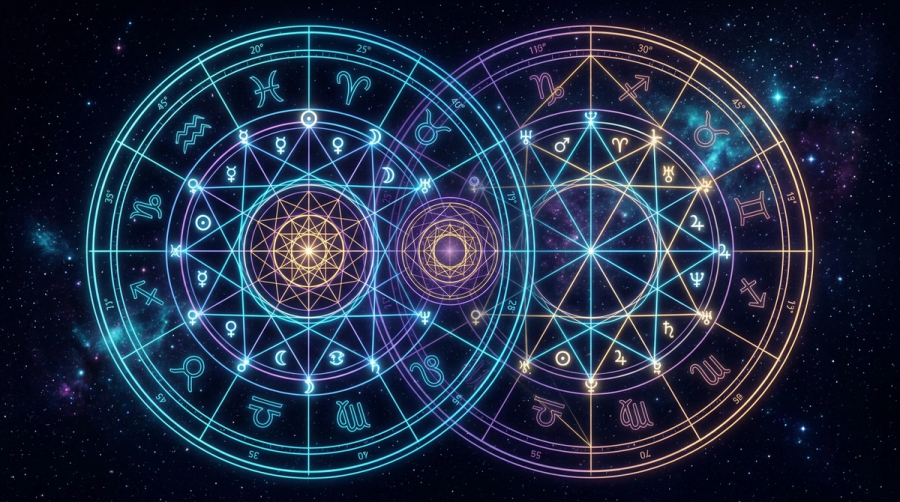
Overlapping zodiac wheels with key aspect lines connecting planets between two birth charts
Synastry Houses Explained
Synastry houses describe which area of your life your partner activates by virtue of where their planets fall in your chart. The house overlay is one of the most concrete things synastry reveals - it tells you what the relationship is for, in the structural sense, far more clearly than a single aspect ever can.
A working tour of the twelve. When your partner's planets fall in your:
1st house, they activate your identity directly. You feel them in your skin. You can't be neutral around them. Their presence changes how you walk into a room. This is one of the most physically magnetic overlays - and one of the most disorienting, because the partner can come to feel like part of your self.
2nd house, they activate your sense of value, your money, your relationship to the body and material world. The partner often becomes either someone who supports your worth or someone who challenges it. Money themes are common.
3rd house, they activate your communication, your daily exchanges, your siblings-and-neighbors layer of life. The relationship runs on conversation. You text constantly. You talk for hours. They feel like the person you most want to think out loud with.
4th house, they activate your home, your family, your sense of roots. The partner often becomes someone you want to live with, someone who feels like family in your gut. The 4th house overlay is one of the most binding for cohabitation.
5th house, they activate your romance, creativity, play, and children. This is the classic romantic overlay. Dating someone whose planets fall in your 5th house feels exciting, generative, fun, sexual. Often where new relationships begin.
6th house, they activate your daily routines, your work, your health. The partner becomes someone you want around in the ordinary day. The 6th house overlay is one of the most underrated for marriage - it's the daily life compatibility.
7th house, they activate your committed-partnership zone directly. As covered above, this is one of the strongest overlays for marriage and long-term partnership. The partner feels like a partner in your bones.
8th house, they activate your intimacy, sexuality, shared resources, and depths. This is the overlay of profound, sometimes terrifying closeness. Sex is intense. So is the rest. Power dynamics, trust, and what's hidden all come up.
9th house, they activate your meaning, beliefs, travel, and expansion. The partner often feels like someone who introduces you to a bigger world - geographically, intellectually, spiritually. Long-distance relationships and cross-cultural pairings often have strong 9th-house overlays.
10th house, they activate your career, public reputation, and life direction. The partner can feel like a mentor, a boss, or someone whose support changes your professional trajectory. This is the power couple overlay.
11th house, they activate your friendships, networks, and shared visions. The partner often starts as a friend, integrates into your circle, and becomes the person you're building the future with in a collective sense.
12th house, they activate your unconscious, your dreams, your spiritual life. This is the most mysterious overlay. The partner feels like a soul connection. They also can feel hard to see clearly. Hidden dynamics, projections, and spiritual themes are common. This overlay can produce the sense of having known someone in another life.
The overlays multiply. A partner usually has several planets falling across several of your houses. Reading synastry houses well means looking at the full pattern - which life areas they activate, which planets activate them, and how the activation feels in lived experience.
The Composite Chart vs Synastry Distinction
The composite chart and the synastry chart answer different questions about the same relationship - and you need both to fully understand a partnership. Synastry shows the chemistry between you. The composite shows what the relationship is becoming as a third entity. Reading only one leaves you with half the picture.
The clearest way to hold the distinction: synastry is the interaction, composite is the result. Two people with strong synastry but a weak composite have lots of chemistry but no shared destination. Two people with weak synastry but a strong composite have a relationship that means something but doesn't always feel alive in the moment. Most lasting partnerships have meaningful signatures in both.
For the full deep dive on the relationship as its own entity, see the composite chart calculator and relationship astrology guide. The shorter reference at synastry birth chart compatibility and relationship astrology covers complementary practical material.
When Synastry Looks "Bad": What It Actually Means
Synastry that looks "bad" - full of squares, oppositions, Saturn contacts, Pluto aspects, and Chiron activations - is usually the synastry of relationships that produce the deepest growth. Hard aspects don't predict failure. They predict the kind of relationship that requires something from both people. Easy synastry rarely changes anyone. Hard synastry, met consciously, often does.
Most popular synastry content treats squares and oppositions as warnings to flee. The classical psychological-astrology tradition treats them differently. Liz Greene's Relating: An Astrological Guide to Living with Others on a Small Planet makes the argument explicitly: in psychological astrology, the hard aspects show where a relationship has traction - where it presses on something unfinished in each partner and asks them to grow. A relationship with no hard aspects is often a pleasant relationship that doesn't go anywhere.
Saturn squares feel restrictive at first. Over years, they become foundational. The partner who initially feels too cold or too critical eventually shows up as the one who actually held you steady through the Saturn return.
Mars-Saturn contacts produce sexual frustration in early dating. Over years, they often produce the slow-built physical trust that easy Mars-Venus contacts can't sustain on their own.
Pluto aspects produce intensity and power dynamics that look toxic from outside. Met consciously, they're the reason the relationship is the one that finally transformed both people.
Chiron contacts produce the wound activation that feels intolerable. They're also what makes the relationship a place where the wound finally heals instead of getting projected onto the next partner.
The honest reading: there's no synastry that's "bad." There's synastry that's easy and synastry that's hard. Easy synastry is pleasant and rarely transformative. Hard synastry is challenging and frequently transformative. The same chart that's a beautiful long marriage in one couple is a ruinous breakup in another. The chart shows the potential pattern. What happens in lived experience depends on whether each person does their work.
Astrology offers a framework for understanding - it doesn't replace professional mental health support. If you're going through relationship pain that's affecting your wellbeing, please reach out to a licensed therapist or counselor who can hold the work alongside you.
Common Synastry Patterns
Reading hundreds of synastry charts across years of practice surfaces recurring patterns - combinations of contacts that produce a recognizable dynamic. Naming the patterns lets you see your own relationship more clearly. Most readers recognize at least one of these on first reading.
The chemistry-without-foundation pattern. Strong Venus-Mars contacts (often a conjunction or square), weak or no Saturn contacts, weak or no Sun-Moon connection. The relationship ignites fast, runs hot for months, and dissolves once the chemistry naturally cools because there's no underlying structure to hold it. The classic intense-but-short affair. Recognizing this pattern early can save both partners months of confused grief once it ends.
The friend-zone pattern. Strong Mercury-Mercury or Mercury-Sun contacts, deep mutual understanding, weak Venus-Mars connection. The two people are genuinely best matched intellectually and emotionally - but the chemistry never quite ignites romantically. Some friend-zone pairs eventually grow into love through accumulated trust. Others remain extraordinary friendships. The chart usually shows which, if you read it honestly.
The karmic-relationship pattern. Strong Pluto contacts, strong nodal contacts (especially South Node activation), strong Vertex aspects, often a 12th house overlay. The relationship feels fated, ancient, magnetic, sometimes torturous. Walking away feels impossible. The lesson is usually about what each person came into the relationship to learn rather than to keep. Some karmic relationships are forever. Many are intense, transformative, and finite.
The parent-projection pattern. Strong Saturn contacts, especially Saturn aspecting the Moon or the Sun, often replicating one or both partners' early family dynamics. The Saturn person comes to feel like a parent. The Moon or Sun person comes to feel like the criticized or unmet child. Recognizing the pattern is half the work - the projection is happening because each person is seeing the other through the lens of their original family. Naming the pattern lets the partners stop enacting it.
The mirror pattern. Heavy emphasis on hard aspects - squares and oppositions - between similar planets in both charts. Each partner is reflecting back to the other something they refuse to see in themselves. The conflicts repeat in the same shape, decade after decade, until one of them finally turns and looks. Then the relationship transforms. Or ends. Either is healing.
The teacher-student pattern. Strong Jupiter or Saturn contacts to the other's personal planets, often with one chart older and structurally more mature than the other. One partner is genuinely guiding the other through something. The pattern works as long as the role isn't permanent. When the student grows, the dynamic has to evolve, or the relationship calcifies into resentment.
The 12th-house pattern. Heavy 12th-house overlay in either direction, often with Neptune contacts. The relationship has a soul-mate quality and a "can't quite see clearly" quality at the same time. Spiritual depth is real. So is the risk of projection, idealization, or hidden dynamics neither person wants to look at. Healing requires both partners eventually pulling the projection back.
These patterns are not deterministic. Two couples with the chemistry-without-foundation pattern can have completely different stories - one ends amicably after a year, the other does the work and builds the missing structure consciously. The pattern is a tendency, not a verdict.
How to Read Your Own Synastry: Step-by-Step
Reading your own synastry is possible if you have both birth charts and you're willing to look at what's actually there rather than what you wish was there. The work is patient, not fast. Most useful readings take an hour or two of actually sitting with the charts. LookUpTheStars' introduction to synastry lays out a similar reading order - start with the inner-emotional contacts, move to chemistry, then sustainability, then depth.
A practical step-by-step.
- Get accurate birth data for both people. Date, time, and city. Time matters - without it, you'll know the signs but not the houses, and the houses are half of synastry. If one or both birth times are unknown, work with what you have but flag the limit.
- Generate the synastry chart. Use any reputable astrology software or online calculator that produces a bi-wheel - your chart in the inner ring, your partner's planets in the outer ring (or vice versa). Note both directions. The aspects look the same from either side. The house overlays differ depending on whose chart is the inner wheel.
- Read Sun-to-Moon contacts first. Look for any aspect - conjunction, trine, square, sextile, opposition - between either person's Sun and the other's Moon. This is the marriage signature. It's the deepest emotional fit dimension.
- Read Venus-to-Mars contacts. Look for any aspect between either person's Venus and the other's Mars. This is the chemistry. Note conjunctions and trines especially - they produce the most reliable attraction.
- Read Moon-to-Moon. What sign is each person's Moon in? What's the aspect between the two Moons? This is the daily emotional rhythm of the relationship.
- Read Saturn contacts. Note any aspect between either person's Saturn and the other's Sun, Moon, Venus, or Mars. This is the staying-power dimension. If there are none, the relationship will need to build structure consciously rather than receiving it from the synastry.
- Read Pluto, Chiron, and the lunar nodes. Look for any aspect between Pluto and personal planets, between Chiron and personal planets, and between either person's planets and the other's Nodes or Vertex. These are the depth and karmic-pull dimensions.
- Read the house overlays. Where do each person's planets fall in the other's chart? Pay particular attention to planets in the 1st, 4th, 5th, 7th, 8th, and 12th houses - these are the most relationally vivid.
- Hold the orbs. Tight aspects (under 3 degrees) are the most active. Wide aspects (5-8 degrees) operate more subtly. Most synastry practitioners use 5-7 degrees for major aspects and tighter orbs (2-3 degrees) for minor ones - this is slightly looser than the orb conventions used for natal-chart aspects, because the live energy between two charts tends to operate over a wider range than a single natal placement.
- Synthesize, don't catastrophize. Avoid the common mistake of fixating on one hard aspect and ignoring the rest. Synastry is always a composite picture. A single Saturn square doesn't define a relationship. Look at the whole set of contacts and the patterns they form together.
- Notice what surprises you. The synastry chart often confirms what you already feel about the relationship - and sometimes names something you've been avoiding. Trust the surprise. The chart is rarely wrong about what's already happening.
- Sit with what comes up. Don't rush to act on the reading. A synastry chart isn't a verdict to leave or stay. It's a description of what's actually happening between you, and the description is the beginning of being able to do something different inside it.
If you want a deeper, personalized reading, give Nitya both birth charts and ask for the full synastry. Get personalized guidance based on your birth chart on MyNitya.
A Brief Note on Vedic vs Western Synastry
A note that comes up often: synastry as practiced in this article is a Western astrology technique. Vedic astrology has its own time-tested compatibility system - Ashtakoot Kuta - which evaluates eight specific dimensions of compatibility (mental, emotional, sexual, longevity, and so on) and produces a score out of 36 used widely in Indian marriage counseling. Both systems are legitimate. They're answering related but different questions.
Western synastry, with roots in Hellenistic astrology and modern depth psychology through Liz Greene and Howard Sasportas, is most useful for understanding the psychological dynamic between two people - the projections, the chemistry, the inner architecture of the bond. Vedic Ashtakoot is most useful for evaluating karmic and structural fit in the context of marriage as a long-term institution. Many practitioners use both layers.
MyNitya supports both systems. You can ask Nitya for a Western synastry reading or a Vedic Kuta analysis depending on which lens speaks to your question. Western excels at psychological depth and the inner architecture of relationship. Vedic excels at timing, karmic markers, and the long-arc compatibility view.
The Real Limit of Synastry
The honest limit of synastry is this: it shows potential, not certainty. Two people with the same synastry chart can have wildly different relationships depending on each person's level of consciousness, age, life context, and willingness to do the work the chart asks of them. The chart is the score. Each couple plays the music differently.
This is the sentence most synastry articles never write: a beautiful synastry chart in the hands of two unconscious people produces a beautiful disaster. A challenging synastry chart in the hands of two committed people produces a relationship that genuinely heals both of them. The astrology describes the field. The people decide what to grow in it.
So when synastry comes back showing strong chemistry and strong Saturn and a 7th house overlay and a Sun trine Moon - that's a hopeful map, not a guarantee. Both people still have to show up. Both still have to face their own wounds. Both still have to do the daily work of choosing each other when it's not easy.
And when synastry comes back showing Saturn squares, Pluto oppositions, Chiron conjunct Venus, and a 12th house overlay - that's not a sentence to leave. It's a description of a relationship that will demand everything and, if both people stay conscious, can transform both of them in ways an easier relationship couldn't.
The synastry chart is real. Astrology is real. Both work. But they don't replace the daily, ordinary, sometimes boring choice to actually be in a relationship with someone who isn't a fantasy of who you wish they were. That choice is yours. The chart just tells you what kind of choice you're being asked to make.
If you want to see how the upcoming year's transits will affect a specific relationship - when the gravity tightens, when the openings appear - see the love transits 2026 guide for the specific windows ahead.
Frequently Asked Questions
What is a synastry chart in astrology?
A synastry chart in astrology is the side-by-side comparison of two people's natal charts to reveal the aspects between their planets and the houses where each person's planets fall in the other's chart. It shows what actually happens between two people - chemistry, emotional fit, friction, and karmic pull - and is the most precise tool astrology has for reading a relationship beyond surface-level sun-sign matching.
What are the most important synastry aspects for love?
The most important synastry aspects for love are Sun-Moon contacts (deep compatibility and marriage potential), Venus-Mars contacts (sexual and romantic chemistry), Moon-Moon contacts (emotional rhythm fit), and Saturn aspects to personal planets (long-term staying power). Pluto, Chiron, and North Node contacts add karmic and transformational depth. A strong relationship usually has meaningful contacts across at least three of these categories.
How does a synastry chart differ from a composite chart?
A synastry chart compares two natal charts directly, showing how the two people affect each other through aspects between their planets. A composite chart creates one new chart from the mathematical midpoints of the two natal charts, representing the relationship itself as a third entity. Synastry shows the chemistry between you. The composite shows what the relationship is becoming as its own being.
What synastry aspects indicate a soulmate?
Soulmate-suggestive synastry aspects include Sun-Moon conjunctions, Venus-Mars trines or conjunctions, contacts between either person's planets and the other's North Node or Vertex, 7th house overlays, and Pluto contacts to personal planets. No single aspect "proves" a soulmate - the felt sense of soulmate connection usually comes from a cluster of these signatures appearing together. Soulmate is a quality of recognition, not a single placement.
Are bad synastry aspects deal-breakers?
Bad synastry aspects - squares, oppositions, Saturn contacts, Pluto aspects - are not automatic deal-breakers. In psychological astrology, hard aspects are where a relationship has traction and growth potential. Many long, healthy marriages contain Saturn squares, Pluto contacts, and Chiron activations. The hard aspects ask both partners to do conscious work. Met consciously, they often produce the deepest transformation. Easy synastry rarely changes anyone.
What does it mean when his planets are in my 7th house?
When his planets fall in your 7th house, he activates your committed-partnership zone directly and tends to feel like partner material in your bones, even before the relationship has formally become a partnership. The 7th house overlay is one of the strongest signatures for marriage and long-term commitment in synastry, and is particularly powerful when combined with Saturn contacts and Venus-Mars chemistry.
How accurate is synastry for predicting relationship outcomes?
Synastry is highly accurate at describing the dynamic between two people but does not predict the outcome with certainty. The same synastry chart can produce a happy marriage in one couple and a difficult breakup in another, depending on each person's age, consciousness, and willingness to do the relational work. Synastry shows the field. The people decide what grows in it.
Can two people share the same synastry chart?
No two couples share an exactly identical synastry chart, because the chart depends on the precise birth time, date, and location of both people. Even twins paired with the same partner produce slightly different synastry. Couples with similar Sun-Moon-Venus-Mars patterns may share qualities of dynamic, but the full house overlays and minor aspects always differ. Synastry is uniquely individual.
What's the difference between synastry and a compatibility calculator?
A synastry chart maps every aspect between two charts and the full house overlay pattern, producing a detailed reading of the relationship dynamic. A compatibility calculator outputs a percentage or score, often based on sun signs or a few major placements, with little context. The calculator is a starting point. The synastry chart is the actual reading. They serve different purposes - one for casual curiosity, one for genuine relationship understanding.
Is synastry the same in Vedic and Western astrology?
Synastry is primarily a Western astrology technique. Vedic astrology uses its own compatibility system - Ashtakoot Kuta - which evaluates eight specific dimensions of fit and produces a score out of 36, traditionally used in Indian marriage counseling. Both systems are legitimate. Western synastry excels at psychological depth and chemistry. Vedic Kuta excels at karmic and structural fit. Many practitioners use both.
The Last Word
A synastry chart is the most honest tool astrology offers for reading a relationship. It doesn't promise. It doesn't condemn. It shows what's actually there - the chemistry, the friction, the gravity, the work, the gift. It tells you what kind of relationship you're in, and what kind of relationship it could become if both people stay conscious enough to meet what it's asking from them.
If the chart you're holding is full of squares and Saturn and Pluto, that doesn't mean the relationship is wrong. It might mean you've found the one that will finally ask you to grow. If it's full of trines and easy aspects, that doesn't guarantee happiness. It might mean you've found the one that's pleasant enough that neither of you ever has to change.
Most of us spend our 20s and 30s confused by relationships because nobody gave us the map. Synastry is the map. Not a fortune. Not a verdict. A precise, patient description of what's happening between you and someone else, written in the language of the sky at the moment each of you was born.
Curious what your synastry actually reveals? Give Nitya both birth charts and ask for the full reading. Try MyNitya free. MyNitya - an AI-powered astrology platform where you chat with Nitya, a personal AI astrologer who analyzes over 10,000 data points from your birth chart. Both Western and Vedic systems are supported, so you can read the relationship through whichever lens speaks to you most.
Nitya isn't a one-time horoscope. She's with you for the whole journey.
Understand yourself
Career, love, money, timing - any decision you are weighing. Answers read straight from your birth chart.
Understand any relationship
Add your partner, a parent, a friend, even a colleague. Nitya reads both charts together to explain the bond, the friction, and how to work through it.
Guidance for every day
Start each morning knowing what the day favors, what to watch for, and the best moments to act.
No card needed. Nitya just needs your birth details to read your chart.
Ask Nitya your first question - free →