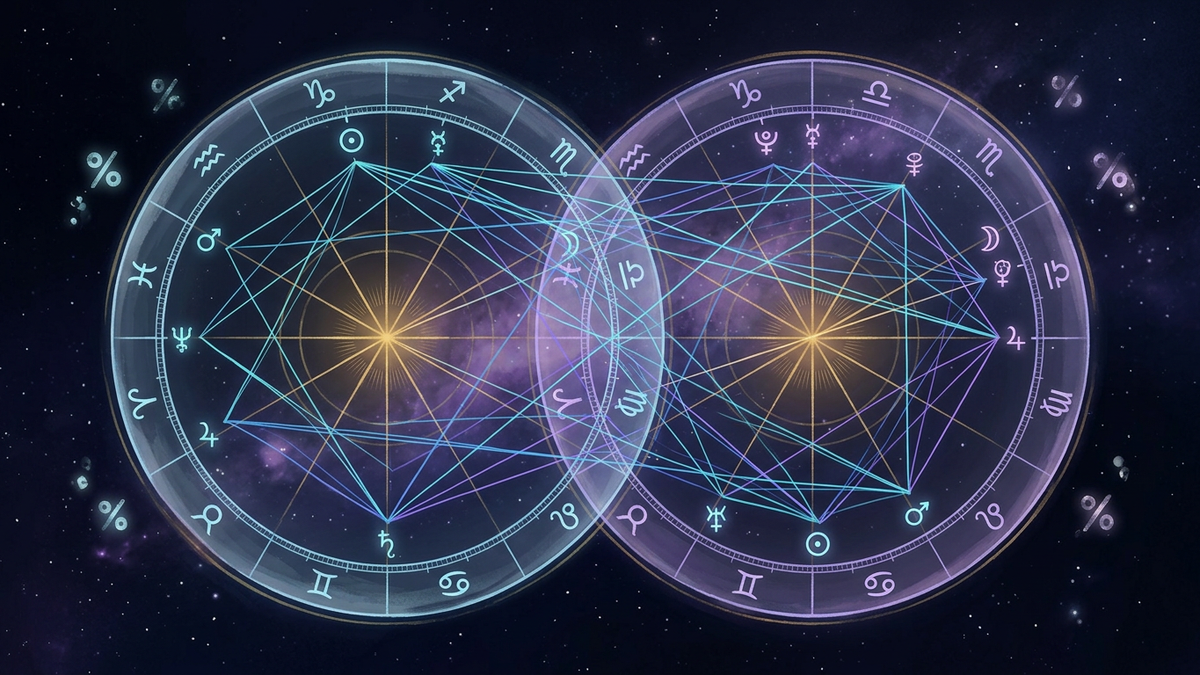
Compatibility Test: Why Sun Signs Aren't Enough
In this Article
A real compatibility test compares two full birth charts - not just two sun signs. It checks Sun-Moon contacts for emotional fit, Venus-Mars contacts for chemistry, Saturn contacts for staying power, Pluto and Chiron contacts for depth, and house overlays for which life areas you actually activate in each other. Most online compatibility tests skip all of that. They rank you by sun sign, hand you a percentage, and call it love. That's why the result rarely matches what your gut already knows about the relationship. Try MyNitya free.
If you landed here from a "compatibility quiz" that told you you and your partner are 87% compatible, or 32%, or "soulmates by sign," and the answer didn't quite satisfy you - there's a reason for that. The test was using one variable. Real compatibility runs on at least eight. You weren't wrong to feel like the quiz was missing something. It was.
Your personal astrologer - Vedic + Western.
Reads all 10,000+ points of your birth chart to answer your question. First question free, no card needed.
Ask your question free →Key Takeaways: A real compatibility test compares full birth charts, not sun signs. The eight things to check: Sun-Moon contacts (the marriage signature), Venus-Mars contacts (chemistry), Moon-Moon (emotional rhythm), Saturn contacts (long-term staying power), Pluto/Chiron/Node contacts (depth and karmic pull), house overlays (especially 7th, 5th, 8th, and 12th), Mercury-Mercury (communication style), and the composite Sun and Moon (the relationship as its own entity). Sun-sign tests use one variable out of dozens. The result is fast, but it's mostly wrong. Compatibility scores are largely meaningless because no aspect can be reduced to a percentage without losing the actual story.
Two luminous starfield figures of different shapes overlapping in deep space representing real astrological compatibility between full charts
Why Sun-Sign Compatibility Tests Are Mostly Wrong
Sun-sign compatibility tests use one placement to summarize a relationship that actually involves at least ten. They tell you whether your sun and your partner's sun are in "compatible" elements or modalities. That's about 5% of the chart. The other 95% - the Moon, Venus, Mars, Mercury, the houses, the aspects, the nodes - is doing the actual work of love.
The math on this is brutal once you see it. Your full natal chart has roughly ten major bodies plus the Ascendant, the Midheaven, the lunar nodes, and Chiron. Each of those is in a sign, in a house, and in aspect to the others. A real compatibility analysis compares every one of those points across two charts and notes the angles between them. A sun-sign test takes one of those points from each chart and asks whether they're "compatible" by element. No real astrologer assesses compatibility based on zodiac signs alone, because that's talking only about the Sun's location, and the Sun is roughly 2% of your entire birth chart. The Sun is one variable. There are dozens.
Here's the part most people don't realize until they've actually run the comparison. Two "compatible" sun signs - say a Cancer and a Pisces, both water, supposedly a soulmate match - can have a synastry chart full of Saturn squares and Mars-Pluto oppositions that produces a relationship neither one can hold together past year two. And two "incompatible" sun signs - say a Capricorn and a Gemini, earth and air, supposedly a clash - can have a Venus trine Mars, a Sun-Moon conjunction, and a 7th-house overlay that produces a thirty-year marriage. The sun-sign test misses both. The first looks like a yes that's actually a no. The second looks like a no that's actually a yes.
Stephen Arroyo's Relationships and Life Cycles makes the point in plain language: sun-sign matching is "the astrological equivalent of judging a book by the first letter of the title." It's fast. It's fun. It's not a tool for understanding actual partnerships. Most reputable astrology calculators carry the same caveat in fine print, noting that no claim is made concerning the accuracy of a sun-sign-only assessment. That's the honest disclaimer. The marketing-friendly versions - the percentage scores, the "your soulmate is" verdicts - leave it out.
The other problem with sun-sign tests is that they confuse element compatibility with personality compatibility. Two fire signs are supposed to "click." But a fire sign with a heavy Saturn influence is cautious, withdrawn, slow to commit. A fire sign with a strong Uranus influence is restless, rebellious, allergic to convention. Same element. Wildly different partners. The test can't see this.
If a compatibility test ranks people by Sun sign and gives you a percentage in under thirty seconds, what it's measuring is whether your stereotypes align. Not whether you and the other person are actually capable of building something. Those are different questions.
What a Real Compatibility Test Checks
A real compatibility test checks at least eight specific dimensions of two birth charts. None of them is reducible to a percentage. All of them matter, and most relationships are strong in some and weak in others. The point of the test isn't to produce a verdict. It's to produce a map clear enough that both people can see what's actually between them.
This is the layered reading a synastry chart relationship reading actually involves - the full pillar guide if you want the deep dive on the technique itself. Here's the working checklist for the test, in the order most practitioners read it.
1. Sun-Moon Contacts - The Marriage Signature
Sun-Moon contacts in synastry are the deepest indicator of marriage-grade compatibility. When one person's Sun aspects the other's Moon - by conjunction, trine, sextile, square, or opposition - the two natures fit. The Sun person illuminates the Moon person's emotional life. The Moon person provides emotional sanctuary for the Sun person's identity.
Sue Tompkins, in Aspects in Astrology, describes the Sun-Moon trine as "an aspect of natural understanding - they get each other without trying." The conjunction is even stronger but more enmeshed: when Sun and Moon are exactly conjunct between two charts, the boundaries blur in a way that can feel like fusion. The trine and sextile preserve more individuality. The square and opposition still bind, but they require active translation work - the Moon's emotional language doesn't automatically register to the Sun.
This single contact does more for long-term compatibility than the entire sun-sign-matching framework. A compatibility test that misses Sun-Moon contacts has missed the most important variable in the chart.
Orb convention: tight aspects (under 3°) are the most active. Wide aspects (5-8°) operate more subtly. Most synastry practitioners use 5-7° for Sun-Moon contacts.
2. Venus-Mars Contacts - Chemistry
Venus-Mars contacts are the most reliable synastry signature for sexual and romantic chemistry. When one person's Venus aspects the other's Mars by conjunction, trine, or sextile, the attraction is bodily, immediate, and self-renewing. The way one person loves matches the way the other person desires.
The conjunction is the most physical. The trine is the most easeful and self-sustaining. The sextile is friendlier, less compulsive. The square produces high attraction with high friction - the kind of relationship where the makeup sex is half the point. The opposition produces a magnetic pull that can swing between idealization and irritation. Venus-Mars is consistently the contact synastry writers point to as the one that supplies the erotic energy of a relationship.
Without Venus-Mars contact in some form, romantic relationships often feel friendly but unromantic. Both partners describe genuine love and respect - and a strange absence of spark. The chart is showing the same thing the body is.
Orb convention for chemistry: 5-7° is the working range. Within 3° the contact is unmistakable.
3. Moon-Moon - Emotional Rhythm
Moon-Moon contacts describe the daily emotional weather of the relationship. The Moon represents inner emotional life - what makes you feel safe, what activates your nervous system, what you need at the end of a hard day. When two Moons are in compatible signs, the emotional rhythms sync without conversation. When they conflict, every emotional moment requires translation.
Moon-Moon conjunctions, trines, and sextiles produce partners whose emotional weather is similar. They both want quiet on Sunday mornings, or both want company. They process stress at similar speeds. They need the same kinds of touch, conversation, silence. Moon-Moon squares and oppositions produce mismatched rhythms - one wants closeness when the other needs space, one processes by talking when the other processes by withdrawing.
Most compatibility tests skip the Moon entirely. Once you've read a few synastry charts, you realize this is the single biggest blind spot in popular astrology. The deeper guide on Moon sign compatibility and the emotional connection covers this dimension in full.
4. Saturn Contacts - Long-Term Staying Power
Saturn contacts in synastry are the test of whether a relationship has long-term structural integrity. When Saturn in one chart aspects a personal planet in the other - especially the Sun, Moon, Venus, or Mars - the connection acquires weight. It feels old. It feels serious. The Saturn person carries authority into the dynamic. The non-Saturn person feels both held and pressured.
Long marriages disproportionately contain Saturn-to-personal-planet contacts. Stephen Arroyo's Relationships and Life Cycles makes the case directly: lasting partnerships almost always feature at least one such contact. Saturn is the glue. Saturn is the staying power. Synastry writers often frame these contacts as "soul contracts", the agreements between two charts that keep them in the room when chemistry alone would have burned out.
The shadow side: Saturn contacts can also produce relationships that feel like duty more than joy. Saturn person becomes controlling, withholding, or rigid. The non-Saturn person feels inhibited, judged, never quite good enough. The aspect determines whether Saturn shows up as foundation or as cage.
A compatibility test without Saturn analysis cannot tell you whether the relationship will last past the chemistry phase. Most online tests don't even mention Saturn.
5. Pluto, Chiron, and Node Contacts - Depth and Karmic Pull
Pluto, Chiron, and lunar node contacts add the dimensions of depth, transformation, and karmic pull. They're what makes some relationships feel ordinary and others feel inevitable.
Pluto in synastry creates obsession, transformation, and power dynamics that operate beneath conscious awareness. When one person's Pluto aspects the other's Sun, Moon, Venus, or Mars, the relationship has the gravity of a black hole. Walking away feels impossible. Loving feels addictive. Robert Hand's Planets in Composite describes Pluto contacts as "the relationship that changes both people permanently, whether they want to be changed or not."
Chiron contacts activate each person's deepest wound. When your partner's Sun, Moon, or Venus touches your natal Chiron, your old pain gets pressed by the very person you most want to feel safe with. It can feel cruel. It's also often what makes the relationship a vehicle for actual healing.
North Node contacts produce the felt sense of fate. When one person's planets - especially Sun, Moon, or Venus - conjunct the other's North Node, the partner is pulling you toward your growth direction. South Node contacts produce the opposite feeling: deep familiarity, "I know you," sometimes a sense of having met before. The most fertile relationships often have a mix.
These contacts are why two compatibility-test users can run the same algorithm and get the same number, and one couple is in a casual situationship while the other can't leave each other after a decade of trying. The depth dimension isn't visible in a sun-sign comparison.
6. House Overlays - Which Life Areas You Activate
House overlays describe which areas of your life your partner activates by virtue of where their planets fall in your chart. This is one of the most concrete things a real compatibility test reveals - and it's invisible to any test that doesn't use birth times.
7th house overlays are the partnership signature. When your partner's planets fall in your 7th house, they activate your committed-partnership zone directly. They feel like partner material, even before the relationship has formally become one. Read more on the 7th house in astrology and relationship meaning for what this house actually governs.
5th house overlays are romance, play, and creativity. The classic dating overlay. New relationships often start here.
8th house overlays activate intimacy, sexuality, shared resources, and depth. Profound, sometimes terrifying closeness. Sex is intense. So is the rest. Power dynamics, trust, and what's hidden all come up.
12th house overlays activate the unconscious, dreams, the spiritual, sometimes the deceptive. The most mysterious overlay. The partner feels like a soul connection. They also can feel hard to see clearly.
A compatibility test that doesn't use birth times cannot read houses. That eliminates one of the most predictive layers of the analysis. Sun-sign tests don't use birth times. Most "free compatibility tests" don't either. Real compatibility analysis needs both.
The deeper guide on the 7th house meaning and attraction patterns covers how the partnership house shapes who you actually attract - separate from anything sun-sign tests would predict.
7. Mercury-Mercury - Communication Style
Mercury contacts describe how the two minds talk. Mercury conjunct Mercury, Mercury trine Mercury, and Mercury sextile Mercury produce two people who think alike. Conversations flow. Misunderstandings are minor and quick to repair. Mercury squares and oppositions produce two people whose minds work differently - sometimes invigorating, sometimes exhausting.
Communication is the dimension most often overlooked by compatibility tests because it's less dramatic than chemistry. It's also one of the most predictive of long-term satisfaction. Couples who can't comfortably talk will eventually run out of subjects. Couples who can will stay interested in each other for decades.
If both charts have heavy air placements (Gemini, Libra, Aquarius), the relationship runs on conversation. If neither does, words may matter less than presence and action - but Mercury contacts still matter for how disagreements get repaired.
8. Composite Chart Sun and Moon - The Relationship as Its Own Entity
The composite chart is a single chart created from the mathematical midpoints between every pair of planets in two natal charts. The midpoint between your Sun and theirs becomes the composite Sun. Same for the Moon, Venus, Mars, and so on. The result is one chart that represents the relationship itself as a separate being.
The composite Sun shows the identity of the relationship. The composite Moon shows its emotional center. Together they describe what the relationship is - its tone, its purpose, its felt sense - independent of either person.
A relationship can have strong synastry (the chemistry between you) and weak composite (the relationship as an entity has no foundation). It can also have weak synastry and strong composite (the relationship has purpose but the daily lived reality feels flat). Both matter. Reading only one leaves you with half the picture. The deeper guide on composite charts and relationship astrology walks through the full method.
A real compatibility test reads both. A sun-sign quiz reads neither.
The "Big Three" Compatibility - Why Even That Misses Half the Picture
A "big three" compatibility test compares Sun, Moon, and Rising signs between two people. It's a real upgrade over sun-sign matching - it's looking at three placements instead of one, and the Moon and Rising add genuine emotional and energetic information. But the big three still misses about half of what actually matters in a relationship.
The big three is popular because it sounds thorough without being overwhelming. Most casual astrology readers know their Sun, Moon, and Rising. The big three test is what apps run when they want to feel more legitimate than a sun-sign quiz without doing actual synastry. It's better than nothing. It's not the same as a real compatibility analysis.
Here's what the big three captures: the basic identity (Sun), the basic emotional nature (Moon), and the surface energy (Rising). That's useful. Two people whose Suns are in compatible signs and whose Moons sync emotionally and whose Risings make a comfortable contact have an easier first impression than people whose big three is mismatched.
Here's what the big three misses: Venus (how each person loves), Mars (how each person desires), Mercury (how each person communicates), Saturn (whether the relationship has structural staying power), Jupiter (whether it has expansion and shared meaning), the outer planets (depth and transformation), the lunar nodes (karmic pull), and every aspect between any of these planets across the two charts. It misses the houses entirely. It can't see overlays.
The Sun, Moon, and Rising are three points. A full chart has roughly fifteen meaningful points. Comparing three out of fifteen is genuinely better than comparing one out of fifteen. It's also genuinely worse than comparing all fifteen. The big three is useful as a first conversation - we're a Cancer-Scorpio-Leo couple - and useless as a real compatibility verdict.
The relationship-defining contacts are usually outside the big three. A Venus-Mars conjunction across two charts says more about the chemistry than any Sun-Sun match. A Saturn aspect to the partner's Moon says more about staying power than any Rising-sign comparison. The big three skips all of that.
If you've been using big-three compatibility as your test of whether a relationship works, you've been getting better data than sun-sign tests give. You've also been missing most of the actual story.
Free Online Compatibility Tests, Reviewed Honestly
Most free online compatibility tests fall into one of three buckets: sun-sign-only quizzes, big-three calculators, and full-chart synastry tools that produce raw data without much interpretation. None of them gives you a real compatibility reading. Most popular online compatibility tools - Cafe Astrology, Astro-Seek, Co-Star, Astrolink, AstroSage - operate at one of these three levels, and the honest reading of any of them needs that limitation in mind.
Let's name what each kind of test actually does and where it falls short.
Sun-sign quizzes. The quickest and most popular kind. You enter two birthdays. The tool returns a percentage and a paragraph. As covered above, this is comparing one variable. It's useful for casual entertainment and useless as a real compatibility test. If you've taken one of these and the result didn't match your gut, your gut was right. The test was reading 5% of the available data.
Big-three calculators. These ask for Sun, Moon, and Rising of both people. They produce a more detailed report that includes element compatibility, emotional rhythm, and surface energy match. Better than sun-sign-only. Still reading 20% of the chart. Still no aspects, no houses, no Venus-Mars chemistry, no Saturn staying power.
Full-chart synastry calculators. These take date, time, and place for both people and generate a real synastry chart with all major aspects. The good ones - and there are several reputable free options - produce data accurate enough that an experienced astrologer could read the relationship from it. The problem is interpretation. The calculator will tell you "Venus square Saturn, orb 2.3°." It won't tell you what that means in lived experience, or how it interacts with the Sun-Moon trine, or whether the whole pattern adds up to a partnership that can hold or one that's about to break.
Some popular tools and where they sit on this spectrum:
- Cafe Astrology uses full birth data and produces longer text reports. It's closer to traditional textbook synastry. The main limitation is canned interpretations - paragraph-level templates that don't weigh aspects against each other the way a human astrologer would. The volume of text can feel generic or contradictory.
- Astro-Seek is more technical and offers many chart options including free synastry charts and aspect tables. It shows the actual chart data, which is great if you can read a chart, and overwhelming if you can't.
- Co-Star uses a combination of NASA data and short, often dramatic interpretations. It's stylish and fun. It also frequently delivers contradictory readings about the same relationship and tends to flatten complex compatibility into one-line verdicts.
- Astrolink offers free birth charts and basic compatibility readings. The compatibility analysis is more nuanced than a sun-sign quiz but still tends toward generic descriptions.
- AstroSage focuses on Vedic compatibility (Ashtakoot Kuta scoring). It's specifically useful if you want the Vedic side of the test, less useful for psychological synastry.
Meet Nitya, your AI astrologer
She reads your birth chart to answer anything about your life. Your first complete answer is free, with no card required. Continued chat, Synastry, and Daily Guidance require Premium.
Questions you can ask about this topic
Tap any one below - or just write your own question in the form ↓
Nitya isn't a one-time horoscope. She's with you for the whole journey.
Understand yourself
Career, love, money, timing - any decision you are weighing. Answers read straight from your birth chart.
Understand any relationship
Add your partner, a parent, a friend, even a colleague. Nitya reads both charts together to explain the bond, the friction, and how to work through it.
Guidance for every day
Start each morning knowing what the day favors, what to watch for, and the best moments to act.
No card needed. Nitya just needs your birth details to read your chart.
Ask Nitya your first question - free →A full birth chart compatibility report analyzes the full astrological blueprint for each person, including the Moon sign, Rising sign, houses, and key aspects between both charts, for a layered, nuanced understanding of how two people connect emotionally, mentally, and practically. The catch is that no calculator on its own can do that layered, nuanced reading. The calculator gives you the data. Someone has to read it.
That's the honest limit of free online compatibility tests. The good ones produce real data. The interpretation is where the actual analysis lives, and an algorithm - even a sophisticated one - can't yet do that the way a thoughtful astrologer can. You can read a real synastry chart on a free calculator. You'll need someone who can hold all eight dimensions at once to tell you what it actually means.
Chat with Nitya about your birth chart - try free.
The "Compatibility Score" Trap
A compatibility score - 87%, 32%, "85% match" - is essentially meaningless because no astrological reality is reducible to a percentage. The score is a marketing artifact, not an astrological one. It's a number designed to feel authoritative, fit on a screen, and sound shareable. The actual compatibility lives in the texture, not the number.
Here's why the math doesn't work. Suppose Person A and Person B have a Venus conjunct Mars synastry contact. That's a strong chemistry signature. Suppose they also have a Saturn square Moon. That's a long-term emotional friction point. What percentage are they "compatible"? The honest answer is that the chemistry is high, the emotional friction is real, the relationship will be intense and demanding, and the outcome depends on whether both partners are conscious enough to hold the friction without weaponizing it. There's no number for that.
Now suppose Person C and Person D have no Venus-Mars contact, mediocre Sun-Moon connection, and a Saturn-Sun trine. What percentage? The chemistry is mild, the emotional fit is okay, the long-term structure is strong. They could build a steady twenty-year marriage with a quiet sex life. Or the lack of chemistry could leave one of them feeling unmet and they could drift apart in year four. Same chart, two outcomes, depending on lived choices. There's no number for that either.
The compatibility score collapses an irreducible texture into a single dimension. The dimension is then ranked against a scale that the calculator made up, against assumptions the calculator made about what counts as "good" compatibility. Different calculators produce different numbers for the same couple. There's no agreed scale. There's no standard. It's a percentage made of nothing.
Among birth charts analyzed on MyNitya, couples who came in convinced they were "incompatible" because a free test scored them at 28% have, on closer reading, often had Sun-Moon trines, Venus-Mars sextiles, and 7th-house overlays - meaning the texture of the relationship was actually stronger than the algorithm could see. The reverse happens too. Couples scored at 92% by an algorithm have come in with synastry full of Saturn squares and Pluto oppositions that produced a relationship neither could safely hold. The score was the same. The reality wasn't.
The honest read on compatibility scores is this: ignore the number. The number is a marketing tool. Read the actual aspects. The aspects are the real test.
DIY Compatibility Test: The Practical Checklist
You can run a real compatibility test on yourself and a partner with two birth charts and an hour of patient looking. The work isn't fast. It also doesn't require a degree in astrology. What it requires is willingness to look at what's actually there rather than what you wish was there. Here's the working checklist.
- Get accurate birth data for both people. Date, time, and city. Time matters. Without it, you can read signs but not houses, and the houses are half of compatibility. If one or both birth times are unknown, work with what you have but flag the limit.
- Generate the synastry chart. Use any reputable free synastry calculator that produces a bi-wheel - your chart in the inner ring, your partner's planets in the outer ring (or vice versa). Note both directions. The aspects look the same from either side. The house overlays differ depending on whose chart is the inner wheel.
- Check Sun-to-Moon contacts first. Look for any aspect - conjunction, trine, square, sextile, opposition - between either person's Sun and the other's Moon. Use 5-7° orb. This is the marriage signature. Strong contact here is the most reliable single indicator of long-term emotional fit.
- Check Venus-to-Mars contacts. Look for any aspect between either person's Venus and the other's Mars. Note conjunctions and trines especially - they produce the most reliable attraction. Use 5-7° orb.
- Check Moon-to-Moon. What sign is each person's Moon in? What's the aspect between the two Moons? This is the daily emotional rhythm of the relationship. Tight orbs (under 3°) are the most active.
- Check Saturn contacts. Note any aspect between either person's Saturn and the other's Sun, Moon, Venus, or Mars. This is the staying-power dimension. If there are none, the relationship will need to build structure consciously rather than receiving it from the synastry.
- Check Pluto, Chiron, and the lunar nodes. Look for any aspect between Pluto and personal planets, between Chiron and personal planets, and between either person's planets and the other's North Node, South Node, or Vertex. These are the depth and karmic-pull dimensions.
- Check the house overlays. Where do each person's planets fall in the other's chart? Pay particular attention to planets in the 1st, 4th, 5th, 7th, 8th, and 12th houses - these are the most relationally vivid. A 7th-house overlay in either direction is the partnership signature.
- Check Mercury-to-Mercury and Mercury-to-personal-planet contacts. This is the communication layer. Easy contacts produce flowing conversation. Hard contacts produce mind-friction that's either invigorating or exhausting depending on each person's tolerance.
- Hold the orbs. Tight aspects (under 3°) are the most active. Wide aspects (5-8°) operate more subtly. Most synastry practitioners use 5-7° for major aspects between two charts - slightly looser than natal-chart conventions, because the live energy between two charts tends to operate over a wider range than a single placement does.
- Note the patterns, not just the individual aspects. A single Saturn square doesn't define a relationship. Look at the whole set of contacts. Where are the strengths concentrated? Where are the friction points? Does the chart look like chemistry-without-foundation, like slow-burn, like karmic? (Patterns covered below.)
- Cross-check with the composite. Generate the composite chart. Look at the composite Sun and Moon. Are they in compatible signs? Is the composite chart strong or weak? The composite tells you what the relationship is as its own thing, separate from each person.
- Sit with what comes up. Don't rush to a verdict. A real compatibility test isn't a decision to leave or stay. It's a description of what's actually there. The description is the beginning of being able to do something different inside it.
This checklist is what a real compatibility test looks like. It's slower than a sun-sign quiz. It's also accurate.
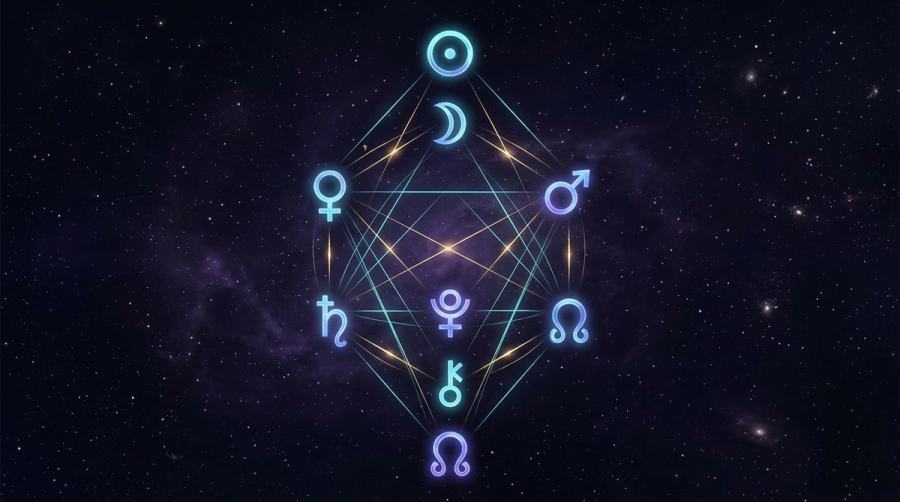
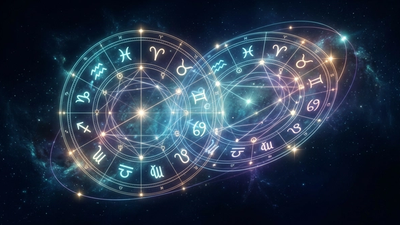
Cosmic checklist of Sun Moon Venus Mars Saturn Pluto Chiron and Node glyphs connected by aspect lines forming a complete compatibility test
When to Trust the Test, When to Ignore It
A compatibility test - even a thorough one - describes potential, not destiny. Two couples with the exact same synastry chart can produce wildly different relationships depending on each person's age, consciousness, life context, and willingness to do the work the chart asks of them. The test is the score. Each couple plays the music differently.
Here's what a compatibility test can reliably tell you: what kind of dynamic this relationship structurally is. Whether the chemistry is built-in or has to be created. Whether the long-term staying power is in the synastry or has to be consciously cultivated. Where the friction points are likely to surface. Where the natural ease lives. What life areas this partner activates in you. What kind of growth the relationship is structurally inviting.
Here's what a compatibility test cannot tell you: whether you should leave. Whether you should stay. Whether this is "the one." Whether the relationship will succeed or fail. Whether you'll be happy. The test names the field. The choices happen in the field. They're not the field itself.
The honest read: a "compatible" chart in the hands of two unconscious people produces a beautiful disaster. A "challenging" chart in the hands of two committed people produces a relationship that genuinely heals both of them. The astrology describes the field. The people decide what to grow in it.
Some practical principles for when to trust the test and when to set it aside.
Trust the test when it confirms what you already feel. If your gut says the chemistry is real and the chart shows Venus conjunct Mars, you're not making it up. The chart is naming what your body already knows.
Trust the test when it surprises you in a small way. Sometimes the chart names a friction point you've been quietly aware of but couldn't articulate. The Saturn square was why the relationship has felt heavy in that specific zone. The Chiron contact was why this person keeps activating that specific old wound. Recognition is useful.
Be cautious when the test surprises you in a big way. If the chart is full of soulmate signatures and you feel nothing, or if the chart looks "incompatible" and the relationship is the most alive thing in your life, the test isn't necessarily wrong - but the test also isn't the whole story. Lived experience always counts. The chart describes potential. Your felt experience describes what's actually happening.
Ignore the test when you're using it to bypass a decision you already know. People sometimes run compatibility tests to outsource decisions they're avoiding. If the chart says yes, I'll commit. If it says no, I'll leave. That's not what the test is for. The test is information. The decision is still yours.
Ignore the test in crisis. If you're in acute relationship pain - discovering an affair, processing a breakup, weighing whether to leave a marriage - the chart is not the right tool for the next forty-eight hours. The chart is a long-arc tool. Crisis decisions need different support.
A compatibility test is a map. The map is genuinely useful. The map is not the territory. Both still matter.
Astrology offers a framework for understanding - it doesn't replace professional mental health support. If you're going through relationship pain that's affecting your wellbeing, please reach out to a licensed therapist or counselor who can hold the work alongside you.
Specific Compatibility Configurations to Watch For
After enough synastry charts, recurring patterns surface - combinations of contacts that produce a recognizable kind of relationship. Naming the patterns lets you read your own compatibility test more clearly. Most readers recognize at least one of these on first sight.
The Marriage Signature Pattern
The marriage signature is a cluster of three to four contacts appearing together: a Sun-Moon contact (especially trine, sextile, or conjunction), a Venus-Mars contact, at least one Saturn-to-personal-planet contact, and a 7th-house overlay in at least one direction. Each piece on its own is meaningful. Together they're the strongest indicator that two charts are structurally built for partnership.
The Sun-Moon brings the deep emotional fit. The Venus-Mars brings the chemistry. The Saturn brings the staying power. The 7th-house overlay activates the partnership zone directly, so the relationship feels like marriage even before it's been formalized.
Among birth charts analyzed on MyNitya, couples whose synastry includes all four pieces of the marriage signature describe their connection most often as "feels like marriage from the start" - the cluster produces the felt sense of partnership-grade pairing in a way that's hard to mistake. The pattern doesn't guarantee a long marriage. It does describe the structural conditions under which one is most likely.
The Chemistry-Without-Foundation Pattern
The chemistry-without-foundation pattern shows strong Venus-Mars contacts (often a conjunction or square), weak or absent Saturn contacts, and weak or absent Sun-Moon connection. The relationship ignites fast, runs hot for months, and dissolves once the chemistry naturally cools because there's no underlying structure to hold it.
This is the classic intense-but-short affair. Both people often describe the relationship as the most chemistry they've ever felt - and they're not wrong. The Venus-Mars contact really is producing it. The problem is that chemistry alone doesn't sustain a relationship past the initial six-to-twelve-month window when the body's novelty response fades. Without Saturn structure, without Sun-Moon emotional fit, without the 7th-house activation, there's nothing to hold the partnership when the spark naturally cools.
Recognizing this pattern early can save both partners months of confused grief once the relationship ends. The chemistry was real. The relationship just wasn't built to last past it. That's not a personal failure. That's a compatibility test reading correctly.
The Slow-Burn Pattern (Saturn-Led)
The slow-burn pattern shows strong Saturn contacts - Saturn trine Sun, Saturn conjunct Venus, Saturn sextile Moon - with mild but present Venus-Mars and Sun-Moon contacts. The relationship builds slowly. The first few months may feel less electric than chemistry-led pairings. The partners often describe a "growing on me" quality, a deepening over time, a connection that gets more, not less, real with months and years.
These are the relationships that look mediocre at six months and stunning at six years. Saturn doesn't accelerate. Saturn deepens. The slow-burn pattern is one of the most consistently long-lasting configurations in synastry, and one of the easiest to underestimate at the start. If you're in a relationship that doesn't have the dramatic chemistry of a chemistry-led pairing but feels increasingly real, check the chart for Saturn signatures. You might be in a slow-burn.
The Karmic Pattern (Pluto/Node-Led)
The karmic pattern shows strong Pluto contacts (especially Pluto-Sun, Pluto-Venus, Pluto-Mars), strong nodal contacts (especially South Node activation), strong Vertex aspects, and often a 12th-house overlay. The relationship feels fated, ancient, magnetic, sometimes torturous. Walking away feels impossible.
The karmic pattern is the most intense and the hardest to read accurately. Some karmic relationships are genuinely lifelong. Many are intense, transformative, and finite - meaning the partners came together to learn something specific, and once it's learned, the relationship doesn't have a structural reason to continue. The chart usually shows which, but only with careful reading. The deeper guide on soulmate compatibility by date of birth explores the karmic-pull dimension at greater length.
The work with karmic relationships is conscious - knowing what's happening, refusing to enact the unconscious patterns, choosing the transformation rather than being dragged through it. Pluto, met consciously, can produce the relationship that finally heals both people. Pluto, unconscious, can produce the kind of obsessive dynamic that takes years to recover from.
These four patterns aren't deterministic. Two couples with the chemistry-without-foundation pattern can have completely different stories - one ends amicably after a year, the other does the work and consciously builds the missing structure. The pattern is a tendency, not a verdict.
How Vedic Compatibility Adds a Different Layer
Vedic astrology has its own time-tested compatibility system - Ashtakoot Kuta - which evaluates eight specific dimensions of fit and produces a score out of 36. It's used widely in Indian marriage counseling, including in arranged-match contexts where families want a structural read on long-term compatibility before commitment. It's a different kind of test from Western synastry, and it answers a different kind of question.
Ashtakoot Kuta is built primarily on the Moon's position in each chart - specifically the Moon's nakshatra (one of 27 lunar mansions) and rashi (sign). The eight kutas evaluate:
- Varna (mental and spiritual compatibility, 1 point)
- Vashya (mutual influence and control, 2 points)
- Tara (health and wellbeing, 3 points)
- Yoni (sexual and instinctive compatibility, 4 points)
- Graha Maitri (mental compatibility and friendship, 5 points)
- Gana (temperament - divine, human, or demonic, 6 points)
- Bhakuta (love, family, and prosperity, 7 points)
- Nadi (genetic and progeny compatibility, 8 points)
Total: 36 points. Most traditional astrologers want at least 18 (50%) for a marriage match. Some traditions require 24 or higher.
What Ashtakoot does well: it gives a structural reading specifically calibrated for marriage as a long-term institution. It checks dimensions Western synastry sometimes underemphasizes - temperament compatibility, family dynamics, even genetic considerations. And because it's primarily Moon-based, it's especially strong at reading emotional and mental compatibility, which Western sun-sign tests miss entirely.
What Ashtakoot doesn't do: psychological depth in the Western sense. It's not a Jungian framework. It doesn't read projection, shadow, or unconscious dynamics the way psychological synastry does. It also doesn't account for the specific sexual and chemistry signatures that Venus-Mars contacts in Western synastry name explicitly. Vedic does have its own approach to chemistry through Mars analysis (Manglik dosha and Mars placement), but it's a different lens.
Many practitioners use both. Western synastry for the psychological dynamic - the projections, the chemistry, the inner architecture of the bond. Vedic Ashtakoot for the karmic and structural fit in the marriage frame. The two systems answer related but different questions, and neither one alone tells the whole story.
If you want a Vedic compatibility reading, Ashtakoot gives you a number out of 36 and a breakdown of which kutas are strong and which are weak. It's significantly more thorough than a Western sun-sign test. It's also doing a different job from Western synastry.
MyNitya supports both systems. You can ask Nitya for a Western synastry reading or a Vedic Kuta analysis depending on which lens speaks to your question. Western excels at psychological depth and the inner architecture of relationship. Vedic excels at timing, karmic markers, and the long-arc compatibility view. Both systems are legitimate. Both produce useful information. Neither is reducible to a percentage.
What MyNitya Does Differently
MyNitya runs a real compatibility test - full birth charts on both sides, every dimension that actually matters, both Western synastry and Vedic Ashtakoot if you want them, and an interpretation that holds the texture instead of collapsing it into a score.
On MyNitya, you enter your birth details and chat with Nitya - an AI astrologer who deeply understands your full Western natal chart. Nitya analyzes planetary positions, house placements, aspects, and transits. For compatibility, you can give Nitya both charts and ask the questions that matter: Does this relationship have long-term staying power? Where's the chemistry coming from? Why does this person keep activating an old wound in me? Is the 7th-house overlay strong enough to make this feel like marriage? What's the composite chart saying about us as our own entity?
Nitya doesn't give you a percentage. The percentage was the wrong tool. Nitya reads the actual contacts, holds the texture, and tells you what's structurally happening in language you can use.
Both Vedic and Western systems are supported. If you want the Ashtakoot Kuta reading, ask for it explicitly. If you want full Western synastry, ask for that. If you want both layered together, that's also possible.
Get personalized guidance based on your birth chart on MyNitya.
Beyond Compatibility - What the Test Doesn't Measure
A compatibility test, even a thorough one, doesn't measure the daily, ordinary, sometimes boring choice to be in a relationship with someone who isn't a fantasy of who you wish they were. The chart describes the field. Both people still have to show up.
This is the part most compatibility content skips. The chart can be perfect - all eight dimensions strong, marriage signature complete, slow-burn Saturn anchoring everything - and the relationship can still fail because one person can't stop chasing someone else, or both people are too wounded to stay open, or life circumstances pull them apart in ways the chart didn't cause and can't fix. And the chart can look "challenging" - Saturn squares, Pluto contacts, Chiron activations - and the relationship can be the deepest love either person has ever known, because both partners chose to do the work the chart was asking from them.
Compatibility tests measure structural potential. They don't measure emotional maturity. They don't measure willingness to do therapy. They don't measure capacity to apologize. They don't measure how each person has been shaped by their family of origin, by their culture, by the specific traumas they're still carrying. The chart shows the field. None of those other variables show up in the synastry.
Couples who are compatible by every test and still don't make it usually fail at one of these untested layers. Couples whose tests look hard and who make it anyway usually succeed at them. The tests are useful. They're not the whole picture.
Read your compatibility test as one input among several. Read your gut as another. Read your lived experience of the relationship as the most important. Read each person's willingness to do the work as the deciding factor. The chart names what's possible. The people name what's actual.
If you want to see how the upcoming year's transits will affect a specific relationship - when the gravity tightens, when the openings appear - see the related guide on astrology compatibility calculators using birth charts for what real chart-based testing involves and how it connects to forecasting. The companion guide on natal chart love compatibility covers what your own chart says about who you attract. And who is my soulmate by birthdate goes deeper on the karmic-pull layer if that's what brought you to the test in the first place.
For the numerology-based compatibility layer, numerology compatibility and life path covers the parallel system most often used alongside astrology. For zodiac-specific compatibility - done honestly, not as a sun-sign verdict - see the zodiac compatibility calculator and the star sign compatibility calculator guides.
Frequently Asked Questions
What is a real astrology compatibility test?
A real astrology compatibility test compares two full birth charts - date, time, and place for each person - and analyzes Sun-Moon contacts, Venus-Mars contacts, Moon-Moon, Saturn aspects, Pluto/Chiron/Node contacts, house overlays, Mercury communication, and the composite chart. It produces a layered description of the relationship dynamic, not a percentage. Sun-sign tests use one variable. Real compatibility tests use at least eight.
Why aren't sun signs enough for a compatibility test?
Sun signs aren't enough because the Sun is one placement out of roughly fifteen meaningful points in a birth chart. Sun-sign tests miss the Moon (emotional fit), Venus and Mars (chemistry), Saturn (staying power), Pluto and the nodes (depth and karmic pull), Mercury (communication), and the entire house overlay system. Two "compatible" sun signs can have a synastry chart full of friction. Two "incompatible" signs can have a synastry chart that produces a thirty-year marriage.
What does a compatibility score actually mean?
A compatibility score (87%, 32%, etc.) is a marketing artifact, not an astrological one. No actual compatibility reading reduces to a percentage because no single number can capture the texture of eight independent dimensions. Different calculators produce different scores for the same couple. Ignore the number. Read the actual aspects - Sun-Moon, Venus-Mars, Saturn contacts, house overlays - those tell the real story.
What are the best aspects to look for in a compatibility test?
The best compatibility aspects are Sun-Moon contacts (deep emotional fit, the marriage signature), Venus-Mars contacts (sexual and romantic chemistry), Moon-Moon harmonious aspects (matched emotional rhythm), Saturn aspects to personal planets (long-term staying power), and 7th-house overlays (partnership activation). A relationship with strong contacts in three or more of these categories has the structural potential for marriage-grade partnership.
Are compatibility tests with bad scores always wrong?
Compatibility tests with low scores are often misleading because they're typically based on sun signs or limited data. A couple scored at 28% compatibility on a free quiz can have a synastry chart with strong Sun-Moon trines, Venus-Mars sextiles, and a 7th-house overlay - meaning the actual relationship is far stronger than the algorithm could see. Always read the full birth chart synastry before trusting a low score.
What's the difference between synastry and a compatibility test?
A compatibility test is a general term for any tool that evaluates relationship potential - sun-sign quizzes, big-three calculators, full synastry, or Vedic Ashtakoot. Synastry is specifically the technique of comparing two natal charts aspect-by-aspect. Synastry is the most thorough kind of compatibility test. Sun-sign quizzes and big-three calculators are simplified compatibility tests that miss most of what synastry checks.
Can the "big three" tell me if we're compatible?
The big three - Sun, Moon, and Rising - captures more than sun-sign matching but still misses about half the chart. It tells you basic identity, emotional nature, and surface energy. It doesn't show Venus-Mars chemistry, Saturn staying power, house overlays, or aspects between any planets. Big-three compatibility is genuinely better than sun-sign-only and genuinely worse than full synastry. Use it as a starting point, not a verdict.
How accurate are free online compatibility tests?
Free online compatibility tests vary widely in accuracy. Sun-sign quizzes are largely entertainment. Big-three calculators add useful information but still miss most of the chart. Full-chart synastry calculators (Cafe Astrology, Astro-Seek) produce real data but limited interpretation. Vedic Ashtakoot tools (AstroSage) provide structural marriage compatibility scoring. For a layered reading that holds all dimensions at once, an experienced astrologer or AI astrology platform is more accurate than any algorithm-only test.
What is Vedic compatibility (Ashtakoot Kuta)?
Vedic compatibility, called Ashtakoot Kuta, is a Vedic astrology system that scores eight dimensions of compatibility (mental, emotional, sexual, longevity, family, and others) for a total out of 36 points. It's primarily Moon-based, using each person's nakshatra and rashi. Most traditions consider 18+ points acceptable for marriage. Ashtakoot is structurally focused on long-term marriage fit and complements Western synastry's psychological-depth approach.
How do I run a compatibility test on myself and a partner?
To run a real compatibility test, get both birth dates, times, and places. Generate a synastry bi-wheel using a free calculator. Check Sun-Moon contacts first, then Venus-Mars, Moon-Moon, Saturn aspects to personal planets, Pluto/Chiron/Node contacts, house overlays (especially 7th, 5th, 8th, 12th), Mercury contacts, and the composite Sun and Moon. Use 5-7° orbs for synastry aspects. Read patterns rather than individual aspects. The full DIY checklist is in the section above.
The Last Word
A compatibility test is supposed to be a tool, not a verdict. The good ones describe what's actually between two people - chemistry and friction and staying power and depth and karmic pull, all at once, none reduced to a percentage. The bad ones rank you by sun sign and call it love.
If you came here from a quick quiz that didn't satisfy you, your gut was right. Your sun sign is one variable. Real compatibility runs on at least eight. The relationship you're trying to understand is a real thing with real texture, and the test that's worth running is the one that can hold all of that texture without flattening it into a number.
Run the full checklist. Read the patterns. Sit with what comes up. Don't outsource the decision to a percentage or to a sign. The chart names what's possible. The two of you decide what's actual.
Curious what your chart actually says about a specific relationship? Give Nitya both birth charts and ask for the full reading - Western synastry, Vedic Ashtakoot, or both layered together. Try MyNitya free. MyNitya - an AI-powered astrology platform where you chat with Nitya, a personal AI astrologer who analyzes over 10,000 data points from your birth chart. Both Western and Vedic systems are supported, so you can read the relationship through whichever lens speaks to you most.