Stellium Calculator: Do You Have a Stellium in Your Birth Chart?
In this Article
Stellium Calculator
Check if you have a stellium — three or more planets in the same sign
A stellium is a tight cluster of three or more planets in the same zodiac sign - and a stellium calculator finds it for you in seconds using your birth date, exact time, and place. If you've ever looked at a chart and noticed a pile-up of symbols crammed into one slice of the wheel, that's what you're seeing. The question isn't whether the cluster is "good." It's how to read what it's actually doing in your life.
I've been reading Western charts for over fifteen years, and stelliums are the placement that surprises people the most. They walk in expecting their Sun sign to be the headline. Then they find out they have four planets in Capricorn, and suddenly half their personality makes sense for the first time.
Your personal astrologer - Vedic + Western.
Reads all 10,000+ points of your birth chart to answer your question. First question free, no card needed.
Key Takeaways
- A stellium is 3 or more planets in the same zodiac sign - some traditions count house stelliums separately
- You'll need your exact birth date, time, and city to identify one accurately
- The five most common stelliums fall in Capricorn, Scorpio, Pisces, Sagittarius, and Virgo
- A house stellium concentrates energy in a life area; a sign stellium concentrates it in a personality style
- Four-planet and five-planet stelliums intensify the pattern but don't change its sign signature
- Outer-planet stelliums (Jupiter through Pluto) shape generations more than individuals
- The same cluster can read as gifted or burdened depending on aspects to the rest of the chart
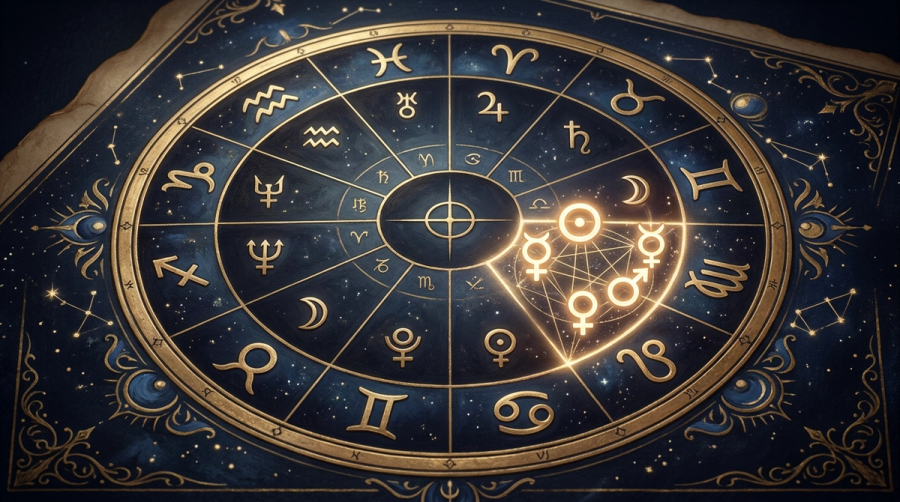
Astrological natal chart wheel with cluster of bright planetary symbols concentrated in one zodiac sign showing a stellium
What Is a Stellium and How Do You Calculate It?
A stellium in Western astrology is a concentration of three or more planets in one zodiac sign or one house of the natal chart. The most common rule counts three planets in a single sign as the threshold. To calculate one, you enter your birth date, exact birth time, and birth city into a stellium calculator that runs an ephemeris and groups the planets by sign and house.
The math itself is simple. The hard part is birth-time accuracy, because some of your "personal" planets - Mercury, Venus, Mars - change sign every few weeks, while the Moon changes sign every two and a half days. A small error in the birth time can move the Moon out of your stellium sign and dissolve the cluster.
Modern Western practice tends to count the ten classical chart bodies: Sun, Moon, Mercury, Venus, Mars, Jupiter, Saturn, Uranus, Neptune, Pluto. Some astrologers include the Ascendant, Midheaven, or Chiron when those land within a few degrees of a planet cluster. AstroSeek's explanation of natal chart aspects and configurations treats the stellium as a major configuration alongside grand trines and T-squares.
Robert Hand, in Planets in Transit and his later commentaries on natal patterns, described a stellium as a "concentration that bends the rest of the chart toward itself." That's the practical effect. The other planets in your chart still matter, but they're answering to the cluster.
How to Use a Stellium Calculator (Step by Step)
A stellium calculator works by computing your full natal chart and then counting how many planets sit in each sign and each house. The output tells you which signs hold three or more bodies and which houses hold the same. You'll want to follow a specific input sequence to get accurate results.
The workflow:
- Pull your birth certificate. Don't trust memory or family stories.
- Enter your birth date in the format the calculator asks for - most use month/day/year, but international tools may use day/month/year.
- Enter the exact birth time. If it says 11:47 PM, type 23:47. Don't round.
- Enter the birth city, not the state or country alone. The calculator needs coordinates and a time-zone lookup.
- Confirm the calculator is using historical Daylight Saving rules for your year. Older tools sometimes get DST wrong for births before 1980.
- Review the chart wheel and look for any sign or house holding three or more planet glyphs.
If you don't have an exact birth time, you can still get a partial answer. The Sun, Mercury, Venus, Mars, Jupiter, Saturn, Uranus, Neptune, and Pluto don't depend on birth time for their sign placement. The Moon and the Ascendant do. So a stellium that doesn't include the Moon will still be detectable from a date-only chart. A stellium that depends on the Moon won't.

Silhouette figure with beams of starlight converging into them representing how a stellium concentrates planetary energy in personality
You can run a full natal chart on MyNitya as part of onboarding - the platform calculates your Western chart with NASA-grade ephemeris data and feeds the stellium pattern into Nitya's analysis. If the cluster surfaces something unexpected, you can ask follow-up questions inside the same conversation. Ask your first question free on MyNitya.
For a fuller walkthrough of how to read what the calculator produces, the free birth chart analysis guide on MyNitya covers the rest of the chart wheel - Sun, Moon, rising, houses, and aspects - once your stellium is identified.
What Counts as a Stellium - 3, 4, or 5 Planets?
What counts as a stellium depends on which astrologer you ask. The mainstream Western standard is three or more planets in the same sign or house. Some traditionalists require four. A few strict schools require all three to be inner or personal planets. The three-planet rule is the most widely used and the one most modern stellium calculators apply.
The reason the threshold matters is that the strength of the effect scales with the number of planets. A three-planet stellium creates a noticeable theme. A four-planet stellium dominates the chart. A five-planet stellium can feel like the entire personality has been compressed into one sign's expression.
A simple breakdown:
- Three planets - A noticeable cluster. The sign's traits show up clearly in personality and life choices, but the rest of the chart still has room to breathe.
- Four planets - The sign becomes the chart's organizing principle. Other placements feel like satellites.
- Five planets - Rare and intense. The native often experiences themselves as "all" that sign, sometimes to the point of struggling to relate to people who don't share the configuration.
- Six or more - Very rare. Usually involves a major planetary alignment in the sky at the time of birth, like the 2020 Capricorn pile-up.
Cafe Astrology's reference page on planetary patterns notes that Marc Edmund Jones, in his work on chart shapes, classified the stellium as one of seven major chart patterns and treated it as the most "concentrated" of them all. Jones's Guide to Horoscope Interpretation (1941) treated this concentration as the chart's "focal determinator" - the placement that bends interpretation around itself.
A worked example: a chart with Sun, Mercury, Venus, and Mars all in Capricorn between 4° and 27° has a four-planet Capricorn stellium spanning most of the sign. The native carries Capricorn as identity (Sun), thought process (Mercury), values (Venus), and drive (Mars). Saturn, the ruler of Capricorn, becomes the most important planet in the chart even when it's placed elsewhere.
The Most Common Stelliums and What They Reveal
The most common stelliums in modern Western charts cluster in five signs: Capricorn, Scorpio, Pisces, Sagittarius, and Virgo. Each stellium produces a recognizable personality signature. Below is what each reveals when three or more personal planets gather there.
Capricorn Stellium - Driven, Structured, Often Workaholic
A Capricorn stellium creates a personality organized around achievement, structure, and the long view. Saturn rules Capricorn, and a stellium here means Saturn becomes the chart's center of gravity even when it's placed elsewhere. Capricorn stellium natives often feel "older than their age" as children and "younger than their age" as adults - the maturity comes early, the playfulness arrives late.
Career tends to dominate the early adult years. Productivity is the metric they measure themselves by, sometimes to a punishing degree. The 2020 conjunction of Jupiter, Saturn, and Pluto in Capricorn produced a small wave of Capricorn-stellium babies whose charts will keep this sign prominent through the 2040s.
Among MyNitya users with a Capricorn stellium in the 10th house, the most common first question is about why their career feels overwhelming despite professional success. The configuration produces external achievement and internal exhaustion at the same rate, and the disconnect is what brings people in.
If your stellium is in Capricorn and Saturn aspects it heavily, the Saturn return calculator guide is worth reading - your Saturn return at 28-30 will hit your stellium directly and reorganize the entire pattern.
Meet Nitya, your AI astrologer
She reads your birth chart to answer anything about your life - and she can go deep on any relationship you care about and guide your day ahead. First question free, no card needed.
Some questions our users ask Nitya
Tap any one below - or just write your own question in the form ↓
Scorpio Stellium - Intense, Transformative, Deeply Private
A Scorpio stellium concentrates depth, secrecy, and transformation. Three or more planets in Scorpio produce a person who can't do anything halfway. Relationships are all-in or absent. Work has to mean something or it can't be tolerated. Casual conversation feels like a foreign language.
Scorpio is co-ruled by Mars and Pluto in modern Western practice, and a stellium here often surfaces strong sexual, psychological, or investigative themes. Therapists, surgeons, researchers, financial analysts working with debt and inheritance - all overrepresented among Scorpio stellium charts I've seen.
The privacy isn't shyness. It's strategic. A Scorpio stellium native usually decides what other people get to know about them, and the deeper layers stay sealed unless trust is fully established.
Pisces Stellium - Psychic, Dreamy, Creative
A Pisces stellium creates a permeable, intuitive, often artistic personality. Pisces is the last sign of the zodiac, and a cluster here makes the native unusually receptive to other people's emotions, undercurrents, and atmospheres. Boundaries are the lifelong work.
These charts tend toward creative or healing professions - music, film, therapy, contemplative spirituality, addiction work. The shadow side is escapism, and a Pisces stellium that's hard-aspected by Saturn or Neptune can struggle with substance use or fantasy as a coping pattern.
The classical Western reading of Pisces - the sign of the dissolution of ego - applies even more strongly when three or more planets gather there. Decisions are made by feel rather than analysis, and the analysis often comes after the fact as a justification.
Sagittarius Stellium - Philosophical, Restless, Big-Picture
A Sagittarius stellium produces a wide-angle, meaning-seeking, geographically restless personality. Travel is rarely optional. Higher education, publishing, religion, philosophy, foreign cultures - these are the natural Sagittarius stellium domains.
The shadow is over-promising and under-delivering. Sagittarius lives in possibility, and a stellium here can mean a person who starts ten projects, finishes two, and feels misunderstood when the other eight collapse. The freedom to roam is so important that committed structure feels like prison until they consciously choose it.
Jupiter rules Sagittarius, so a Sagittarius stellium native should always check where Jupiter is placed in the chart - that single planet often explains the difference between a productive Sagittarius stellium and a chaotic one.
Virgo Stellium - Analytical, Perfectionist, Service-Oriented
A Virgo stellium creates a precise, observant, improvement-focused personality. Three or more planets in Virgo and the native sees the flaw in any system within the first ten minutes. They also feel responsible for fixing it, which is where the burnout pattern starts.
Health, craft, editing, teaching, organizing - these are typical Virgo stellium career zones. The internal critic can be brutal. The compliment they're most starved for is the one that says they don't have to earn their place by being useful.
For a deeper read on how the rest of the chart balances a Virgo stellium - particularly the Sun, Moon, and rising - the sun, moon, and rising sign calculator guide is the next read.
House Stelliums vs Sign Stelliums - The Difference Matters
A sign stellium is three or more planets in the same zodiac sign, while a house stellium is three or more planets in the same house of the chart. They're not the same thing, and the most powerful charts often have both - a stellium that lines up by sign and by house.
The distinction:
- Sign stellium - concentrates personality style. The cluster colors how the native expresses themselves, regardless of which life area is involved. A Scorpio stellium native is intense at work, intense in relationships, intense in their hobbies.
- House stellium - concentrates life area. The cluster pours energy into a specific arena of life. A 10th-house stellium pours it into career and public reputation. A 4th-house stellium pours it into family and home.
When a stellium falls in both a sign and a house - say, a Capricorn stellium in the 10th house - the effect compounds. The sign and the house are echoing each other, and the native's life looks "on theme" in a way that's hard to miss.
Cross-house stelliums also matter. A late-sign stellium can sit in the same sign but cross a house cusp, with one planet ending up in the next house. The cluster still functions as a sign stellium, but the life areas it touches widen.
The houses in the natal chart explained guide walks through what each of the twelve houses governs, which is essential before you can fully read what your house stellium is doing.
A common pattern I see in practice: a person has a clear sign stellium in Pisces but no house stellium, because the planets are spread across two adjacent houses. The personality reads as classic Pisces, but the life-area expression is split - say, between the 11th house of friendships and the 12th house of solitude. That split is the chart trying to tell them they need both.
What Outer Planet Stelliums Mean (Generational Patterns)
An outer-planet stellium - three or more of Jupiter, Saturn, Uranus, Neptune, and Pluto in one sign - is mostly a generational signature, not a personal one. The outer planets move slowly, so large groups of people born in the same multi-year window share the same outer-planet stellium. The personal effect kicks in only when those outer planets sit on or aspect a personal planet, the Ascendant, or the Midheaven.
The recent generational stelliums worth knowing:
- Capricorn 2020 - Jupiter, Saturn, and Pluto all in Capricorn from January through December 2020. Babies born in this window carry an unusually heavy Capricorn imprint that will shape their adult years through the 2050s.
- Aquarius 2023-2026 - Pluto entered Aquarius on March 23, 2023, returned to Capricorn, then re-entered on November 19, 2024 and is now settled there through January 19, 2044. From early 2023 onward, charts with Pluto in Aquarius and other Aquarian planets form a fresh generational cluster.
- Pisces 2025 - Saturn entered Pisces in March 2023 and Neptune entered Pisces in 2011. Until Saturn left Pisces on May 24, 2025, charts in this window held a Saturn-Neptune Pisces cluster that will shape a softer, more boundary-conscious cohort.
- Aries 2026 - Saturn ingressed Aries on May 24, 2025, and the Saturn-Neptune conjunction at 0° Aries on February 20, 2026 anchors a fresh Aries generational cluster for charts born around that date.
Astro.com's astrowiki entry on planetary cycles covers the math behind these generational windows, and they hold up reliably in practice.
The way to read your own outer-planet stellium is to check whether any of your personal planets - Sun, Moon, Mercury, Venus, Mars - are conjunct the outer cluster within five degrees. If yes, you carry the generational theme as a personal one. If no, you participate in it culturally but not biographically.
A 1988-1995 native with Uranus and Neptune both in Capricorn often shows the generational signature of structural disillusionment - a cohort that watched institutions fail in real time. It only becomes biographical if their personal planets are in Capricorn too.
How a Stellium Shapes Your Personality
A stellium shapes personality by concentrating a single sign's themes across multiple parts of the self. Whichever sign holds the cluster becomes the dominant operating system of the chart, even if the Sun, Moon, or rising sign is in a different sign entirely. The stellium native is "more" of that sign than a person with one or two planets there.
What this looks like day to day:
- Identity - The Sun-sign description doesn't fully fit. A Gemini Sun with a Capricorn stellium reads as serious, structured, and long-game-oriented, even though the Sun is supposed to be light and curious.
- Relationships - The native looks for partners who can either match the stellium's intensity or balance it. Both choices come with tradeoffs.
- Work - Career direction often follows the stellium's sign more than the Sun's. A Pisces stellium pulls toward creative, healing, or contemplative work regardless of Sun sign.
- Internal pacing - The stellium sets the rhythm of the inner life. A Sagittarius stellium can't sit still; a Virgo stellium can't stop refining; a Scorpio stellium can't stay on the surface.
The shadow side matters too. A stellium can produce a personality that's lopsided in one direction with no internal counterweight. A Virgo stellium with no air or fire can analyze itself into paralysis. A Pisces stellium with no earth can drift. A Capricorn stellium with no water can armor over.
This is also why two charts with the same Sun sign can feel like completely different people. If one has a stellium and the other doesn't, they're effectively reading from different scripts.
If your stellium sits near your North Node, the cluster's themes tie directly into your life-purpose path. The North Node calculator and life purpose guide covers how to read that overlap, which is one of the most useful interpretations a stellium chart offers.
Common Stellium Misconceptions
Stelliums are surrounded by a few persistent misconceptions that tend to trip up people reading their first chart. Clearing these up makes the rest of the interpretation honest.
Misconception 1 - "A stellium means I'm extra-powerful." It means concentration, not strength. A stellium gives you a lot of one sign's energy. Whether that energy is constructive or self-defeating depends on the aspects to the cluster, the placement of the sign's ruling planet, and the rest of the chart. Plenty of stellium natives experience the cluster as a burden until they learn how to channel it.
Misconception 2 - "A house stellium overrides a sign stellium." Neither overrides the other. They're describing different things. A sign stellium tells you the style of the cluster's expression. A house stellium tells you the life area it lives in. Both are valid layers, and many strong charts have one but not the other.
Misconception 3 - "The Sun being in the stellium makes it stronger." It does intensify the personal expression, because the Sun is identity. But a stellium that doesn't include the Sun can still be the chart's most defining feature - particularly if it includes Mercury, Venus, and Mars, the planets that actually run daily life.
Misconception 4 - "Outer-planet stelliums are always generational and don't matter personally." They're generational by default. But if an outer-planet stellium is conjunct the Ascendant or Midheaven within five degrees, or aspects the Sun or Moon tightly, it becomes biographically loud. Always check the angles.
Misconception 5 - "Stelliums make you destined for greatness." They make you concentrated. The decisions you make with that concentration determine what it builds. The chart describes the raw material. You build the structure.
Misconception 6 - "Counting Chiron, the asteroids, and the angles always makes more stelliums." Some calculators do this, which is why beginners sometimes think they have four stelliums. The mainstream Western reading uses the ten classical bodies - Sun through Pluto. Counting beyond that requires deliberate methodology.
If you're not sure whether your cluster is a real stellium or a calculator artifact, the cleanest test is to drop everything except Sun, Moon, Mercury, Venus, Mars, Jupiter, Saturn, Uranus, Neptune, and Pluto, and recount. That's the standard.
Frequently Asked Questions
Do I have a stellium?
You have a stellium if three or more of the ten classical chart bodies - Sun, Moon, Mercury, Venus, Mars, Jupiter, Saturn, Uranus, Neptune, Pluto - fall in the same zodiac sign or the same house in your natal chart. Run a free stellium calculator with your exact birth date, time, and city, then count the planets in each sign and house. Three is the threshold most modern Western astrologers use.
Can a stellium span two signs?
A stellium has to sit fully within one sign to count as a sign stellium. If three planets are spread across, say, late Capricorn and early Aquarius, that's not a single stellium - though they can still form a tight conjunction-by-degree pattern. House stelliums work differently because house cusps are the boundary, and a planet just past a cusp counts in the next house, not the previous one.
How rare is a stellium?
A three-planet sign stellium is fairly common - roughly one in five charts has one. Four-planet stelliums are less common, around one in fifteen. Five-planet stelliums are rare, often tied to specific multi-planet conjunctions in the sky. The exact rates depend on the years counted, because outer-planet groupings cluster generationally.
What's the difference between a stellium and a conjunction?
A conjunction is two planets within about 8 degrees of each other, regardless of sign. A stellium is three or more planets in the same sign or house. A stellium can contain conjunctions inside it, but the two terms describe different scales of pattern. Conjunctions are about pairs. Stelliums are about clusters.
Does the Moon need to be in the stellium for it to count?
No. The Moon's inclusion strengthens the emotional dimension of the stellium, but a stellium without the Moon is still a stellium. The threshold is three planets in one sign, regardless of which planets they are. That said, a stellium that includes the Sun, Moon, and Ascendant ruler is unusually integrated and tends to dominate the chart's expression.
Can a stellium change over time?
Your natal stellium is fixed for life. The transits and progressions that hit it change continuously, which is why a stellium can feel "active" in one decade and "quiet" in another. A Saturn return, a Pluto transit, or a major eclipse on the stellium degree can reorganize the cluster's expression without changing the underlying configuration.
A stellium isn't a label you check off and move on from. It's the part of your chart that the rest of your life will keep coming back to. Once you know which sign and house hold the cluster, the patterns you've been living usually start making sense in a way they didn't before.
The calculator does the math. The interpretation is yours, and it's worth taking seriously. A Capricorn stellium native who understands the configuration tends to build differently than one who doesn't. The same is true for every other sign.
If you want a real conversation about what your specific stellium means for the year ahead, chat with Nitya about your birth chart - try free. MyNitya supports both Western and Vedic astrology, so whether you want the psychological depth of Western or the timing precision of Vedic, the platform can read your stellium through either lens. Most stellium-curious users start with Western, then ask Vedic timing questions in the same conversation. That's a good way to see what each system contributes.
The cluster is already in your chart. The choice is whether you keep reading it as a coincidence or start using it as a map.
Nitya isn't a one-time horoscope. She's with you for the whole journey.
Understand yourself
Career, love, money, timing - any decision you are weighing. Answers read straight from your birth chart.
Understand any relationship
Add your partner, a parent, a friend, even a colleague. Nitya reads both charts together to explain the bond, the friction, and how to work through it.
Guidance for every day
Start each morning knowing what the day favors, what to watch for, and the best moments to act.
No card needed. Nitya just needs your birth details to read your chart.