Free Birth Chart Analysis Online - How to Read Your Natal Chart (2026)
In this Article
A free birth chart analysis maps the exact positions of all planets at the moment you were born and interprets what those positions mean for your personality, relationships, career, and life timing. To get one, you need your birth date, birth time, and birth location. The analysis reveals far more than your Sun sign - it covers your Moon sign, Rising sign, planetary houses, aspects, and (in Vedic astrology) nakshatras and dasha periods.
You've probably seen your horoscope in a magazine or on an app. Maybe you know you're a Taurus or a Sagittarius. But that single data point - your Sun sign - is like knowing someone's first name and thinking you know their whole story. A birth chart analysis gives you the full picture: the emotional patterns you can't explain, the career instincts that don't match your Sun sign, the relationship dynamics that keep repeating.
Your personal astrologer - Vedic + Western.
Reads all 10,000+ points of your birth chart to answer your question. First question free, no card needed.
Ask your question free →The good news? You don't need to pay $200 for a professional astrologer to get started. There are genuinely useful free tools available - and some of them are remarkably good.
Key Takeaways: A birth chart (also called a natal chart or Kundali) requires your exact birth date, time, and location. It maps all planetary positions across 12 houses and 12 signs. The three most important placements are your Sun sign (identity), Moon sign (emotions), and Ascendant/Rising sign (how others see you). Vedic birth charts add nakshatras, dashas, and divisional charts for deeper precision. Free tools vary widely in accuracy - always check whether a platform uses the Swiss Ephemeris calculation engine.
What Is a Birth Chart Analysis?
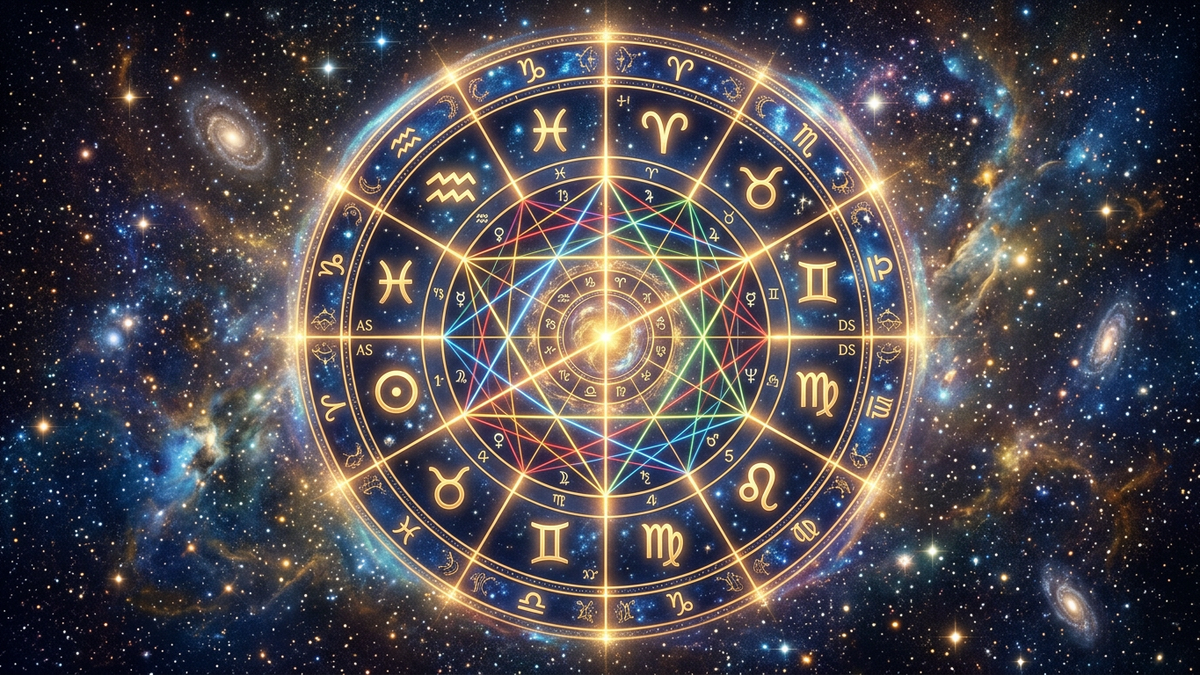
A birth chart analysis is the interpretation of a natal chart - a map of the sky at the exact moment and location of your birth. It shows where each planet was positioned relative to the zodiac signs and the twelve houses, and what those positions mean for your life.
Think of it this way: the planets are the actors, the signs are the costumes they wear, and the houses are the stages where they perform. Mars always represents drive and aggression - but Mars in Aries (its home sign) expresses that energy directly and physically, while Mars in Libra channels it through diplomacy and partnership. Same planet, completely different behavior.
A complete birth chart analysis covers:
- Planetary positions - which sign and house each planet occupies
- The Ascendant (Rising sign) - the zodiac sign on the eastern horizon at birth, which sets the entire house structure
- Aspects - the angular relationships between planets (conjunctions, trines, squares, oppositions)
- House rulerships - which planet rules each house and where that ruler sits
- In Vedic astrology: nakshatras (27 lunar mansions), Vimshottari Dasha periods (planetary timing cycles), and divisional charts (Navamsa, Dasamsa, etc.)
The birth chart is calculated once and never changes - it's a fixed snapshot. But its interpretation evolves as you move through different planetary periods and transits activate different parts of your chart.
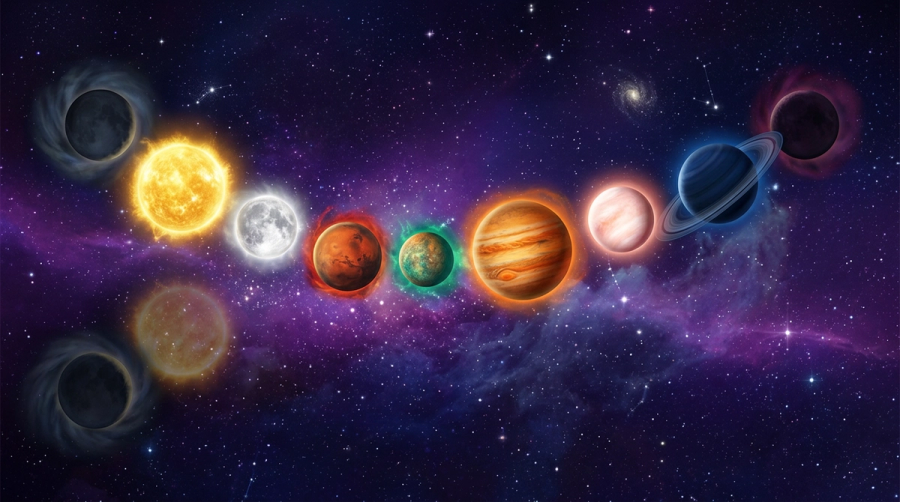
Nine planets of Vedic astrology from Sun to Ketu arranged across cosmic space
How to Get a Free Birth Chart Analysis Online
Getting a free birth chart analysis online takes about 2 minutes. You need three pieces of information, and the accuracy of your reading depends entirely on how precise they are.
What you need:
- Birth date - month, day, and year. This determines which signs the planets were in.
- Birth time - as exact as possible. This determines your Ascendant and house placements. Even 15 minutes can shift your Rising sign.
- Birth location - city and country. This determines the exact angles and house cusps based on latitude and longitude.
Where to find your birth time:
- Birth certificate (many US states and countries record it)
- Hospital records
- Family members who were present
- Baby books or journals
Step-by-step process:
- Gather your birth date, time, and location
- Choose a birth chart platform (see comparison below)
- Enter your details into the calculator
- Review your chart - look for your Sun, Moon, and Rising sign first
- Read the interpretation for each placement
The quality of the interpretation varies enormously between platforms. Some give you a raw chart with no explanation. Others provide template-based reports. And a few - like MyNitya - let you ask specific questions and get answers grounded in your actual chart data.
Free Birth Chart Tools Compared - What Each One Actually Gives You
Not all free birth chart tools are created equal. Here's what you actually get from each major platform:
Astro.com (Astrodienst)
Generates the most technically precise Western tropical charts available for free. Uses the Swiss Ephemeris engine. But the free experience gives you a chart wheel with no interpretation - you need to already understand astrology to make sense of it. Best for intermediate and advanced users who want raw data.
Cafe Astrology
Offers free natal chart reports with written interpretations for each placement. The reports are template-based (the same Venus in Scorpio paragraph for everyone with that placement), but they're well-written and educational. Good starting point for beginners learning Western astrology.
AstroSage
The go-to platform for free Vedic Kundli generation. Provides detailed charts with Vimshottari Dasha calculations, Shadbala, and dosha analysis. Reports are static and text-heavy, but the Vedic calculation depth is solid. Best for users who want traditional Jyotish charts.
MyNitya
Takes a different approach entirely. Instead of generating a static report, MyNitya calculates your full Vedic birth chart using Swiss Ephemeris precision (6,000+ data points including nakshatras, dashas, and divisional charts) and then lets you chat with Nitya - an AI astrologer who reads your specific chart and answers your questions in conversation. Your first question is free. Best for users who want personalized answers, not generic reports.
TimePassages (Astrograph)
Provides a free natal chart with color-coded interpretations by astrologer Henry Seltzer. The Western tropical interpretations are thoughtful and well-written. The free version covers basic placements; detailed reports require payment. Good for beginners who want guided Western chart reading.
How to Read Your Birth Chart - The 5 Essential Steps
Reading a birth chart follows a specific sequence. Professional astrologers don't read charts randomly - they start with the most important points and work outward. Here's the process.
Step 1: Start with your Ascendant
Your Ascendant (Rising sign, or Lagna in Vedic astrology) is the single most important point in your chart. It's the zodiac sign that was rising on the eastern horizon at your birth, and it determines which sign rules each of your twelve houses.
The Ascendant shapes your outward personality, physical appearance tendencies, and instinctive approach to life. In Vedic astrology, the Ascendant lord (the planet that rules your Rising sign) becomes one of the most important planets in your entire chart.
Your Rising sign changes every 2 hours - which is why birth time is so critical for an accurate chart.
Step 2: Find your Moon sign and nakshatra
Your Moon sign reveals your emotional nature, instincts, and subconscious patterns. In Vedic astrology, the Moon is considered more important than the Sun because it governs the mind (manas).
The Moon's nakshatra adds precision that sign-level analysis can't provide. Two people with Moon in Cancer will have very different emotional profiles depending on whether their Moon falls in Punarvasu nakshatra (optimistic, philosophical) or Ashlesha nakshatra (intuitive, psychologically intense).
Step 3: Check your Sun sign placement
Meet Nitya, your AI astrologer
She reads your birth chart to answer anything about your life. Your first complete answer is free, with no card required. Continued chat, Synastry, and Daily Guidance require Premium.
Questions you can ask about this topic
Tap any one below - or just write your own question in the form ↓
Nitya isn't a one-time horoscope. She's with you for the whole journey.
Understand yourself
Career, love, money, timing - any decision you are weighing. Answers read straight from your birth chart.
Understand any relationship
Add your partner, a parent, a friend, even a colleague. Nitya reads both charts together to explain the bond, the friction, and how to work through it.
Guidance for every day
Start each morning knowing what the day favors, what to watch for, and the best moments to act.
No card needed. Nitya just needs your birth details to read your chart.
Ask Nitya your first question - free →Your Sun sign represents your core identity and life purpose. Note both the sign and the house it occupies. Sun in Leo in the 10th house creates a very different person than Sun in Leo in the 4th house - same identity energy, completely different life focus.
Step 4: Map the remaining planets
Look at where each planet falls by sign and house:
- Mercury - how you think and communicate
- Venus - how you love and what you find beautiful
- Mars - how you take action and handle conflict
- Jupiter - where you find growth, wisdom, and luck
- Saturn - where you face challenges and build discipline
- Rahu (North Node) - your karmic direction and worldly ambitions
- Ketu (South Node) - your past-life talents and spiritual detachment
Step 5: Look at planetary periods and timing
This is where Vedic astrology pulls far ahead of Western approaches. The Vimshottari Dasha system divides your life into planetary periods determined by your Moon's nakshatra at birth. Each planet "rules" a specific stretch of years, activating its themes.
If you're in a Venus dasha, themes of love, beauty, and relationships dominate. If you're in a Saturn dasha, themes of discipline, hard work, and karmic lessons take center stage. Knowing your current dasha transforms a static chart into a dynamic life roadmap.
Among charts analyzed on MyNitya, users in their Saturn Mahadasha who also have Saturn in the 7th house consistently report relationship delays that resolve once the dasha shifts - a pattern described in the Brihat Parashara Hora Shastra's teachings on Saturn's temporal influence over the 7th bhava.
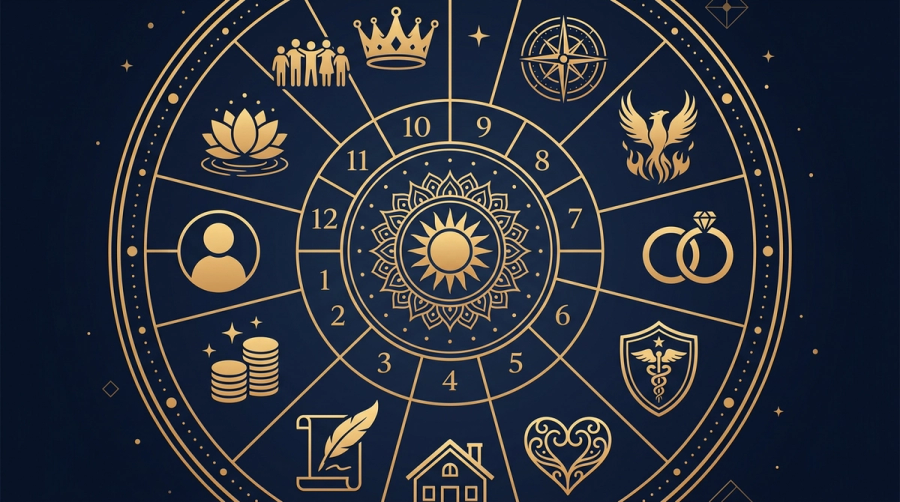
Twelve astrological houses wheel diagram with symbolic icons for each life area
The 12 Houses - Where Life Happens in Your Chart
The 12 houses represent different areas of your life. Planets in a house activate that area; the sign on the house cusp colors how those themes express. Here's what each house governs:
- 1st House (Lagna) - Self, identity, physical body, personality
- 2nd House (Dhana) - Wealth, speech, family values, food
- 3rd House (Sahaja) - Courage, siblings, communication, short travel
- 4th House (Sukha) - Home, mother, emotional security, property
- 5th House (Putra) - Creativity, romance, children, intelligence
- 6th House (Ripu) - Health, daily work, enemies, obstacles
- 7th House (Kalatra) - Marriage, partnerships, open enemies
- 8th House (Ayur) - Transformation, inheritance, hidden depths, sexuality
- 9th House (Dharma) - Higher learning, philosophy, luck, father
- 10th House (Karma) - Career, reputation, public life, achievements
- 11th House (Labha) - Gains, friendships, social networks, fulfilled desires
- 12th House (Vyaya) - Spirituality, losses, foreign lands, liberation
Empty houses aren't "missing" anything. They simply mean no planet was in that sign at your birth. The house still functions - you just look at the sign on the cusp and where its ruling planet sits to understand how that life area operates for you.
For a deeper dive into specific houses, see our guides on the 5th house and wealth indicators in your chart.
Why Vedic Birth Chart Analysis Goes Deeper
Vedic birth chart analysis (Jyotish) includes several layers that Western astrology doesn't offer. These aren't minor additions - they fundamentally change the depth and specificity of what a chart reading can tell you.
Nakshatras - 27 lunar mansions
The 27 nakshatras divide the zodiac into segments of 13 degrees 20 minutes each - far more precise than the 30-degree signs. Each nakshatra has its own ruling deity, planetary ruler, and psychological profile. Your Moon's nakshatra is particularly important because it determines your Vimshottari Dasha sequence.
Vimshottari Dasha - planetary timing
The dasha system maps a 120-year cycle of planetary periods based on your Moon's nakshatra at birth. It tells you which planet is "activated" at any given time, making predictions far more specific than Western transit-based timing. Knowing you're in a Jupiter-Venus sub-period, for example, tells an astrologer that themes of growth meeting love, wisdom meeting beauty, and expansion meeting pleasure are active right now.
Divisional charts - zooming in
Vedic astrology uses divisional charts (Vargas) that zoom into specific life areas. The Navamsa (D9) reveals the deeper truth of relationships and spiritual purpose. The Dasamsa (D10) focuses on career. A planet that looks weak in the main chart might be strong in the Navamsa, suggesting hidden potential that emerges through relationships or later in life.
Yogas - planetary combinations
Vedic astrology identifies hundreds of yogas - specific planetary combinations that produce defined results. Gajakesari Yoga (Jupiter in a kendra from Moon) brings wisdom and social respect. Dhana Yoga (lords of wealth houses connecting) indicates financial prosperity. The presence of a yoga doesn't guarantee results - its activation depends on the current dasha period.
This layered approach is why Vedic chart analysis can be remarkably specific. It's not just "you're a Scorpio" - it's "your Moon in Anuradha nakshatra in the 4th house during Saturn Mahadasha suggests a period of emotional deepening through family responsibilities, with relief coming when the Mercury sub-period begins in late 2026."
Curious what your Vedic birth chart reveals? Ask your first question free on MyNitya.
Common Birth Chart Patterns and What They Mean
Certain configurations appear frequently in birth charts and carry well-established meanings. Recognizing these helps you quickly identify the major themes in any chart.
Stellium - 3 or more planets in one sign or house
A stellium concentrates energy in one life area. Three planets in the 10th house creates someone whose identity is deeply tied to career. Three planets in the 7th house creates someone whose life revolves around partnerships. Stelliums create intensity and focus - but also potential imbalance.
Retrograde planets
When a planet is retrograde in your birth chart, its energy turns inward. Retrograde Mercury processes information differently - often more deeply but with communication challenges. Retrograde Venus may struggle with expressing affection openly but develops a rich inner aesthetic life. About 80% of people have at least one retrograde planet.
Exalted and debilitated planets
Each planet has a sign where it functions at peak strength (exaltation) and a sign where it struggles (debilitation). Jupiter exalted in Cancer brings abundant wisdom. Jupiter debilitated in Capricorn may struggle with rigid beliefs. But debilitation isn't destiny - aspects from benefic planets or strength in the Navamsa can cancel debilitation effects.
Combustion
When a planet is too close to the Sun (within a few degrees), it's considered "combust" - its energy is overwhelmed by the Sun's brightness. A combust Mercury can create communication difficulties. A combust Venus can make it harder to express love openly. The exact degree of combustion matters - closer to the Sun means stronger effect.
What Your Birth Chart Can and Cannot Tell You
A birth chart is a powerful tool for self-understanding, but it has limits. Being honest about those limits is what separates genuine astrology from fortune-telling.
What a birth chart CAN tell you:
- Your personality tendencies and psychological patterns
- Your emotional needs and relationship dynamics
- Career strengths and natural talents
- Timing windows when certain themes are likely to activate (through dashas and transits)
- Areas of life that require extra attention or effort
- Karmic patterns and spiritual growth directions
What a birth chart CANNOT tell you:
- Exact future events with certainty
- Whether you'll marry a specific person
- Lottery numbers or exact financial outcomes
- Medical diagnoses (astrology is not medicine)
- Fixed destiny that can't be influenced by your choices
The Vedic tradition is clear on this: a birth chart shows the terrain, not the path. Saturn in the 7th house during Sade Sati indicates relationship challenges - but whether those challenges break you or strengthen you depends on your awareness and choices. Astrology illuminates patterns. You decide what to do with that knowledge.
Chat with Nitya about your birth chart - try free on MyNitya.
Frequently Asked Questions
How do I get a free birth chart analysis?
To get a free birth chart analysis, enter your birth date, exact birth time, and birth location into a birth chart calculator online. Astro.com provides free Western tropical charts. AstroSage offers free Vedic Kundli generation. MyNitya calculates your full Vedic chart with 6,000+ data points and lets you ask Nitya - your AI astrologer - one question free. The quality of interpretation varies significantly between platforms.
What does my birth chart tell me?
Your birth chart tells you about your personality patterns, emotional needs, relationship tendencies, career strengths, and the timing of major life themes. It maps the positions of all planets at your birth across twelve houses (life areas) and twelve signs (expression styles). In Vedic astrology, it also includes nakshatras, dasha periods, and divisional charts that add layers of specificity a Sun sign reading can't provide.
Is birth time really necessary for a birth chart?
Birth time is essential for an accurate birth chart. Without it, your Ascendant (Rising sign) - which changes every 2 hours - cannot be calculated, and the entire house structure becomes unreliable. You can still determine your Sun sign (from birth date) and approximate Moon sign, but the most personalized and useful parts of a chart reading require precise birth time. Check your birth certificate or hospital records.
What's the difference between a natal chart and a birth chart?
A natal chart and a birth chart are the same thing - different names for the same astrological map. "Natal chart" comes from the Latin "natalis" (relating to birth). In Vedic astrology, it's called a Kundali or Janam Kundli. All three terms refer to the chart of planetary positions at the exact moment and location of your birth.
How accurate are free online birth chart calculators?
Accuracy depends on the calculation engine. Platforms using the Swiss Ephemeris - the gold standard developed by Astrodienst - achieve precision of 0.001 arcseconds calibrated to NASA JPL data. In a benchmark of 15 astrology APIs, 4 failed against the Swiss Ephemeris reference. Always verify what engine a platform uses. Astro.com, MyNitya, and TimePassages all use the Swiss Ephemeris.
Can AI read my birth chart as well as a human astrologer?
The best AI astrology platforms can match human astrologers for chart interpretation and pattern recognition. MyNitya's AI astrologer Nitya analyzes over 6,000 Vedic data points from your chart - including nakshatras, dashas, yogas, and divisional charts - and answers your specific questions in conversation. Where human astrologers still excel is in intuitive reading and therapeutic presence. AI's advantage is instant availability, multiple languages, and a fraction of the $100-$300 cost of a human session.