How to Find Your Sun, Moon, and Rising Signs - Complete Guide (2026)
In this Article
Sun Sign and Estimated Moon Sign Calculator
Your birth date gives your Sun sign and an estimated Moon sign. An exact Moon needs your birth time, while Rising also requires your birthplace.
Your Sun sign, Moon sign, and Rising sign are the three most important placements in your birth chart. To find them, you need your exact birth date (Sun sign), birth date plus birth time (Moon sign), and birth date, time, and location (Rising sign). Together, they're called your "Big Three" - and they shape your personality far more accurately than your Sun sign alone.
You've probably been asked "What's your sign?" a hundred times. And you've probably answered with your Sun sign - Aries, Virgo, Sagittarius, whatever falls on your birthday. But that's only a third of the picture. Your Moon sign governs your emotional world, and your Rising sign shapes how everyone else experiences you. Knowing all three is the difference between reading a headline and reading the full story.
Your personal astrologer - Vedic + Western.
Reads all 10,000+ points of your birth chart to answer your question. First question free, no card needed.
Ask your question free →Here's the frustrating part: most horoscope sites only talk about your Sun sign. That means the daily horoscope you've been reading applies to roughly 650 million other people. Your Big Three narrows that down to you.
Key Takeaways: Your Sun sign is determined by your birth date alone. Your Moon sign requires your birth date and approximate time. Your Rising sign (Ascendant) requires your exact birth date, time, and location - it changes every 2 hours. In Vedic astrology, the Moon sign and Rising sign (Lagna) are considered more important than the Sun sign. On MyNitya, all three are calculated automatically using Swiss Ephemeris precision when you enter your birth details.
How to Find Your Sun Sign
Your Sun sign is the zodiac sign the Sun occupied on the day you were born. It represents your core identity, ego, and life purpose - the qualities you're actively developing throughout your lifetime.
Finding your Sun sign is the easiest of the three. You only need your birth date. Here are the Western tropical dates:
- Aries: March 21 - April 19
- Taurus: April 20 - May 20
- Gemini: May 21 - June 20
- Cancer: June 21 - July 22
- Leo: July 23 - August 22
- Virgo: August 23 - September 22
- Libra: September 23 - October 22
- Scorpio: October 23 - November 21
- Sagittarius: November 22 - December 21
- Capricorn: December 22 - January 19
- Aquarius: January 20 - February 18
- Pisces: February 19 - March 20
But here's something most sites won't tell you: if you use Vedic (sidereal) astrology, your Sun sign is likely one sign back from the Western one. The sidereal zodiac is aligned to the actual star constellations, while the tropical zodiac is fixed to the seasons. They've drifted about 24 degrees apart over the centuries due to the precession of the equinoxes.
So if you're a Western Gemini (born June 5), you're likely a Vedic Taurus. Many people who never resonated with their Western Sun sign find their Vedic placements feel far more accurate.
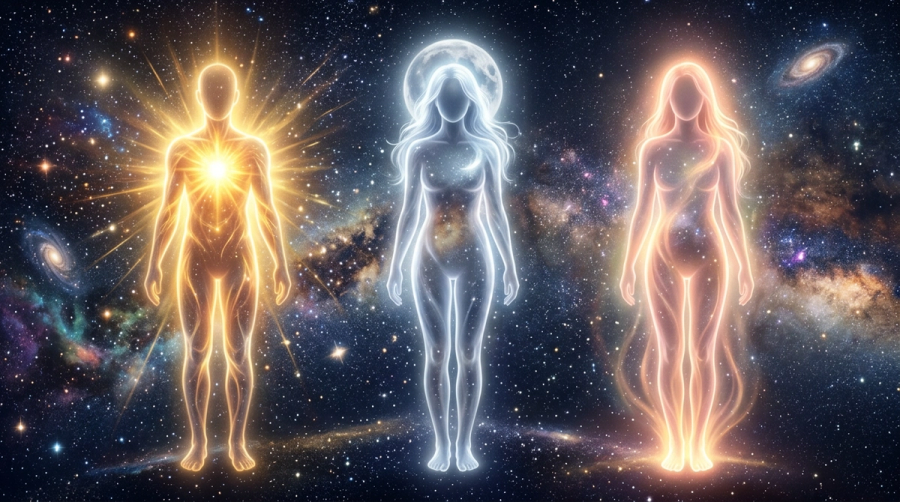
Three glowing silhouettes representing Sun sign, Moon sign, and Rising sign energies
How to Find Your Moon Sign
Your Moon sign is the zodiac sign the Moon occupied at the time of your birth. It governs your emotional nature, instincts, comfort needs, and subconscious patterns - the inner world you don't always show to others.
Finding your Moon sign requires your birth date and your approximate birth time. The Moon moves through each zodiac sign in about 2.5 days, so if you were born on a day when the Moon changed signs, the time matters.
Step-by-step to find your Moon sign:
- Gather your birth date and approximate birth time (even a 2-hour window helps)
- Use a birth chart calculator that shows Moon sign placement
- Enter your details and look for "Moon in [Sign]" in the results
The Moon sign is where Vedic and Western astrology diverge most dramatically in emphasis. In Western astrology, the Sun sign gets top billing. In Vedic astrology (Jyotish), the Moon sign is considered the primary indicator of personality and emotional wellbeing. The Brihat Parashara Hora Shastra - one of the foundational texts of Vedic astrology - places the Moon's strength as the primary indicator of mental and emotional health.
This is why your Vedic horoscope is typically read from your Moon sign, not your Sun sign. And it's why Vedic astrology goes a step further with nakshatras - the 27 lunar mansions that divide the zodiac into segments of 13 degrees 20 minutes each. Your Moon's nakshatra adds a layer of precision that Western astrology simply doesn't have.
For example, two people with Moon in Scorpio will have very different emotional natures if one has Moon in Vishakha nakshatra (driven, goal-oriented, intensely focused) and the other in Anuradha nakshatra (devoted, loyal, emotionally deep). Same Moon sign. Different emotional fingerprint.
Among charts analyzed on MyNitya, users with Moon in Rohini nakshatra consistently report heightened emotional sensitivity and a strong connection to beauty and comfort - a pattern that aligns with Rohini's Venusian rulership described in classical Jyotish texts.
How to Find Your Rising Sign (Ascendant)
Your Rising sign - also called the Ascendant or Lagna in Vedic astrology - is the zodiac sign that was rising on the eastern horizon at the exact moment and location of your birth. It's the most time-sensitive placement in your chart, changing approximately every 2 hours.
The Rising sign shapes your outward personality, physical appearance tendencies, first impressions, and instinctive approach to new situations. It's often more visible to others than your Sun sign, especially when they first meet you. Think of it as the lens through which the rest of your chart expresses itself.
What you need to find your Rising sign:
- Exact birth date - month, day, year
- Exact birth time - as precise as possible (even 15 minutes can change it)
- Birth location - city and country (for latitude, longitude, and time zone calculations)
The birth time is non-negotiable for an accurate Rising sign. Because the Ascendant shifts every 2 hours, a birth time of "sometime in the afternoon" isn't precise enough. If you don't know your exact birth time, check your birth certificate, hospital records, or ask family members. Some countries routinely record birth time; others don't.
Without an accurate birth time, you can still know your Sun and Moon signs (with some uncertainty for Moon on sign-change days). But the Rising sign - and the entire house structure of your chart - becomes unreliable.
Meet Nitya, your AI astrologer
She reads your birth chart to answer anything about your life. Your first complete answer is free, with no card required. Continued chat, Synastry, and Daily Guidance require Premium.
Questions you can ask about this topic
Tap any one below - or just write your own question in the form ↓
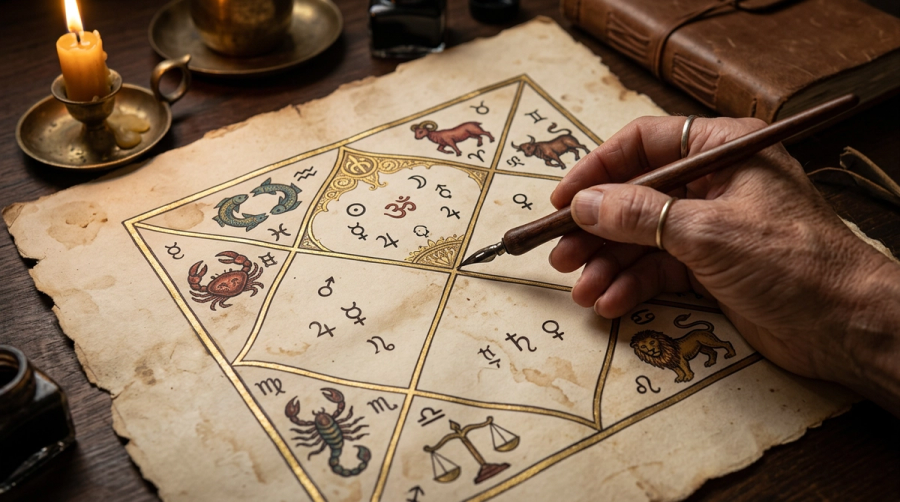
Hand pointing to ascendant position on a traditional Vedic birth chart drawn on parchment
Why the Rising sign matters so much
In Vedic astrology, the Rising sign (Lagna) is arguably the single most important point in your chart. Here's why: it determines which sign rules each of your twelve houses. And the houses are where life actually happens - career, relationships, health, finances, spirituality.
Change the Rising sign, and every house shifts. A person with Leo Rising has Aquarius ruling their 7th house of partnerships (attracting unconventional, independent partners). A person with Virgo Rising has Pisces ruling their 7th house (attracting dreamy, intuitive partners). Same person in every other way - but a completely different relationship pattern based on a 2-hour difference in birth time.
This is why accurate birth chart analysis requires precise birth time. And it's why platforms that calculate your Rising sign with Swiss Ephemeris precision - like MyNitya, which achieves 0.001-arcsecond accuracy calibrated to NASA JPL data - produce fundamentally more reliable charts than apps using simplified calculations.
What Your Big Three Actually Reveals About You
Your Sun, Moon, and Rising signs work together as a system. Understanding each one individually is useful, but understanding how they interact is where real self-knowledge begins.
Sun sign: Who you are
Your Sun sign represents your conscious identity - the qualities you're developing and expressing throughout your life. It's your ego, your vitality, your sense of purpose. When someone asks "who are you?" at your core, the Sun sign answers.
A Leo Sun is developing confidence, creativity, and leadership. A Pisces Sun is developing compassion, intuition, and spiritual connection. The Sun sign is your life's assignment.
Moon sign: How you feel
Your Moon sign represents your emotional nature - how you process feelings, what makes you feel safe, and your instinctive reactions when you're not performing for the world. It's the you that comes out at home, in private, in moments of vulnerability.
A Capricorn Moon processes emotions through structure and control - they need to feel productive to feel okay. An Aries Moon processes emotions through action - they need to do something about how they feel. Understanding your Moon sign explains emotional patterns that your Sun sign can't account for.
Rising sign: How others see you
Your Rising sign is your social mask - not in a fake way, but in the way that your face is the first thing people see before they know your thoughts. It governs first impressions, your physical mannerisms, and the energy you project into a room.
Someone with Scorpio Rising walks into a room and people notice intensity, depth, maybe a hint of mystery. Someone with Sagittarius Rising walks in and people notice warmth, humor, restlessness. Neither person is "being fake" - the Rising sign is a genuine part of who they are. It's just the outermost layer.
When the Big Three conflict
The most interesting charts are the ones where the Big Three pull in different directions. A Virgo Sun (analytical, detail-oriented) with an Aries Moon (impulsive, action-first) and a Pisces Rising (dreamy, empathetic) creates a person who thinks methodically, feels urgently, and appears gentle. That internal tension is real - and understanding it through your chart is genuinely liberating.
On MyNitya, Nitya doesn't just list your Big Three. She explains how they interact in your specific chart - including which one dominates based on planetary strength (Shadbala), house placement, and your current Vimshottari Dasha period. Chat with Nitya about your birth chart - try free on MyNitya.
Why Your Vedic Big Three May Differ from Your Western One
If you've looked up your signs on a Western astrology site and then checked a Vedic site, you may have gotten different results. This isn't an error. It's a fundamental difference in how the two systems measure the zodiac.
Western astrology uses the tropical zodiac, which fixes 0 degrees Aries to the spring equinox. Vedic astrology uses the sidereal zodiac, which aligns to the actual position of the star constellations. Due to the precession of the equinoxes - a slow wobble in Earth's axis - these two reference points have drifted about 24 degrees apart over the past 2,000 years.
The practical result: your Vedic signs are typically one sign back from your Western ones. A Western Gemini Sun might be a Vedic Taurus Sun. A Western Libra Rising might be a Vedic Virgo Rising.
Which system is "right"? Both are internally consistent. But the sidereal system has one objective advantage: it's aligned to where the stars actually are in the sky right now. When Vedic astrology says your Moon is in Scorpio, the Moon was physically in the Scorpio constellation at your birth. When Western astrology says your Moon is in Sagittarius for the same birth moment, it's using a mathematical framework that no longer corresponds to the visible sky.
Our Vedic vs Western astrology comparison covers this in depth. Many people who never connected with their Western signs find their Vedic placements resonate immediately.
How to Calculate Your Signs Without Birth Time
Not everyone knows their exact birth time. If that's you, here's what you can and can't determine:
What you CAN find without birth time:
- Sun sign - determined by birth date alone (100% accurate)
- Moon sign - accurate if the Moon didn't change signs on your birthday. If it did, you'll get two possible Moon signs. The Moon spends about 2.5 days in each sign, so roughly 1 in 5 people have a birth date where the Moon changed signs.
What you CANNOT find without birth time:
- Rising sign - impossible without birth time. The Ascendant changes every 2 hours, so without knowing when you were born, there are 12 possible Rising signs.
- House placements - the entire house structure depends on the Rising sign
- Accurate Moon sign on sign-change days
How to find your birth time:
- Birth certificate - many countries and US states record birth time
- Hospital records - contact the hospital where you were born
- Family members - parents or grandparents may remember
- Baby book or journal - some families record the time
- Rectification - an advanced astrological technique where an astrologer works backward from major life events to estimate your birth time
If you truly can't find your birth time, you can still get value from your Sun and Moon signs. But the Rising sign is what transforms a generic reading into a personal one. It's worth the effort to track down.
The Nakshatra Layer: Precision Beyond Signs
Vedic astrology adds a layer of precision that Western astrology doesn't offer: nakshatras. These are 27 lunar mansions that divide the zodiac into segments of 13 degrees 20 minutes each - far more specific than the 30-degree signs.
Your Moon's nakshatra is particularly important. It determines your Vimshottari Dasha sequence - the planetary period system that maps the timing of major life events across a 120-year cycle. It also adds psychological nuance that sign-level analysis can't capture.
Here's a concrete example. Three people all have Moon in Cancer. But:
- Moon in Punarvasu nakshatra (Cancer 0-3:20) - optimistic, philosophical, drawn to teaching and travel. Ruled by Jupiter.
- Moon in Pushya nakshatra (Cancer 3:20-16:40) - nurturing, protective, deeply caring but sometimes controlling. Ruled by Saturn.
- Moon in Ashlesha nakshatra (Cancer 16:40-30:00) - intuitive, psychologically perceptive, intense emotional depth. Ruled by Mercury.
Same Moon sign. Three completely different emotional profiles. This is why Vedic astrology practitioners consider nakshatra placement essential for accurate personality analysis - and why platforms that include nakshatra data in their calculations provide fundamentally richer readings.
On MyNitya, your Moon's nakshatra is calculated automatically as part of the 6,000+ data points analyzed from your birth chart. Nitya uses this information when answering your questions about emotional patterns, relationship dynamics, and life timing. Get personalized guidance based on your birth chart on MyNitya.
Frequently Asked Questions
How do I find my 3 zodiac signs?
To find your three zodiac signs (Sun, Moon, and Rising), enter your birth date, exact birth time, and birth location into a birth chart calculator. Your Sun sign comes from your birth date. Your Moon sign requires your birth date and time. Your Rising sign requires all three - date, time, and location. On MyNitya, all three are calculated automatically using Vedic sidereal positions when you enter your birth details. Ask your first question free on MyNitya.
Can I find my Rising sign without birth time?
No. Your Rising sign (Ascendant) changes approximately every 2 hours, so without knowing your exact birth time, there are 12 possible Rising signs. Check your birth certificate, hospital records, or ask family members for your birth time. If you truly can't find it, your Sun and Moon signs still provide valuable insight, but the Rising sign is what makes a chart reading truly personal.
Why is my Vedic sign different from my Western sign?
Your Vedic sign differs from your Western sign because the two systems use different zodiac frameworks. Western astrology uses the tropical zodiac (fixed to the seasons), while Vedic astrology uses the sidereal zodiac (aligned to actual star constellations). Due to the precession of the equinoxes, they've drifted about 24 degrees apart, which typically shifts your Vedic signs one sign back from your Western ones.
Which is more important - Sun sign, Moon sign, or Rising sign?
In Western astrology, the Sun sign is traditionally emphasized. In Vedic astrology, the Moon sign and Rising sign (Lagna) are considered more important. The Moon governs the mind and emotions, while the Lagna sets the entire house structure of your chart. For the most complete picture, all three matter - they work as a system, not in isolation. Your birth chart interpretation should account for all three.
What does it mean if my Sun and Moon are in the same sign?
When your Sun and Moon occupy the same sign, your conscious identity and emotional nature are aligned. You tend to be more internally consistent - what you want and what you feel pull in the same direction. In Vedic astrology, this occurs when you're born near a new Moon (Amavasya). It can intensify the qualities of that sign but may also create blind spots, since there's less internal tension pushing you to develop other qualities.
How accurate are online birth chart calculators?
Accuracy depends on the astronomical engine behind the calculator. Platforms using the Swiss Ephemeris - like MyNitya - achieve precision of 0.001 arcseconds, calibrated to NASA JPL ephemeris data. This is the same standard used by professional astrologers and astronomical researchers. Apps using simplified calculations can drift by several degrees, potentially placing planets in the wrong sign or house. Always check what calculation engine a platform uses before trusting its results.
Nitya isn't a one-time horoscope. She's with you for the whole journey.
Understand yourself
Career, love, money, timing - any decision you are weighing. Answers read straight from your birth chart.
Understand any relationship
Add your partner, a parent, a friend, even a colleague. Nitya reads both charts together to explain the bond, the friction, and how to work through it.
Guidance for every day
Start each morning knowing what the day favors, what to watch for, and the best moments to act.
No card needed. Nitya just needs your birth details to read your chart.
Ask Nitya your first question - free →