What Is My Astrological Birth Chart? Everything Your Chart Reveals About You
In this Article
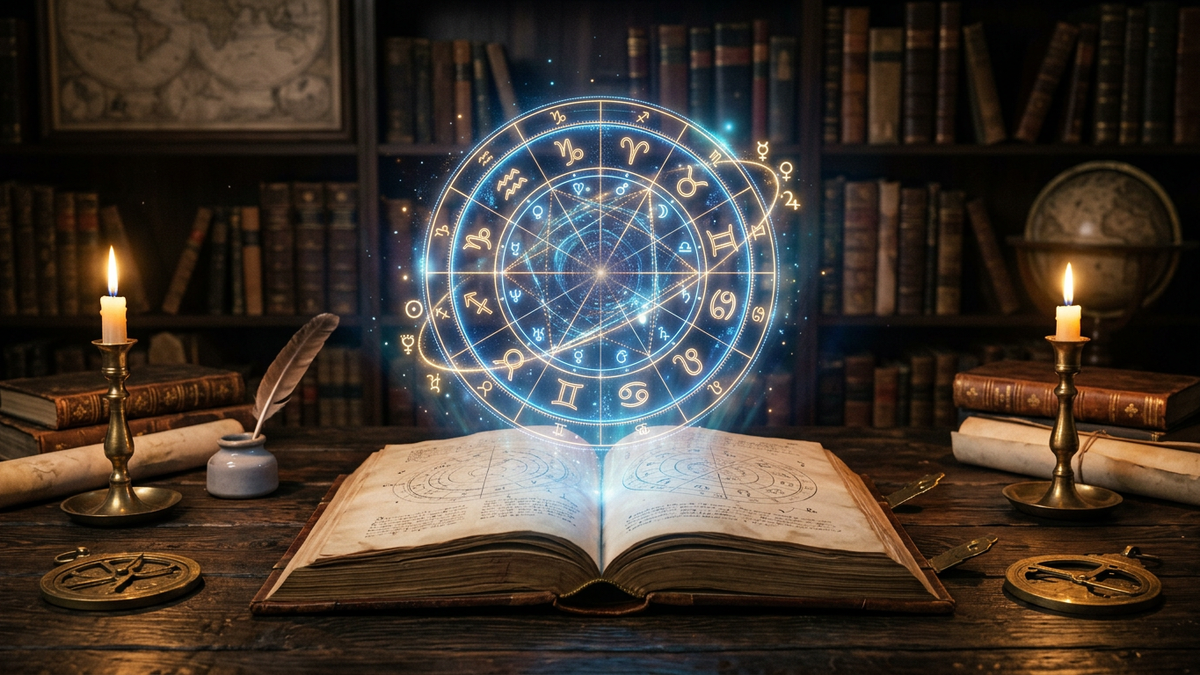
Your astrological birth chart is a complete map of the sky at the exact moment and location you were born. In Vedic astrology (Jyotish), this chart - called a Kundali or Janam Kundli - reveals virtually everything about your life: your personality, emotional patterns, career path, marriage timing, health vulnerabilities, wealth potential, children, spiritual growth, past-life karma, and the precise timing of when major events are likely to unfold. All you need is your birth date, exact birth time, and birth location.
Most people think astrology means reading a horoscope column about their zodiac sign. That's like thinking medicine means checking your temperature. Your Sun sign is one data point. Your Vedic birth chart contains nine planets, twelve houses, twelve signs, twenty-seven nakshatras, dozens of aspects, hundreds of yogas, and sixteen divisional charts - each one zooming into a different dimension of your life. The total number of unique combinations runs into the billions. No two charts are identical unless two people are born at the exact same second in the exact same location.
Your personal astrologer - Vedic + Western.
Reads all 10,000+ points of your birth chart to answer your question. First question free, no card needed.
Ask your question free →This isn't a personality quiz. It's a mathematical model of the cosmos at your birth, calculated using the same astronomical data NASA uses for planetary positions. And in the hands of Vedic astrology's interpretive framework - refined over thousands of years - it becomes the most detailed personal blueprint you'll ever encounter.
Key Takeaways: A Vedic birth chart (Kundali) maps all planetary positions at your birth across 12 houses, 12 signs, and 27 nakshatras. It reveals personality, career, marriage, health, wealth, children, travel, spiritual path, and past-life karma. The Vimshottari Dasha system predicts when events unfold across a 120-year timeline. Sixteen divisional charts (Vargas) zoom into specific life areas - the Navamsa (D9) for marriage, Dasamsa (D10) for career, Saptamsa (D7) for children. Your chart is calculated once and never changes, but its interpretation evolves as you move through different planetary periods.
What a Birth Chart Actually Contains
A birth chart is a snapshot of the solar system frozen at your birth moment, viewed from your birth location. In Vedic astrology, it contains several interconnected layers that work together to paint a complete picture of your life.
The nine planets (Navagraha)
Vedic astrology uses nine celestial bodies, each governing specific life domains:
- Sun (Surya) - soul, identity, father, authority, vitality, government
- Moon (Chandra) - mind, emotions, mother, comfort, public image
- Mars (Mangala) - courage, energy, siblings, property, conflict, surgery
- Mercury (Budha) - intellect, speech, business, education, nervous system
- Jupiter (Guru) - wisdom, children, wealth, spirituality, husband (in a woman's chart)
- Venus (Shukra) - love, marriage, beauty, luxury, creativity, wife (in a man's chart)
- Saturn (Shani) - discipline, karma, longevity, chronic illness, delays, service
- Rahu (North Node) - worldly ambition, foreign lands, obsession, unconventional paths
- Ketu (South Node) - spiritual detachment, past-life skills, liberation, sudden events
Each planet sits in a specific sign and house in your chart. The combination of which planet, which sign, and which house creates the interpretation. Venus in the 7th house of partnerships in Pisces (its exaltation sign) tells a completely different love story than Venus in the 6th house of conflict in Virgo (its debilitation sign).
The twelve houses (Bhavas)
The houses represent the twelve domains of life. Your Ascendant (Lagna) determines which sign rules each house, making the house structure entirely unique to your birth time and location.
- 1st House - Self, body, personality, overall life direction
- 2nd House - Wealth, family, speech, food, early education
- 3rd House - Courage, siblings, communication, short travel, skills
- 4th House - Home, mother, emotional peace, property, vehicles
- 5th House - Children, creativity, romance, intelligence, past-life merit
- 6th House - Health challenges, enemies, debts, daily work, service
- 7th House - Marriage, business partnerships, public dealings
- 8th House - Longevity, transformation, inheritance, hidden knowledge, sexuality
- 9th House - Fortune, higher education, long travel, father, dharma
- 10th House - Career, reputation, authority, public achievements
- 11th House - Gains, income, friendships, fulfilled desires, elder siblings
- 12th House - Losses, foreign settlement, spirituality, isolation, liberation

Person at a crossroads with planetary paths leading to career, home, love, and adventure
The twenty-seven nakshatras
Nakshatras are the 27 lunar mansions that divide the zodiac into segments of 13 degrees 20 minutes each. Every planet in your chart occupies a specific nakshatra, adding a layer of psychological and karmic detail that zodiac signs alone can't provide.
Your Moon's nakshatra is especially important - it determines your Vimshottari Dasha sequence (the planetary timing system that predicts when events happen) and reveals your deepest emotional and spiritual tendencies. The Brihat Parashara Hora Shastra, one of the foundational texts of Jyotish, describes each nakshatra's deity, ruling planet, and life themes in precise detail.
What Your Birth Chart Reveals About Career and Wealth
Your birth chart doesn't just hint at career direction - it maps it with remarkable specificity. The 10th house (Karma Bhava) and its lord show your professional path, the nature of your work, and your public reputation. But that's just the starting point.
The 2nd house reveals accumulated wealth and earning capacity through speech, knowledge, or family business. The 11th house shows gains, income from profession, and the fulfillment of ambitions. The relationship between these houses - and the planets connecting them - creates what Vedic astrology calls Dhana Yogas (wealth combinations).
For example, if the lord of your 2nd house sits in the 11th house and the lord of your 11th sits in the 2nd, you have a powerful exchange yoga that indicates strong wealth accumulation. If Jupiter aspects either house, the wealth comes through ethical means and grows steadily.
The Dasamsa chart (D10) zooms specifically into career. A planet that looks ordinary in your main birth chart might be exalted in the D10, revealing hidden professional potential that activates when the right dasha period begins. Among charts analyzed on MyNitya, users with Sun in the 10th house of their Dasamsa consistently report strong leadership roles and public visibility in their careers - especially when their Sun Mahadasha or Antardasha activates.
Your chart also reveals when career breakthroughs happen. The Vimshottari Dasha system tells you which planet is activated at any given time. A person in their Jupiter Mahadasha with Jupiter ruling the 10th house will experience career expansion during that 16-year period. The specific Antardasha (sub-period) narrows the timing further - sometimes to within months.
What Your Birth Chart Reveals About Love and Marriage
The 7th house is the primary indicator of marriage and partnerships, but Vedic astrology goes far deeper than that. Your chart reveals the nature of your spouse, the quality of your marriage, the timing of when you'll meet your partner, and the specific challenges your relationship will face.
Venus governs love and attraction in everyone's chart. But in a man's chart, Venus also represents the wife. In a woman's chart, Jupiter represents the husband. The sign, house, and nakshatra of these planets describe your partner's personality, appearance tendencies, and the role they play in your life.
The Navamsa chart (D9) is called the "chart of marriage" for good reason. It reveals the deeper truth of your relationships - the spiritual and karmic dimension that the main chart only hints at. A strong 7th house in the D9 can compensate for a challenged 7th house in the main chart, suggesting that marriage improves over time or that the real connection deepens after initial difficulties.
Timing of marriage is one of Vedic astrology's most specific predictions. Marriage typically occurs during the dasha of the 7th house lord, Venus, or Jupiter - especially when these planets also connect to the 1st, 2nd, or 11th houses. Saturn's involvement often delays marriage but doesn't deny it. Among charts on MyNitya, users with Saturn in the 7th house during Sade Sati consistently report that relationships face a reality check - partnerships built on genuine connection survive and deepen, while those built on convenience dissolve.
The love transits for 2026 article covers current planetary movements affecting relationships.
What Your Birth Chart Reveals About Health and Longevity
Vedic medical astrology (Jyotish Chikitsa) maps health vulnerabilities through the 6th house (diseases), 8th house (longevity and chronic conditions), and 12th house (hospitalization). Together, these form the "health triangle" of your chart.
Meet Nitya, your AI astrologer
She reads your birth chart to answer anything about your life. Your first complete answer is free, with no card required. Continued chat, Synastry, and Daily Guidance require Premium.
Questions you can ask about this topic
Tap any one below - or just write your own question in the form ↓
Nitya isn't a one-time horoscope. She's with you for the whole journey.
Understand yourself
Career, love, money, timing - any decision you are weighing. Answers read straight from your birth chart.
Understand any relationship
Add your partner, a parent, a friend, even a colleague. Nitya reads both charts together to explain the bond, the friction, and how to work through it.
Guidance for every day
Start each morning knowing what the day favors, what to watch for, and the best moments to act.
No card needed. Nitya just needs your birth details to read your chart.
Ask Nitya your first question - free →Each planet governs specific body systems:
- Sun - heart, bones, eyes, vitality, immune strength
- Moon - mind, fluids, hormones, emotional health, stomach
- Mars - blood, muscles, inflammation, accidents, surgery
- Mercury - nervous system, skin, lungs, speech
- Jupiter - liver, fat metabolism, hormones, growth
- Venus - reproductive system, kidneys, throat, skin beauty
- Saturn - bones, joints, chronic illness, aging, teeth
When a planet is afflicted (debilitated, combust, or aspected by malefics) and connected to the 6th or 8th house, it indicates vulnerability in that body system. Saturn aspecting the Moon from the 6th house, for instance, can indicate periods of depression or anxiety - especially during Saturn's dasha or transit over the natal Moon.
The 8th house specifically governs longevity. Its lord's strength, the planets aspecting it, and the condition of Saturn (the natural significator of lifespan) together indicate the overall vitality of the chart. The Ayur Dosha system in Vedic astrology classifies charts into short, medium, and long lifespan categories based on these factors.
This isn't about predicting illness with certainty - it's about understanding vulnerabilities so you can take preventive action during sensitive planetary periods.
What Your Birth Chart Reveals About Children and Family
The 5th house governs children, creativity, intelligence, and past-life merit (Purva Punya). Its lord, the planets sitting in it, and Jupiter's condition (the natural significator of children) together reveal the likelihood, timing, and nature of your children.
The Saptamsa chart (D7) zooms specifically into progeny. It reveals not just whether you'll have children, but the nature of your relationship with them, their temperament, and the karmic lessons they bring into your life.
Jupiter's placement is critical. Jupiter in the 5th house or aspecting it strongly indicates children who bring wisdom and joy. Saturn's involvement may delay children but often produces responsible, mature offspring. Rahu in the 5th can indicate unconventional paths to parenthood - adoption, IVF, or children who are markedly different from the family norm.
The timing of children follows the dasha system. Children typically arrive during the dasha of the 5th house lord, Jupiter, or planets connected to the 5th house in the Saptamsa. This is one of the areas where Vedic astrology's timing predictions are remarkably specific.
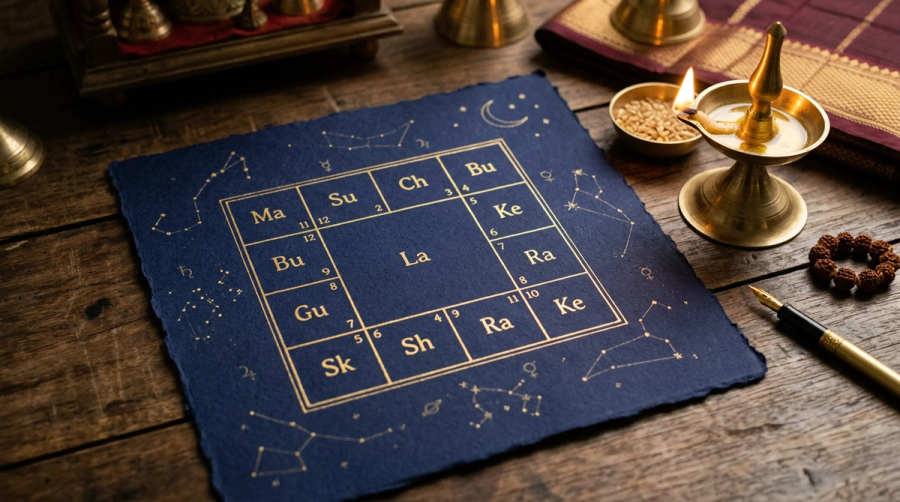
Traditional South Indian Vedic birth chart in gold ink on indigo paper with brass oil lamp
What Your Birth Chart Reveals About Travel and Foreign Settlement
The 9th house (long-distance travel, fortune abroad) and 12th house (foreign lands, settlement away from birthplace) are the primary indicators of travel and relocation. When these houses connect to each other - or when their lords exchange signs - the chart strongly indicates a life lived far from home.
Rahu is the primary significator of foreign lands in Vedic astrology. Rahu connected to the 4th house (homeland), 9th house, or 12th house creates what's called a "foreign settlement yoga." During Rahu's 18-year Mahadasha, these yogas activate - often triggering the move abroad.
Movable signs (Aries, Cancer, Libra, Capricorn) on the Ascendant or 4th house cusp enhance mobility. The Moon-Rahu conjunction (Grahan Yoga) creates a natural attraction to foreign cultures and often indicates someone who feels more at home abroad than in their birthplace.
Your chart can even indicate which direction is favorable for travel and settlement, based on the signs and houses involved. Fire signs point south, earth signs point south-west, air signs point west, and water signs point north - a system described in classical Jyotish texts for muhurta (auspicious timing) calculations.
What Your Birth Chart Reveals About Past-Life Karma
This is where Vedic astrology enters territory that no other system touches. The 5th house represents Purva Punya - the merit accumulated from past lives. The 9th house represents Bhagya - the fortune you've earned through past actions. And the 12th house represents Moksha - the spiritual liberation you're working toward.
The Shashtiamsa chart (D60) is specifically designed to reveal past-life karma (Sanchita Karma). It shows the hidden roots of current life patterns - why certain struggles persist despite effort, why certain talents come effortlessly, and why certain people enter your life at specific times.
Rahu and Ketu - the lunar nodes - are the primary karmic indicators. Rahu shows where you're headed in this life (your karmic direction, your unfulfilled desires). Ketu shows where you've already been (your past-life mastery, the skills you carry forward). The axis they form across your chart reveals the central karmic tension of your incarnation.
For example, Rahu in the 10th house and Ketu in the 4th suggests someone who mastered domestic life and emotional security in past lives but is now driven to build a public career and legacy. The pull between home comfort (Ketu) and worldly ambition (Rahu) defines their life's central struggle.
Saturn's placement reveals karmic debts - areas where you must put in sustained effort before receiving results. Saturn in the 7th house indicates relationship karma that requires patience and maturity. Saturn in the 10th indicates career karma that demands years of disciplined work before recognition arrives.
The Vimshottari Dasha System - When Everything Happens
The most powerful feature of Vedic astrology isn't what it reveals - it's when. The Vimshottari Dasha system maps a 120-year cycle of planetary periods based on your Moon's nakshatra at birth. Each planet rules a specific number of years:
- Ketu - 7 years
- Venus - 20 years
- Sun - 6 years
- Moon - 10 years
- Mars - 7 years
- Rahu - 18 years
- Jupiter - 16 years
- Saturn - 19 years
- Mercury - 17 years
The sequence always follows this order, but your starting point depends on where the Moon was at birth. If your Moon was in Rohini nakshatra (ruled by Moon), you begin life in Moon Mahadasha. If it was in Ashwini (ruled by Ketu), you begin in Ketu Mahadasha.
Each Mahadasha divides into Antardashas (sub-periods) of the same nine planets, creating a nested timing system that can narrow predictions to specific months. A person in Jupiter Mahadasha, Venus Antardasha will experience themes of wisdom meeting love, growth meeting beauty, and spiritual expansion meeting material pleasure - for a specific duration that can be calculated to the day.
This is why Vedic astrologers can say things like "your career breakthrough is most likely between March and August 2027" - because they're tracking the intersection of your dasha period, the transiting planets, and the activation of specific houses in your chart.
On MyNitya, your complete Vimshottari Dasha timeline is calculated automatically as part of the 6,000+ data points analyzed from your birth chart. Nitya uses your current dasha period when answering questions about timing - career moves, relationship decisions, health precautions, or any life area where "when" matters as much as "what."
Divisional Charts - Zooming Into Every Life Area
The main birth chart (Rasi or D1) gives the overview. But Vedic astrology uses sixteen divisional charts (Shodasavarga) that zoom into specific life areas with surgical precision. The most important ones:
- Navamsa (D9) - Marriage, spouse, dharma, spiritual purpose, post-40 life. The second most important chart after D1. A planet weak in D1 but strong in D9 reveals hidden potential that emerges through relationships.
- Dasamsa (D10) - Career, profession, public achievements, authority. Shows your professional destiny independent of the main chart.
- Saptamsa (D7) - Children, progeny, fertility. Reveals the nature and timing of children.
- Dwadasamsa (D12) - Parents, ancestry, inherited traits. Shows the karmic relationship with your parents.
- Trimsamsa (D30) - Misfortunes, health vulnerabilities, hidden challenges. Used for diagnosing difficult periods.
- Shashtiamsa (D60) - Past-life karma. The most granular chart, revealing the deepest karmic roots of current life patterns.
A skilled Vedic astrologer reads these charts in layers - checking whether the main chart's indications are confirmed, modified, or contradicted by the divisional charts. When multiple Vargas agree, the prediction strengthens. When they conflict, the interpretation requires nuance.
This layered system is why Vedic birth chart analysis can be so remarkably specific. It's not guessing. It's reading multiple maps of the same territory at different zoom levels.
Curious what your birth chart reveals? Ask your first question free on MyNitya.
How to Get Your Birth Chart Analyzed
Getting your Vedic birth chart analyzed requires three pieces of information:
- Birth date - month, day, year
- Birth time - as exact as possible (even 15 minutes changes the Ascendant)
- Birth location - city and country (for latitude, longitude, and timezone)
The birth time is the most critical piece. It determines your Ascendant, which sets the entire house structure. Without it, the chart loses its most personalized dimensions - houses, dasha starting point, and divisional charts all depend on precise birth time.
For a step-by-step guide to finding your signs, including what to do if you don't know your birth time, see our dedicated article.
On MyNitya, your Vedic birth chart is calculated using the Swiss Ephemeris - the same astronomical engine used by professional astrologers worldwide, achieving precision of 0.001 arcseconds calibrated to NASA JPL data. The platform analyzes over 6,000 data points from your chart, and Nitya - your AI astrologer - interprets them in the context of whatever question you bring. Career timing, relationship patterns, health precautions, spiritual direction - your chart has answers for all of it.
Chat with Nitya about your birth chart - try free on MyNitya.
Frequently Asked Questions
What is my astrological birth chart?
Your astrological birth chart is a map of the sky at the exact moment and location of your birth. It shows where each planet was positioned across the twelve zodiac signs and twelve houses. In Vedic astrology, it also includes nakshatras, planetary periods (dashas), and divisional charts. Your birth chart reveals your personality, career path, marriage timing, health patterns, wealth potential, children, travel, spiritual growth, and past-life karma - essentially a complete blueprint of your life's potential and timing.
What do I need to get my birth chart?
You need three pieces of information: your exact birth date (month, day, year), birth time (as precise as possible - even 15 minutes matters), and birth location (city and country). The birth time is most critical because it determines your Ascendant, which sets the entire house structure of your chart. Check your birth certificate, hospital records, or ask family members if you don't know your birth time.
Can a birth chart predict the future?
A Vedic birth chart maps potentials, tendencies, and timing windows rather than fixed events. The Vimshottari Dasha system indicates when certain themes are likely to activate - career growth, relationship changes, health challenges, financial gains. But how those themes manifest depends on your choices, environment, and awareness. The chart shows the terrain and the weather forecast. You choose the path.
What's the difference between a birth chart and a horoscope?
A birth chart is a personalized map calculated from your exact birth data - unique to you. A horoscope is a general forecast written for everyone sharing your Sun sign (1/12th of the population). Your birth chart contains dozens of placements, aspects, and timing cycles. A horoscope addresses one placement. The difference in accuracy and usefulness is enormous. For a detailed comparison, see our guide on what makes horoscopes accurate.
How is a Vedic birth chart different from a Western one?
Vedic birth charts use the sidereal zodiac (aligned to actual constellations), while Western charts use the tropical zodiac (aligned to seasons). They've drifted about 24 degrees apart, so your Vedic signs may differ from Western ones. Vedic astrology also includes nakshatras (27 lunar mansions), the Vimshottari Dasha timing system, sixteen divisional charts, and hundreds of yogas - precision tools that Western astrology doesn't offer. Our Vedic vs Western comparison covers this in depth.
Can my birth chart tell me about my past lives?
Yes. Vedic astrology uses several indicators for past-life karma. The 5th house reveals Purva Punya (past-life merit). The Rahu-Ketu axis shows your karmic direction - where you've been and where you're headed. The Shashtiamsa chart (D60) specifically maps Sanchita Karma (accumulated karma from all past lives), revealing the hidden roots of current life patterns. Saturn's placement indicates karmic debts requiring sustained effort before results arrive.