Free Birth Chart Interpretation: What Your Planets Actually Mean
In this Article
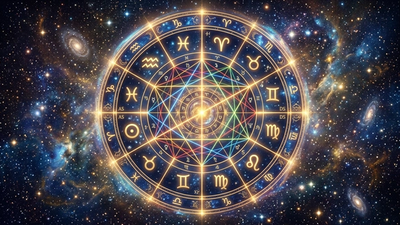
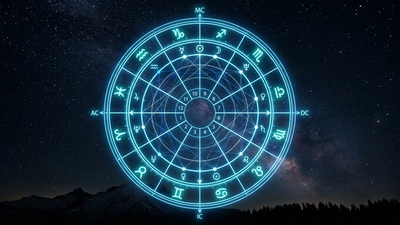
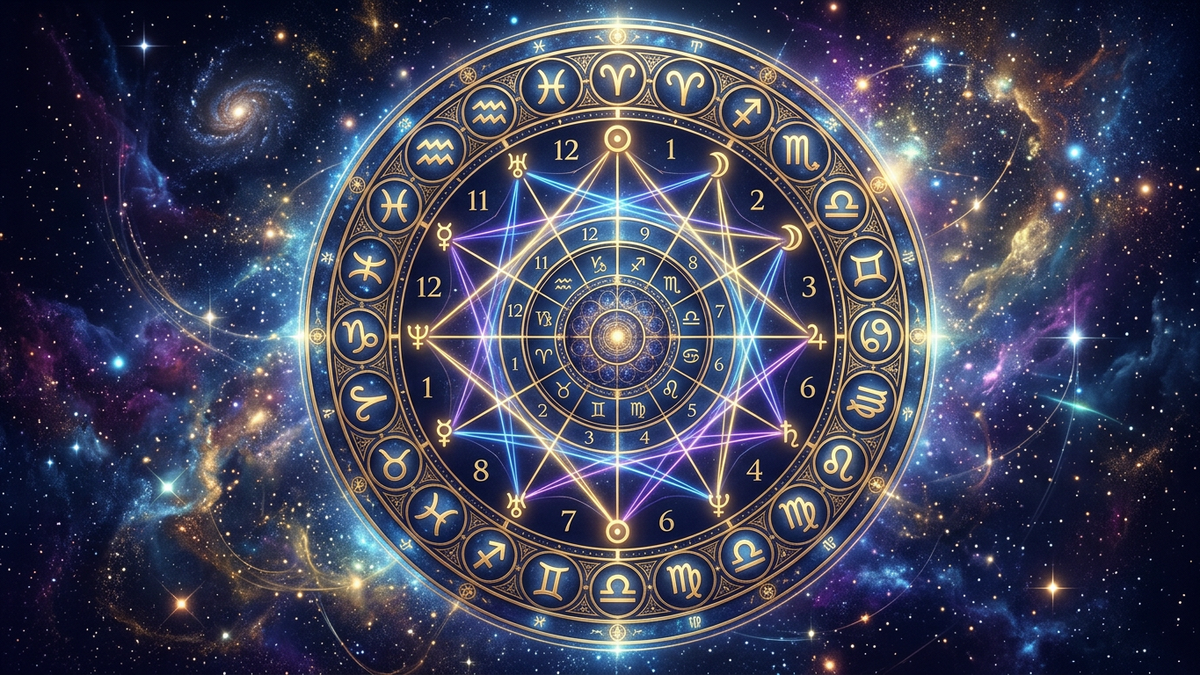
A free birth chart interpretation breaks down the meaning of every planet, sign, and house in your natal chart - the astrological snapshot of the sky at the exact moment you were born. Your birth chart reveals your personality patterns, relationship tendencies, career strengths, and the timing of major life events. All you need is your date, time, and place of birth.
You've probably looked up your sun sign before. Maybe you're a Scorpio or a Gemini, and you've read the horoscope columns. But your sun sign is one piece of a much larger picture. Your birth chart contains nine planets, twelve houses, twelve signs, and dozens of aspects - and each one tells a different part of your story. Reading just your sun sign is like judging a book by its cover.
Your personal astrologer - Vedic + Western.
Reads all 10,000+ points of your birth chart to answer your question. First question free, no card needed.
Ask your question free →Key Takeaways: A birth chart (natal chart or Kundali) maps the exact positions of all planets at your birth. The three most important placements are your Sun sign (identity), Moon sign (emotions), and Ascendant/Rising sign (how others see you). In Vedic astrology, the chart uses the sidereal zodiac and includes nine grahas (planets) including Rahu and Ketu (lunar nodes), 12 bhavas (houses), and divisional charts like the Navamsa (D9) for deeper relationship and spiritual insights. Your birth time determines your Ascendant, which sets the entire house structure - making it the single most important piece of data for an accurate interpretation.
What Is a Birth Chart?
A birth chart is a map of the sky at the precise moment and location of your birth, showing where each planet was positioned relative to the zodiac signs and the horizon. It's the foundation of all personalized astrology - everything from personality analysis to timing predictions starts here.
In Western astrology, the birth chart uses the tropical zodiac (aligned to the seasons). In Vedic astrology (Jyotish), it uses the sidereal zodiac (aligned to the actual constellations), which is currently about 24 degrees behind the tropical system. This means your Vedic signs may differ from your Western ones - and many people find the sidereal placements resonate more accurately.
To generate your birth chart, you need three pieces of information:
- Date of birth - determines which signs the planets were in
- Time of birth - determines your Ascendant (rising sign) and house placements
- Place of birth - determines the exact angles and house cusps based on latitude and longitude
The birth time is critical. Even a 15-minute difference can shift your Ascendant to a different sign, which changes the entire house structure of your chart. If you don't know your exact birth time, the chart can still show planetary sign placements, but the house-level interpretation - which is where the real specificity lives - becomes unreliable.
On MyNitya, your Vedic birth chart is calculated using NASA-grade ephemeris data, analyzing over 6,000 astrological data points including planetary positions, nakshatras (lunar mansions), dashas (planetary periods), and divisional charts. Nitya, your AI astrologer, then interprets these placements in the context of your specific questions about career, relationships, timing, and life patterns.
How to Read Your Birth Chart: Step by Step
Reading your birth chart starts with three anchor points - your Ascendant, Sun, and Moon - then expands outward to the remaining planets and houses. Here's the sequence experienced astrologers follow.
Step 1: Find Your Ascendant (Rising Sign)
Your Ascendant (Lagna in Vedic astrology) is the zodiac sign that was rising on the eastern horizon at your birth moment. It's the starting point of your entire chart - the 1st house cusp - and it determines which sign rules each of your twelve houses.
The Ascendant shapes how you present yourself to the world, your physical appearance tendencies, and your instinctive approach to new situations. It's often more visible to others than your Sun sign, especially in first impressions.
As Farfaraway's Vedic chart reading guide explains, the Ascendant is the chart's foundation - it defines your personality alongside your Moon sign, which Vedic astrology considers more important than the Sun sign that Western astrology emphasizes.
Step 2: Locate Your Sun and Moon
Your Sun sign represents your core identity, ego, vitality, and life purpose. It's who you are at your center - the qualities you're developing throughout your lifetime. In Vedic astrology, the Sun (Surya) is the atmakaraka, the significator of the soul.
Your Moon sign represents your emotional nature, instincts, comfort needs, and subconscious patterns. In Vedic astrology, the Moon (Chandra) is arguably more important than the Sun because it governs the mind (manas). Your Moon's nakshatra (the specific lunar mansion it occupies) adds another layer of precision that Western astrology doesn't offer.
Together, your Ascendant, Sun, and Moon form your "Big Three" - the three placements that define the broadest strokes of your personality. Our guide on Sun, Moon, and Rising signs goes deeper into how these three interact.
Step 3: Map Each Planet to Its House and Sign
Once you've anchored yourself with the Big Three, look at where each remaining planet falls:
- Which sign is it in? The sign colors how the planet expresses itself. Mars in Aries is direct and aggressive. Mars in Libra is strategic and diplomatic. Same planet, completely different style.
- Which house is it in? The house tells you which life area the planet activates. Venus in the 7th house focuses love energy on partnerships. Venus in the 10th house channels beauty and charm into career and public image.
Step 4: Check for Conjunctions and Aspects
Planets don't operate in isolation. When two or more planets occupy the same sign or house (conjunction), their energies blend - sometimes harmoniously, sometimes in tension. A Moon-Jupiter conjunction in the 4th house creates emotional abundance and a nurturing home life. A Moon-Saturn conjunction in the same house creates emotional restriction and a sense of duty around family.
Aspects (drishti in Vedic astrology) are the angular relationships between planets. In Vedic astrology, aspects work differently than in Western - each planet has specific houses it aspects from its position. Saturn, for instance, aspects the 3rd, 7th, and 10th houses from wherever it sits, casting its disciplining influence across multiple life areas simultaneously.
Step 5: Look at Planetary Periods (Dashas)
This is where Vedic astrology pulls far ahead of Western approaches. The Vimshottari Dasha system divides your life into planetary periods - each planet "rules" a specific stretch of years, activating its themes in your life.
If you're in a Jupiter dasha, themes of growth, wisdom, and expansion dominate. If you're in a Saturn dasha, themes of discipline, restriction, and hard-earned achievement take center stage. Knowing your current dasha period transforms a static birth chart into a dynamic, time-sensitive roadmap.
What Each Planet Means in Your Birth Chart
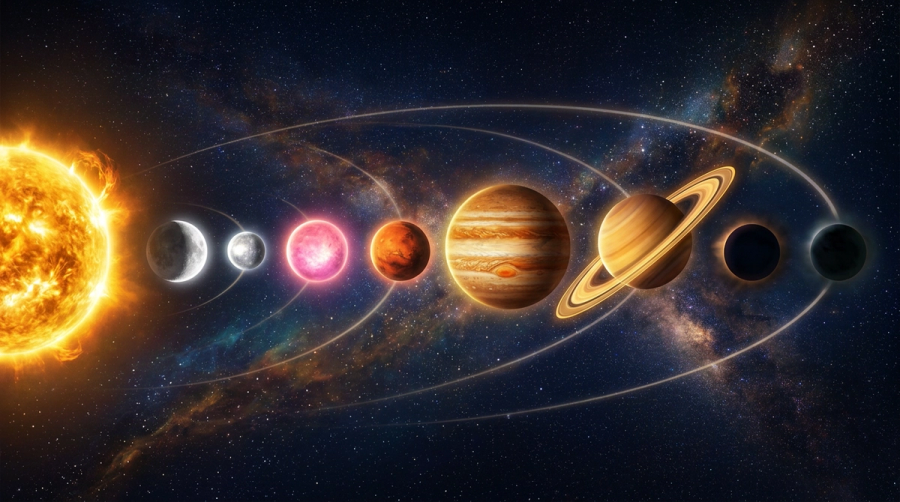
Nine planets of Vedic astrology arranged in cosmic space from Sun to Ketu
Each planet in your birth chart represents a specific type of energy that influences different aspects of your life. The nine grahas (planets) of Vedic astrology each carry distinct significations.
Sun (Surya) - Your Core Identity
The Sun represents your ego, vitality, authority, and soul purpose. A strong Sun gives confidence, leadership ability, and clarity of direction. A challenged Sun (afflicted by malefics or poorly placed) can manifest as ego struggles, authority issues, or a weak sense of self. The Sun rules Leo and is exalted in Aries.
Moon (Chandra) - Your Emotional World
The Moon governs your emotions, intuition, mind, and nurturing instincts. It's the most personal planet in Vedic astrology - your Moon sign and nakshatra reveal how you process feelings, what makes you feel safe, and your instinctive reactions. The Moon rules Cancer and is exalted in Taurus. According to the Brihat Parashara Hora Shastra, the Moon's strength in a chart is the primary indicator of mental and emotional wellbeing.
Mercury (Budha) - Your Mind and Communication
Mercury represents intellect, communication, analytical ability, and adaptability. It governs how you think, speak, write, and process information. A strong Mercury gives sharp wit, business acumen, and linguistic skill. Mercury rules Gemini and Virgo and is exalted in Virgo.
Venus (Shukra) - Love, Beauty, and Pleasure
Venus embodies love, relationships, beauty, creativity, and sensory pleasure. It shows how you attract and what you find beautiful. In a man's chart, Venus also represents the wife or romantic partner. Venus rules Taurus and Libra and is exalted in Pisces.
Mars (Mangala) - Drive, Courage, and Conflict
Mars signifies action, courage, physical energy, competition, and aggression. It's your fighting spirit - how you assert yourself and pursue what you want. A strong Mars gives determination and physical vitality. An afflicted Mars can manifest as anger issues, accidents, or reckless behavior. Mars rules Aries and Scorpio and is exalted in Capricorn.
Jupiter (Guru) - Wisdom, Growth, and Fortune
Jupiter is the great benefic - the planet of wisdom, expansion, ethics, spirituality, and prosperity. It represents your capacity for growth, your relationship with meaning, and your fortune. Jupiter rules Sagittarius and Pisces and is exalted in Cancer. In Vedic astrology, Jupiter is the guru - the teacher who guides you toward dharma (right action).
Meet Nitya, your AI astrologer
She reads your birth chart to answer anything about your life. Your first complete answer is free, with no card required. Continued chat, Synastry, and Daily Guidance require Premium.
Questions you can ask about this topic
Tap any one below - or just write your own question in the form ↓
Nitya isn't a one-time horoscope. She's with you for the whole journey.
Understand yourself
Career, love, money, timing - any decision you are weighing. Answers read straight from your birth chart.
Understand any relationship
Add your partner, a parent, a friend, even a colleague. Nitya reads both charts together to explain the bond, the friction, and how to work through it.
Guidance for every day
Start each morning knowing what the day favors, what to watch for, and the best moments to act.
No card needed. Nitya just needs your birth details to read your chart.
Ask Nitya your first question - free →Saturn (Shani) - Discipline, Karma, and Structure
Saturn represents discipline, restriction, karma, hard work, and long-term achievement. It's the taskmaster that delays gratification but rewards persistence. Saturn's position in your chart shows where you'll face your greatest challenges - and where you'll build your most enduring structures. Saturn rules Capricorn and Aquarius and is exalted in Libra. Our Saturn return guide explains what happens when Saturn completes its 29.5-year cycle back to its natal position.
Rahu (North Node) - Ambition and Obsession
Rahu is the ascending lunar node - a shadow planet unique to Vedic astrology. It represents worldly desires, ambition, innovation, and karmic direction. Where Rahu sits in your chart, you'll feel an insatiable hunger - a drive to experience, acquire, and master. Rahu amplifies whatever it touches, creating both opportunity and obsession.
Ketu (South Node) - Detachment and Past Lives
Ketu is the descending lunar node - Rahu's opposite. It represents spiritual detachment, past-life skills, and liberation from material attachment. Where Ketu sits, you have natural talent but little worldly interest. Ketu's house and sign show what you've already mastered in previous incarnations and what you're ready to release.
The 12 Houses: Where Life Happens
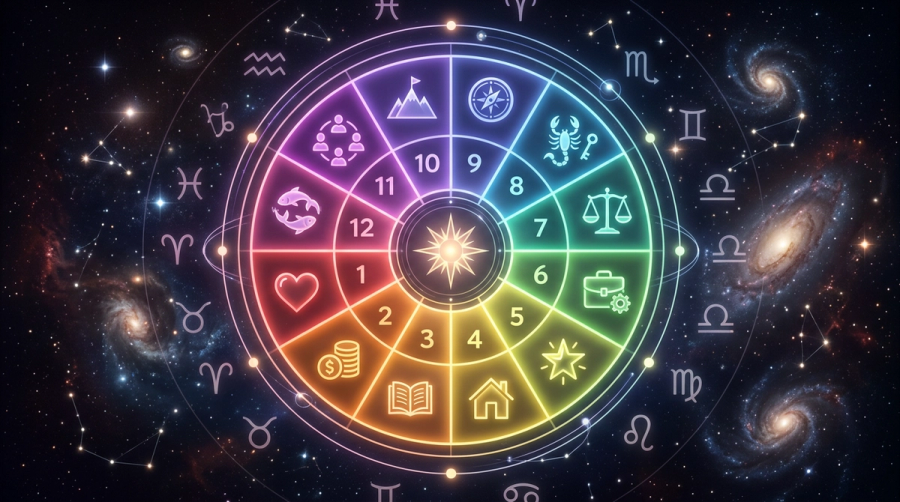
Twelve astrological houses diagram with life theme icons in cosmic space
The 12 houses (bhavas) in your birth chart represent different areas of life. Planets in a house activate that life area; the sign on the house cusp colors how those themes express.
1st House (Lagna) - Self and Identity
Your physical body, personality, appearance, and overall vitality. The 1st house is you - how you show up in the world. Planets here strongly influence your character and life direction.
2nd House (Dhana) - Wealth and Speech
Money, possessions, family values, speech patterns, and food preferences. The 2nd house shows your relationship with material security and how you communicate.
3rd House (Sahaja) - Courage and Communication
Siblings, short travels, courage, writing, and self-expression. The 3rd house governs your initiative - your willingness to take action and communicate your ideas.
4th House (Sukha) - Home and Emotional Foundation
Home, mother, emotional security, property, vehicles, and inner peace. The 4th house is your foundation - the private world you retreat to when the outer world gets heavy.
5th House (Putra) - Creativity and Romance
Children, creativity, romance, intelligence, past-life merit, and speculation. The 5th house is where joy lives - your capacity for play, creation, and love affairs.
6th House (Ripu) - Health and Daily Work
Health, daily routines, service, enemies, debts, and obstacles. The 6th house shows the challenges you must overcome and the work ethic you bring to daily life.
7th House (Kalatra) - Partnerships and Marriage
Marriage, business partnerships, open enemies, and your relationship with "the other." The 7th house is the mirror - it shows what you attract in partners and what qualities you project onto others.
8th House (Ayur) - Transformation and Hidden Depths
Death, rebirth, transformation, inheritance, occult knowledge, and sexuality. The 8th house governs everything hidden beneath the surface - the psychological depths that most people avoid.
9th House (Dharma) - Purpose and Higher Learning
Religion, philosophy, higher education, long-distance travel, luck, and father. The 9th house is your relationship with meaning - what you believe and why.
10th House (Karma) - Career and Public Life
Career, reputation, authority, public image, and life achievements. The 10th house is your visible legacy - what the world sees when it looks at your life's work.
11th House (Labha) - Gains and Community
Income, gains, friendships, social networks, and fulfilled desires. The 11th house shows where abundance flows in and which communities support your growth.
12th House (Vyaya) - Spirituality and Release
Losses, expenses, foreign lands, spirituality, isolation, and liberation. The 12th house is where the material world dissolves and the spiritual world begins. For a complete breakdown of all twelve houses, see our guide to astrological houses.
Why Vedic Birth Chart Interpretation Is Different
Vedic birth chart interpretation differs from Western astrology in several fundamental ways that affect the accuracy and depth of your reading. Understanding these differences helps you get more from your chart.
Sidereal vs Tropical Zodiac
Western astrology uses the tropical zodiac, which is fixed to the seasons (the spring equinox always marks 0 degrees Aries). Vedic astrology uses the sidereal zodiac, which is aligned to the actual star constellations. Due to the precession of the equinoxes, these two systems have drifted about 24 degrees apart.
This means your Vedic Sun sign is likely one sign back from your Western one. If you're a Western Gemini, you might be a Vedic Taurus. Many people who never resonated with their Western sign find their Vedic placements far more accurate.
Nakshatras: Precision Beyond Signs
The 27 nakshatras (lunar mansions) divide the zodiac into segments of 13 degrees 20 minutes each - far more precise than the 30-degree signs. Each nakshatra has its own ruling deity, planetary ruler, and psychological profile.
Two people with Moon in Scorpio will have very different emotional natures if one has Moon in Vishakha nakshatra (driven, goal-oriented, intense focus) and the other in Anuradha (devoted, loyal, emotionally deep). Nakshatras are what make Vedic chart interpretation genuinely personalized rather than generic.
Dasha System: Timing Is Everything
Western astrology uses transits and progressions for timing. Vedic astrology adds the Vimshottari Dasha system - a 120-year cycle of planetary periods determined by your Moon's nakshatra at birth. This system tells you which planet is "activated" at any given time in your life, making predictions far more specific.
Knowing that you're in a Venus-Saturn period, for example, tells an astrologer that themes of love meeting restriction, beauty meeting discipline, and pleasure meeting responsibility are active right now. That level of timing specificity is unique to Vedic astrology.
Divisional Charts
Vedic astrology doesn't stop at the birth chart (Rasi). It uses divisional charts (Vargas) that zoom into specific life areas. The Navamsa (D9) reveals the deeper truth of relationships and spiritual purpose. The Dasamsa (D10) focuses specifically on career. The Saptamsa (D7) examines children and progeny.
These divisional charts add layers of nuance that a single birth chart can't provide. A planet that looks weak in the Rasi chart might be strong in the Navamsa, suggesting hidden potential that emerges later in life or through relationships.
Chat with Nitya about your birth chart to get personalized interpretation of your planets, houses, and current dasha period - try free on MyNitya.
Common Birth Chart Patterns and What They Mean
Certain planetary configurations appear frequently in birth charts and carry well-established meanings. Recognizing these patterns helps you quickly identify the major themes in any chart.
Stellium (3+ Planets in One Sign or House)
A stellium concentrates energy in one life area. Three planets in the 10th house creates someone whose identity is deeply tied to career and public achievement. Three planets in the 4th house creates someone whose emotional world revolves around home and family. Stelliums create intensity and focus - but also potential imbalance if other life areas are neglected.
Retrograde Planets
When a planet is retrograde in your birth chart, its energy turns inward. Retrograde Mercury processes information differently - often more deeply and intuitively, but with communication challenges. Retrograde Venus may struggle with expressing affection openly but develops a rich inner aesthetic life. About 80% of people have at least one retrograde planet in their chart - it's normal, not a defect.
Exalted and Debilitated Planets
Each planet has a sign where it functions at peak strength (exaltation) and a sign where it struggles (debilitation). Jupiter exalted in Cancer brings abundant wisdom and emotional generosity. Jupiter debilitated in Capricorn may struggle with rigid beliefs or restricted growth. But debilitation isn't destiny - aspects from benefic planets, placement in a strong house, or strength in the Navamsa can cancel or reduce debilitation effects.
Yoga Formations
Vedic astrology identifies hundreds of yogas - specific planetary combinations that produce defined results. Gajakesari Yoga (Jupiter in a kendra from Moon) brings wisdom and social respect. Dhana Yoga (lords of wealth houses connecting) indicates financial prosperity. Raj Yoga (lords of trines and kendras combining) suggests authority and success.
Among charts analyzed on MyNitya, users frequently ask about specific yogas in their chart and what they mean for career timing, relationship prospects, and financial growth. The presence of a yoga doesn't guarantee results - its activation depends on the current dasha period and supporting transits.
Frequently Asked Questions
What does my birth chart tell me?
Your birth chart tells you about your personality traits, emotional patterns, relationship tendencies, career strengths, health vulnerabilities, and the timing of major life events. It maps the positions of all planets at your birth across twelve houses (life areas) and twelve signs (expression styles). The specific combination of placements is unique to you - no two birth charts are identical unless two people are born at the exact same time and place.
How do I get a free birth chart interpretation?
Get a free birth chart interpretation by entering your birth date, time, and place into a Vedic astrology platform. On MyNitya, your chart is calculated using NASA-grade ephemeris data with over 6,000 data points, and Nitya - your AI astrologer - provides personalized interpretation based on your specific questions. Your first question is free, no credit card required.
What's the difference between Vedic and Western birth charts?
Vedic birth charts use the sidereal zodiac (aligned to actual constellations), while Western charts use the tropical zodiac (aligned to seasons). This creates an approximately 24-degree difference, meaning your Vedic signs may be one sign back from your Western ones. Vedic astrology also includes nakshatras (27 lunar mansions), the Vimshottari Dasha timing system, and divisional charts - tools that add precision layers Western astrology doesn't offer.
Why is birth time important for a birth chart?
Birth time determines your Ascendant (rising sign), which sets the entire house structure of your chart. Even a 15-minute difference can shift your Ascendant to a different sign, changing which planets rule which houses and altering the interpretation significantly. Without an accurate birth time, planetary sign placements are still valid, but house-level analysis - where the real specificity lives - becomes unreliable.
What are the most important placements in a birth chart?
The most important placements are your Ascendant (rising sign), Moon sign and nakshatra, and Sun sign - collectively called the "Big Three." After that, the 7th house lord (relationships), 10th house lord (career), and the current Vimshottari Dasha lord (timing) are the placements that most directly answer the questions people actually ask astrologers about.
Can a birth chart predict the future?
A birth chart doesn't predict fixed events - it maps potentials, tendencies, and timing windows. The Vimshottari Dasha system and planetary transits indicate when certain themes are likely to activate in your life, but how those themes manifest depends on your choices, environment, and level of self-awareness. Astrology is a map, not a script. It shows the terrain - you choose the path.