Synastry Birth Chart Compatibility: How to Read Relationship Charts
In this Article
You've felt instant chemistry with someone-that electric pull you couldn't explain. Or you've dated someone who looked perfect on paper, but something fundamental was missing. Or you're in a relationship that's passionate but challenging, and you can't figure out why it feels both meant-to-be and impossibly difficult.
Sun Sign Compatibility by Birth Date
A quick Sun-element comparison. This does not calculate the Moon, Venus, houses, or synastry aspects.
Your personal astrologer - Vedic + Western.
Reads all 10,000+ points of your birth chart to answer your question. First question free, no card needed.
Ask your question free →Synastry explains it all.
Synastry is the art of comparing two birth charts to understand relationship dynamics. It goes far beyond "Libra and Gemini are compatible!" Sun sign compatibility to reveal the deep patterns that create attraction, harmony, friction, and growth between two people.
When you understand synastry, you stop asking "Are we compatible?" and start asking better questions: "How are we compatible? Where do we flow easily? Where do we challenge each other? What are we here to teach each other?"
This guide will teach you how to read relationship charts and understand what the stars reveal about your connections.
Synastry Chart Compatibility: The Short Version
Synastry chart compatibility compares two birth charts to see how two people actually affect each other. Read it in this order: Sun and Moon contacts for emotional fit, Venus and Mars for chemistry, Saturn for staying power, then house overlays.
- Tight beats plentiful. Five aspects inside 2 degrees say more than thirty loose ones.
- Sun-Moon and Moon-Moon contacts predict daily life together better than Sun sign matching ever will.
- Venus-Mars is attraction. Saturn is whether it lasts. Those are different questions.
- House overlays show which part of your life the other person switches on.
- Squares and oppositions are not disqualifying. A chart with only trines often lacks the friction that makes people grow.
- No birth time still gives you a usable reading. It just costs you the Moon, the angles and every house overlay.
What Is Synastry?
Synastry comes from the Greek words "syn" (together) and "astron" (star). It literally means "stars together"-the study of how two people's charts interact.
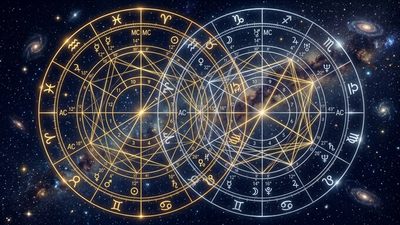
In synastry, you overlay one person's birth chart onto another's. Where their planets fall in relation to each other-and the angles (aspects) they form-reveals the dynamics of the relationship.
Every relationship has a unique synastry signature. Your connection with your partner looks completely different from your connection with your best friend, your sibling, or your colleague. Synastry shows you why.
What Synastry Shows
Attraction. Why you're drawn to someone. The chemistry that pulled you together. Whether it's physical, emotional, intellectual, or spiritual attraction-or all of the above.
Harmony areas. Where the relationship flows easily. What you naturally do well together. Your strengths as a couple.
Challenge areas. Where friction occurs. Growth edges. Potential conflict points. These aren't necessarily bad-some of the best relationships have challenging aspects that push both people to grow.
Long-term potential. Whether the relationship has staying power or is primarily short-term chemistry. Not all connections are meant to last forever, and that's okay.
Karmic connections. Signs of past-life or soul-level ties. That feeling of "I've known you before" often shows up clearly in synastry.
Emotional compatibility. How well you understand each other's feelings and needs. Can you speak each other's emotional language?
Sexual compatibility. Physical chemistry and erotic dynamics. What turns you on about each other, and whether your desires align.
Communication style. How you exchange ideas, resolve conflicts, and understand each other's thinking.
What Synastry Doesn't Show
It's important to understand what synastry can't tell you:
It doesn't predict whether you'll be together. Free will exists. Chart compatibility doesn't override choice, timing, or circumstances.
It doesn't make anyone "right" or "wrong" for you. There's no such thing as perfect compatibility. Every connection has both harmony and challenge.
It doesn't account for personal growth. You can grow into compatibility or grow apart. Charts show potential, not destiny.
It doesn't replace communication. Understanding your synastry helps you communicate better, but it doesn't replace actually talking to each other.
Which Synastry Aspects Actually Matter: Orbs Explained
An orb is how many degrees an aspect sits away from exact. It is the single best filter for a synastry chart, because a calculator will hand you forty aspects and give them all equal visual weight. Tightness decides which ones you actually feel.
Most synastry calculators default to an 8 to 10 degree orb for everything. That is why a 9 degree Mercury-Neptune trine can look as important on screen as a 1 degree Venus-Moon conjunction. It is not.
Working orb ranges
- Sun and Moon, the luminaries: up to about 8 degrees. They carry the most weight in any chart, so they earn the most room.
- Personal planets, Mercury, Venus, Mars, Jupiter and Saturn: up to about 6 degrees.
- Outer planets, Uranus, Neptune and Pluto: 2 to 3 degrees, no more. A wide Neptune contact usually says more about being born a couple of years apart than about the two of you.
- Minor aspects, semisextile and quincunx: 2 degrees maximum, or skip them.
Anything inside 2 degrees is the story. Anything past 6 degrees, outside the luminaries, is texture. These are working ranges used in practice, not a settled standard, and astrologers do disagree about them.
Why more aspects is not a stronger connection
A chart showing thirty-five loose contacts is not more connected than one showing six exact ones. It usually means the two charts happen to have planets scattered widely, which is common. Count what is tight, not what is listed.
Conjunctions and oppositions tolerate the widest orbs because they are the most forceful. Squares need to be close to really land. Trines and sextiles feel soft even when exact, which is why an easy-looking chart can still feel flat.
Key Elements in Synastry
Synastry analysis looks at several layers of connection. Let's break down the most important ones.
Sun Connections
The Sun represents core identity, ego, and life purpose. When one person's Sun connects with another's planets, it illuminates something essential.
Sun-Sun aspects:
- Conjunction (same sign): Strong recognition, feeling of similarity. Can be harmonious or competitive depending on other factors. You see yourself in each other.
- Trine (same element): Easy understanding, natural harmony. You "get" each other without trying.
- Square (challenging angle): Friction but also dynamic energy. You push each other's buttons but also push each other to grow.
- Opposition: Complementary opposites, attraction of difference. You complete each other but might also frustrate each other.
Sun-Moon connection: One of the most important aspects for emotional compatibility. When your Sun connects to their Moon (or vice versa), there's a feeling of "home." You instinctively understand what they need.
Classic romantic synastry: your Sun conjunct their Moon, or your Sun trine their Moon. This creates warmth, understanding, and mutual support.
Moon Connections
The Moon governs emotions, instincts, and needs. Moon connections are crucial for long-term compatibility and emotional intimacy. For the sign-by-sign layer, see Moon sign compatibility.
Moon-Moon aspects:
- Compatible Moons (same element or compatible elements): Emotional understanding flows naturally. You speak the same feeling-language.
- Challenging Moons (square or opposition): Different emotional languages. What comforts one person might not comfort the other. Requires conscious effort and communication.
For example:
- Fire Moon + Air Moon = usually compatible (stimulating)
- Earth Moon + Water Moon = usually compatible (grounding)
- Fire Moon + Water Moon = often challenging (one needs space, one needs closeness)
Moon-Venus: Nurturing affection, tender love. Venus person adores how Moon person feels and expresses emotion. Moon person feels seen and appreciated.
Moon-Mars: Emotional passion. Can be volatile but exciting. Mars energizes Moon's feelings; Moon softens Mars's aggression. Sexual chemistry often strong.
Moon-Saturn: Can indicate emotional distance or maturity. Saturn person might seem cold or critical to Moon person. Or Saturn provides the structure and stability Moon needs. Depends on the individuals.
Venus Connections
Venus is the planet of love, attraction, values, and pleasure. Venus connections show romantic compatibility and what you appreciate in each other.
Venus-Venus: Shared appreciation of beauty, harmony in values. You like similar things, have compatible tastes, enjoy similar pleasures.
Venus-Mars: Classic attraction chemistry. Mars pursues what Venus attracts. There's physical pull, sexual desire, masculine-feminine polarity (regardless of actual genders). This is the "I want you" aspect.
Venus-Saturn: Serious commitment vibes, but sometimes challenges around giving/receiving love. Saturn person might make Venus person feel not good enough, or Saturn might provide the commitment Venus craves.
Venus-Jupiter: Generosity, expansion, joy in the relationship. Jupiter person makes Venus person feel appreciated and optimistic. Warm, generous connection.
Mars Connections
Mars represents desire, drive, action, and how you assert yourself. Mars connections show passion, motivation, and sometimes conflict.
Mars-Mars: Can be competitive or dynamically energizing. If harmonious (trine, sextile), you motivate each other. If challenging (square, opposition), you might fight often-but the makeup sex is probably good.
Mars-Venus: Sexual attraction and romantic chemistry. One of the most important aspects for physical compatibility.
Mars-Pluto: Intense, transformative passion-for better or worse. Powerful sexual chemistry but potential for power struggles. This can be obsessive, all-consuming, sometimes destructive.
Mars-Jupiter: Enthusiasm, adventure, shared optimism. You inspire each other to take action and pursue dreams.
Saturn Connections
Saturn represents commitment, challenges, karma, and lessons. Saturn aspects often indicate serious, long-term connections-but not always easy ones.
Saturn conjunct personal planets (Sun, Moon, Venus, Mars): Often indicates past-life connection and karmic work to do together. Feels fated or destined. Saturn person might be a teacher or authority figure to the other person.
Saturn-Sun/Moon/Venus: Can be stabilizing but can also feel restrictive. Saturn person might criticize or limit the other person. Or Saturn provides the commitment and structure needed for lasting love.
Saturn's role: Relationships with strong Saturn connections often last, but they require maturity, commitment, and work. These aren't light, breezy connections-they're serious.
Outer Planet Connections
Uranus aspects: Excitement, unpredictability, independence themes, electric chemistry. Uranus connections can feel like lightning-exciting but unstable. Relationships might be unconventional or on-and-off.
Neptune aspects: Romantic idealization, spiritual connection, potential for illusion or deception. Neptune can create soulmate feelings, but also fantasy that doesn't match reality. Beautiful but potentially confusing.
Pluto aspects: Intense transformation, power dynamics, deep bonding or control issues. Pluto connections are rarely neutral-they're profound. You transform each other, for better or worse.
North Node Connections
The North Node represents destiny, growth direction, and soul purpose. Connections here often feel "fated" or cosmically significant.
Someone's planet conjunct your North Node: They support your soul's growth direction. They're teaching you something important. These relationships often feel destined.
North Node-North Node contacts: You're walking similar life paths, learning similar lessons. You can support each other's growth.
North Node-South Node contacts: Past-life connections. Feels familiar immediately, like you've known each other before. Can be deeply bonding but might also repeat old patterns.
House Overlays
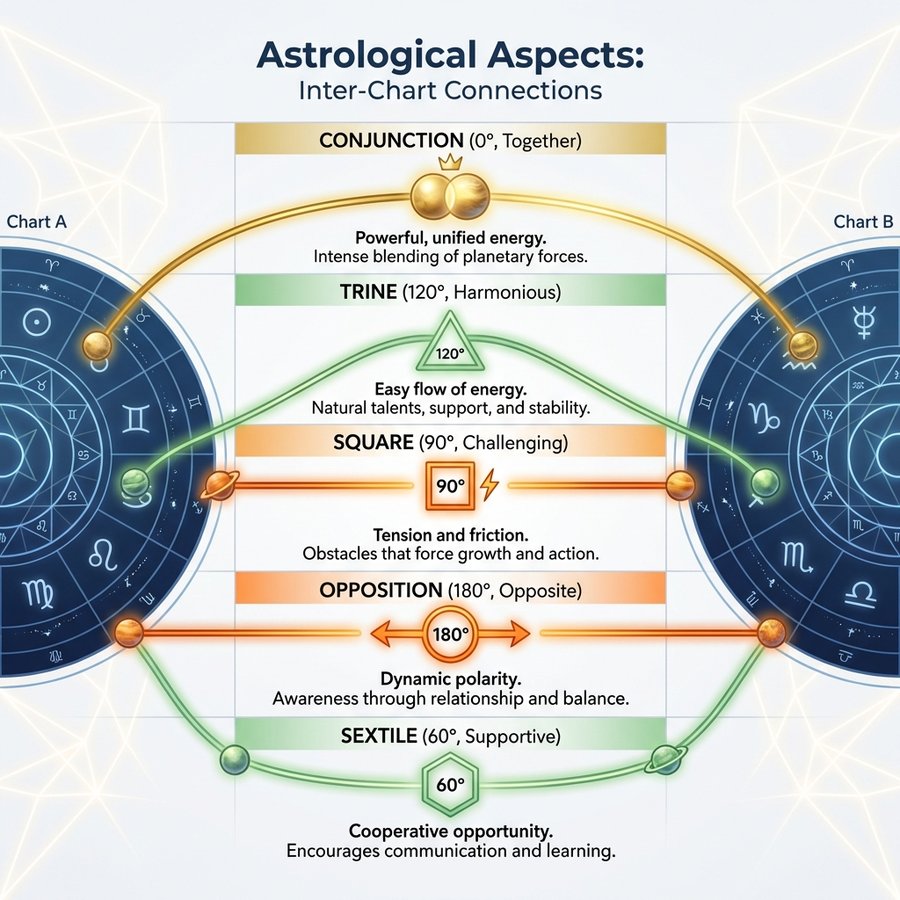
Astrological aspects infographic showing conjunctions, trines, squares, and oppositions in synastry chart compatibility
Beyond aspects between planets, synastry looks at where one person's planets fall in the other's houses (life areas).
How it works: If their Venus falls in your 7th house, they naturally activate your partnership sector. You might immediately see them as potential "the one." If their Mars falls in your 4th house, they energize your home and family life-you might want to build a home together.
Key houses for romantic relationships:
Meet Nitya, your AI astrologer
She reads your birth chart to answer anything about your life. Your first complete answer is free, with no card required. Continued chat, Synastry, and Daily Guidance require Premium.
Questions you can ask about this topic
Tap any one below - or just write your own question in the form ↓
1st House: Strong personal impact. They affect how you see yourself. Their planets here make you more aware of yourself.
5th House: Romance, fun, creative spark, playfulness. Their planets here make you feel young, creative, flirty. Pure romance energy.
7th House: Partnership energy, long-term potential, marriage vibes. Their planets here trigger your commitment sector. Read more about your 7th house partnership blueprint.
8th House: Deep intimacy, transformation, sexuality, merging. Their planets here create intensity, sexual chemistry, desire for soul-level bonding.
12th House: Spiritual or karmic connection, sometimes hidden aspects or self-undoing. Can feel dreamy, fated, but also confusing. You might not fully understand your connection.
Example: Your Venus falls in their 10th house. They see you as someone who enhances their reputation and public image. You might inspire their career ambitions or appear as the perfect partner publicly.
How to Get a Synastry Reading
What You Need
For both people:
- Birth date
- Birth time (as accurate as possible)
- Birth location (city and country)
Without accurate birth times, you can compare Sun, Mercury, Venus, and Mars signs, but you can't see house overlays or aspects involving the Moon, Rising, or angles. The reading will be incomplete.
What You Can Still Read Without Their Birth Time
You can still read a synastry chart without a birth time. You keep every Sun, Mercury, Venus, Mars, Jupiter and Saturn contact, which covers attraction, communication style, values and staying power. What you lose is the Moon, the Ascendant and Descendant, and all house overlays.
Still reliable without a birth time:
- Venus and Mars contacts, so the chemistry question is answerable.
- Saturn to personal planets, so the commitment question is answerable.
- Sun contacts, Mercury contacts and North Node contacts.
Not reliable without a birth time:
- The Moon. It moves roughly 12 to 15 degrees a day, so on an unknown-time chart it can sit anywhere across a sign or cross into the next one. Never call a Moon-Moon aspect until you have a time.
- Every house overlay, including the 7th house partnership signal people most want to check. Houses depend on the Ascendant, and the Ascendant changes every few minutes.
- The Ascendant and Descendant themselves, and anything aspecting them.
A workaround: if you know their birth time within an hour or two, generate the chart at both ends of that window and only trust what stays the same in both. If the Moon holds the same sign and the aspect holds inside 6 degrees across the whole window, it is safe to read. If it flips, leave it out.
Getting the time is worth the awkward text message. If your own time is uncertain, how to find your rising sign walks through narrowing it down.
Free Methods
- Free chart generators: several astrology sites will build a synastry chart at no cost. Enter both sets of birth data and you get a chart wheel plus an aspect grid. What almost none of them give you is a reading order or an orb filter, which is why the raw output feels overwhelming. Use the orb ranges above to decide what to look at first.
- Generate two individual charts and compare: Look at where planets align between them. This is more time-consuming but possible.
- Look up aspects: Once you identify aspects (like "my Venus squares their Mars"), research what that aspect means.
Professional/AI Methods
- Astrologer consultation: A professional can interpret the nuances, context, and the complete picture. Human astrologers bring experience and intuition.
- AI-powered analysis: Tools like MyNitya can analyze synastry with personalized interpretation. You can ask specific questions like "Why do we keep having the same argument?" or "What does his Moon in my 8th house mean?" and get detailed answers based on your specific charts.
Reading Your Own Synastry
If you want to interpret your own synastry, here's a basic process:
Step 1: Generate Both Charts
Use reliable astrology software or website to generate complete birth charts for both people. Make sure the birth data is accurate.
Step 2: Create the Synastry Grid
Most software will overlay the charts and show you an aspect grid-a table listing every planetary connection with their angles (conjunction, trine, square, opposition, sextile).
Step 3: Identify Key Aspects
Focus first on:
- Sun, Moon, Venus, Mars connections (core identity, emotions, love, attraction)
- Saturn, Pluto, Node connections (commitment, transformation, karma)
- The angles these planets form (harmonious or challenging)
Step 4: Note House Overlays
Where do their planets fall in your chart, and vice versa? Which life areas do they activate for each other?
Step 5: Look for Patterns
- Many harmonious aspects (trines, sextiles) = ease, flow, natural compatibility
- Many challenging aspects (squares, oppositions) = growth opportunity but requires conscious work
- Mix of both = realistic, balanced-most healthy relationships have both harmony and challenge
Step 6: Consider the Complete Picture
One challenging aspect doesn't doom a relationship. One harmonious aspect doesn't guarantee success. Look at the whole pattern.
Common Synastry Patterns
Artistic illustration of two people with cosmic connections representing synastry relationship compatibility in astrology
"Love at First Sight" Chart
Usually includes:
- Venus-Mars aspects (immediate attraction, "I want you")
- Strong Moon connections (emotional recognition, "I feel safe with you")
- 5th or 7th house overlays (romance or partnership activation)
- Possibly Jupiter contacts (expansion, optimism, feel-good energy)
This creates instant chemistry and excitement. May or may not have long-term staying power depending on other factors.
"Karmic/Past Life" Chart
Usually includes:
- Saturn aspects to personal planets (lessons to learn together, fated feeling)
- Node contacts, especially South Node (past-life recognition)
- 12th house overlays (spiritual or hidden connection)
- Pluto connections (soul-level transformation)
This feels destined, familiar, like you've known each other before. Often intense and not always easy. You have work to do together.
"Challenging but Growthful" Chart
Usually includes:
- Squares and oppositions between personal planets (different but complementary)
- Saturn aspects (commitment but restrictions)
- Pluto contacts (transformation through friction)
- Different elemental emphasis (different approaches to life)
This relationship pushes you both to grow. It's not always comfortable, but you become better versions of yourselves through the challenges.
"Best Friend Energy" Chart
Usually includes:
- Harmonious Mercury aspects (you understand how each other thinks)
- 11th house overlays (friendship, shared ideals)
- Similar Moon signs or compatible elements (emotional compatibility)
- Less intense Mars-Venus (friendship might be stronger than passion)
This creates deep friendship, understanding, shared values. May or may not have strong romantic/sexual chemistry, but you genuinely like each other.
"Twin Flame/Soulmate" Chart
Usually includes:
- Multiple tight conjunctions (planets at same or very close degrees)
- Sun-Moon connections (core identity + emotions aligned)
- Venus-Mars chemistry (romantic and sexual attraction)
- Node contacts (destined to meet)
- 8th house emphasis (deep transformation, soul bonding)
- Strong Pluto or Neptune aspects (spiritual or transformative connection)
Feels like meeting yourself in another person. Intense, transformative, often challenging but deeply meaningful.
Beyond Synastry: Composite Charts
While synastry compares two charts, a composite chart creates one chart that represents the relationship itself as its own entity.
How it works: Take the midpoint between each person's planets and create a new chart. This chart describes the relationship's personality, purpose, and dynamics.
When to use composite: After looking at synastry. Synastry shows how you affect each other; composite shows what you create together. You can also read your composite chart step by step.
What composite reveals:
- The relationship's strengths and challenges
- Its purpose or reason for existing
- How others perceive you as a couple
- The relationship's growth journey
Both synastry and composite together give you the fullest picture of a relationship.
Practical Application: Making Synastry Work
Understanding your synastry doesn't fix your relationship by itself. But it gives you a roadmap.
If you have challenging aspects:
- Understand that friction is growth opportunity, not incompatibility
- Learn each other's languages (emotional, communication, love)
- Give extra attention to those areas
- Appreciate what the challenge teaches you
If you have harmonious aspects:
- Don't take the ease for granted
- Keep using your natural strengths on purpose
- Understand these areas might lack growth stimulation
- Balance might mean introducing healthy challenge
If you have strong Saturn or Pluto connections:
- Recognize this is serious, transformative work
- Don't expect it to always feel easy
- Commit to growth and maturity
- Appreciate the depth even when it's hard
If you have weak synastry overall:
- Few aspects doesn't mean incompatibility
- It might mean you give each other space to be yourselves
- Or it might mean you lack strong connection points
- Context matters
Getting Deeper Understanding
Synastry is complex. Reading your own chart accurately requires significant astrological knowledge. Most people benefit from professional interpretation, at least initially.
At MyNitya, you can explore your synastry through conversation. Ask specific questions about your relationship dynamics, challenges, or potential. Your first chat question is free, and Premium unlocks Nitya's two-chart compatibility readings along with ongoing chat and daily guidance.
Whether you're exploring a new connection, understanding a current relationship, or learning from past relationships, synastry offers profound insight into how you connect, why you're drawn together, and what you're here to experience and learn with each other.
Key Takeaway
Synastry birth chart compatibility reveals the deep patterns behind relationship dynamics-far beyond simplistic Sun sign matching. By comparing two charts, you see where you naturally harmonize, where you challenge each other, and what you're here to teach and learn together. Understanding synastry doesn't guarantee relationship success, but it offers a roadmap for navigating your connection with awareness, compassion, and insight. Every relationship-easy or challenging-has purpose. Synastry helps you understand what that purpose is.
Questions for Reflection
- What patterns do you notice across your relationships? Do you repeatedly attract similar dynamics or planetary connections?
- In your current or past relationships, where have you experienced the most growth? Does that correlate with challenging aspects in synastry?
- What do you value more: easy harmony or growthful challenge? How does that influence your relationship choices?
Frequently Asked Questions
What orb should I use for synastry aspects?
Use about 8 degrees for Sun and Moon contacts, about 6 degrees for Mercury, Venus, Mars, Jupiter and Saturn, and only 2 to 3 degrees for Uranus, Neptune and Pluto. Aspects inside 2 degrees carry the most weight regardless of which planets are involved.
What should I read first in a synastry chart?
Read Sun and Moon contacts first for emotional fit, then Venus and Mars for attraction, then Saturn for staying power, then house overlays and the Ascendant and Descendant. Leave the outer planets and Nodes for last. They add depth but should not lead the reading.
Can you do synastry without a birth time?
Yes, partially. Sun, Mercury, Venus, Mars, Jupiter and Saturn contacts stay valid, so chemistry and commitment are still readable. The Moon, the Ascendant and Descendant, and every house overlay are not, because they change within hours of birth.
Is synastry or the composite chart more accurate?
They answer different questions rather than competing. Synastry shows how two people affect each other. The composite chart describes the relationship as its own entity. Read synastry first, then the composite for what the two of you build together.
How many synastry aspects make a strong connection?
Quality of orb beats quantity. Five to eight tight contacts involving the Sun, Moon, Venus, Mars or Saturn indicate a far stronger connection than thirty wide aspects. Count only what falls inside the orb ranges above.
Do challenging synastry aspects mean the relationship will fail?
No. Squares and oppositions create friction, and friction is where growth happens. Long relationships usually show a mix. Charts with almost no hard aspects can feel comfortable but unstimulating. Synastry shows the terrain, not the outcome.
Related Topics to Explore
- Sun, Moon, and Rising Sign Calculator: Discover Your Big Three in Astrology
- Synastry Chart Reading: What a Difficult Chart Really Means
- Virgo Man: Complete Personality Traits, Love Style, and Compatibility Guide
- Virgo Woman: Complete Personality Traits, Love Style, and Compatibility Guide
Nitya isn't a one-time horoscope. She's with you for the whole journey.
Understand yourself
Career, love, money, timing - any decision you are weighing. Answers read straight from your birth chart.
Understand any relationship
Add your partner, a parent, a friend, even a colleague. Nitya reads both charts together to explain the bond, the friction, and how to work through it.
Guidance for every day
Start each morning knowing what the day favors, what to watch for, and the best moments to act.
No card needed. Nitya just needs your birth details to read your chart.
Ask Nitya your first question - free →