Astrology Wheel: How to Read Your Birth Chart Wheel
In this Article
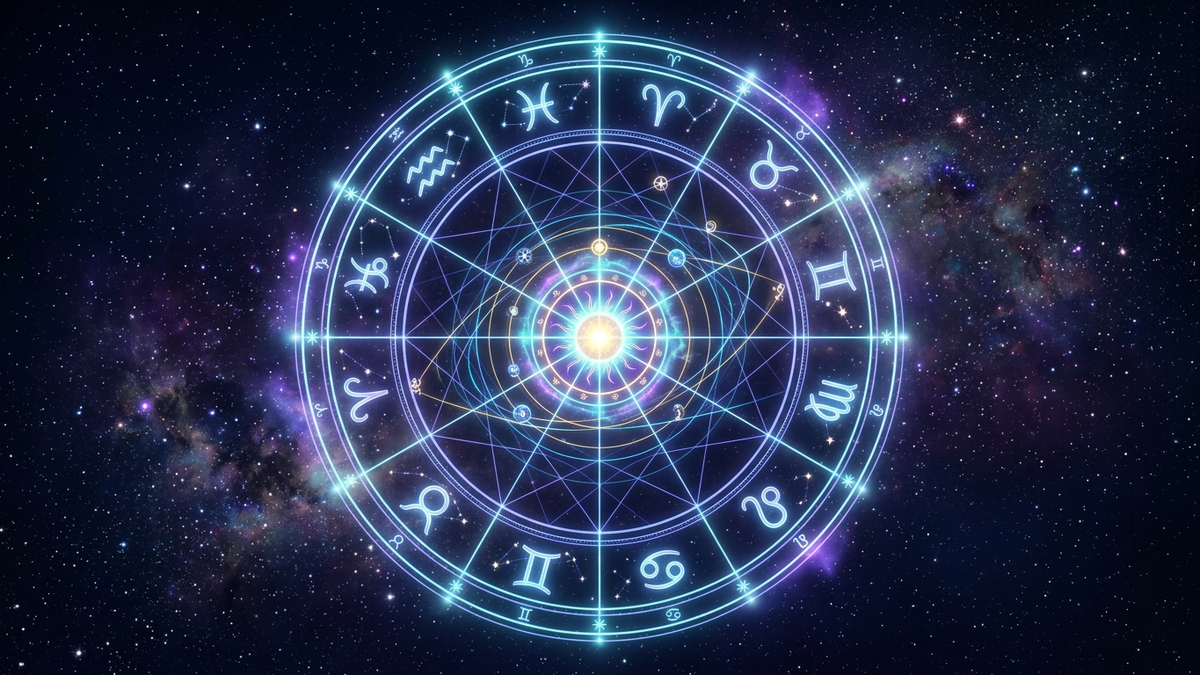
The astrology wheel is a circular map of the sky at the exact moment and place you were born. It has four layers you read in order: the 12 zodiac signs on the outer rim, the 12 houses inside them, the planets placed around the ring, and the aspect lines that cross the center. Read together, they show your personality, your life areas, and your timing. Nitya reads your whole wheel and explains it in plain language - ask your first question free on MyNitya.
If you have ever opened your birth chart and felt like you were staring at a clock covered in strange symbols, you are not alone. The wheel looks intimidating until someone shows you its four moving parts. After that, it reads like a sentence instead of a puzzle.
Your personal astrologer - Vedic + Western.
Reads all 10,000+ points of your birth chart to answer your question. First question free, no card needed.
Ask your question free →
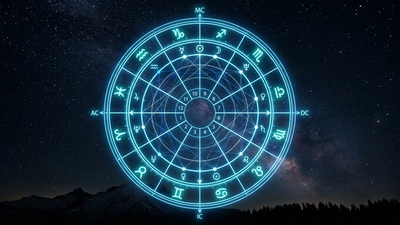
Cosmic chart wheel with a horizon axis and vertical meridian axis marking the four chart angles
Key Takeaways:
- The astrology wheel (or birth chart wheel) is a 360 degree circle divided into 12 signs and 12 houses
- You read it in four layers: signs (the style), houses (the life area), planets (the actors), aspects (the relationships)
- The Ascendant sits on the left of a Western wheel and sets the whole chart in motion
- The four angles - Ascendant, Descendant, Midheaven, and IC - are the most sensitive points in the chart
- Aspect lines across the center show which parts of you cooperate and which create tension
- Western charts are round; Vedic charts are usually drawn as a square (North Indian) or diamond (South Indian) using whole-sign houses
- Your exact birth time changes the houses and angles, so an accurate wheel needs date, time, and place
What Is the Astrology Wheel?
The astrology wheel is a circular diagram showing where the Sun, Moon, and planets sat against the zodiac at your birth. The outer ring holds the 12 signs, the inner ring holds the 12 houses, planet symbols sit inside, and lines across the middle mark aspects. It is the visual form of a full birth chart.
Think of it as three questions layered on one circle. The signs answer how an energy behaves. The houses answer where in life it plays out. The planets answer what the energy is. The planet shows the function, the sign shows the style, and the house shows the life area. Hold those three together and any placement becomes a plain sentence.
This is a Western circular chart, the format most people picture. Vedic astrology maps the same sky as a square or diamond grid, covered further down. Either way, the wheel is not a prediction machine. It is a map of patterns and timing you can learn to read.
The 12 Zodiac Signs: The Outer Rim
The 12 zodiac signs form the outer rim of the astrology wheel, each taking up an equal 30 degree slice of the 360 degree circle. The signs describe the style of energy, from Aries at the start to Pisces at the end. Every planet in your chart expresses itself through the sign it lands in.
The order never changes. Aries, Taurus, Gemini, Cancer, Leo, Virgo, Libra, Scorpio, Sagittarius, Capricorn, Aquarius, Pisces - always in that sequence around the wheel. That fixed cycle is why the wheel of the zodiac reads as one continuous cosmic story rather than 12 disconnected labels.
Here is the useful part for reading a chart. A sign on its own does nothing until a planet occupies it. Mars in Aries is direct and impatient. Mars in Cancer is protective and indirect. Same planet, same drive, but the sign changes the flavor completely. So when you scan the outer rim, you are really asking which style each of your planets is wearing.
The 12 Houses: Where Life Happens
The 12 houses are the inner segments of the astrology wheel, and each one represents a specific area of life. Reading counterclockwise from the Ascendant, they cover identity, money, communication, home, romance, work, partnership, and so on. A planet in a house shows where that energy is most active for you.
The houses are the stage, and the planets are the actors standing on it. A chart can have several planets crowded into one house, which concentrates a lot of energy in that life area and makes its theme loud in your life. Here is a quick map of the twelve houses and the life areas they govern.
House | Life area
- 1st: Self, appearance, first impressions
- 2nd: Money, values, self-worth, possessions
- 3rd: Communication, siblings, learning, short trips
- 4th: Home, family, roots, private life
- 5th: Romance, creativity, children, play
- 6th: Work, health, daily routine, service
- 7th: Partnership, marriage, close others
- 8th: Intimacy, shared resources, transformation
- 9th: Travel, higher learning, beliefs, meaning
Meet Nitya, your AI astrologer
She reads your birth chart to answer anything about your life. Your first complete answer is free, with no card required. Continued chat, Synastry, and Daily Guidance require Premium.
Questions you can ask about this topic
Tap any one below - or just write your own question in the form ↓
Nitya isn't a one-time horoscope. She's with you for the whole journey.
Understand yourself
Career, love, money, timing - any decision you are weighing. Answers read straight from your birth chart.
Understand any relationship
Add your partner, a parent, a friend, even a colleague. Nitya reads both charts together to explain the bond, the friction, and how to work through it.
Guidance for every day
Start each morning knowing what the day favors, what to watch for, and the best moments to act.
No card needed. Nitya just needs your birth details to read your chart.
Ask Nitya your first question - free →- 10th: Career, reputation, public role
- 11th: Friends, community, hopes, networks
- 12th: Solitude, the subconscious, endings, healing
The line that opens each house is called the house cusp, and the sign sitting on that cusp colors how the area behaves. For a deeper walk through each one, the guide to the meaning of the astrological houses in the birth chart breaks them down with examples. And because those cusps confuse a lot of beginners, it helps to understand what a cusp actually is in astrology before you read house boundaries too literally.
The Planets: The Actors on the Wheel
The planets are the symbols placed inside the astrology wheel, and they are the driving forces of the chart. The Sun, Moon, and eight planets each represent a core function - identity, emotion, communication, love, drive, growth, discipline, and more. Where each one sits by sign and house tells its story.
Start with the big three. The Sun is your core identity and vitality. The Moon is your emotional world and instincts. The Ascendant is how you meet the world. Learning to spot those first gives you the spine of the whole chart, which is exactly why the guide on how to find your Sun, Moon, and rising signs is a smart first stop.
Then the personal planets fill in the detail. Mercury shapes how you think and speak, Venus what you love and value, Mars how you pursue and fight for things. The outer planets - Jupiter, Saturn, Uranus, Neptune, Pluto - move slower and paint the bigger, long-term themes. When you read a planet, always name all three parts: the planet, its sign, and its house. That habit turns symbols into sentences.
The Four Angles: Ascendant, Descendant, MC, and IC
The four angles are the most sensitive points on the astrology wheel: the Ascendant, Descendant, Midheaven, and Imum Coeli. They are tied to the horizon and meridian at your exact birth time, so they anchor the whole chart. Planets touching an angle carry extra weight in your life.
The angles form two axes. The horizontal axis is the horizon: the Ascendant (AC) sits on the left, the eastern horizon, and describes your outer image and first impression. Directly opposite, on the right, is the Descendant (DC), which describes partnership and the qualities you seek in others. This Self versus Other axis is one of the most telling lines in any reading.
The vertical axis is the meridian. The Midheaven (MC) sits at the top and points to career, reputation, and public role. The Imum Coeli (IC) sits at the bottom and points to home, roots, and your private inner life. Because these points depend on birth time, a planet sitting right on your Descendant genuinely shapes your relationships - which is why planets on the Descendant in the 7th house get their own detailed treatment.
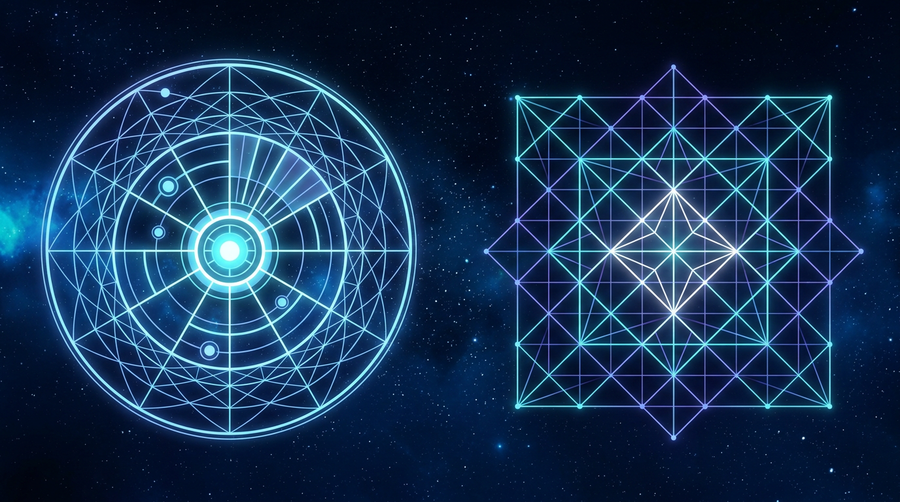
A circular Western astrology wheel beside a square Vedic North Indian chart grid showing two ways to map the sky
Aspects: The Lines Across the Wheel
Aspects are the lines drawn across the center of the astrology wheel, showing the angles between planets. They reveal how different parts of you cooperate or clash. Harmonious aspects like trines flow easily, while tense aspects like squares create friction that pushes you to grow.
The five major aspects are simple to learn. A conjunction (0 degrees) fuses two planets into one blended force. A sextile (60 degrees) offers easy opportunity. A square (90 degrees) creates tension and drive. A trine (120 degrees) flows with natural talent. An opposition (180 degrees) pulls between two poles that need balancing. As The Old Farmer's Almanac explains in its primer on what aspects mean in astrology, the colored lines are simply the geometry of how your planets talk to each other.
Take a concrete example. Saturn square Venus in the natal chart often shows up as delayed romantic commitment, frequently loosening in the early thirties as Saturn matures. That is not a vague claim, it is a specific configuration with a specific effect and a rough timeline. Among the birth charts analyzed on MyNitya, people with a tight Sun-Saturn square frequently describe feeling "older than their years" from a young age, a pattern the aspect predicts.
Western Wheel vs Vedic Chart: Round vs Square
The Western astrology wheel is round, while the Vedic chart is usually drawn as a square (North Indian style) or a diamond (South Indian style). Both map the same sky, but they differ in shape, in what stays fixed, and in how houses are assigned. The core reading logic still rhymes across both.
The Western circular chart uses the tropical zodiac, anchored to the seasons, with the Ascendant on the left and houses running counterclockwise. House sizes can be unequal depending on the house system. The Vedic chart uses the sidereal zodiac, anchored to the fixed stars, which currently sits about 24 degrees behind the tropical zodiac. That gap is the whole reason sidereal and tropical zodiac signs often differ for the same birthday.
The visual difference is striking. In the North Indian square chart, the houses are fixed - the 1st house (Lagna) always sits at the top diamond, and the signs rotate through those fixed house positions. In the South Indian diamond chart, the signs are fixed in place and the houses move. As Kaala Vedic Astrology details in its comparison of Vedic and Western birth charts, most Vedic charts also use whole-sign houses, where each entire sign is one house, so the sign boundary and the house boundary are the same line. The four angles trace back to the seasonal, tropical framework Ptolemy set out in his Tetrabiblos in the 2nd century, which anchored the signs to the equinoxes rather than the constellations - the single choice that still separates the two systems today.
How to Read the Astrology Wheel Step by Step
To read the astrology wheel, work from the frame inward to the detail. Start with the Ascendant and angles, then note the signs, then place the planets in their houses, and finally trace the aspect lines. This order builds a coherent picture instead of a pile of symbols.
- Find the Ascendant on the left and note its sign - this sets the tone.
- Locate the other three angles (DC, MC, IC) to frame Self, Other, career, and home.
- Read the outer rim to see which sign each planet occupies.
- Place each planet in its house to see which life area it activates.
- Note any house or sign holding three or more planets.
- Trace the aspect lines to see which planets support or challenge each other.
- Read each placement as a sentence: planet plus sign plus house.
Do not try to memorize everything at once. Even seasoned readers keep a reference handy for aspects and house meanings. The goal is not to recall trivia, it is to see the pattern.
Bringing the Whole Wheel Together
A single placement rarely tells the full story. The wheel is a system, and the meaning lives in how the parts combine. A Venus in Scorpio in the 7th house squared by Saturn reads very differently from the same Venus with no hard aspects. Context is everything.
This is where a good reading earns its keep, and where MyNitya fits in. MyNitya is an AI astrology platform where Nitya, your personal AI astrologer, reads your full Vedic or Western birth chart. Ask her anything in chat, compare your chart with someone else's for a compatibility reading, and get a personalized daily guidance reading each morning. Premium unlocks all three; your first question is free. Western astrology leans into psychological depth and personality, while Vedic astrology leans into timing, dashas, and karmic patterns - so you can read your wheel through whichever lens fits the question you are carrying.
Frequently Asked Questions
What is the astrology wheel?
The astrology wheel is a circular map of the sky at your exact birth moment. It shows the 12 zodiac signs on the outer rim, the 12 houses inside, the planets placed around the ring, and aspect lines across the center. Together these reveal personality, life areas, and timing. It is simply the visual form of a full birth chart.
How do I read the astrology wheel as a beginner?
Read the astrology wheel from the frame inward. Start with the Ascendant on the left, then find the other three angles. Next, note which sign each planet sits in, then which house it occupies. Finally, trace the aspect lines. Read every placement as a sentence: planet plus sign plus house. That order keeps it manageable.
Why does the Ascendant sit on the left of the wheel?
The Ascendant sits on the left of the Western astrology wheel because it marks the eastern horizon, where the zodiac was rising at your birth. Houses are then numbered counterclockwise from that point. It sets the whole chart's tone, which is why readers always start there.
What do the lines across the astrology wheel mean?
The lines across the astrology wheel are aspects - the angles between planets. They show how different parts of you interact. Conjunctions fuse energies, trines and sextiles flow easily, and squares and oppositions create tension that drives growth. The colored lines are a visual shorthand for how your planets cooperate or clash.
Why is the Vedic chart square instead of round?
The Vedic chart is drawn as a square (North Indian) or diamond (South Indian) by tradition, not necessity. It maps the same sky as the round Western wheel but uses the sidereal zodiac and usually whole-sign houses. In the North Indian style, houses stay fixed with the 1st house at the top; in the South Indian style, the signs stay fixed.
Do I need my exact birth time to read the astrology wheel?
Yes, you need your exact birth time to read the astrology wheel accurately. The houses and the four angles are calculated from the horizon at your birth moment, and they shift within minutes. Without a precise time, the signs and planets are still correct, but the house placements and angles can be wrong, which changes the entire reading.
The astrology wheel stops being intimidating the moment you see it as four simple layers stacked on one circle: signs for style, houses for life area, planets for the players, and aspects for the relationships between them. Learn to read those four things and you can look at any chart, yours or someone else's, and start telling its story.
You do not have to hold all of it in your head at once. Start with your Ascendant, find your Sun and Moon, and let the rest fill in over time. When you want the whole wheel read back to you in plain language - Vedic or Western - chat with Nitya about your birth chart, try free.