Sidereal vs Tropical: Why Your Real Zodiac Sign Might Be Different
In this Article
Sidereal astrology uses the actual positions of the stars and constellations to determine your zodiac sign. Tropical astrology - the system most Western horoscopes use - is based on the seasons instead. The difference between the two systems is currently about 24 degrees, which means roughly 80% of people have a different zodiac sign in sidereal astrology than the one they've always identified with. If you've ever read your horoscope and thought "this doesn't sound like me at all," the sidereal zodiac might be the reason.
Here's the thing that trips people up: two thousand years ago, the tropical and sidereal zodiacs were perfectly aligned. Aries season started when the Sun was actually in the constellation Aries. But Earth wobbles on its axis - slowly, about one degree every 72 years - and over two millennia, the seasons and the stars have drifted apart by nearly a full sign. Western astrology kept tracking the seasons. Vedic astrology kept tracking the stars. Same sky, two different maps.
Your personal astrologer - Vedic + Western.
Reads all 10,000+ points of your birth chart to answer your question. First question free, no card needed.
Ask your question free →Key Takeaways: The sidereal zodiac is fixed to the actual star constellations, while the tropical zodiac is fixed to Earth's seasons. A ~24-degree gap (called ayanamsa) means most people's sidereal sign is one sign earlier than their tropical sign. Vedic astrology (Jyotish) uses the sidereal system and adds layers like nakshatras, dashas, and divisional charts that tropical astrology doesn't include. Neither system is "wrong" - they measure different things. But if your Western horoscope has never quite fit, your sidereal chart might explain why.
What Is Sidereal Astrology?
Sidereal astrology is a system that calculates planetary positions based on the fixed stars and actual constellations in the sky. The word "sidereal" comes from the Latin sidereus, meaning "of the stars."
When a sidereal astrologer says your Sun is in Taurus, they mean the Sun was physically positioned in front of the constellation Taurus at the moment you were born. It's astronomy-based. The planets are where they actually are, relative to the star patterns humans have tracked for thousands of years.
This is the system used in Vedic astrology (Jyotish), which originated in ancient India and has been practiced continuously for over 5,000 years. The foundational text, Surya Siddhanta, explicitly accounts for the shifting relationship between the seasons and the stars - a phenomenon called the precession of the equinoxes. As Cafe Astrology's sidereal ephemeris data shows, the offset between tropical and sidereal positions is currently about 24 degrees. Vedic astrologers have been correcting for this drift since at least the 5th century CE.
Sidereal astrology doesn't just swap your sign and call it a day. In the Vedic system, your chart includes nakshatras (27 lunar mansions that divide the zodiac into even finer segments), the Vimshottari dasha system (planetary timing cycles that predict when specific life themes activate), and divisional charts like the Navamsa (D9) that reveal deeper layers of your destiny. It's a fundamentally different - and many would argue more precise - framework for understanding your birth chart.
What Is Tropical Astrology?
Tropical astrology is the system used by most Western astrologers. It defines the zodiac based on Earth's relationship to the Sun and the seasons, not the stars.
In the tropical system, 0 degrees Aries always begins at the vernal equinox - the first day of spring in the Northern Hemisphere, around March 20-21. It doesn't matter where the actual constellation Aries is in the sky. The tropical zodiac is anchored to the equinoxes and solstices, making it a seasonal calendar rather than a star map.
This system works well for describing personality archetypes tied to seasonal energy. Spring signs (Aries, Taurus, Gemini) carry initiating, grounding, and communicating energy. Summer signs (Cancer, Leo, Virgo) carry nurturing, expressive, and analytical energy. And so on through autumn and winter. The tropical zodiac is elegant in its simplicity.
But here's the catch: when the Greek astronomer Ptolemy codified tropical astrology around 150 CE, the seasons and the constellations were nearly aligned. Aries season and the constellation Aries overlapped. Ptolemy's system worked because both zodiacs pointed to the same sky. That alignment no longer holds.
The Precession of the Equinoxes: Why Your Sign Shifted
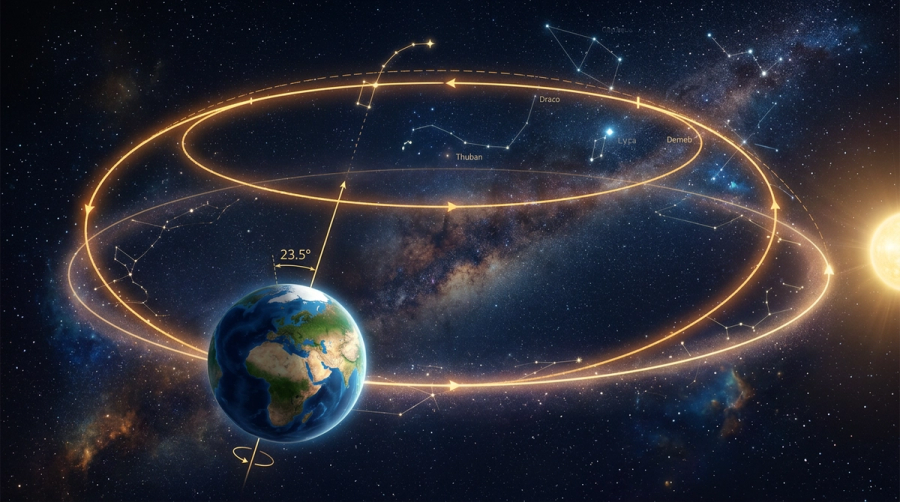
Earth axial precession diagram showing the slow wobble that shifts star positions over 26000 years
The precession of the equinoxes is the astronomical phenomenon that created the gap between sidereal and tropical astrology. It's not a theory or a belief - it's a measurable fact of physics that NASA and every observatory on Earth confirms.
Earth doesn't spin perfectly upright. Its axis is tilted at about 23.5 degrees, and that axis slowly wobbles in a circle - like a spinning top that's starting to slow down. One full wobble takes approximately 25,772 years. This wobble is called axial precession, and it gradually shifts the position of the equinox points against the backdrop of the fixed stars.
The practical effect: every 72 years, the equinox point drifts backward by about one degree relative to the constellations. Over the roughly 1,870 years since Ptolemy, that drift has accumulated to approximately 24 degrees - nearly an entire zodiac sign.
This is why the tropical zodiac and the sidereal zodiac no longer agree. The tropical system ignores the drift and keeps Aries locked to the spring equinox. The sidereal system tracks the drift and adjusts for it using a correction factor called ayanamsa. The most widely used ayanamsa in Vedic astrology is the Lahiri ayanamsa, which places the current offset at approximately 24 degrees and 8 minutes as of 2026.
The ancient Indian text Surya Siddhanta (Chapter 3, Verses 9-10) describes this precession explicitly, instructing astrologers to account for the shifting relationship between the seasons and the stars. As DashaClub's detailed comparison notes, Vedic astrologers have been making this correction for over 1,500 years. Western astrology, for the most part, chose not to.
Is Precession the Reason My Horoscope Feels Off?
Possibly. If you were born in the last third of your tropical sign - say, August 15 (tropical Leo) - your sidereal Sun is almost certainly in Cancer. That's a fundamentally different energy. Leo is fire, performance, and self-expression. Cancer is water, emotional depth, and nurturing instinct. If you've spent your life reading Leo horoscopes and thinking "I'm not really that dramatic," your sidereal Cancer Sun might be the missing piece.
Among birth charts analyzed on MyNitya, users who discover their sidereal placements for the first time frequently report that the Vedic descriptions resonate more deeply than the Western ones they'd been reading for years - particularly for Moon sign and Ascendant, which shape daily emotional experience and outward personality more than the Sun sign alone.
Your Sidereal Zodiac Sign: The Complete Conversion Table

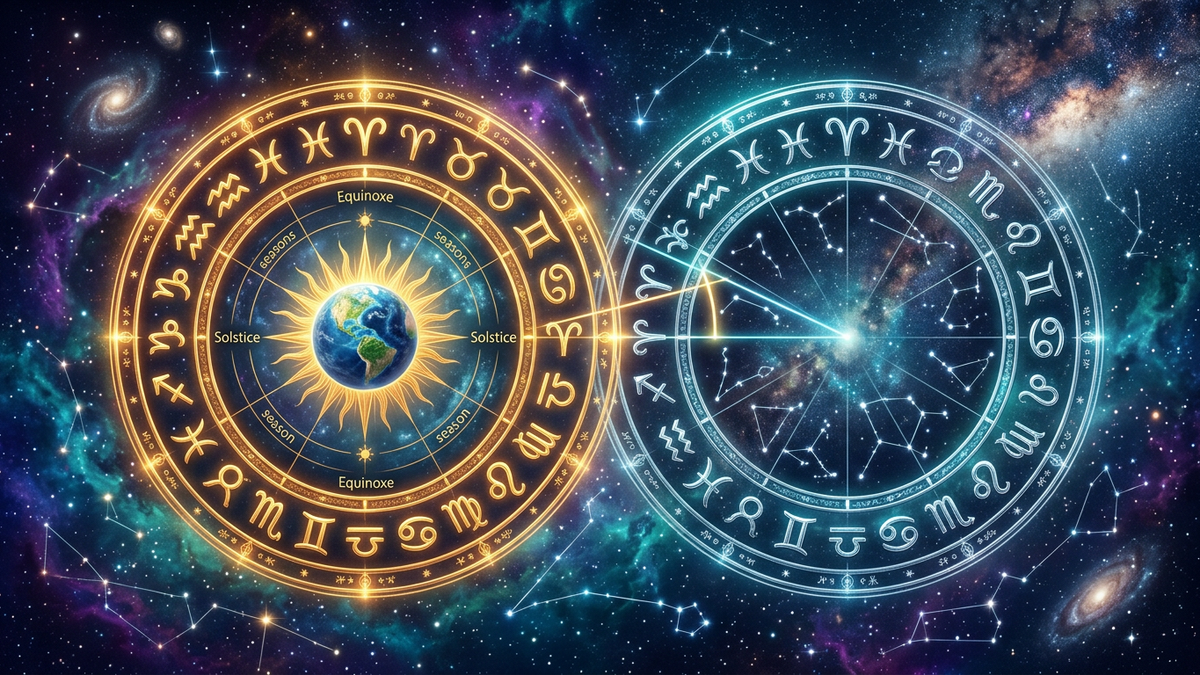
Split comparison showing how a person can be Leo in tropical astrology but Cancer in sidereal astrology
Sidereal zodiac signs run approximately 24 days later than their tropical counterparts. Here's the full conversion table using the Lahiri ayanamsa for 2026:
- Aries (Mesha): April 14 - May 14 (Tropical: March 21 - April 19)
- Taurus (Vrishabha): May 15 - June 14 (Tropical: April 20 - May 20)
- Gemini (Mithuna): June 15 - July 15 (Tropical: May 21 - June 20)
- Cancer (Karka): July 16 - August 16 (Tropical: June 21 - July 22)
- Leo (Simha): August 17 - September 16 (Tropical: July 23 - August 22)
- Virgo (Kanya): September 17 - October 17 (Tropical: August 23 - September 22)
- Libra (Tula): October 18 - November 16 (Tropical: September 23 - October 22)
- Scorpio (Vrischika): November 17 - December 15 (Tropical: October 23 - November 21)
- Sagittarius (Dhanu): December 16 - January 14 (Tropical: November 22 - December 21)
- Capricorn (Makara): January 15 - February 12 (Tropical: December 22 - January 19)
- Aquarius (Kumbha): February 13 - March 14 (Tropical: January 20 - February 18)
- Pisces (Meena): March 15 - April 13 (Tropical: February 19 - March 20)
Notice the pattern: if you were born in the first two-thirds of your tropical sign, your sidereal sign is likely one sign earlier. Born August 1? You're a tropical Leo but a sidereal Cancer. Born October 5? Tropical Libra, sidereal Virgo. Born December 30? Tropical Capricorn, sidereal Sagittarius.
But Sun sign is just the surface. Your Moon sign, Ascendant (Lagna), and all planetary positions shift by the same 24 degrees. A complete sidereal birth chart recalculates everything - and the picture that emerges can be strikingly different from what you're used to. If you're new to reading birth charts, our guide to birth chart interpretation breaks down what each planet and placement means.
To see your full sidereal chart with all planetary positions, nakshatras, and dasha periods, enter your birth details on MyNitya. Nitya calculates your Vedic birth chart using NASA-grade planetary positions and analyzes over 6,000 data points - then explains what it all means in plain language, personalized to your life.
Sidereal vs Tropical: Which System Is More Accurate?
Sidereal vs tropical accuracy is the most debated question in astrology. Both systems produce results that practitioners swear by. But they're measuring fundamentally different things, and understanding that distinction matters more than picking a winner.
What Tropical Astrology Measures
Tropical astrology maps the relationship between Earth and the Sun through the lens of seasonal cycles. It's excellent at describing archetypal personality patterns, psychological tendencies, and the general "flavor" of different time periods. When someone says "I'm such a Scorpio," they're usually describing a tropical archetype that resonates with their personality.
The tropical system's strength is its psychological depth. Modern Western astrologers have integrated Jungian psychology, evolutionary astrology, and humanistic approaches that give tropical readings a rich, introspective quality. If you want to understand your personality patterns and psychological motivations, tropical astrology does that well.
What Sidereal Astrology Measures
Sidereal astrology maps the relationship between you and the actual cosmos - the stars, constellations, and planetary positions as they exist in physical space. It's rooted in observable astronomy. When a Vedic astrologer says Jupiter is in Taurus, you can point a telescope at the sky and confirm it.
The sidereal system's strength is its predictive precision. Vedic astrology's dasha system can pinpoint timing windows for career changes, relationship shifts, health events, and financial fluctuations with a specificity that tropical astrology typically doesn't attempt. The Vimshottari dasha system divides your life into planetary periods and sub-periods, each activating different themes based on your unique chart.
The Honest Answer
Neither system is universally "more accurate." They're different tools for different questions.
If you want to understand your psychological makeup and personality archetypes, tropical astrology has a strong track record. If you want to predict timing - when will I get married, when should I change careers, when does this difficult period end - sidereal astrology's dasha system and transit analysis are significantly more specific.
Many experienced astrologers use both. They read the tropical chart for psychological insight and the sidereal chart for timing and karmic patterns. The two systems aren't enemies - they're complementary lenses on the same life.
That said, if you've only ever used one system and it hasn't fully resonated, trying the other is worth your time. The "aha" moment when someone reads their sidereal chart for the first time and finally feels seen is something we witness regularly on MyNitya.
Meet Nitya, your AI astrologer
She reads your birth chart to answer anything about your life. Your first complete answer is free, with no card required. Continued chat, Synastry, and Daily Guidance require Premium.
Questions you can ask about this topic
Tap any one below - or just write your own question in the form ↓
Nitya isn't a one-time horoscope. She's with you for the whole journey.
Understand yourself
Career, love, money, timing - any decision you are weighing. Answers read straight from your birth chart.
Understand any relationship
Add your partner, a parent, a friend, even a colleague. Nitya reads both charts together to explain the bond, the friction, and how to work through it.
Guidance for every day
Start each morning knowing what the day favors, what to watch for, and the best moments to act.
No card needed. Nitya just needs your birth details to read your chart.
Ask Nitya your first question - free →What Vedic Astrology Adds Beyond the Sidereal Zodiac
Switching from tropical to sidereal isn't just about moving your sign back by one. Vedic astrology (Jyotish) is an entirely different system with tools and techniques that Western astrology doesn't use. The sidereal zodiac is just the starting point.
Nakshatras: The 27 Lunar Mansions
The 27 nakshatras divide the zodiac into segments of 13 degrees and 20 minutes each - far more precise than the 30-degree signs. Each nakshatra has its own ruling deity, planetary ruler, animal symbol, and specific life themes.
Two people can both have their Moon in sidereal Cancer, but if one has Moon in Pushya nakshatra (ruled by Saturn - nurturing through discipline) and the other has Moon in Ashlesha nakshatra (ruled by Mercury - intense, serpentine emotional intelligence), their emotional lives will be dramatically different. Nakshatras are the reason Vedic astrology can distinguish between people who share the same sign placement.
The Brihat Parashara Hora Shastra, the foundational text of Vedic astrology, devotes extensive chapters to nakshatra analysis - describing each one's qualities, compatible nakshatras for marriage, and the specific life patterns each nakshatra produces.
The Dasha System: Predictive Timing
The Vimshottari dasha system assigns planetary periods that span your entire life. Each planet rules a specific number of years:
- Sun: 6 years
- Moon: 10 years
- Mars: 7 years
- Rahu: 18 years
- Jupiter: 16 years
- Saturn: 19 years
- Mercury: 17 years
- Ketu: 7 years
- Venus: 20 years
Your dasha sequence is determined by your Moon's nakshatra at birth. If you were born during Rohini nakshatra (ruled by Moon), your first dasha is Moon dasha, followed by Mars, then Rahu, and so on. Each period activates the themes of that planet in your specific chart.
This is why two people with identical sign placements can have completely different life trajectories. One might be running Jupiter dasha (expansion, opportunity, wisdom) while the other is in Saturn dasha (restriction, hard work, delayed rewards). The dasha system is Vedic astrology's most powerful predictive tool - and it has no equivalent in Western tropical astrology.
Divisional Charts
Vedic astrology uses 16 divisional charts (Varga charts) that zoom into specific life areas. The birth chart (Rasi) gives the overview. The divisional charts give the details:
- Navamsa (D9) - Marriage, spiritual purpose, and the deeper truth of your chart
- Dashamsa (D10) - Career and professional destiny
- Dwadashamsa (D12) - Parents and ancestral patterns
- Saptamsa (D7) - Children and progeny
A planet that looks weak in your Rasi chart might be powerfully placed in the Navamsa - meaning its full potential unfolds in the second half of life or through marriage. This layered analysis is unique to Vedic astrology and gives it a depth that single-chart systems can't match.
Why Your Vedic Sign Might Resonate More Than Your Western One
If you've always felt like your Western zodiac sign description was only partially right, your sidereal chart might explain the disconnect. Here's why the shift often feels more accurate.
The Moon Sign Matters More in Vedic Astrology
Western astrology emphasizes the Sun sign - your core identity and ego expression. Vedic astrology places equal or greater emphasis on the Moon sign (Rashi), which governs your emotional nature, instinctive reactions, and daily inner experience.
Most people relate more to their emotional patterns than their ego identity. You might project Leo confidence at work (Sun sign behavior) but feel deeply Cancerian at home - sensitive, protective, needing emotional security. If your sidereal Moon is in Cancer while your tropical Moon is in Leo, the Vedic reading captures your inner world more accurately.
The Ascendant Shift Changes Everything
Your Ascendant (Lagna) determines your entire house system - which life areas each planet governs in your chart. When the Ascendant shifts from tropical to sidereal, the 7th house shifts too. Understanding how the 12 houses shape your life is essential here, because a one-sign shift in the Ascendant can completely reorganize which planet rules your career, your relationships, your finances, and your health.
Someone with a tropical Virgo Ascendant has Mercury ruling their identity and first impressions. But if their sidereal Ascendant is Leo, suddenly the Sun rules their identity - a fundamentally different energy. The entire chart interpretation changes because the house lordships shift.
Nakshatras Add Nuance That Signs Can't
A tropical "Gemini" is a broad category covering 30 degrees of the zodiac. But within sidereal Gemini, you might be in Mrigashira nakshatra (curious, searching, restless), Ardra nakshatra (intense, transformative, storm-like), or Punarvasu nakshatra (optimistic, returning to center, nurturing). Each nakshatra tells a more specific story than the sign alone.
This is why people who've only read sun-sign horoscopes often feel like astrology is too vague. It is - at the sun-sign level. The nakshatra level is where astrology gets personal enough to be genuinely useful.
Chat with Nitya about your sidereal birth chart to discover your real zodiac placements, nakshatras, and current dasha period - ask your first question free on MyNitya.
How to Find Your Sidereal Birth Chart
Finding your sidereal birth chart requires three pieces of information: your birth date, your exact birth time, and your birth location. The birth time matters enormously - even a 15-minute difference can shift your Ascendant and change your entire house system.
What You Need
- Birth date - Day, month, and year
- Birth time - As precise as possible (check your birth certificate)
- Birth location - City and country (the system needs coordinates for accurate calculations)
Why Birth Time Precision Matters
In sidereal astrology, the Ascendant moves through one zodiac sign approximately every two hours. A birth time that's off by 30 minutes could place your Ascendant in the wrong sign, which cascades through your entire chart - wrong house lordships, wrong dasha calculations, wrong predictions.
If you don't know your exact birth time, Vedic astrologers use a technique called birth time rectification - working backward from known life events to narrow down the correct Ascendant. It's painstaking but effective.
Getting Your Chart Calculated
On MyNitya, you enter your birth details and your full Vedic birth chart is calculated automatically using Swiss Ephemeris data (the same astronomical engine used by NASA for planetary position calculations). The chart includes all sidereal planetary positions, your nakshatra placements, your current Vimshottari dasha period, and over 6,000 data points that Nitya - your personal AI astrologer - uses to give you personalized guidance.
Unlike generic sidereal calculators that just show you a chart and leave you to figure it out, Nitya explains what your placements mean in the context of your actual life. Ask about your career, your relationships, your timing for major decisions - and get answers grounded in your complete Vedic birth chart, not a sun-sign horoscope.
Common Misconceptions About Sidereal Astrology
"NASA Changed the Zodiac Signs"
This headline goes viral every few years and causes mass panic. What actually happened: NASA pointed out that the astronomical constellations don't match the 12 equal signs of the tropical zodiac - which Vedic astrologers have known and accounted for since the Surya Siddhanta was written. The sidereal zodiac already corrects for this. As Mastering the Zodiac explains, the sidereal system has always tracked the actual sky rather than a seasonal abstraction. NASA didn't "change" anything - they described a discrepancy that sidereal astrology resolved centuries ago.
"If My Sign Changed, My Whole Personality Changes"
Your personality doesn't change when you discover your sidereal sign. You're the same person. What changes is the lens through which astrology describes you. Many people find the sidereal description fits better. Some find the tropical description fits better. Some find both capture different facets of who they are. The chart is a map - it doesn't create the territory.
"Sidereal Astrology Is Only for Indians"
Vedic astrology originated in India, but the sidereal zodiac is based on universal astronomy. The stars don't care about your nationality. Hellenistic astrologers in ancient Greece used a sidereal-adjacent system. Some modern Western astrologers (the Fagan-Bradley school) use the sidereal zodiac within a Western framework. The sidereal zodiac belongs to anyone who wants to use it.
"One System Must Be Right and the Other Wrong"
This is the biggest misconception. Tropical and sidereal astrology are different coordinate systems applied to the same sky - like Celsius and Fahrenheit measuring the same temperature. A tropical Leo and a sidereal Cancer born on August 10 are the same person with the same sky overhead at birth. The two systems simply emphasize different relationships: your relationship to the seasons (tropical) versus your relationship to the stars (sidereal).
The question isn't which system is "right." It's which system gives you more useful insight into your specific life questions. For many people, especially those seeking timing-based guidance and predictive specificity, the sidereal system delivers more actionable answers.
Sidereal Astrology and Your Relationships
The sidereal shift doesn't just change your Sun sign - it can fundamentally reframe your relationship compatibility. Two people who seem incompatible in tropical astrology might have excellent synastry in the sidereal system, and vice versa.
Compatibility in Vedic Astrology
Vedic astrology uses a compatibility system called Ashtakoot Milan (eight-fold compatibility matching) that analyzes the Moon nakshatras of both partners across eight dimensions: temperament, emotional wavelength, magnetic attraction, dominance patterns, family compatibility, health harmony, children prospects, and overall auspiciousness.
This system produces a numerical score out of 36 points. Scores above 18 are considered favorable for marriage. The system is nakshatra-based - meaning it uses the precise sidereal Moon position, not just the sign. Two people with Moon in the same sidereal sign but different nakshatras can score very differently.
If you've been reading about zodiac compatibility based on tropical sun signs and the descriptions don't match your actual relationship experience, your sidereal Moon signs and nakshatras might tell a more accurate story.
The 7th House Shift
Your 7th house - the house of partnerships and marriage - is determined by your Ascendant. When the Ascendant shifts from tropical to sidereal, the 7th house shifts too. The planet ruling your 7th house changes. The type of partner your chart indicates changes. The timing of relationship events (through dasha analysis) changes.
Someone whose tropical chart suggests a Mercury-ruled partner (intellectual, communicative) might find their sidereal chart points to a Venus-ruled partner (artistic, sensual, harmony-seeking). If your relationships have consistently defied your tropical chart's predictions, the sidereal 7th house configuration might explain why.
Frequently Asked Questions
What is the difference between sidereal and tropical astrology?
Sidereal astrology calculates zodiac signs based on the actual positions of stars and constellations, while tropical astrology bases signs on Earth's seasons and the equinoxes. The two systems are currently offset by approximately 24 degrees (the ayanamsa), meaning most people's sidereal sign is one sign earlier than their tropical sign. Vedic astrology uses sidereal; most Western astrology uses tropical.
Is sidereal astrology more accurate than tropical?
Sidereal astrology is more astronomically precise because it tracks actual star positions. For predictive timing - when events will happen in your life - the Vedic sidereal system with its dasha periods is significantly more specific than tropical methods. For psychological personality analysis, tropical astrology has its own strengths. Many experienced astrologers use both systems for different purposes.
What is my real zodiac sign in sidereal astrology?
Your sidereal zodiac sign is typically one sign earlier than your tropical (Western) sign. If you're a tropical Leo (July 23 - August 22), your sidereal Sun is likely in Cancer (July 16 - August 16). The exact cutoff depends on the ayanamsa used and your birth year. For precise sidereal placements of all your planets, you need a full Vedic birth chart calculated from your exact birth time and location.
Why is my Vedic sign different from my Western sign?
Your Vedic sign differs because Vedic astrology uses the sidereal zodiac (fixed to stars) while Western astrology uses the tropical zodiac (fixed to seasons). Earth's axial precession has shifted these two reference frames apart by about 24 degrees over the past 1,700+ years. The Vedic system corrects for this drift using a factor called ayanamsa; the Western system does not.
Can I use both sidereal and tropical astrology?
Yes. Many astrologers read the tropical chart for psychological insight and personality archetypes, and the sidereal chart for predictive timing, karmic patterns, and life-event forecasting. The two systems describe different dimensions of the same person. Using both gives you a more complete picture than either system alone.
What are nakshatras and why do they matter?
Nakshatras are 27 lunar mansions in Vedic astrology, each spanning 13 degrees and 20 minutes of the zodiac. They provide far more precision than the 12 zodiac signs alone. Your Moon's nakshatra determines your Vimshottari dasha sequence (life timing cycles), your emotional temperament, and your compatibility profile. Two people with the same sidereal Moon sign but different nakshatras will have distinctly different emotional patterns and life timelines.