Most Accurate Horoscopes Online - What Makes a Horoscope Reliable (2026)
In this Article
The most accurate horoscopes are the ones based on your complete birth chart - not just your Sun sign. A horoscope written for "all Leos" applies to roughly 650 million people. An accurate reading accounts for your Moon sign, Rising sign, planetary houses, aspects, and current planetary periods. The difference between a generic horoscope and a personalized one is the difference between a weather forecast for your continent and a radar check for your street.
You've probably noticed that some horoscopes feel eerily accurate while others miss completely. One week your Virgo horoscope nails your exact situation. The next week it describes someone you've never been. That inconsistency isn't random - it's structural. The horoscope was never written for you. It was written for everyone born between August 23 and September 22. And that's a lot of very different people.
Your personal astrologer - Vedic + Western.
Reads all 10,000+ points of your birth chart to answer your question. First question free, no card needed.
Ask your question free →So what actually makes a horoscope accurate? It comes down to three layers that most people never think about - and most horoscope sites only get the first one right.
Key Takeaways: Horoscope accuracy depends on three layers: calculation precision (the math behind planetary positions), astrological system (Vedic sidereal vs Western tropical), and personalization depth (Sun sign only vs full birth chart). Generic Sun sign horoscopes apply to 1/12th of the world's population. Truly accurate readings require your exact birth date, time, and location to calculate all planetary positions, houses, nakshatras, and dasha periods. The Swiss Ephemeris is the gold standard for calculation accuracy, achieving 0.001-arcsecond precision.
Why Most Horoscopes Are Inaccurate
Most horoscopes are inaccurate because they're based on a single data point - your Sun sign - while ignoring the dozens of other placements that make your chart unique. It's the astrological equivalent of diagnosing someone's health by checking only their temperature.
Your Sun sign is determined by your birth date alone. It represents your core identity and life purpose. But your birth chart contains nine planets (in Vedic astrology), twelve houses, twelve signs, twenty-seven nakshatras, and hundreds of aspects and yogas. Each combination is unique. Two people born on the same day but at different times and locations will have completely different Rising signs, house placements, and Moon positions.
Here's a concrete example. Take two people born on October 5 - both Libra Suns in Western astrology (likely Virgo Suns in Vedic). Person A was born at 7 AM in New York. Person B was born at 7 PM in Mumbai. Person A might have Libra Rising with Moon in Aries. Person B might have Pisces Rising with Moon in Scorpio. Same Sun sign. Completely different emotional worlds, relationship patterns, and career instincts.
When a horoscope says "Libra, this week brings romantic opportunities," it's speaking to both of these people identically. But Person A (Aries Moon, Libra Rising) processes romance through impulsive action and social charm. Person B (Scorpio Moon, Pisces Rising) processes romance through emotional intensity and intuitive connection. The same "romantic opportunity" would look and feel completely different to each of them.
This is why the most accurate horoscopes move beyond Sun signs entirely.
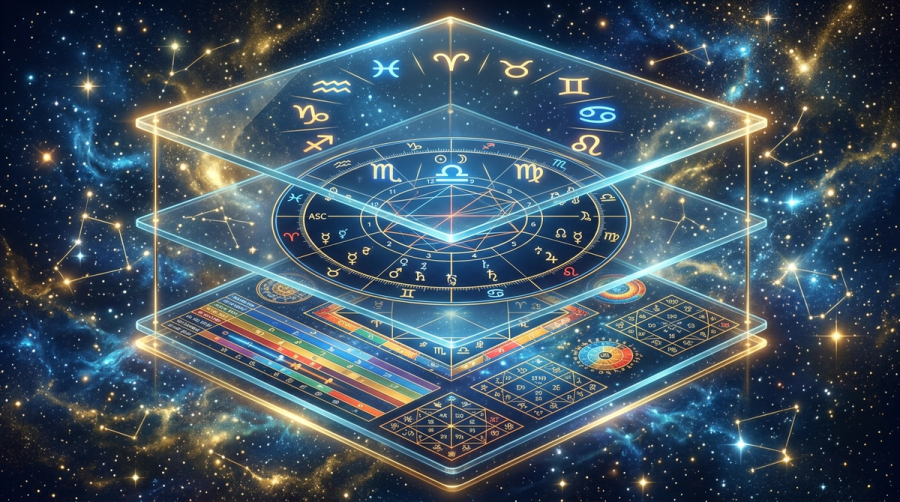
Three layers of horoscope accuracy shown as concentric rings from calculation to system to personalization
The Three Layers of Horoscope Accuracy
Accuracy in astrology isn't one thing - it's three distinct layers stacked on top of each other. A horoscope can nail one layer and completely fail the other two.
Layer 1: Calculation precision
The foundation of any accurate horoscope is precise astronomical calculation. Where exactly was Mars at 3:47 AM on April 12, 1991, as seen from Chicago? The answer needs to be precise to fractions of a degree, because even small errors can place a planet in the wrong sign or house.
The Swiss Ephemeris - developed by Astrodienst and calibrated to NASA JPL ephemeris data - is the gold standard, achieving accuracy of 0.001 arcseconds. In a benchmark test of 15 astrology APIs across 100 birth charts, the Swiss Ephemeris served as the reference standard with 99.9% accuracy, and 4 of the 15 APIs failed against it.
Platforms using the Swiss Ephemeris (Astro.com, MyNitya, TimePassages) produce technically identical planetary positions. Platforms using simplified calculations or approximations can drift by several degrees - enough to place a planet in the wrong sign entirely.
Layer 2: Astrological system
Western tropical astrology and Vedic sidereal astrology use different zodiac frameworks. The tropical zodiac is fixed to the seasons (spring equinox = 0 degrees Aries). The sidereal zodiac is aligned to the actual star constellations. Due to the precession of the equinoxes, these systems have drifted about 24 degrees apart.
Your Vedic Sun sign is typically one sign back from your Western one. A Western Gemini is often a Vedic Taurus. Neither system is "wrong" - they measure different things. But the sidereal system has one objective advantage: it's aligned to where the stars physically are in the sky right now. Our Vedic vs Western comparison covers this in depth.
Layer 3: Personalization depth
This is where most horoscopes fail catastrophically. A Sun sign horoscope applies to approximately 1/12th of the world's population. Your complete birth chart - with its unique combination of planetary positions, house placements, nakshatras, and dasha periods - is as individual as a fingerprint.
A truly accurate reading must account for:
- Your Ascendant (Rising sign) and its lord
- Your Moon sign and nakshatra
- Planetary positions by sign AND house
- Aspects between planets
- Current Vimshottari Dasha period (in Vedic astrology)
- Active transits hitting your natal positions
The jump from Layer 1 to Layer 3 is enormous. Most horoscope sites get Layer 1 right (accurate calculations) but stop at Layer 2 (they pick one system) and never reach Layer 3 (true personalization). That's why you can read a perfectly calculated horoscope that still feels completely wrong for you.
What Makes a Horoscope Truly Personalized
A truly personalized horoscope reads your complete birth chart and connects current planetary movements to your specific natal positions. Here's what that looks like in practice.
Generic horoscope approach:
"Saturn is transiting Pisces in 2026. Virgos may experience relationship challenges this year."
This applies to everyone born between August 23 and September 22. It's technically correct - Saturn in Pisces does oppose Virgo placements. But it tells you nothing about your specific situation.
Meet Nitya, your AI astrologer
She reads your birth chart to answer anything about your life. Your first complete answer is free, with no card required. Continued chat, Synastry, and Daily Guidance require Premium.
Questions you can ask about this topic
Tap any one below - or just write your own question in the form ↓
Nitya isn't a one-time horoscope. She's with you for the whole journey.
Understand yourself
Career, love, money, timing - any decision you are weighing. Answers read straight from your birth chart.
Understand any relationship
Add your partner, a parent, a friend, even a colleague. Nitya reads both charts together to explain the bond, the friction, and how to work through it.
Guidance for every day
Start each morning knowing what the day favors, what to watch for, and the best moments to act.
No card needed. Nitya just needs your birth details to read your chart.
Ask Nitya your first question - free →Personalized birth chart approach:
"Saturn is transiting your 7th house at 8 degrees Pisces, forming an exact opposition to your natal Venus at 9 degrees Virgo in the 1st house. You're currently in your Mercury Mahadasha, Venus Antardasha. This combination suggests a period where existing relationships face a reality check - Saturn demands authenticity from Venus. Relationships built on genuine connection will deepen. Those built on convenience may dissolve. This transit peaks between March and June 2026."
Same planetary event. Completely different level of usefulness. The second reading requires your exact birth data, your complete chart, and knowledge of your current dasha period. That's what separates accurate astrology from entertainment.
Among charts analyzed on MyNitya, users experiencing Saturn transiting their 7th house during Sade Sati consistently report that the transit's intensity varies dramatically based on their natal Saturn's dignity - Saturn in its own sign (Capricorn or Aquarius) handles the transit with more resilience than Saturn debilitated in Aries. The Brihat Parashara Hora Shastra describes this as Saturn's "temporal strength" (kala bala) modifying its transit effects.
Person receiving personalized astrology reading on a tablet with birth chart data visible
How to Find the Most Accurate Horoscope for You
Finding an accurate horoscope isn't about finding the right website - it's about finding the right type of reading. Here's a practical framework.
If you just want a quick daily read:
Look for horoscopes that use decanate divisions (splitting each sign into three 10-degree segments) rather than treating all 30 degrees of a sign identically. Cafe Astrology does this well. It's still Sun sign-based, but the decanate approach triples the specificity.
If you want real accuracy:
You need a reading based on your complete birth chart. This means entering your exact birth date, time, and location into a platform that calculates all planetary positions and interprets them in context.
For Western astrology, TimePassages (Astrograph) provides solid free natal chart interpretations that account for your specific planetary placements and current transits.
For Vedic astrology, MyNitya calculates your full chart using Swiss Ephemeris precision - analyzing over 6,000 data points including nakshatras, Vimshottari Dasha periods, and divisional charts - and lets you ask Nitya specific questions about your life. Your first question is free.
If you want ongoing personalized guidance:
The most accurate ongoing guidance comes from platforms that track your current planetary periods (dashas) alongside transits. Knowing that you're in a Venus-Saturn sub-period while Saturn transits your 7th house tells a fundamentally different story than just knowing Saturn is in Pisces.
This is where Vedic astrology's dasha system provides an accuracy advantage that Western transit-based timing can't match. The dasha tells you which planet is "activated" in your life right now. The transit tells you what's happening in the sky. When both point to the same theme, the prediction becomes remarkably specific.
Curious what your current dasha period reveals? Ask your first question free on MyNitya.
Why Vedic Horoscopes Are Often More Precise
Vedic astrology (Jyotish) includes several precision tools that Western astrology doesn't offer. These aren't philosophical differences - they're practical tools that make readings more specific.
Nakshatras narrow the lens
The 27 nakshatras divide the zodiac into segments of 13 degrees 20 minutes - less than half the width of a zodiac sign. Two people with Moon in Scorpio will have very different emotional profiles depending on whether their Moon falls in Vishakha nakshatra (driven, goal-oriented) or Anuradha nakshatra (devoted, emotionally deep). This granularity is why Vedic readings can describe personality traits with surprising specificity.
Dashas add timing
The Vimshottari Dasha system maps a 120-year cycle of planetary periods based on your Moon's nakshatra at birth. Instead of saying "Saturn will affect you sometime this year," a Vedic astrologer can say "your Saturn Mahadasha, Mercury Antardasha begins in October 2026, activating themes of disciplined communication and structured learning for the next 2 years and 8 months."
That level of timing specificity is unique to Vedic astrology. Western astrology uses transits and progressions for timing, which are useful but less precise for long-range prediction.
Divisional charts zoom in
Vedic astrology doesn't stop at the birth chart (Rasi). It uses divisional charts (Vargas) that zoom into specific life areas. The Navamsa (D9) reveals the deeper truth of relationships. The Dasamsa (D10) focuses on career. A planet that looks weak in the main chart might be strong in the Navamsa, suggesting hidden potential that emerges through partnerships.
These layers compound. A Vedic reading that accounts for your Rasi chart, Navamsa, current dasha, active transits, and nakshatra positions produces a level of specificity that a Sun sign horoscope simply cannot approach.
The Accuracy Problem with Daily Horoscopes
Daily horoscopes face a fundamental accuracy problem that no amount of good writing can solve: they're written for 1/12th of the population at a time.
Even the best daily horoscope writers - and some are genuinely talented astrologers - are constrained by the format. They track real planetary transits (Moon changing signs, Mercury aspects, etc.) and interpret them through each Sun sign's lens. But they can't account for your Rising sign, your house placements, your Moon sign, or your current dasha period.
The result is a reading that's sometimes accurate by coincidence (when the transit happens to hit a sensitive point in your chart) and sometimes completely irrelevant (when the transit activates a part of the zodiac that has no connection to your specific chart).
This is why you'll have weeks where your horoscope feels uncannily accurate, followed by weeks where it describes a stranger. It's not that the astrologer got better or worse. It's that the transits sometimes align with your chart and sometimes don't.
The solution isn't to stop reading daily horoscopes - they can be fun and occasionally insightful. The solution is to understand their limitations and supplement them with readings based on your actual birth chart.
How AI Is Making Horoscopes More Accurate
The biggest accuracy improvement in horoscopes right now isn't coming from better astrologers or new planetary discoveries. It's coming from AI.
Traditional horoscope writing is a one-to-many broadcast. One astrologer writes one paragraph for all Virgos. AI changes this to a one-to-one conversation. Instead of broadcasting to millions, an AI astrologer can read your specific chart and respond to your specific question.
But not all AI astrology is equally accurate. The key question is: does the AI actually read your birth chart data, or does it just generate plausible-sounding astrology text?
On MyNitya, Nitya analyzes over 6,000 astrological data points from your Vedic birth chart - planetary positions calculated with Swiss Ephemeris precision, all 27 nakshatras, your complete Vimshottari Dasha timeline, navamsha chart, and hundreds of yoga combinations. When you ask "Is this a good time to change careers?", Nitya doesn't give you a generic answer about your Sun sign. She looks at your 10th house lord, its current dasha activation, the transits hitting your career houses, and your Dasamsa chart - then explains what she sees.
That's the standard for accurate AI astrology: chart-grounded responses, not generated text.
Chat with Nitya about your birth chart - try free on MyNitya.
Frequently Asked Questions
What is the most accurate horoscope?
The most accurate horoscope is one based on your complete birth chart - not just your Sun sign. It should account for your Ascendant, Moon sign, planetary houses, aspects, and current planetary periods. For calculation precision, look for platforms using the Swiss Ephemeris engine (0.001-arcsecond accuracy). For personalization, choose platforms that let you ask specific questions about your chart rather than serving generic sign-based content.
Are daily horoscopes accurate?
Daily horoscopes are based on real planetary transits but applied generically to 1/12th of the population. They're occasionally accurate when the day's transits happen to activate sensitive points in your specific chart, and irrelevant when they don't. For consistent accuracy, you need readings based on your complete birth chart that track transits against your personal planetary positions and current dasha period.
Which is more accurate - Vedic or Western astrology?
Both systems use precise astronomical calculations, but they measure different things. Vedic astrology uses the sidereal zodiac (aligned to actual constellations) and includes precision tools like nakshatras, the Vimshottari Dasha timing system, and divisional charts that Western astrology doesn't offer. Many people find their Vedic placements resonate more accurately than their Western ones, particularly for timing predictions.
How can I get a more accurate horoscope reading?
Get a more accurate reading by providing your exact birth date, time, and location to a platform that calculates your complete birth chart. The more data points the platform analyzes, the more personalized the reading. MyNitya analyzes over 6,000 Vedic data points from your chart. Your birth time is the most critical piece - even 15 minutes can change your Rising sign and shift your entire house structure.
Why do some horoscopes feel accurate and others don't?
Horoscopes feel accurate when the day's planetary transits happen to activate sensitive points in your specific birth chart - and irrelevant when they activate parts of the zodiac unconnected to your chart. This creates an inconsistent experience that has nothing to do with the astrologer's skill. The only way to get consistently accurate readings is through personalized birth chart analysis rather than Sun sign-based horoscopes.
Is AI astrology accurate?
AI astrology accuracy depends entirely on whether the AI reads your actual birth chart data or just generates generic astrology text. The best AI platforms analyze thousands of data points from your chart - planetary positions, nakshatras, dashas, aspects, and divisional charts - and ground their responses in that data. AI's advantage over human astrologers is consistency and accessibility. Its limitation is the absence of intuitive reading that experienced human astrologers bring to complex chart patterns.