Soulmate Astrology: Chart Signs of a Soulmate Connection
In this Article
Soulmate astrology is the study of the birth-chart markers that describe a soul-deep partnership - who you're karmically drawn to, and when that bond is likely to arrive. It can't hand you a name or a date. What it can do is name the exact signs of a soulmate connection: in Vedic astrology, the 7th house, Darakaraka, Navamsa, and the Rahu-Ketu axis; in Western astrology, the North Node, Vertex, Juno, and Venus-Mars contacts. Compare your chart with theirs - ask Nitya on MyNitya.
Here's the honest version before we go deep. No chart earmarks "the one." Real astrologers don't read soulmates from Sun signs alone. But the more of these markers that stack up between two charts, the more a bond tends to feel fated, weighty, and hard to walk away from. That convergence is what this guide teaches you to read.
Your personal astrologer - Vedic + Western.
Reads all 10,000+ points of your birth chart to answer your question. First question free, no card needed.
Ask your question free →Key Takeaways:
- Soulmate astrology describes the type and timing of a soul-deep bond, not a specific name or face.
- Vedic markers: the 7th house and its lord, the Darakaraka (Jaimini spouse significator), the Navamsa (D9) chart, the Rahu-Ketu karmic axis, and nakshatra/Ashtakoota matching.
- Western markers: North & South Node contacts, the Vertex, Juno, Venus-Mars, Sun-Moon, and Saturn for durability - anchored by the 7th house/Descendant.
- Same-element and complementary-element sign pairs (Fire-Air, Earth-Water) are the classic "zodiac signs soulmates" starting point - but the full chart matters far more than Sun signs.
- You've likely met a soulmate when recognition outlasts the chemistry and the synastry markers repeat.
- Birth time is essential - without it you lose the Descendant, the Vertex, and every house overlay.
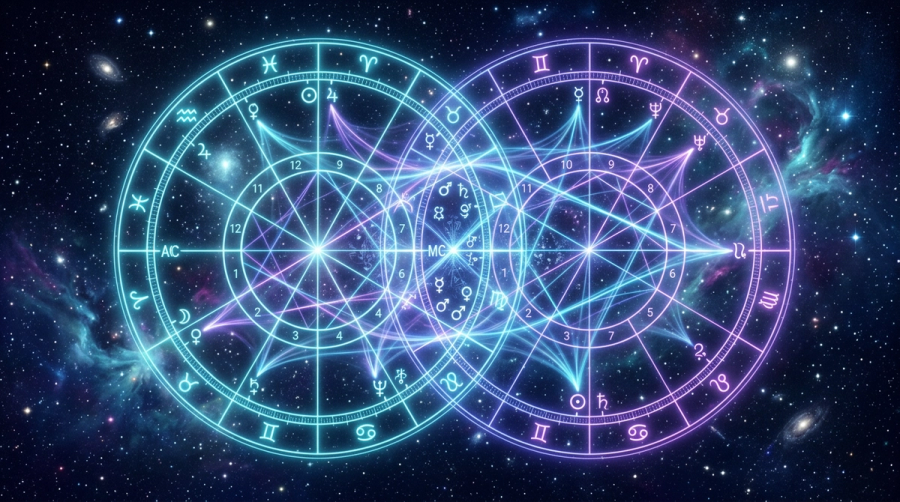
Two overlapping natal chart wheels with glowing connection lines showing a synastry soulmate overlay
What Is Soulmate Astrology - and What It Can't Show
Soulmate astrology is the practice of reading a birth chart, and the comparison of two charts, for the specific placements that mark a karmic, life-changing partnership. It shows temperament, theme, and timing windows. It does not predict a name, a face, or a guaranteed outcome - those depend on free will and real-world circumstance.
The confusion starts because pop culture sells "soulmate" as one fated person waiting somewhere. Classical astrology never promised that. What it offers is a map of what to recognize and when the ground is fertile. That's more useful than a fortune, because it puts the work back in your hands.
Two things are worth saying plainly. First, you can have several soulmate-grade connections across a lifetime - a karmic teacher, a romantic soulmate, a life-partner soulmate. Each activates a different piece of your growth. Second, soulmate markers describe potential, not destiny. Two charts loaded with signatures still need two willing people who do the work.
This pillar covers the overview, the indicators in both systems, and the sign pairings. For the two deeper angles, we've written dedicated guides: the who side - reading your soulmate's likely traits - lives in who is my soulmate by birthdate, and the when side lives in the guide to when you'll meet your soulmate and the astrology timing behind it.
The Chart Signs of a Soulmate in Vedic Astrology
In Vedic astrology (Jyotish), the soulmate signs of a chart cluster around five things: the 7th house and its lord, the Darakaraka (the Jaimini spouse significator), the Navamsa or D9 chart, the Rahu-Ketu karmic axis, and nakshatra-based Ashtakoota matching. Read together, these describe the partner and the karma the bond carries.
Vedic astrology is famous for one thing above all: timing and karmic pattern. It treats marriage not as a mood but as a bhava - a life department with rulers, occupants, and cycles. The classical source, the Brihat Parashara Hora Shastra, dedicates specific chapters to reading the spouse from the 7th house and its lord. The Jaimini tradition, in the Jaimini Sutras, adds a second, elegant layer through the karakas.
The 7th House and the 7th Lord
The 7th house - Kalatra Bhava - is the primary house of marriage, the spouse, and committed partnership. The planets sitting in it, and the placement of its ruling lord, describe the kind of partner you attract and how the bond behaves.
Configuration and effect: Venus or well-placed Jupiter in the 7th tends toward affectionate, fated-feeling partnerships that become a central life theme. Saturn in the 7th doesn't deny marriage - it delays and deepens it, often producing a late but unusually durable bond. Rahu in the 7th can signal a partner from a very different background, and a relationship that feels unusually magnetic from the first meeting. The 7th lord's house placement then tells you where and how the partner is likely to enter your life.
Darakaraka - the Jaimini Spouse Significator
The Darakaraka (DK) is the planet at the lowest degree in your chart, and in Jaimini astrology it's the single most personal significator of your spouse. Its sign, house, and the planets aspecting it sketch your soulmate's core nature.
The strongest single Vedic soulmate marker sits here: when one person's Atmakaraka (the highest-degree planet, the "soul" indicator) matches the same planet as the other's Darakaraka, Jaimini tradition reads it as a soul-recognizing bond - the other person literally embodies your soul's central relational lesson. When the two charts show this cross-match, the pull is rarely casual. This karakas framework is drawn straight from the classical Jyotish soulmate indicators outlined by Vedaz, which walks through DK and Atmakaraka analysis in detail.
The Navamsa (D9) Chart
The Navamsa, or D9, is the divisional chart Vedic astrologers treat as the true chart of marriage and dharma. A promise of partnership seen in the main rashi chart only becomes reliable if the D9 confirms it. This is why a Vedic reading of a soulmate always checks both.
Look for the D9 Lagna lord and the D9 7th lord being strong or well-connected, and for benefics influencing the Navamsa 7th. A common pattern: a chart with an afflicted 7th house in the main chart but a strong, benefic-influenced Navamsa 7th often marries later - and marries well. The D9 is where the depth of the bond is written.
The Rahu-Ketu Karmic Axis
The Rahu-Ketu axis - the lunar nodes - is Vedic astrology's karmic backbone, and it's central to soulmate work. When one person's nodal axis lands across the other's 1st/7th houses in synastry, the connection carries a fated, "we've done this before" quality. Ketu brings the sense of familiarity; Rahu brings the hunger to keep going.
Configuration and effect: a Rahu-Ketu axis across the 1st/7th houses in chart comparison signals a karmic, magnetic pull that can feel destined rather than chosen. These are the bonds that form fast and refuse to be reasoned away. They aren't always smooth - nodal connections are here to move something in you, not to keep you comfortable.
Nakshatra and Ashtakoota (Kuta) Matching
Vedic astrology's oldest compatibility system, Ashtakoota Milan, scores two charts across eight kutas (categories) worth 36 points total, based mainly on the Moon's nakshatra. It's the framework used in traditional Indian matchmaking for centuries.
The eight kutas measure different layers - Varna (spiritual compatibility), Vashya (mutual influence), Tara (health and well-being), Yoni (physical and instinctive compatibility), Graha Maitri (mental friendship), Gana (temperament), Bhakoot (emotional and financial harmony), and Nadi (health and progeny). A score above 18 is considered workable; above 28 is strong. But even a modest score with strong Darakaraka and nodal links can outrank a "perfect" 32 with no soul markers - which is exactly why serious astrologers never stop at the number.
The Chart Signs of a Soulmate in Western Astrology
In Western astrology, the soulmate signs of a chart center on synastry - the overlay of two natal charts. The strongest markers are North & South Node contacts, the Vertex, Juno, Venus-Mars cross-aspects, Sun-Moon links, and Saturn contacts for durability, all anchored by the 7th house and the Descendant.
Where Vedic excels at karmic timing, Western astrology excels at psychological depth - why you're drawn to a person and what the relationship is built to teach. Its soulmate toolkit rests on the classical foundation Ptolemy laid out in Tetrabiblos (Book IV reads the partner from the 7th place), layered with the modern synastry work of astrologers like Robert Hand and Liz Greene.
North Node and South Node Contacts
The lunar nodes are Western astrology's clearest soulmate signature. The North Node marks your soul's growth direction; the South Node marks what's familiar and karmic. When one person's Sun, Moon, or Venus conjuncts your North Node within about three degrees, they pull you toward the person you're becoming.
Configuration and effect: North Node conjunct Venus between two charts is a classic soulmate marker - the partner feels both magnetic and destined, someone who draws you forward. South Node conjunct a personal planet feels like instant, uncanny familiarity - "I've known you forever" - and can be a past-life echo that's either deeply healing or hard to release.
The Vertex - the "Fated Meeting" Point
The Vertex is a sensitive point often called the chart's "third angle," associated with fated encounters that change a life's direction. When someone's Sun, Venus, Mars, or an outer planet conjuncts your natal Vertex, the meeting tends to feel significant from the first conversation.
The Vertex isn't a guarantee of romance - it can mark a pivotal friendship or teacher too. But for soulmate work, a Vertex contact in synastry is one of the strongest single indicators that a meeting mattered. People describe these encounters as arriving "out of nowhere" and rearranging everything.
Juno - the Marriage Asteroid
Juno is the asteroid Western astrologers read as the signature of committed, marriage-grade partnership. Your natal Juno sign describes what you need in a long-term spouse; Juno contacts in synastry point to lasting commitment specifically.
When one person's Sun, Moon, Venus, or Ascendant conjuncts the other's Juno, the relationship carries a "this is the one I commit to" quality. Juno tends to show up quietly in the charts of couples who actually marry - less flashy than Venus, more binding. It's the difference between attraction and partnership.
Meet Nitya, your AI astrologer
She reads your birth chart to answer anything about your life. Your first complete answer is free, with no card required. Continued chat, Synastry, and Daily Guidance require Premium.
Questions you can ask about this topic
Tap any one below - or just write your own question in the form ↓
Nitya isn't a one-time horoscope. She's with you for the whole journey.
Understand yourself
Career, love, money, timing - any decision you are weighing. Answers read straight from your birth chart.
Understand any relationship
Add your partner, a parent, a friend, even a colleague. Nitya reads both charts together to explain the bond, the friction, and how to work through it.
Guidance for every day
Start each morning knowing what the day favors, what to watch for, and the best moments to act.
No card needed. Nitya just needs your birth details to read your chart.
Ask Nitya your first question - free →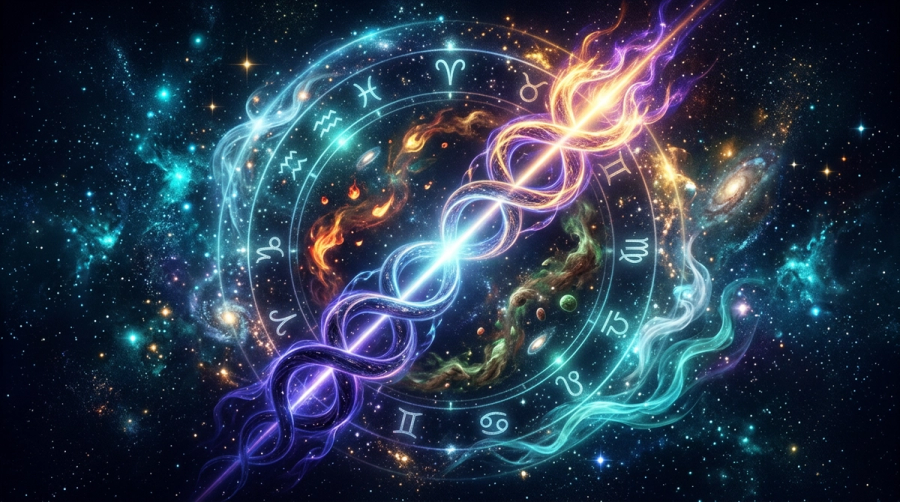
A glowing diagonal node axis crossing a zodiac wheel with fire, earth, air and water elements
Venus-Mars and Sun-Moon Contacts
Venus-Mars cross-aspects are the chemistry engine of synastry. When one person's Venus contacts the other's Mars, there's a natural romantic and physical spark. Venus trine or conjunct Mars between two charts is one of the most-cited attraction markers online - real, but on its own it's chemistry, not a soulmate.
Sun-Moon contacts run deeper. When one person's Sun conjuncts the other's Moon, the relationship has a natural sense of home - the Sun person feels seen by the Moon person, and the Moon person feels warmed. Cafe Astrology's overview of what makes a soulmate connection in synastry treats Sun-Moon and the strength of the composite chart as core soulmate signatures.
Saturn - the Marker of Durability
Saturn is what separates a soulmate bond from a passing spark. When one person's Saturn conjuncts the other's Sun, Moon, Venus, or Descendant within about five degrees, the relationship has weight and staying power from the start. It often feels older than it should.
Configuration and effect: Saturn conjunct the Descendant in synastry - one partner's Saturn landing on the other's 7th-house cusp - is the quiet "we build a life together" signature. Saturn contacts aren't the comfortable ones. They're the durable ones. As Liz Greene's work on Saturn in synastry describes, these are the aspects that hold soulmate-grade relationships together through the years. For a fuller walk-through of how these signatures stack in a real reading, see the guide to synastry birth chart compatibility and relationship astrology.
The 7th House and the Descendant
The 7th house and its cusp, the Descendant, anchor the entire Western soulmate reading. The Descendant sign describes the partner archetype you're drawn to - the qualities you don't lead with yourself but recognize as missing. Planets in your 7th house then color the partner type.
A worked example: a Capricorn rising carries a Cancer Descendant, and often finds soulmate-level safety in a nurturing, emotionally present partner who softens their armor. The deeper mechanics of this house - attraction patterns, planets on the cusp - are unpacked in the guide to the 7th house and its relationship meaning.
Zodiac Signs Soulmates: Best Sign Pairings by Element
Zodiac signs soulmates are most naturally paired by element. Same-element couples (Fire-Fire, Earth-Earth, Air-Air, Water-Water) share a pace and set of values, while complementary pairings - Fire-Air and Earth-Water - balance each other. This is the honest starting point for soulmate horoscope signs, but Sun sign alone is the weakest layer of real compatibility.
Astrologers begin with the four elements because they describe how a sign meets the world: Fire acts, Earth builds, Air thinks, Water feels. Two rules repeat across the tradition. Same-element pairs "get" each other instinctively. And two complementary combinations lift each other - Air fuels Fire's passion while Fire energizes Air's ideas; Water deepens Earth's stability while Earth grounds Water's emotion. This element logic is summarized well in the zodiac sign compatibility guide by element from Celesian.
Here's the quick map of star sign soulmates by element:
Your element | Best soulmate elements | Why the pairing works
- Fire (Aries, Leo, Sagittarius): Fire, Air - Shared drive and passion; Air adds ideas and flexibility
- Earth (Taurus, Virgo, Capricorn): Earth, Water - Loyalty and structure; Water brings emotional depth
- Air (Gemini, Libra, Aquarius): Air, Fire - Mental spark and communication; Fire adds momentum
- Water (Cancer, Scorpio, Pisces): Water, Earth - Emotional bonding; Earth provides safety and grounding
And the commonly cited soulmate sign pairings that fall out of that logic:
- Aries & Libra - opposite signs on the same axis; the classic "opposites complete each other" soulmate pairing.
- Taurus & Cancer - Earth meets Water; steady sensuality plus emotional safety.
- Gemini & Aquarius - two Air signs; friendship-first love built on ideas.
- Leo & Sagittarius - two Fire signs; a warm, adventurous, mutually adoring match.
- Virgo & Capricorn - two Earth signs; a grounded, build-a-life partnership.
- Scorpio & Pisces - two Water signs; the emotionally telepathic, all-in bond.
- Libra & Gemini - Air harmony; charm, conversation, and ease.
Read this section for what it is: a doorway, not a verdict. Sun-sign matching ignores the Moon, Venus, the Descendant, and every synastry contact that actually decides whether two people can stay. A "perfect" element match with no deeper links can fizzle, while a supposedly "incompatible" pairing with strong Venus, node, and Saturn contacts can last decades. For the sign-specific deep dive people ask for most, see the Scorpio soulmate compatibility guide, and for the layer beneath Sun signs, the natal chart love compatibility guide.
Signs You've Already Met Your Soulmate
The clearest sign you've met a soulmate isn't butterflies - it's recognition that outlasts the chemistry. When the initial spark settles and something steadier remains, and when comparing your two charts keeps surfacing the same markers (nodes, Saturn, Venus, Vertex), astrology suggests the bond is soul-grade rather than passing.
Look for these signals together, not in isolation:
- Recognition that doesn't fade. The "I already know you" feeling survives past the honeymoon months instead of evaporating with the novelty.
- The relationship asks you to grow. Soulmate bonds tend to press on your patterns rather than just feeling good - often a Saturn or nodal signature at work.
- Repeating synastry markers. When you compare charts, the soulmate contacts show up again and again: Sun-Moon, North Node-Venus, Saturn-Descendant.
- A sense of timing that lines up. You met during an active window - Jupiter through your 7th house, a nodal return, a Vertex transit - rather than randomly.
- Familiarity with an edge. A South Node or Ketu contact makes it feel ancient; a North Node or Rahu contact keeps pulling you forward into new territory.
A gentle reframe if you're reading this while single and aching. The absence of a bond right now isn't evidence one isn't coming. Astrology offers a framework for understanding, not a replacement for professional mental-health support - if longing has tipped into hopelessness, please reach out to a licensed therapist or counselor. The chart shows the wound and the window. It doesn't keep score against you.
If you suspect the connection is more confrontation than homecoming, you may be looking at a twin flame rather than a soulmate - the twin flame calculator and birth-chart guide breaks down how those markers differ. And for the birth-date patterns that so often show up between people who end up together, see the guide to the birthdays of soulmates.
How to Find Soulmate Indicators in Your Own Birth Chart
To find soulmate indicators in your birth chart, start with your relationship points, then compare them against a partner's chart. In Western astrology: locate your Descendant, 7th-house planets, Venus, Juno, Vertex, and North Node. In Vedic astrology: find your 7th house and lord, your Darakaraka, and your Moon's nakshatra. Birth time is essential for all of it.
Here's the practical order:
- Get an accurate birth time. Without it, you lose the Descendant, the Vertex, the exact 7th house, and every house overlay - roughly half the soulmate analysis. A four-minute error can shift the Ascendant into a different sign.
- Find your Descendant and 7th house. The sign opposite your Rising sign is your partner archetype. Note any planets in the 7th - each one shifts the type.
- Locate Venus, Juno, and the Vertex. Venus is how you love; Juno is what you commit to; the Vertex is where fated meetings register.
- Check the North Node. Its sign and house show the growth direction a soulmate tends to activate.
- In Vedic, add the Darakaraka and Navamsa. Identify the lowest-degree planet (your DK) and confirm the marriage promise in the D9.
- Compare two charts (synastry). Overlay your placements with a partner's and look for the repeating soulmate contacts - nodes, Saturn, Venus-Mars, Sun-Moon.
This is exactly where an AI reading saves hours of manual chart math. On MyNitya, you enter your birth details and Nitya reads your full chart - Vedic or Western - then compares it with someone else's for a compatibility reading in plain language. MyNitya supports both systems: Western shines for the psychological partner profile, Vedic shines for karmic timing and dasha windows, so you can use whichever speaks to you. Premium unlocks Nitya's chat, compatibility readings, and daily guidance; your first chat question is free. See how your charts really connect with Nitya's compatibility reading on MyNitya.
Among the birth charts analyzed on MyNitya, users asking soulmate questions most often turn out to have a strong Descendant or Venus contact they'd overlooked, and a soulmate-grade transit window either just past or just ahead - which is usually the more useful discovery than any single placement.
What "April Soulmate Astrology" Actually Means
"April soulmate astrology" isn't a real astrological technique - it's a search-trend phrase. It combines "April" (timing), "soulmate" (relationship type), and "astrology" (method), and people use it when hunting for April love forecasts or asking whether a given April is a special month to meet someone.
There's no classical concept of an "April soulmate." What's real is that any month can host soulmate-grade transits for your specific chart - if Jupiter, the North Node, or Venus is activating your 7th house, Descendant, or natal Venus that April. A general April forecast hits everyone the same; a personal one only lights up for the charts it actually touches.
So the honest answer to the trend: don't wait for a calendar month. Check whether your chart has an active partnership window, in any month. For the year-specific transits worth tracking, the guide to love transits in 2026 and when you'll meet someone special maps the real dates against your chart.
Frequently Asked Questions
Can astrology really tell me who my soulmate is?
Soulmate astrology can describe your soulmate's likely temperament, the karmic theme of the bond, and the timing windows when it's most likely to form. It can't name a person, predict an exact date, or guarantee a relationship works. The chart is a map of pattern and probability, not a fixed script.
What is the strongest soulmate indicator in astrology?
In Western astrology, the strongest single markers are a North Node-Venus contact and a Saturn-Descendant contact in synastry - the first for destiny, the second for durability. In Vedic astrology, the strongest is an Atmakaraka-Darakaraka cross-match between two charts, backed by a Rahu-Ketu axis across the 1st/7th houses.
Do soulmates have to be compatible zodiac signs?
No. Zodiac signs soulmates pairings by element are a starting point, not a rule. Sun-sign compatibility is the weakest layer - a soulmate-grade partner can have any Sun sign as long as their Moon, Venus, nodes, and Saturn make the right contacts to your chart. The full chart decides, not the Sun sign.
How do I know if I've already met my soulmate?
Look for recognition that outlasts the chemistry, a relationship that asks you to grow rather than just feel good, and synastry markers that repeat when you compare charts - Sun-Moon, North Node-Venus, Saturn contacts. Meeting during an active transit window is another strong sign the connection is soul-grade.
What's the difference between a soulmate and a twin flame in astrology?
A soulmate connection feels like a homecoming - steady recognition, often marked by Saturn and North Node contacts. A twin-flame connection feels like a confrontation - intense and catalytic, concentrated around Pluto, the South Node, and exact-degree mirrors. Both transform you; only the soulmate bond tends to be sustainable without repeated separation.
Does the "April soulmate astrology" trend actually mean anything?
Not as a technique. "April soulmate astrology" is a search phrase for April love forecasts, not a real astrological concept. What matters is whether your personal chart has an active partnership transit in any given month - Jupiter or the North Node hitting your 7th house or Venus - which can happen in April or any other month.
Soulmate astrology won't hand you a name, but it will teach you what to recognize. In Vedic terms, watch the 7th house, the Darakaraka, the Navamsa, and the Rahu-Ketu axis. In Western terms, watch the North Node, the Vertex, Juno, Venus, and Saturn - all anchored by your Descendant. When those markers converge between two charts, the pull is rarely accidental.
The zodiac sign pairings are a doorway, not a destiny. The real portrait lives in the full chart - the houses, the aspects, the karmic points that Sun signs never touch. Reading it carefully is permission to stop chasing the wrong thing and start recognizing the right one when they arrive.
If you want the specific read on your own chart - and on the connection between your chart and someone else's - compare your chart with theirs by asking Nitya on MyNitya. You give the birth details. Nitya shows you the soulmate markers, in whichever system speaks to you, and explains what they mean in plain language.