Birthdays of Soulmates: Do Their Birth Dates Share Patterns?
In this Article
The birthdays of soulmates don't have to match, mirror, or fall in the same season to signal a real bond. What matters is the pattern two birth dates make once you turn them into charts. In Western astrology, one person's Sun sitting on the other's Moon is the classic soulmate signature. In Vedic astrology, matching birth nakshatras through the Ashtakoota system scores the connection out of 36 gunas. Neither needs a shared birthday to work.
People notice small things first. You were born three days apart. Your day numbers reverse each other. You share a month. It feels like a sign, and sometimes it is a clue worth following. But a birth date alone is a starting point, not destiny - and this article shows you exactly how far it takes you.
Your personal astrologer - Vedic + Western.
Reads all 10,000+ points of your birth chart to answer your question. First question free, no card needed.
Ask your question free →Key Takeaways:
- Soulmates rarely share the same birthday; the real signal is how their two birth dates interact as charts
- Western astrology reads Sun sign, element, and Sun-Moon links from two birth dates
- Vedic astrology matches birth nakshatras through the Ashtakoota system, scoring out of 36 gunas
- Sun conjunct Moon and North Node contacts are the strongest cross-chart soulmate markers
- Life Path numerology is a popular quick lens but the least precise of the three
- A birth date without birth time and place misses the Moon's exact position, houses, and angles
- Comparing two birthdays reveals temperament and timing patterns - never a guaranteed outcome
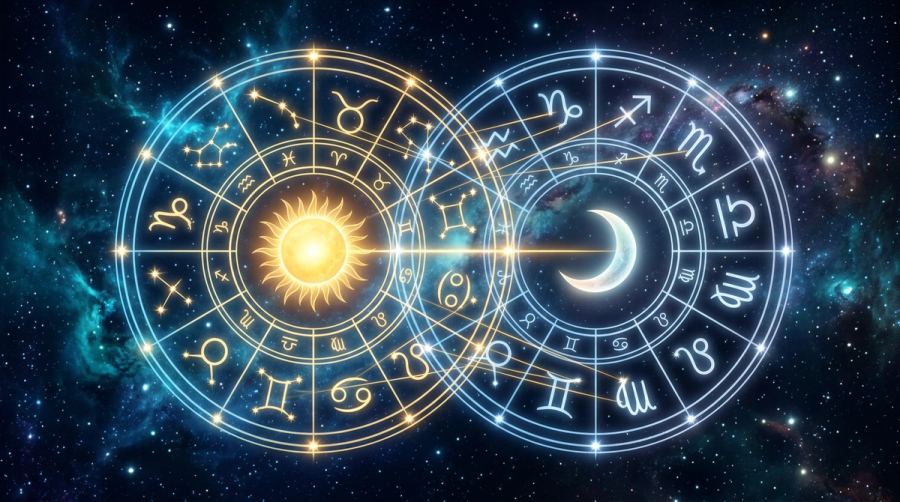
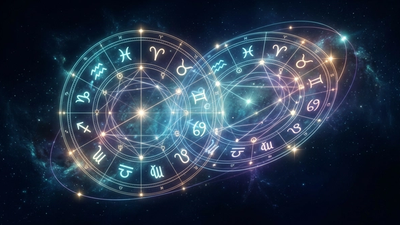
Two overlapping natal chart wheels with glowing lines connecting a Sun symbol to a Moon symbol between two birth dates
Do the Birthdays of Soulmates Share Astrological Patterns?
The birthdays of soulmates share patterns in their charts far more often than in the calendar. Two people born months apart can carry a tight Sun-Moon link or a high Ashtakoota score, while two born on the same day can have almost nothing connecting their charts. The date is raw material. The pattern lives in what the date becomes.
Here's the honest version. A shared or mirrored birthday is a fun coincidence, not a compatibility indicator. What astrologers actually read is the relationship between two full charts - a practice called synastry in the West and guna milan in Vedic tradition. Both start from birth dates. Both go much deeper than the date itself.
Three lenses matter most: Western sign-and-aspect analysis, Vedic nakshatra and Ashtakoota matching, and birthday numerology. Each reads the same two birth dates differently. Together they explain why some connections feel fated and others fizzle despite looking perfect on paper. If you want the wider map first, our complete guide to soulmate astrology frames where each of these fits.
What Two Birth Dates Reveal in Western Astrology
Two birth dates give Western astrology the Sun sign, the element balance, and most planetary positions by sign - enough to sketch attraction style and emotional fit, but not the houses or angles. The Sun sign tells you the core temperament. The element tells you how two people's energy blends.
Start with the elements. Fire signs (Aries, Leo, Sagittarius) and air signs (Gemini, Libra, Aquarius) tend to spark each other. Earth signs (Taurus, Virgo, Capricorn) and water signs (Cancer, Scorpio, Pisces) tend to ground each other. Same-element pairs usually feel easy and familiar. Opposite-element pairs generate friction that can read as either chemistry or exhaustion, depending on the rest of the chart.
But Sun signs are the loosest layer. Ptolemy laid out the foundations of Western partnership reading in Tetrabiblos nearly two thousand years ago, and even then the emphasis was on planetary relationships, not just the solar position. Modern astrology follows the same logic: the Moon, Venus, and Mars carry more soulmate weight than the Sun sign a birthday advertises.
A specific configuration worth naming: Venus square Saturn between two charts often shows a slow-building bond that survives distance and delay. It's not a "no" - it's a "not yet, and worth the wait." If you want the deeper cross-chart method, soulmate compatibility by date of birth walks through the five synastry indicators professional astrologers check.
Vedic Nakshatra and Ashtakoota - Matching Birthdays by Guna
Vedic astrology matches two birth dates through the birth nakshatra (the lunar mansion the Moon occupied at birth) and scores the pair using the Ashtakoota system - eight factors totaling 36 points, or gunas. A score of 18 or higher is traditionally considered workable; 24 and above is strong.
This is where a birth date alone starts to strain. The Moon moves through a full nakshatra roughly every 24 hours, so pinning down the exact birth star usually needs a birth time, not just a date. There are 27 nakshatras in all, each with its own ruling planet and temperament - this reference on the 27 nakshatras lays out the traditional meanings. Your nakshatra shapes emotional instinct in a way the Sun sign never captures.
The Ashtakoota (also called Kuta or guna milan) system comes from classical muhurta and matchmaking traditions rooted in texts like the Brihat Parashara Hora Shastra. Each of the eight kootas measures a different layer of compatibility:
- Varna (1 point) - spiritual and ego harmony
- Vashya (2 points) - mutual attraction and control
- Tara (3 points) - health and well-being of the bond
- Yoni (4 points) - physical and instinctive compatibility
- Graha Maitri (5 points) - mental and intellectual friendship
- Gana (6 points) - temperament match
Meet Nitya, your AI astrologer
She reads your birth chart to answer anything about your life. Your first complete answer is free, with no card required. Continued chat, Synastry, and Daily Guidance require Premium.
Questions you can ask about this topic
Tap any one below - or just write your own question in the form ↓
Nitya isn't a one-time horoscope. She's with you for the whole journey.
Understand yourself
Career, love, money, timing - any decision you are weighing. Answers read straight from your birth chart.
Understand any relationship
Add your partner, a parent, a friend, even a colleague. Nitya reads both charts together to explain the bond, the friction, and how to work through it.
Guidance for every day
Start each morning knowing what the day favors, what to watch for, and the best moments to act.
No card needed. Nitya just needs your birth details to read your chart.
Ask Nitya your first question - free →- Bhakoot (7 points) - emotional and financial welfare
- Nadi (8 points) - health and progeny; the single heaviest factor
Nadi koota alone carries 8 of the 36 points, and a Nadi dosha (both partners sharing the same Nadi) is treated seriously in traditional matching. That's why two people with a warm, easy vibe can still score low - one heavily weighted koota can pull the number down. Vedic matching also reads timing through dashas, which is why it's the system of choice for the "when" of a relationship, not just the "who."
The Sun-Moon and Nodal Connections Soulmates Often Share
Across two birth dates, the strongest soulmate patterns are Sun conjunct Moon and contacts to the lunar Nodes. Sun conjunct the partner's Moon is the classic emotional-soulmate signature in Western synastry. Nodal contacts - the North Node in the West, Rahu and Ketu in Vedic astrology - mark the karmic pull that makes a connection feel destined.
When one person's Sun lands on the other's Moon within a few degrees, their identity and emotional core occupy the same space. Many astrologers treat Sun conjunct Moon in synastry as the first thing to check for long-term potential. People describe it as feeling instantly at home with someone. When it goes both ways, your Sun on their Moon and their Sun on your Moon, it's one of the most durable signatures in the book.
Cosmic timeline of two birth dates joined by nodal axis threads and nakshatra star points on a deep navy background
The Nodes add the karmic layer. In Western astrology, when a partner's Sun, Moon, or Venus sits on your North Node, they pull you toward who you're becoming. In Vedic astrology, the Rahu-Ketu axis between two charts often shows up in relationships that feel fated and hard to walk away from. A breakdown of synastry soulmate aspects covers how these nodal contacts stack with Saturn and Venus links.
Here's the catch that ties back to birthdays. The Sun's sign is stable across a whole day, so you can read it from a date. The Moon and the Nodes move fast and shift by house depending on birth time. So the very connections that matter most - Sun-Moon, nodal contacts - are exactly the ones a bare birth date struggles to confirm. You get the hint; you need the time to lock it in.
Birthday Numerology - The Life Path Lens
Birthday numerology reduces a full birth date to a single Life Path number (1 through 9, plus master numbers 11, 22, and 33) and compares two people's numbers for resonance. It's the most accessible soulmate lens because it needs only the date - no time, no place. It's also the least precise.
The method is simple. Add every digit of the birth date until you reach one digit. Someone born on July 14, 1990 reduces 7 + 1 + 4 + 1 + 9 + 9 + 0 = 31, then 3 + 1 = 4. Their Life Path is 4. Numerologists then read pairs for harmony - matching or complementary numbers suggest shared values and life direction, while clashing numbers suggest lessons rather than ease.
Some traditions link each Life Path to a ruling planet, echoing astrology: a Venus-ruled number paired with a Saturn-ruled one might signal a serious, committed bond. It's an elegant idea, and it's why numerology feels astrological even though it works from numbers, not sky positions.
Treat it as a conversation starter, not a verdict. Two soulmates can have clashing Life Path numbers and a chart full of Sun-Moon and nodal links. If numerology is your entry point, numerology compatibility by life path explains how far the numbers actually reach before astrology takes over.
Where Birth-Date-Only Analysis Breaks Down
A birth date alone is a starting point, not destiny - and it breaks down in three concrete places. Without a birth time, you lose the exact Moon position, the entire house system, and the chart angles (Ascendant and Descendant). That's roughly half of any serious soulmate reading.
The Moon is the biggest loss. It moves 12 to 15 degrees a day, so a date-only chart can leave the Moon in one of two signs and almost never nails the nakshatra. Since the Moon governs emotional needs in both systems - and the Sun-Moon link is the headline soulmate marker - this gap matters more than any other.
Then there's location. Two people born on the same date in different cities have different rising signs, different house placements, and different chart angles the moment you add time and place. The birthday is identical; the chart is not. This is why a "same birthday" coincidence tells you very little on its own.
Astrology offers a framework for understanding, not a guarantee. It can describe temperament, timing, and the lessons a bond carries. It can't override two people's choices. Anyone promising a soulmate's exact identity from a birth date alone is selling certainty that the chart doesn't provide.
What You Can Actually Learn by Comparing Two Birthdays
Comparing two birthdays reliably reveals temperament fit, attraction style, and rough timing patterns - the "what kind of bond is this" questions. It can't deliver a guaranteed outcome or a name. Used honestly, it's a map of tendencies, not a prophecy.
Here's what two birth dates genuinely give you:
- Sun sign and element blend - the baseline temperament match (Western)
- Venus and Mars by sign - how each person gives affection and pursues (Western)
- Approximate Life Path resonance - shared values direction (numerology)
- Likely nakshatra range and Ashtakoota clues - emotional and karmic fit (Vedic)
- Whether major markers like Sun-Moon or nodal links are even possible - worth confirming with full charts
And here's where it stops: exact Moon degree, house overlays, the Vertex, the precise Ashtakoota score, and dasha timing all need birth time and place. Among people who bring a specific person's birthday to MyNitya, the most common follow-up isn't the compatibility score - it's the timing question: when does this connection become real. That's a Vedic dasha and Western transit question, and it needs more than a date.
For the timing side specifically, when you'll meet your soulmate through astrology covers the transits and cycles that open recognition windows.
MyNitya is an AI astrology platform where Nitya, your personal AI astrologer, reads your full Vedic or Western birth chart. Ask her anything in chat, compare your chart with someone else's for a compatibility reading, and get a personalized daily guidance reading each morning. Premium unlocks all three; your first question is free. Vedic shines for timing and karmic matching, Western for psychological and relationship depth - you choose the lens. See how your charts really connect with Nitya's compatibility reading on MyNitya.
Frequently Asked Questions
Do soulmates usually have the same birthday?
No. Sharing a birthday is a coincidence, not a compatibility marker. Soulmate connections show up in how two charts interact - Sun-Moon links, nodal contacts, and Ashtakoota scores - not in matching calendar dates. Two people born months apart often have far stronger chart connections than two born the same day.
Can I check soulmate compatibility from just our birth dates?
Partly. Birth dates give you Sun signs, element balance, most planetary signs, and Life Path numbers - enough to sketch temperament and attraction. But the exact Moon position, birth nakshatra, houses, and angles need a birth time and place. Date-only analysis is a useful first pass, not a full reading.
What's the strongest soulmate pattern between two birthdays?
In Western astrology, Sun conjunct the partner's Moon is the classic emotional-soulmate signature, especially when it works both ways. In Vedic astrology, a high Ashtakoota score (24+ of 36 gunas) plus a Rahu-Ketu connection between charts marks a karmic bond. Nodal contacts add the "fated" quality in both systems.
How does Vedic birthday matching differ from Western?
Vedic matching uses the birth nakshatra and the Ashtakoota system to score compatibility out of 36 gunas, and it reads timing through dashas. Western astrology compares Sun, Moon, Venus, Mars, and the Nodes by sign and aspect. Vedic excels at timing and karmic fit; Western excels at psychological and emotional depth.
Is birthday numerology accurate for finding a soulmate?
Birthday numerology is popular because it needs only the date, but it's the least precise soulmate lens. Life Path numbers describe broad values and direction, not the detailed emotional and karmic fit that astrology reads. Treat it as a conversation starter, then confirm with a proper chart comparison.
Why does birth time matter so much if we already know the birthdays?
Birth time locks in the Moon's exact sign and nakshatra, the house placements, and the chart angles. Since the Moon drives emotional needs and the Sun-Moon link is the headline soulmate marker, a missing birth time removes the most important layer. Same birthday, different time or city, means a genuinely different chart.
The birthdays of soulmates are the doorway, not the whole house. A shared month or a mirrored day number is a nice detail, but the real story lives in the charts those dates unfold into - the Sun-Moon link, the nodal pull, the Ashtakoota score that reads emotional and karmic fit out of 36 gunas. Read that way, two birth dates tell you what kind of bond you're dealing with and what it will ask of you.
What they won't do is hand you a name or a guarantee. That part is still yours to live. If you want to see who your own birthdate points toward first, who your soulmate is by birthdate reads the portrait your chart draws - and when you're ready to compare two charts in depth, a full synastry chart reading shows exactly where two people connect. Bring the dates. The chart fills in the rest.