Who Is My Soulmate by Birthdate? What Your Natal Chart Reveals
In this Article
Compatibility Calculator
Check astrological compatibility by birth dates
Your birthdate doesn't name your soulmate, but it does describe the person - their temperament, the energy they carry, the way they show up. The clues sit in four places: your 7th house, your Descendant sign, your Venus, and the karmic markers around Saturn and your North Node. Read together, they sketch a recognizable type long before you ever meet them.
I've been reading soulmate questions for fifteen years, and the same pattern keeps repeating. People want a name. Astrology gives a portrait. Once you learn to read the portrait, the recognition is striking - the person walks in and you realize the chart has been describing them all along.
Your personal astrologer - Vedic + Western.
Reads all 10,000+ points of your birth chart to answer your question. First question free, no card needed.
Key Takeaways
- Your birthdate maps to a specific soulmate "type" through the 7th house, Descendant, Venus, and Mars or Moon
- The 7th house cusp shows the qualities you're drawn to in a long-term partner
- Your Venus sign reveals what you find attractive and how you give and receive love
- Saturn cross-aspects and North Node contacts in synastry are the strongest karmic-soulmate markers
- Astrology can describe the type, the timing, and the lessons - not the exact name or face
- Birth time matters: without it, you lose the Descendant, the Vertex, and the house overlays
- Major transits to your 7th house, like Jupiter or the North Node, open recognition windows
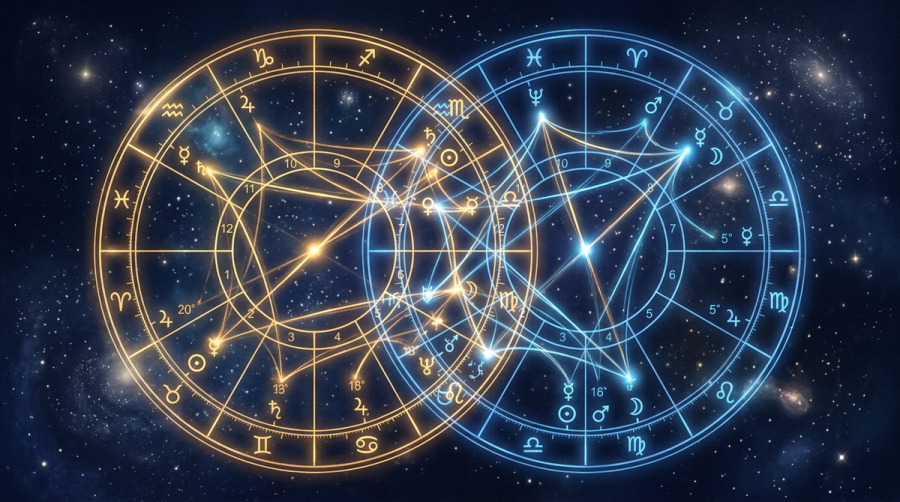
Two natal chart wheels overlapping with glowing connection lines showing synastry between potential soulmates
What Your Natal Chart Reveals About Your Soulmate
Your natal chart reveals the type of partner you're karmically drawn to, the qualities you find attractive, and the timing windows when soulmate-grade relationships are most likely to form. It doesn't predict a specific person. It describes a recognizable pattern that the right person will fit.
There are four chart elements that do most of the heavy lifting. Your 7th house and its sign on the cusp (the Descendant) describe the partner you commit to. Your Venus describes what you find beautiful and how you express affection. Your Mars or Moon - depending on tradition - describes the polarity that pulls you in. And your Saturn-North Node axis describes the soul-level work the relationship is meant to do.
Cyril Fagan and other 20th-century astrologers refined what Ptolemy first sketched out in Tetrabiblos Book IV on marriage: that the partner is read primarily from the 7th house and the planets that aspect it. Modern Western astrology has layered the Descendant, Venus, and the lunar nodes on top of that classical foundation, but the core idea hasn't changed in nearly two thousand years.
Among MyNitya users who ask "who is my soulmate" in their first session, the most common follow-up isn't about the name. It's about whether the partner the chart describes is someone they've already met. That tells you something. The chart is rarely describing a stranger - it's usually describing someone already on the periphery of your life.
The 7th House - Where Your Soulmate Shows Up in Your Chart
The 7th house is the natal chart's house of partnership. The sign on its cusp (your Descendant) and any planets inside it describe the qualities of the person you're most likely to commit to, the dynamic you'll build with them, and what you'll subconsciously look for in a long-term partner.
The 7th house sits directly opposite the 1st house, and that's not an accident. The 1st house is you. The 7th is the "not-you" - the qualities you don't naturally lead with but recognize and need in someone else. Astro.com's astrowiki entry on the 7th house describes it as the house of conscious encounter, the place where your unconscious half walks toward you wearing someone else's face.
Planets in your 7th house tell you a lot. Each one shifts the partner type:
- Sun in the 7th - drawn to confident, identity-anchored partners; relationship is central to how you express yourself
- Moon in the 7th - needs an emotionally attuned partner; home and partnership feel inseparable
- Venus in the 7th - seeks beauty, harmony, ease; classic "marriage placement" in Western astrology
- Mars in the 7th - drawn to assertive, sometimes combative partners; passion runs hot
- Jupiter in the 7th - partner often foreign, philosophical, or older; relationship is expansive
- Saturn in the 7th - the karmic-soulmate placement; commits late, but commits deeply
- Uranus in the 7th - drawn to unconventional partners; sudden meetings, sudden endings
- Neptune in the 7th - soulmate fantasies are strong; needs to distinguish partner from projection
- Pluto in the 7th - transformative, intense partnerships that change you at the core
A specific configuration worth naming: Saturn in the 7th house is often misread as "delayed marriage" or "no marriage." That's not what the placement does. Saturn in the 7th delays the right one - usually until the person is mature enough to recognize and hold what shows up. The marriages that form under Saturn in the 7th tend to outlast almost every other 7th-house placement.
If you want to see how 7th-house planets and the Descendant interact with the rest of your chart, the natal chart love compatibility guide walks through how to layer them.
Reading Your Descendant Sign
Your Descendant is the sign exactly opposite your rising sign - and it's the soulmate signature most astrologers read first. Each Descendant points to a specific partner archetype:
Descendant | The Soulmate Type
- Aries: Direct, energetic, decisive; the one who pushes you to act
- Taurus: Grounded, sensual, steady; the one who builds with you
- Gemini: Curious, conversational, mentally quick; the one who keeps you interested
- Cancer: Nurturing, emotionally available, family-oriented; the one who feels like home
- Leo: Warm, generous, expressive; the one who makes you feel chosen
- Virgo: Thoughtful, practical, helpful; the one who pays attention to detail
- Libra: Diplomatic, refined, fair; the one who genuinely partners
- Scorpio: Intense, loyal, transformative; the one who sees you completely
- Sagittarius: Adventurous, philosophical, free; the one who expands your horizons
- Capricorn: Responsible, ambitious, mature; the one who can hold weight with you
- Aquarius: Original, independent, cause-driven; the one who's also your friend
- Pisces: Compassionate, intuitive, creative; the one who softens you
The Descendant shows the qualities you don't naturally have but recognize as missing. A Capricorn rising with Cancer Descendant carries the world on their own shoulders and finds soulmate-level safety in someone who actually softens them. The "opposite that completes you" framing is cliché in pop psychology, but in astrology it's literal - your Descendant sign is your Ascendant's mirror.
Venus Placement - What You're Actually Attracted To
Your Venus placement describes what you find beautiful, how you flirt, what makes you feel loved, and the type of person who registers as attractive to you. Venus by sign tells you the flavor; Venus by house tells you the life area where love most often shows up.
Venus moves through the zodiac about every ten and a half months, spending roughly twenty-five days in each sign. That means everyone born within a few weeks of you shares a Venus sign, even if your Sun signs differ. It's one of the cleanest fingerprints in the chart for "what does my soulmate look and feel like."
Venus by sign - quick read:
- Venus in Aries - drawn to confident, direct, slightly chase-worthy partners; fast attraction, gets bored with hesitation
- Venus in Taurus - drawn to physical sensuality, stability, beautiful voice and presence; slow burn, lasting bonds
- Venus in Gemini - drawn to wit, conversation, mental agility; the soulmate is also a friend
- Venus in Cancer - drawn to emotional safety, family-mindedness, nurturing care; needs to feel held
- Venus in Leo - drawn to warmth, generosity, dramatic flair; needs to feel special and visible
Meet Nitya, your AI astrologer
She reads your birth chart to answer anything about your life - and she can go deep on any relationship you care about and guide your day ahead. First question free, no card needed.
Some questions our users ask Nitya
Tap any one below - or just write your own question in the form ↓
- Venus in Virgo - drawn to attentiveness, capability, quiet service; loves through small precise gestures
- Venus in Libra - drawn to grace, fairness, beauty; needs partnership to feel like art
- Venus in Scorpio - drawn to depth, intensity, all-or-nothing presence; suspicious of casual love
- Venus in Sagittarius - drawn to philosophy, travel, openness; needs space inside the relationship
- Venus in Capricorn - drawn to maturity, capability, long-game thinking; commits when committing makes sense
- Venus in Aquarius - drawn to originality, intellectual independence, friendship-based love
- Venus in Pisces - drawn to soul, art, compassion, spiritual sensitivity; classic "soulmate-coded" Venus
Cafe Astrology's in-depth Venus by sign overview covers the nuances if you want to read deeper.
A specific configuration: Venus square Saturn in your natal chart often means you delay love but build deeper bonds when you do. It's not a "no soulmate" placement. It's a "no rushing" placement. Among MyNitya users with this aspect, the most common pattern is a partner who appears late twenties or early thirties - usually after a Saturn-driven life chapter that taught the user what they actually need.
Mars or Moon - The Polarity You're Pulled Toward
Classical Western astrology assigned a specific role to Mars and the Moon in describing the opposite-sex partner: Mars for women, Moon for men. The idea is that the polarity planet describes the energy you're magnetically pulled toward. Modern astrology reads this inclusively - the principle works regardless of gender or orientation. What matters is which planet describes the partner-energy your chart is calling in.
Many practicing astrologers now read both placements for everyone and let the client identify which feels more accurate. If you're drawn to traditionally masculine-coded energy in a partner, your Mars sign tends to describe them. If you're drawn to traditionally feminine-coded or nurturing energy, your Moon sign tends to describe them. People often have a clear preference that lines up with one or the other.
The moon sign compatibility guide goes deeper into how the Moon-side of soulmate energy works in long-term relationships.
Two intertwined silhouettes against a cosmic background symbolizing twin souls connected through birth chart astrology
How Saturn and the North Node Mark a Karmic Soulmate
Saturn cross-aspects between two charts and North Node contacts to a partner's personal planets are the two strongest karmic-soulmate signatures in Western synastry. Saturn marks the bond that lasts. The North Node marks the partner who pulls you toward your destiny.
Saturn is the planet of time, structure, and commitment. When one person's Saturn conjuncts the other's Sun, Moon, Venus, or Ascendant within five degrees, the relationship has a weight to it from the first conversation. It often feels older than it should. There's a quality of "we've been here before" - and if you take past lives seriously, that's exactly what classical karmic astrology says is happening.
Liz Greene's work on Saturn in synastry, summarized in numerous astrology textbooks and on AstroSeek's synastry interpretation reference, describes Saturn contacts as the glue that holds soulmate-grade relationships together. They aren't comfortable. They are durable. People who marry under Saturn synastry tend to stay married.
The North Node is your soul's growth direction in this lifetime. When someone's Sun, Moon, or Venus conjuncts your North Node within three degrees, they're someone who pulls you forward - often into the version of yourself you're becoming. South Node contacts feel familiar and easy but can keep you stuck in old patterns; North Node contacts feel scary in the best possible way.
A specific marker I see often: Saturn conjunct Descendant in synastry. When one partner's natal Saturn lands on the other's 7th-house cusp, the relationship has a "this is the one I build with" signature. It's not flashy. It's structural. These are the couples who quietly stay together while everyone else's relationships dissolve.
For a deeper read on how synastry indicators stack in real charts, synastry birth chart compatibility relationship astrology walks through the layered analysis.
Twin Flame Markers vs Soulmate Markers
Twin flame configurations show up differently. Where soulmate synastry favors Saturn and the North Node, twin-flame patterns concentrate around Pluto, the South Node, and exact-degree planetary mirrors. The twin flame calculator astrology birth chart guide breaks down those specific markers if you want to compare.
A short distinction. Soulmate connections feel like a homecoming. Twin-flame connections feel like a confrontation. Both can be transformative. Only one tends to be sustainable without significant cycles of separation.
Reading Your Soulmate's Type by Birthdate (Worked Examples)
Worked examples make this concrete. Below are four sample birthdates and the partner-type each chart's 7th house, Descendant, Venus, and Mars or Moon points toward. Birth-time-dependent points (Descendant, exact 7th house) are estimated; the principle is the same once you have the real chart.
Example 1 - Born March 21, 1995
Aries Sun on the cusp of spring. Venus in Aquarius (Venus was retrograding into Aquarius in early 1995 for many March births). If born around late afternoon, Descendant likely Libra. Mars in Aquarius for many of these births.
Soulmate type: An independent, intellectually original partner who feels like a friend first. Probably attracted to humanitarian causes, slightly unconventional, comfortable with their own company. The relationship is built on shared ideas and mutual respect for autonomy. Not a smothering soulmate - a soulmate who gives you room.
Example 2 - Born July 14, 1990
Cancer Sun. Venus in Cancer (yes, July 1990 Venus was in Cancer for most of the month). If born midday, Descendant likely Aquarius or Capricorn depending on birth time. Mars in Taurus.
Soulmate type: Steady, embodied, grounded - but with an edge of independence that surprises you. Cancer Venus needs emotional safety; Mars in Taurus is drawn to physical reliability. The Descendant adds the "not-you" element - someone slightly cooler, more structured, who balances the Cancer softness. The soulmate is the calm, capable presence in the room.
Example 3 - Born October 8, 1988
Libra Sun. Venus in Scorpio (Venus moved into Scorpio in early October 1988). If born early evening, Descendant likely Aries. Mars in Pisces.
Soulmate type: Direct, brave, decisive - almost the opposite of how you yourself move. Aries Descendant pulls a Libra Sun toward someone who actually says what they mean. Venus in Scorpio adds depth and possessive loyalty. The soulmate is intense, focused, and incapable of small talk for long.
Example 4 - Born February 2, 2000
Aquarius Sun. Venus in Aquarius. If born morning, Descendant likely Leo. Moon in Sagittarius.
Soulmate type: Warm, generous, theatrically affectionate - the dramatic Leo energy that breaks through Aquarius emotional cool. Moon in Sagittarius needs adventure and meaning, not domestic routine. The soulmate is someone who pulls you out of your head and reminds you that love is a body experience as much as a mind experience.
These four birthdates point to four different partner types. None of them name a person. All of them describe a temperament you'd recognize in three minutes of conversation.
If you want a personalized read of your own birthdate, chat with Nitya about your birth chart - try free. MyNitya analyzes your full Western natal chart - houses, aspects, transits, and the soulmate-relevant points - and explains what shows up in plain language. MyNitya supports both Vedic and Western astrology; Western shines for psychological partner profiling, Vedic shines for timing and karmic dasha cycles, so you can use whichever speaks to you.
What Astrology Can and Can't Tell You About Your Soulmate
Astrology can describe the type, the timing, and the lesson. It can't name the person, predict the outcome, or guarantee a relationship will work. The chart is a map of probability and pattern, not a fixed script. Knowing this saves a lot of magical thinking.
What astrology can do:
- Describe partner temperament and likely traits with surprising specificity
- Identify the karmic theme of the relationship (growth, healing, building, transforming)
- Point to timing windows when meetings are most likely
- Flag patterns you keep repeating and why
- Distinguish soulmate, karmic, and twin-flame signatures
What astrology can't do:
- Tell you a name, face, or address
- Predict whether a specific person will commit
- Override free will - yours or theirs
- Replace the work of becoming someone the right partner can recognize
A small reframe that helps. The chart isn't describing a fated stranger somewhere in the world. It's describing the energy you're calling in. If your chart points toward a Capricorn-rising, Saturn-strong soulmate and you keep dating people with no follow-through, the issue isn't that the soulmate is missing. The issue is that you haven't built the conditions where someone with weight can land. The chart describes who. You build the where.
When You'll Meet Them - Reading Transit Timing
Transits to your 7th house and to your natal Venus mark the strongest meeting windows. Three transits matter most: Jupiter through your 7th house, the North Node through your 7th or across your Venus, and Saturn forming a major aspect to your Descendant. Each opens a different kind of door.
Jupiter through your 7th house. Jupiter expands and brings opportunity to whatever house it transits. Its tour through the 7th lasts about a year and happens roughly every twelve years. New partnership opportunities show up - sometimes in unexpected forms. If you have a Cancer Descendant, Jupiter's pass through Cancer in 2025-2026 was your window; if Leo Descendant, the next one starts when Jupiter ingresses Leo in mid-2026.
The North Node activating love points. The North Node moves backward through the zodiac and stays in each sign about eighteen months. When it crosses your Descendant or conjuncts your natal Venus, fated meetings become statistically more likely. The North Node ingresses Aquarius on July 26, 2026, which means anyone with an Aquarius Descendant or Aquarius Venus enters a recognition window for the eighteen months that follow.
Venus transits as recognition triggers. Venus is fast - about a month per sign - but its returns to your natal Venus, your 7th-house ruler, or your Descendant often mark short-term openings. Venus enters Cancer on June 27, 2026, often triggering soulmate-recognition events for people with strong 7th-house Cancer placements or Cancer Venus.
Progressed Moon through your 7th house. Slower and more personal. The progressed Moon takes about two and a half years to cross any house. Its passage through the 7th frequently coincides with a felt-from-the-inside readiness for partnership - you stop wanting what you used to want and start noticing what you actually need.
For step-by-step compatibility analysis once you've met someone, soulmate compatibility by date of birth walks through the synastry side - what to check between two charts to see if the connection is what your natal chart was pointing to.
Common Misconceptions About Soulmates in Astrology
A few myths come up over and over. Clearing them out matters because each one quietly distorts how people read their own charts.
Myth: There's only one soulmate. Astrologically, you can have soulmate-level connections with several people across a lifetime. Different people activate different soul-level work. The "one and only" framing is romance-novel material, not classical astrology.
Myth: Your soulmate is your zodiac opposite. Sometimes yes, often no. The opposite-sign attraction is a Descendant-Ascendant pattern. But Sun signs aren't the same as Descendants, and many soulmate matches show up between signs traditional compatibility lists call "incompatible."
Myth: A soulmate connection should feel easy. Some do. Many don't. Saturn-heavy soulmate bonds - the long-haul ones - feel weighty from day one. Easy isn't the marker. Recognition is.
Myth: If your chart says soulmate, the relationship is guaranteed. Charts describe potential, not destiny. Two charts with strong soulmate signatures still need two willing people doing the work. Astrology doesn't override choice.
Myth: You can identify your soulmate from sun signs alone. Sun-sign matching is the weakest layer of compatibility analysis. The 7th house, Venus, Mars or Moon, Saturn aspects, and node contacts all carry far more information.
Get personalized guidance based on your birth chart on MyNitya - Nitya reads the full chart, not just your sun sign, which is what makes the partner-profile actually specific.
Frequently Asked Questions
Can my birthdate alone tell me who my soulmate is?
Your birthdate gives you Sun, Moon, planetary signs, and the lunar nodes - enough to describe your soulmate's general type, your Venus attraction style, and karmic markers. Without your birth time, you lose the Descendant, the exact 7th house, and the Vertex. That's roughly half the soulmate analysis. With a birth time, the description gets specific.
What's the most important placement for finding my soulmate?
Most experienced astrologers read the 7th house and the Descendant first, then Venus, then Mars or Moon depending on the partner energy you're drawn to. Saturn aspects to those points and North Node placements add the karmic layer. No single placement decides everything - it's the combination that paints the picture.
Does my soulmate have to be a specific zodiac sign?
No. The "you must date a Sagittarius" framing oversimplifies. Your Descendant sign and Venus sign tell you what you're drawn to, but a soulmate-level partner can have any Sun sign as long as their key personal planets aspect your chart correctly. Sun-sign compatibility is the loosest of all the compatibility layers.
How do I know if I've already met my soulmate?
Look for three signals. Recognition that doesn't fade after the initial chemistry settles. A sense that the relationship asks you to grow rather than just feel good. And synastry markers - Saturn cross-aspects, North Node contacts, Sun-Moon connections - that show up consistently when you compare the two charts.
What if I keep meeting people who don't match what my chart describes?
Usually one of two things. Either your birth time is off and the chart you're reading isn't quite yours, or you're choosing partners who match an old wound rather than your actual chart pattern. Repeating mismatches often resolve when the underlying pattern (often a Venus square Saturn, or a 7th-house Neptune projection) is worked with directly.
Is it possible to have multiple soulmates over a lifetime?
Yes, and it's common. Astrology recognizes karmic teachers, romantic soulmates, twin-flame catalysts, and life-partner soulmates as distinct categories. Each one shows up at a different time and serves a different soul-level purpose. People who've had several deep, transformative relationships usually have several soulmate-grade signatures across different people.
Your birthdate is the starting point, not the finish line. The chart sketches a portrait - the Descendant gives you the silhouette, Venus colors in the warmth, the 7th house adds the relational weight, and Saturn and the North Node tell you what the relationship is for. None of that names a person. All of it tells you what to recognize when they show up.
Most people who do this work end up startled. The chart's been quietly describing someone they already half-know, or a type they've been stepping past because they thought they were supposed to want something else. Reading it carefully is permission to stop looking for the wrong thing.
If you want the specific read on your own chart - the actual Descendant, the actual Venus, the actual karmic markers - ask your first question free on MyNitya. The conversation is straightforward. You give your birth details. Nitya describes who your chart is pointing to. You decide what to do with it.
Nitya isn't a one-time horoscope. She's with you for the whole journey.
Understand yourself
Career, love, money, timing - any decision you are weighing. Answers read straight from your birth chart.
Understand any relationship
Add your partner, a parent, a friend, even a colleague. Nitya reads both charts together to explain the bond, the friction, and how to work through it.
Guidance for every day
Start each morning knowing what the day favors, what to watch for, and the best moments to act.
No card needed. Nitya just needs your birth details to read your chart.