Who Will I Marry Astrology: Spouse Indicators Decoded
In this Article
Who will I marry astrology answers by reading a pattern, not a single line: in Vedic astrology it's the 7th house and its lord, the Darakaraka, the Navamsa (D9), Venus and Jupiter, and the Upapada Lagna; in Western astrology it's the Descendant, Venus and its aspects, and Juno. No chart names a person. But it does describe the spouse's nature, how you'll meet, and whether the partner you already have is built to last. Try MyNitya free.
If you keep wondering is this the one, you're asking the oldest question astrology has ever been handed. This piece goes past the quiz-style traits list into the actual machinery - the technical spouse indicators both systems use, and the synastry logic that tells you whether a specific current partner holds up. For the timing side, the pillar guide on when you'll get married according to astrology pairs with everything below.
Your personal astrologer - Vedic + Western.
Reads all 10,000+ points of your birth chart to answer your question. First question free, no card needed.
Ask your question free →Key Takeaways: In Vedic astrology, the spouse is read through the 7th house and 7th lord (the partnership pattern), the Darakaraka (Jaimini's spouse significator), the Navamsa D9 7th lord (what you actually get), Venus and Jupiter (the natural karakas), and the Upapada Lagna (the marriage partner itself). In Western astrology, it's the Descendant sign, Venus and its aspects, Juno (the commitment asteroid), and the 7th-house ruler. To test "will I marry my current partner," read synastry - Saturn contacts for staying power, Venus-Mars for chemistry, Sun-Moon for fit - alongside whether their planets light up your 7th house. Marriage timing comes from dasha activation (Vedic) and outer-planet transits to the 7th (Western).

A glowing path of light winding through a blue and purple nebula toward a distant bright star
Who Will I Marry Astrology: What Your Chart Actually Shows
Who will I marry astrology reveals the type of spouse and the shape of the marriage, not a name or a face. Your chart shows the partner's temperament, likely background, how you'll meet, and whether commitment comes early or late. It's a description of a pattern you keep meeting - read across several indicators, never one.
The mistake most people make is hunting for one magic placement. There isn't one. Classical Vedic astrology synthesizes at least five separate spouse indicators, and no serious astrologer predicts marriage from a single house. The same holds in the West - your Sun sign says almost nothing about who you'll marry.
What the chart can do is describe the archetype: a partner who is serious and older, or playful and creative; someone you meet through work, family, or a foreign connection; a marriage at 24 or one that waits past 30. These are readable. The specific human walking toward you is not - and that's the honest boundary of the practice. For the lighter, traits-focused take, the sibling guide on who you'll marry and their likely qualities covers the personality side.
Vedic Spouse Indicators: The 7th House and Its Lord
In Vedic astrology, the 7th house (kalatra bhava) is the primary house of marriage and spouse, and its lord describes the archetypal partner you attract. A 7th lord well-placed in a strong sign and a good house points to a stable, supportive marriage. A 7th lord in the 6th, 8th, or 12th brings delays, distance, or friction that must be worked through.
The 7th house is where you meet the other - the person you face life beside. But the deeper key is the 7th lord: the ruler of the sign on your 7th cusp, placed wherever it lands. Find that sign, identify its ruling planet, then follow the planet. A 7th lord in the 10th tends to bring partners through career; in the 5th, through romance or children; in the 12th, marriage can feel fated, sometimes to someone from far away. The Brihat Parashara Hora Shastra treats the 7th lord as a primary indicator of the spouse's nature - its dignity, sign, and aspects deciding whether the marriage runs smooth or rough.
A concrete example both traditions recognize: Saturn's influence on the 7th delays marriage rather than denying it - as 7th lord or aspecting the 7th, it often pushes marriage past the late 20s toward a mature, dutiful, sometimes older partner. The same logic runs through the Western 7th house as your relationship blueprint.
What Is the Darakaraka in Spouse Prediction?
The Darakaraka is the Jaimini spouse significator - the planet at the lowest degree in your birth chart, regardless of sign. In Jaimini astrology, it's the single most personal indicator of your spouse's core nature, working alongside the 7th house rather than replacing it. Its sign and nakshatra describe the partner's temperament and the karmic lesson the marriage carries.
The Jaimini Sutras introduced the chara karakas - a set of planetary significators assigned by degree. The planet holding the lowest degree becomes the Darakaraka, literally "the significator of the spouse." It's a beautifully counterintuitive rule: the weakest-by-degree planet carries the marriage story.
Reading it is direct. Venus as Darakaraka points to a charming, aesthetic, relationship-oriented spouse; Saturn to a serious, responsible, possibly older partner and a marriage built on endurance; Mars to a driven, passionate, sometimes combative one. The nakshatra-level guide to the Darakaraka shows how placement refines this further.
Practitioners debate whether the Darakaraka or the 7th lord "wins" when they disagree. The cleaner reading is that they answer different questions - the 7th lord shows the pattern of partnership you live out, the Darakaraka the soul-signature of the person. Read together, they sharpen each other.
Navamsa (D9): What You Actually Get in Marriage
The Navamsa, or D9 chart, is the Vedic divisional chart that governs marriage and the spouse - and its 7th lord shows what you actually get, not just what you want. Astrologers hold a working principle: the main birth chart (D1) shows the partner you desire, while the Navamsa shows the marriage as it truly matures after the honeymoon fades.
This technique separates casual readers from serious ones. A promising 7th house in the main chart can be undercut by a weak Navamsa, and a plain main chart can hide a strong marriage revealed only in the D9.
Read the Navamsa 7th house in three layers: the sign on the D9 7th shows the spouse's broad nature, planets there show day-to-day temperament once you're living together, and the D9 7th lord shows the partner's deeper karmic behavior. That lord in a kendra or trikona (1, 4, 7, 10, 5, 9) gives the marriage structural strength; parked in the 6th, 8th, or 12th, it signals conflict, upheaval, or separation to work through. For example, a Saturn D9 7th lord points to a serious, responsible spouse, often with an age gap or strong sense of duty. This detailed D9 marriage guide covers the placement-by-placement readings.
Venus, Jupiter, and the Upapada Lagna
Venus and Jupiter are the natural significators of marriage in Vedic astrology, and the Upapada Lagna (UL) is a specialized point describing the marriage partner directly. Venus signifies the wife and the pleasures of union - classically the spouse-indicator for men; Jupiter signifies the husband, especially for women. Both must be reasonably strong for marriage to flow easily.
Saravali and the classical Parashari texts treat Venus as the naisargik karaka of relationships - beauty, harmony, and the capacity for partnership. A dignified, unafflicted Venus lets love arrive with ease; combust, debilitated, or hemmed in by malefics, the road carries more friction. Jupiter does the parallel work in a woman's chart, describing the husband's wisdom and generosity.
The Upapada Lagna is the specialist's tool. Derived from the 12th house from the Ascendant via the arudha system, the UL and the sign after it describe the spouse and the marriage's durability. Benefics around the UL support a lasting bond; malefics flanking it warn of instability. Put the full stack together - 7th house and lord, Darakaraka, Navamsa D9 7th lord, Venus and Jupiter, and the Upapada Lagna - and you get a rounded portrait: who the spouse is, how the marriage functions, and how solidly it's built.
Western Spouse Indicators: Descendant, Venus, and Juno
Meet Nitya, your AI astrologer
She reads your birth chart to answer anything about your life. Your first complete answer is free, with no card required. Continued chat, Synastry, and Daily Guidance require Premium.
Questions you can ask about this topic
Tap any one below - or just write your own question in the form ↓
Nitya isn't a one-time horoscope. She's with you for the whole journey.
Understand yourself
Career, love, money, timing - any decision you are weighing. Answers read straight from your birth chart.
Understand any relationship
Add your partner, a parent, a friend, even a colleague. Nitya reads both charts together to explain the bond, the friction, and how to work through it.
Guidance for every day
Start each morning knowing what the day favors, what to watch for, and the best moments to act.
No card needed. Nitya just needs your birth details to read your chart.
Ask Nitya your first question - free →In Western astrology, the spouse is read through the Descendant (the 7th house cusp), Venus and its aspects, Juno the commitment asteroid, and the ruler of the 7th house. The Descendant sign describes the qualities you seek and keep meeting in partners. Venus shows how you love and what you find beautiful. Juno points specifically to the kind of person you're wired to commit to.
Ptolemy's Tetrabiblos anchored marriage delineation in the Moon (a man's chart), the Sun (a woman's), and the condition of Venus - a framework Western astrologers still use. Modern practice adds the Descendant and Juno for precision. The working set:
- Descendant sign - the style of partner you attract. Capricorn on the Descendant draws serious, ambitious, sometimes older partners; Leo draws warm, dramatic, attention-loving ones.
- Venus and its aspects - Venus trine Jupiter softens and expands love; Saturn square Venus often shows up as delayed commitment in the late 20s, love that has to prove itself before it settles.
- Juno - the asteroid of marriage. Juno conjunct your Sun, Moon, or Venus in synastry is a classic marriage signature.
- 7th-house ruler - where the ruler of your Descendant lands describes the life arena where partnership plays out.
Robert Hand's work on composite and relationship astrology stresses that no single contact decides a marriage - you read the weight of the pattern. Our natal chart love compatibility guide goes deeper into how Venus, Mars, and the 7th house combine beyond sun signs, including the ruler-tracing method for predicting marriage from the 7th house.
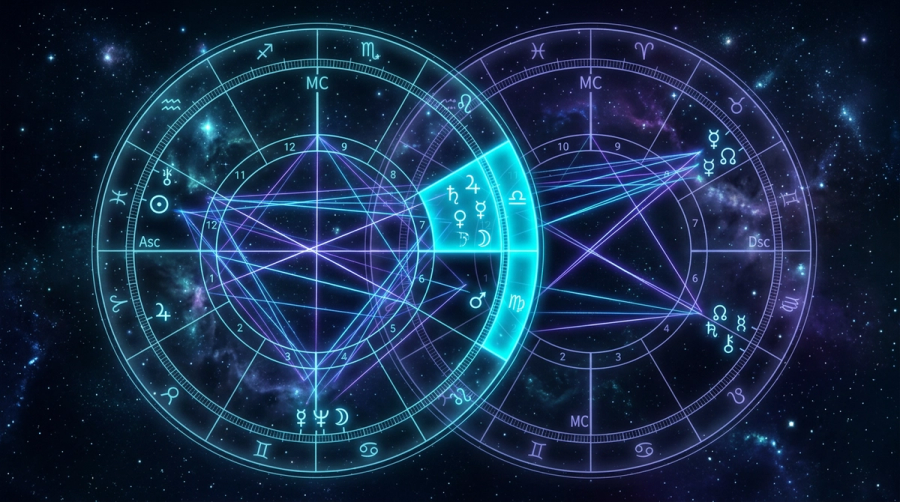
Two overlapping birth chart wheels with glowing aspect lines and a highlighted seventh house sector
Will I Marry My Boyfriend? Reading Synastry for "The One"
Will I marry my boyfriend astrology answers through synastry - the overlay of both birth charts - not through your chart alone. Three signatures matter most: Saturn contacts for staying power, Venus-Mars for chemistry, and Sun-Moon for emotional fit. Add whether his planets land in your 7th house, and you can read whether this specific partner is marriage-grade or a meaningful chapter.
This is the question the technical indicators finally serve. Your own 7th house tells you the type you attract; synastry tells you whether this person fits it.
Start with Saturn, the commitment planet and the one people misread. When your partner's Saturn falls in your 7th house - or yours in theirs - the relationship feels serious from the start, weighted toward structure over novelty. Long marriages consistently carry at least one Saturn-to-personal-planet contact between the charts. Saturn is the glue; without it, even intense chemistry tends to burn bright and fade.
Then read the rest of the stack:
- Venus-Mars contacts - the reliable signature of chemistry. Conjunction is hottest, trine most durable, square volatile but binding.
- Sun-Moon contacts - the "feels like home" signature, one of the most consistent marriage indicators when harmonious.
- 7th-house overlay - if his Sun or Venus lands in your 7th house, he registers as partner material on a gut level.
The synastry chart relationship reading guide breaks down all five dimensions. There's a Vedic parallel too: check whether your partner's key planets sit near your Darakaraka's sign or activate your 7th lord - when the person in front of you echoes your own spouse significators, that's the strongest chart-based "yes" the tradition offers.
Among birth charts analyzed on MyNitya, couples whose synastry combines a 7th-house overlay, at least one Saturn contact, and one Venus-Mars aspect most often describe their bond as "felt like marriage from the start" - the three signatures together produce the felt sense of partnership-grade pairing. See how your charts really connect with Nitya's compatibility reading on MyNitya.
When Does Marriage Actually Happen? Dasha and Transit Activation
Marriage happens when the spouse indicators get activated by timing techniques - the dasha system in Vedic astrology and outer-planet transits in Western astrology. A strong 7th house is only potential; it needs a triggering period to become an event. This is why two people with similar charts marry a decade apart.
In Vedic astrology, marriage tends to arrive during the mahadasha or antardasha of the 7th lord, Venus, Jupiter, or a planet tied to the Upapada Lagna - especially when transiting Jupiter or Saturn supports the 7th house. The marriage-date guide breaks down how to pin the specific window.
In Western astrology, the classic triggers are transiting Jupiter or Saturn crossing the Descendant or 7th house, and progressed Venus or Moon aspects to natal marriage points. The first Saturn return, around age 29, is a common marriage threshold - Saturn maturing the chart toward commitment. It's a season of readiness, not a fixed date.
The honest synthesis: your chart shows what kind, timing shows when, and synastry shows whether this person. Put all three together and "who will I marry" stops being a mystery and becomes a readable pattern.
Frequently Asked Questions
Can astrology really tell me who I will marry?
Who will I marry astrology describes the spouse's type, temperament, and how you'll meet - not a specific name. Both Vedic and Western systems read a pattern across the 7th house, Venus, and significators like the Darakaraka or Juno. It's a portrait of the partner you keep attracting, not a literal identity.
What is the most accurate spouse indicator in Vedic astrology?
There isn't a single one - accuracy comes from synthesis. The 7th house and its lord show the partnership pattern, the Darakaraka shows the spouse's soul-nature, and the Navamsa D9 7th lord shows what the marriage actually becomes. Reading all three together, plus Venus, Jupiter, and the Upapada Lagna, gives the reliable picture.
How do I know if I'll marry my current boyfriend?
Read synastry between both birth charts. Saturn contacts point to staying power, Venus-Mars to chemistry, and Sun-Moon to emotional fit. If his planets fall in your 7th house and echo your own spouse significators, the chart supports marriage. A single strong aspect isn't enough - you're reading the weight of the whole pattern.
What does the 7th house say about marriage?
The 7th house is the primary house of marriage in both Vedic and Western astrology. It describes the spouse's qualities, the style of your committed partnerships, and how you relate one-to-one. The sign on it, planets inside it, and the placement of its ruling planet together shape whether marriage runs smoothly or needs work.
Does Saturn delay marriage?
Saturn typically delays marriage rather than denying it. In Vedic astrology, Saturn influencing the 7th house or acting as 7th lord often pushes marriage past the late 20s toward a mature, dutiful partner. In Western astrology, Saturn square Venus shows the same delayed-commitment theme. The marriage, once it arrives, tends to be durable.
Can Vedic and Western astrology both predict my spouse?
Yes - they read the same question through different tools. Vedic uses the 7th lord, Darakaraka, Navamsa, and Upapada Lagna. Western uses the Descendant, Venus aspects, and Juno. On MyNitya you can get guidance from either system, so you can cross-check the spouse portrait both ways.
Reading the Whole Pattern, Not One Line
Who will I marry astrology is never answered by a single placement - it's answered by the weight of a pattern. Vedic astrology hands you the 7th house and lord, the Darakaraka, the Navamsa, Venus and Jupiter, and the Upapada Lagna. Western astrology hands you the Descendant, Venus, Juno, and the 7th ruler. And synastry tells you whether the person already beside you fits the portrait your own chart has been drawing all along.
You're not waiting for a prophecy. You're learning to read the shape of the room you keep walking partners into - and once you can see it, the choosing gets clearer.
MyNitya is an AI astrology platform where Nitya - your personal AI astrologer - reads your full Vedic or Western birth chart. Ask her anything in chat, compare your chart with someone else's for a compatibility reading, and get a personalized daily guidance reading each morning. Premium unlocks all three; your first question is free. Compare your chart with theirs - ask Nitya on MyNitya.