When Will I Meet My Soulmate? Astrology Timing
In this Article
Astrology can't tell you the exact date you'll meet your soulmate. No chart can. What it can do is show you the windows in your life when partnership-grade love is structurally most likely to arrive - and explain why the wait has been this long. If you're searching this question at 2 a.m. with a knot in your stomach, you're not broken. You're in pain that millions of charts have been in before you. Ask your first question free on MyNitya.
Here's what's true and what isn't, said plainly. Astrology is not a fortune-teller. It won't hand you a name and a Tuesday. But your birth chart does carry rhythms - Jupiter cycles, Saturn returns, nodal returns, progressed Moon and progressed Venus shifts - and those rhythms describe the seasons of your life when love is most likely to find a foothold. Some of those seasons are wider than others. Some have already passed. Some are coming. And some require something from you before they'll deliver what they're capable of delivering.
Your personal astrologer - Vedic + Western.
Reads all 10,000+ points of your birth chart to answer your question. First question free, no card needed.
Ask your question free →Key Takeaways: When will I meet my soulmate astrology can't predict a specific date - but Jupiter through your 7th house (about 12 months every 12 years), your Saturn return at ages 28-30 and 56-58, North Node returns at 18.6 / 37.2 / 55.8, the Vertex transit, and your progressed Moon and progressed Venus shifts mark real windows of heightened romantic potential. The chart shows the seasons. Whether the window delivers depends on whether the inner work is done.
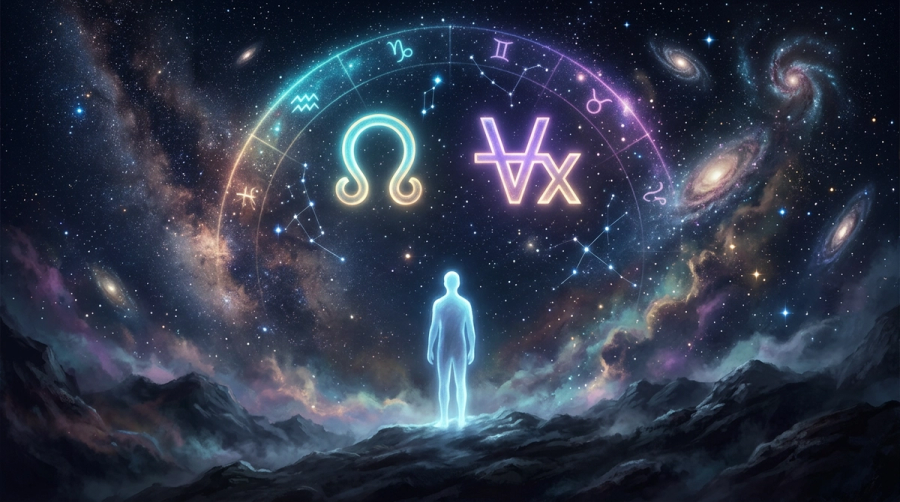
Solitary luminous figure looking up at a starry sky with the North Node and Vertex symbols glowing softly
Why This Question Hurts More Than the Internet Admits
Most articles answering "when will I meet my soulmate astrology" treat the question like a mild curiosity. It isn't. The question is usually being asked by someone who is tired. Someone who has been on the apps for years. Someone who watched another friend get engaged last weekend and smiled and went home and cried in the shower. Someone whose mother has stopped asking and whose father started a sentence yesterday with "I just want to see you settled before I -" and didn't finish it.
The question is the question of someone in pain. Pretending otherwise is the first dishonesty.
If you're reading this and any of that landed, take a breath. You're not behind. You're not unlovable. You're not being punished for some failure you can't identify. The fact that the right person hasn't arrived yet doesn't mean they won't. It also doesn't mean the universe is keeping score against you. It usually means the conditions - internal, external, astrological - haven't quite aligned, and that some piece of you is still finishing the work of becoming a person who can recognize and receive what arrives.
That's not a comfortable answer. But it's an honest one. And honest is what this article is going to be.
The Honest Limit of Astrology Here
Astrology cannot predict, and has never been able to predict, a specific person on a specific date. Anyone selling you that is selling you something. The chart is a map of cycles, not a calendar of names. It shows seasons of higher and lower romantic probability - sometimes very precisely - but it doesn't pull faces out of the future. The good astrologers, going back centuries, have always said this.
What astrology can do is more useful than a fortune. It can tell you when your chart is most receptive to long-term partnership - when transits are activating your 7th house of partnership, when your North Node is being contacted, when the Vertex of fated meeting is being touched, when your inner romantic clock (progressed Venus, progressed Moon) is shifting into a new chapter. It can tell you when those windows opened in your past and what you were doing during them. And it can tell you when the next significant window arrives.
Robert Hand, in Planets in Transit, makes this explicit: transits show probability and theme, not specific events. A Jupiter transit through the 7th house is a year in which partnership themes are amplified - that does not mean you will be married by December. It means the partnership channel is open. What flows through it depends on your readiness, your circumstances, the available people in your life, and the choices you make during the window.
Reading YourTango's overview of how the 7th house ruler shapes where you'll meet your soulmate covers the where question. This article covers the when. Both pieces of the puzzle matter, and neither one is destiny.
What Astrology Can Tell You About Soulmate Timing
What astrology can tell you about soulmate timing comes down to six measurable cycles in your chart: North Node activations, Jupiter and Saturn through the 7th house, Vertex transits, progressed Venus and progressed Sun ingresses, the Saturn return, and the progressed Moon return. Each marks a different kind of opening. Read together, they give you the actual map.
These are the cycles a serious astrologer checks when someone asks the timing question. None of them is decisive on its own. Together, they describe the rhythm of your romantic life with surprising accuracy.
1. Your North Node Activations
Your North Node is the point in your birth chart that represents your soul's growth direction in this lifetime. When transiting planets - especially Jupiter, Saturn, Uranus, or the transiting nodes themselves - make a tight aspect to your natal North Node, you often meet people who feel pre-arranged. Not romantic in every case. But significant. Karmic-feeling. The kind of meeting where, six months later, you say "everything changed when I met them."
The transiting nodes complete a full cycle every 18.6 years, which means your North Node return - when transiting North Node lands exactly on your natal North Node - happens at roughly 18.6, 37.2, and 55.8 years old. These are not coincidence ages. Many people's most significant relationship begins within twelve months on either side of one of those returns.
2. Jupiter and Saturn Through Your 7th House
Your 7th house is the house of partnership - committed one-to-one bonds, marriage, the Other. When transiting Jupiter spends about a year passing through your 7th house, partnership themes are amplified, and the channel for meeting someone significant is wider than it is at almost any other time. Jupiter takes about 12 years to circle the zodiac, so this window opens roughly once every 12 years.
When transiting Saturn moves through your 7th house - a roughly 2.5-year passage that recurs about every 29 years - the theme shifts from expansion to definition. Saturn in the 7th is when relationships get real, when commitments get tested, when "are we doing this or not" becomes the central question. People often marry under Jupiter in the 7th and redefine the marriage under Saturn there.
3. Vertex Transits - The "Fated Meeting" Point
The Vertex is a sensitive point in the chart, often called the "third angle," that modern relationship astrologers associate with fated encounters and meetings that change the course of a life. When transiting Sun, Venus, Mars, Jupiter, Saturn, or an outer planet conjuncts or opposes your natal Vertex, people often report meeting someone who feels uncannily significant from the first conversation.
The Vertex isn't a soulmate guarantee. It marks a turning-point encounter - which can be romantic, professional, therapeutic, or even adversarial. But for the soulmate timing question, the Vertex is one of the strongest single indicators in the modern chart.
4. Progressed Venus and Progressed Sun Ingresses
Secondary progressions are a slow-motion version of your chart that describe internal evolution rather than external events. Progressed Venus changes sign about every 12 to 30 years depending on its speed at your birth. When it does, what you can receive in love quietly changes. The kind of partner you'd recognize as right shifts. Old patterns lose their grip.
Progressed Sun changes sign every 30 years, marking a deep identity shift. Stephen Arroyo, in Relationships and Life Cycles, treats progressed Venus and progressed Sun ingresses as some of the most reliable markers of internal romantic readiness. Not "you'll meet someone today." More like: "the version of you that's been waiting to be capable of love just came online."
5. The Saturn Return at 28-30
The Saturn return is when transiting Saturn comes back to the exact degree it was at your birth - the first one happens between ages 28 and 30, the second between 56 and 58. It's a structural reset of life. Old patterns end. Real commitments are made or broken. Erin Sullivan, in Saturn in Transit, describes the Saturn return as "the year you become who you actually are."
Many people meet a long-term partner during the Saturn return, or formalize an existing relationship into marriage. Just as many end a relationship that was never going to last, freeing the channel for what comes after. The Saturn return doesn't guarantee partnership. It guarantees clarity about partnership - which is often the precondition for the real one to arrive.
6. The Progressed Moon Return at ~27.3
The progressed Moon takes about 27.3 years to circle the entire chart, returning to its birth position. That return - your progressed lunar return - is an emotional reset. The inner you that's been quietly maturing for nearly three decades crosses a threshold. People often describe the year of their progressed Moon return as the year they finally felt ready for the kind of love they used to fantasize about.
Combined with the first Saturn return, which overlaps in time, the late twenties become a particularly active window. As the Kerykeion guide on progressed Moon contacts to natal Venus lays out, when the progressed Moon and progressed Venus interact during this window, internal readiness for partnership often crystallizes.
The Three Most Common Soulmate-Window Configurations
The three most common soulmate-window configurations are: Jupiter through your 7th house, Saturn return overlapping with Saturn or transits through the 7th house, and the North Node return at 18.6, 37.2, or 55.8. These aren't the only configurations, but they're the ones that come up again and again in the charts of people who report a partnership-grade meeting in retrospect.
Read them as overlapping seasons, not deadlines.
Window A: Jupiter Through Your 7th House (≈ 12 Months Every 12 Years)
This is the classical "year of meeting someone significant." Jupiter spends about twelve months in any house, so once every twelve years your 7th house - partnership - gets a Jupiter visit. The channel widens. Existing relationships often deepen. New partnerships arrive more easily than usual.
People miscount this window because they're checking their Sun sign instead of their actual 7th house. Your 7th house starts at your Descendant - the sign opposite your Rising sign. If your Ascendant is in Cancer, your 7th house is Capricorn, and Jupiter through Capricorn is your partnership window. If you don't know your Rising sign yet, the chart can be calculated quickly with your birth time. Without birth time, this window can be approximated but not pinpointed.
The Jupiter-through-7th window doesn't always deliver a new partner. Sometimes it deepens an existing one. Sometimes it brings a meaningful relationship that doesn't last but plants the seed for the right one. Sometimes - and this is the painful version - the window opens and closes and seemingly nothing happens, because the inner conditions weren't ready. We'll come back to that.
Window B: Saturn Return + Transits Through the 7th House Cluster (Ages 28-30, Again at 56-58)
Meet Nitya, your AI astrologer
She reads your birth chart to answer anything about your life. Your first complete answer is free, with no card required. Continued chat, Synastry, and Daily Guidance require Premium.
Questions you can ask about this topic
Tap any one below - or just write your own question in the form ↓
Nitya isn't a one-time horoscope. She's with you for the whole journey.
Understand yourself
Career, love, money, timing - any decision you are weighing. Answers read straight from your birth chart.
Understand any relationship
Add your partner, a parent, a friend, even a colleague. Nitya reads both charts together to explain the bond, the friction, and how to work through it.
Guidance for every day
Start each morning knowing what the day favors, what to watch for, and the best moments to act.
No card needed. Nitya just needs your birth details to read your chart.
Ask Nitya your first question - free →This is the partnership-formalizing window, and it's the most common timing for first marriages in the West. Between roughly ages 28 and 30, transiting Saturn returns to its natal position - the Saturn return - and the structural pressure to "make life real" peaks. Around the same window, Saturn often transits through the 7th house for some natal configurations, doubling the partnership focus.
Many people meet their long-term partner shortly before, during, or shortly after this window. Many others end a relationship during it that wasn't sustainable. Both outcomes serve the same function: clearing the structure for the partnership your life will actually carry. The second Saturn return at ages 56-58 reopens this question on a different scale, often coinciding with second marriages, late-life partnerships, or a deep recommitment in an existing one.
Window C: North Node Return at 18.6 / 37.2 / 55.8
The North Node returns to its natal position every 18.6 years. These returns mark moments of soul-direction clarity - and very often, the meeting of a person whose presence accelerates that direction. The first return at 18.6 typically happens too early for most people to recognize the significance. The second at 37.2 is where the "I met them when I'd given up" narrative most often shows up. The third at 55.8 can deliver the late-life partnership that finally feels like home.
Among birth charts analyzed on MyNitya, users who ask "when will I meet my soulmate astrology" frequently turn out to have either an active 7th-house transit within the next 18 months or an upcoming North Node return that hasn't quite hit yet. Knowing which one is yours changes how you spend the next year.
Celestial calendar wheel with planetary windows highlighted and two souls converging
Why the Window Doesn't Always Deliver
The hardest truth in soulmate timing is that the windows don't always deliver. Jupiter can move through your 7th house and nothing externally happens. Saturn can return without a wedding. The North Node can come back around and the only person you meet is a friend who introduces you to someone three years later who turns out to be the one. The window is a season, not a guarantee - and seasons require the ground to be ready.
So why does a window sometimes pass without delivering? A few reasons, all worth naming.
The inner work isn't finished. If your nervous system still associates love with abandonment, betrayal, or invisibility, the chart can hand you the perfect partner during your Jupiter window and you will not be able to stay in the room with them. You will run, or test, or cling, or self-sabotage. The astrology can open the door. It cannot drag you through it.
The right people aren't yet in your environment. Astrology operates through real-world conditions. If your daily life is structured so that you only see the same five colleagues and never meet anyone new, no transit can manufacture a stranger out of thin air. Some windows ask you to change your environment first - move, change jobs, join the thing you keep meaning to join - and then the chart's potential becomes meetable.
The pattern is older than this lifetime. Some attachment wounds have such deep roots that one favorable window isn't enough to re-pattern them. The wound runs the moment of recognition. The chart cycles through favorable transits for years before the body finally trusts that being seen is safe. This is why you can read a meditation by Cafe Astrology on soulmates and synastry, nod at every line, and still find yourself ghosting the next person who actually likes you.
The relationship is being protected from arriving too early. This one is harder to prove, but practitioners see it often. The window appears to pass without delivering, and a year later, in retrospect, the person realizes the partner they would have committed to during that window wasn't actually the right one. The chart withheld delivery to make room for the right delivery. You can call this karma, or grace, or coincidence. The pattern is real.
The Internal Work That Has to Happen First
The internal work required to recognize a soulmate when they arrive is usually the actual variable - more than the date, more than the transit, more than the chart. The astrology shows the season. Whether you can stay still long enough to be met depends on what you've done with your wound pattern.
Here's the honest version. Most of us have an attachment template that was set in childhood and that has been quietly running every romantic interaction since. If your template is "people leave," you'll create scenarios that confirm it. If your template is "I'm only loved when I'm useful," you'll attract partners who love your usefulness and can't quite see your selfhood. If your template is "love is unsafe," you'll mistake the calm of a healthy partner for boredom and chase the chaos that feels familiar.
Liz Greene's Relating names this directly: the patterns we form in love are the patterns we form with our earliest caregivers, replayed in adult bodies with new faces. The chart shows the wound. It also shows the gift on the other side of the wound - what you become capable of receiving once you've turned around to face it.
If your 7th house has Chiron in it, or if Saturn aspects Venus tightly in your natal chart, the pattern is especially loud. The piece on Chiron in the 7th house and attachment issues maps this terrain directly - why you might be repeating the same partner-shaped wound across very different people, and what stops the cycle. If you suspect this is part of your story, that piece is worth reading before you wait for any transit to deliver.
Astrology offers a framework for understanding - it doesn't replace professional mental health support. If you're searching this question in real distress, if loneliness has tipped into hopelessness, please reach out to a licensed therapist or counselor. In the United States, you can call or text the 988 Suicide and Crisis Lifeline. The chart can show the wound. Healing usually wants more than charts.
"I'm 35 and Still Single - What Does the Chart Say?"
If you're 35 and still single and reading this, the chart is not saying what you're afraid it's saying. It is not saying you're behind. It is not saying the right person isn't coming. The most common pattern for late-arriving partnership in Western astrology is a chart with strong Saturn placements - Saturn in the 7th house, Saturn aspecting Venus or the Moon, Saturn ruling the Descendant - and these charts almost always partner later, more carefully, and more permanently than the average.
Saturn delays. That's its job. Saturn doesn't deny - it ripens. The 35-year-old Saturn-Venus chart is often the one that, at 39, meets a partner so well-suited that the years of waiting suddenly make sense. Stephen Arroyo, in Relationships and Life Cycles, devotes an entire section to what he calls "the late bloomers" - charts in which the partnership window opens after the second nodal return at 37 or after Saturn passes through the 7th house in the early 30s.
Among MyNitya users asking the soulmate-timing question, a significant proportion are between 32 and 42 and have charts where the strongest 7th-house transit window is still ahead of them, not behind. The grief of "everyone else got there first" is real, and it deserves to be sat with. But the conclusion that you got skipped is, astrologically speaking, often wrong.
A 35-year-old chart can have an active North Node return at 37 right around the corner. It can have progressed Venus changing sign within the next two years, completely altering what you can receive. It can have a Saturn return in the 7th house at 56 - far away, yes, but real - that delivers the kind of late-life partnership that's actually worth the wait. The chart doesn't owe you a deadline. It does often hold a window you can't see yet.
"I'm in a Relationship That Doesn't Feel Right - What Does the Chart Say?"
Sometimes the soulmate question is hiding inside an existing relationship. You're partnered, technically. You're not alone, technically. But something feels off, and the question "when will I meet my soulmate" is actually the question "is this the wrong person, and if it is, what do I do." The chart can speak to that, and it deserves a different answer than the single-person version.
The first thing to check is whether you're in a long Saturn-in-the-7th-house transit. Saturn in the 7th tests every relationship. It pressurizes the bond, removes illusion, and forces you to see what's actually there. A relationship that survives Saturn in the 7th is the real one. A relationship that ends during Saturn in the 7th was almost always the rehearsal. The grief of either outcome is real. The clarity is the gift.
The second thing to check is whether your synastry with this partner contains any of the deep-bond markers - Pluto contacts, Saturn contacts, North Node overlays, Venus and Mars cross-aspects - or whether the bond is built mostly on chemistry that's already starting to fade. The piece on synastry chart relationship reading walks through this in detail. It's worth reading slowly, with the actual chart in front of you, before making any decisions about leaving or staying.
The third thing to check, and this is the hardest one, is whether the discomfort is the relationship being wrong or the relationship being correct and asking you to grow. Real partnership, especially under transits like Saturn in the 7th, is uncomfortable in ways that pop astrology rarely admits. The right relationship will sometimes feel exactly like the wrong one if you've never been in a relationship that was actually asking something of you.
How to Use This Year's Transits to Increase Your Odds
Astrology isn't passive. The chart shows the windows, but you spend the windows - and how you spend them changes whether they deliver. If you want to use this year's transits to actually increase the odds of meeting a partnership-grade person, here are the moves that practitioners consistently see make the difference.
- Identify your active partnership transits this year. Run a transit report and check whether Jupiter is anywhere near your 7th house, your Vertex, or your Descendant ruler in the next 18 months. If the answer is yes, the channel is open and you should treat this year as the priority romantic year, not a maintenance year.
- Change your environment by at least one variable. Astrology works through real life. Join a class. Take the trip. Move neighborhoods. Show up at the gathering you'd normally skip. The transit can't introduce you to someone you'll never be in the same room as.
- Stop dating exactly the type that's been failing. If the same archetype has hurt you four times, the chart isn't asking you to keep meeting them harder. Saturn-Venus and Chiron-Venus charts especially benefit from a deliberate break from the familiar pattern.
- Date the calm one once. The slowness of a healthy connection often reads as "boring" to a nervous system trained on chaos. Sit through it long enough to find out whether it's actually boring or whether your body just isn't used to safety yet.
- Get clarity on your own chart's partnership signature before you keep searching. The 7th house breakdown in the 7th house astrology partnerships and marriage guide is one place to start. Knowing what your chart actually wants is half of being able to recognize it when it shows up.
- Read the who is my soulmate by birthdate guide for the who side of the question. This article is the when. The two together are the full picture.
- Track the love transits for 2026 that signal when you'll meet someone special against your own chart, and read the transits for love and romance forecast guide for how to identify the active aspects in your specific chart. A general transit hits everyone, but the personal version hits only those whose natal chart resonates. Knowing which of this year's transits are yours is the difference between hoping and aiming.
If you want a personalized read of your own active windows - not a generic horoscope, but an actual scan of your chart's transits for the next two years and what they suggest about your partnership timeline - chat with Nitya about your birth chart - try free.
The Spiritual View on "Soulmate"
The word "soulmate" carries a spiritual weight that astrology is in honest conversation with, not in conflict with. The classical astrologers from Robert Hand to Liz Greene to Stephen Arroyo all describe meaningful long-term partnership as something more than chemistry plus compatibility - there's a quality of recognition, of "this person was already on my path before I knew I had a path." The Vedic tradition uses the framework of sanchita karma and shared past-life patterning. Western depth astrology talks about soul agreements and pre-incarnational bonds. The vocabulary is different. The intuition is the same.
What astrology refuses to do - what it cannot honestly do - is collapse "soulmate" into a single name on a single date. Even in the Vedic system, where the Venus dasha and Jupiter dasha are read as the most precise marriage-timing instruments in any astrological tradition, the prediction is always "this is the period when partnership-grade love is most likely to consolidate," not "this is the day." Vedic astrology is famously precise about timing. Even at its most precise, it gives windows.
MyNitya supports both Vedic and Western astrology, and you can switch between them mid-conversation. Vedic astrology excels at timing - the dasha system gives marriage windows with a precision Western astrology can't quite match, and the Venus and Jupiter dashas in particular are the classical timing tools. Western astrology excels at psychological depth - at explaining why you're afraid of the love you say you want, what your attachment template looks like, and what kind of person can meet it. Read together, they answer the when and the what of the soulmate question more completely than either system alone. Get personalized guidance based on your birth chart on MyNitya.
Frequently Asked Questions
Can astrology really predict when I'll meet my soulmate?
Astrology cannot predict an exact date or person. It can identify windows - Jupiter through your 7th house, the Saturn return at 28-30, North Node returns at 18.6 / 37.2 / 55.8, Vertex transits, progressed Venus sign changes - when partnership-grade love is structurally most likely to arrive. The chart shows the season, not the calendar.
What's the most accurate astrological indicator for meeting a soulmate?
The most accurate combined indicator is transiting Jupiter through your natal 7th house, especially when it overlaps with a transit to your Vertex, Descendant ruler, or natal Venus. No single transit guarantees a meeting, but this overlap shows up most consistently in the charts of people who report meeting a long-term partner in retrospect.
What age do most people meet their soulmate, astrologically?
Astrologically, the most common age windows are 27-30 (the progressed Moon return at 27.3 plus the first Saturn return), 37-38 (the second North Node return), and 55-58 (the second Saturn return plus the third nodal return). Many people meet their long-term partner within 18 months of one of these returns, though delays of several years on either side are normal.
What if my soulmate window already passed and I missed it?
A passed window is rarely the only window. Most charts contain multiple soulmate-grade openings across a lifetime - Jupiter cycles every 12 years, Saturn every 29, the nodes every 18.6. If a previous window didn't deliver externally, it may have done internal work that's making the next window more useful. The next one is closer than you think.
Does the Saturn return guarantee marriage?
The Saturn return doesn't guarantee marriage. It guarantees clarity about partnership - whether the relationship you're in is the one, whether you're ready for commitment, whether your past template is still serving you. Many people marry around the Saturn return at 28-30. Many also end relationships, freeing the channel for what arrives between 31 and 37.
What if I'm 35, 40, or older and still single - is something wrong with my chart?
Nothing is wrong with your chart. Charts with strong Saturn placements - Saturn in the 7th, Saturn-Venus aspects, Saturn ruling the Descendant - partner later by design, often after the second nodal return at 37 or the Saturn-in-7th transit in the late 30s and 40s. Late-arriving partnership is a chart pattern, not a punishment. The bond, when it comes, often lasts.
Can I make my soulmate window deliver if it's coming up?
You can significantly improve the odds. Identify the active transit, change at least one variable in your environment (where you spend time, who you meet), interrupt the dating pattern that has hurt you before, and do whatever inner work you've been postponing. The window is the season. Whether it delivers depends on whether you show up to it ready.
Does Vedic astrology predict marriage timing more precisely than Western?
Vedic astrology is generally more precise about marriage timing than Western, primarily through the dasha system - particularly the Venus and Jupiter mahadashas and their sub-periods, which often correlate tightly with marriage windows. Western astrology uses transits, progressions, and the Saturn return for the same question. Reading both systems together gives the fullest timing picture.
A Closing Note
You're not behind. You're not unlovable. You're not the friend who got passed over. You're a person whose chart is moving through real cycles at its own pace, and whose readiness - internal and external - is finishing forming on a timeline that has nothing to do with the timelines of the people around you. The pain is real. So is the love that's coming. Both can be true.
The astrology will show you the windows. The Jupiter year. The Saturn return. The North Node return. The Vertex transit. The progressed Venus shift. These are not promises. They're seasons. What grows in them depends on what you've planted, what you've cleared, and whether you can let yourself be met when the time comes.
If you want a personalized read of your own active windows - when your next 7th-house transit hits, when your North Node return arrives, what your progressed Venus is currently doing, and what your chart specifically asks for in a partner - chat with Nitya about your birth chart - try free. Bring the question that's been keeping you up at night. The chart has more to say about it than you'd expect, and saying it out loud, even to an AI astrologer, is sometimes the start of something turning.
If this whole question has been running through a long-arc lens - career, relationships, life decisions all tangled together - bring it to Nitya alongside your chart. But for the soulmate-timing question specifically, the next move is simple. Find your window. Do the work. Stay open. The right one isn't arriving on schedule. They're arriving when both of you are finally ready for each other.