Numerology Compatibility: What Your Numbers Reveal
In this Article
Numerology compatibility is the practice of comparing two people's life path numbers - the single digit you get from reducing a birth date - to see where their natural rhythms create flow, where they create productive friction, and where they drain each other. Most articles you'll find on the topic stop at a chart of "3 matches with 7" and call it solved. That's the lazy version. The real question is why certain numbers create ease together while others scrape against each other, and what that actually feels like inside a relationship. Ask your first question free on MyNitya.
If you're reading this, you've probably already calculated your life path number, looked up someone else's, and felt the familiar shrug at whatever the chart said. The numbers were either "compatible" with no real explanation, or "incompatible" with a vague warning. Neither answer told you why your last relationship felt the way it did, or why this new one feels different. That's because numerology, in the way it's usually presented, is a starting frame - useful, ancient, mathematically clean - but it's only one layer of compatibility. The depth comes when you understand what the numbers actually represent emotionally, and where the system reaches its limits and astrology takes over.
Your personal astrologer - Vedic + Western.
Reads all 10,000+ points of your birth chart to answer your question. First question free, no card needed.
Ask your question free →Key Takeaways: Numerology compatibility uses life path numbers (1-9 plus master numbers 11, 22, 33) calculated from birth dates to reveal the emotional rhythm two people bring to a relationship. Numbers don't simply match or clash - some create natural flow, some create growth-producing friction, and some create slow drain. The system is rooted in Pythagorean philosophy and codified in modern Western numerology by figures like Hans Decoz and Glynis McCants. Numerology gives you the rhythm; astrology gives you the texture. The two together - life path plus full birth chart - show you what one number alone can't reach.
Two figures connected by streams of glowing numbers in deep cosmic blue representing the emotional dynamics of life path numbers
What Is Numerology Compatibility?
Numerology compatibility is the comparison of two people's core numerology numbers - most commonly the life path number - to assess the natural fit between their personalities, emotional needs, and life rhythms. The life path is the single digit (or master number 11, 22, or 33) you reach by reducing a full birth date. Compatibility analysis looks at how those two numbers interact: whether their energies amplify each other, balance each other, or pull in opposing directions.
The system rests on a simple but unproven premise. Pythagoras and his school taught that numbers carry qualities, not just quantities - that one is unity, two is duality, three is creativity, and so on through a sacred sequence. Modern numerology takes that philosophical layer and applies it to people: your life path number describes the dominant rhythm of your inner life, and two life path numbers placed side by side give a picture of how those rhythms will interact day to day, year over year, fight after fight, reconciliation after reconciliation.
There's no scientific evidence behind it. There's no mechanism. What numerology does have, after roughly 2,500 years of refinement, is a remarkably consistent vocabulary for describing temperament - and when used honestly, it points to real differences between people that anyone in a long relationship will recognize. A life path 1 paired with a life path 6 will, on average, run into the same arguments most life path 1s and life path 6s run into. That's not magic. That's pattern recognition encoded in a number system.
Among birth charts analyzed on MyNitya, users who also calculate their life path numbers tend to ask about compatibility in a particular way. They don't want a verdict. They want to understand why a relationship that "should" work on paper feels off, or why one that "shouldn't" work feels like home. Numerology can begin to answer that. Astrology finishes the answer. We'll get to the layering.
How to Calculate Your Life Path Number
Calculating a life path number takes two minutes and a birth date. The method: write the date out as numbers, add every digit together, and reduce the sum to a single digit between 1 and 9 - unless you land on 11, 22, or 33, which are kept as master numbers.
Here's a worked example, using June 15, 1990:
- Write out the date as digits: 6 (June), 1, 5 (the day), 1, 9, 9, 0 (the year).
- Add them all: 6 + 1 + 5 + 1 + 9 + 9 + 0 = 31.
- Reduce: 3 + 1 = 4.
Someone born on June 15, 1990 has a life path 4.
A second example. November 11, 1988:
- Digits: 1, 1 (November), 1, 1 (the day), 1, 9, 8, 8 (the year).
- Add: 1 + 1 + 1 + 1 + 1 + 9 + 8 + 8 = 30.
- Reduce: 3 + 0 = 3.
That person is a life path 3. (Note: some practitioners add by the older method - reducing day, month, and year separately first, then summing - which can preserve master numbers more often. Both methods are accepted; the all-digit method is the modern Pythagorean standard used by Hans Decoz and most contemporary writers.)
Master numbers - 11, 22, 33 - are the exception. If you're reducing and you hit one of those before reducing to a single digit, you stop and treat that number as your life path. Someone born on, say, February 9, 1992 would compute 2 + 9 + 1 + 9 + 9 + 2 = 32 → 3 + 2 = 5, life path 5. Someone born on December 1, 1989 would compute 1 + 2 + 1 + 1 + 9 + 8 + 9 = 31 → 4 (no master number, no special handling). Master numbers are rarer than people think - they show up only when the math actually lands there.
That's it. The calculation is unambiguous, and once you have your number and your partner's number, you have the inputs for compatibility.
The Pythagorean System: Why Modern Western Numerology Looks the Way It Does
Modern Western numerology is called Pythagorean numerology because it draws its philosophical scaffolding from Pythagoras (c. 570-495 BC), the Greek mathematician and mystic who taught that numbers were the fundamental principles of reality. Britannica's biography of Pythagoras describes him as the figure who first systematically linked number to cosmic order, harmony, and proportion. He didn't, however, invent the reading-people-from-birthdates system you find on numerology sites today. That came much later.
What Pythagoras and his school actually did was build a number-symbolic philosophy. One was unity, the source. Two was duality and pairing. Three was the first true number, the synthesis. The tetractys - a triangular figure of ten dots arranged in four rows - was treated as sacred. The Pythagoreans practiced something closer to mathematical mysticism than to readings. The leap from that philosophy to modern life-path calculation happened in the late 19th and early 20th centuries through Western occult writers - most notably L. Dow Balliett and her student Dr. Juno Jordan, who codified the method of assigning A=1, B=2, and so on, and reducing dates and names to single-digit cores.
That branch of numerology is now the dominant Western system. It's the one Hans Decoz uses. It's the one Glynis McCants - a contemporary numerologist whose books like Glynis Has Your Number helped popularize life path readings in the 2000s - uses. It's the one most app calculators run. When someone says "my life path is 7," they almost always mean it in the Pythagorean frame.
There's a second major Western system worth knowing: Chaldean numerology, the older, Babylonian-derived tradition revived in the West largely through Cheiro - the pen name of Count Louis Hamon, an Irish occultist who lived from 1866 to 1936. Cheiro popularized Chaldean readings in late-Victorian England and beyond, and his system uses different letter-to-number assignments (no letter equals 9, the number is reserved as sacred). Chaldean numerology is generally considered more esoteric and less widely practiced today, but it still has serious followers and sometimes produces strikingly different readings from the Pythagorean approach for the same person.
For the purposes of this article, we'll stay inside the Pythagorean frame, because that's what most readers and most online calculators are working with. Just know that "your numerology" in one system isn't the only numerology - the same way "your sun sign" isn't your whole astrology.
There's also a Vedic counterpart. Indian (Vedic) numerology uses what's sometimes called the mulank (root number) - calculated from the day of the month - and the bhagyank or destiny number - calculated from the full date - alongside a name number derived from the full given name. Vedic numerology often pairs with the birth chart for richer readings, and it treats certain numbers (like 1, 3, 5, 7) as having ruling planets - Sun, Jupiter, Mercury, Ketu - that link directly to astrology. If you ever see Indian numerology readings that talk about your "lucky number," that's the mulank-bhagyank-name number system at work. Western Pythagorean and Vedic numerology agree on more than they disagree, but the Vedic system tends to work hand-in-hand with the natal chart in a way Western numerology often doesn't.
The 9 Life Path Numbers and What Each One Really Means in Relationships
Each life path number describes a dominant emotional and motivational rhythm. In compatibility, what matters isn't whether two numbers "match on a chart" - it's whether their rhythms can sustain each other across time, conflict, and change. Below is what each number actually shows up as in a relationship, beyond the keyword summaries.
Life Path 1 - The Pioneer
A life path 1 is wired for initiative. They want to lead, build, and direct. In a relationship, this shows up as decisiveness - sometimes welcomed, sometimes overpowering. They love to be admired for what they're building, but they often forget to admire what their partner is building. The shadow is loneliness inside the partnership: the 1 ends up running ahead, glances back, and finds the partner two paces behind, quietly resentful. The work is learning to slow down and consult before deciding. The gift is that a 1 will fight for the relationship the way they fight for everything else - with focus, drive, and zero quitting energy.
Life Path 2 - The Diplomat
A life path 2 is wired for harmony, sensitivity, and partnership. They feel the room before anyone speaks. In a relationship, this is extraordinary - a 2 can read their partner's mood with embarrassing accuracy and adjust without being asked. The shadow is self-effacement. A 2 can disappear into a relationship, spending years tracking the partner's needs and forgetting they have any of their own. When the resentment finally lands, it lands hard and feels disproportionate to anything that just happened. The work is learning to name needs early. The gift is depth of attunement that few other numbers can match.
Life Path 3 - The Communicator
A life path 3 is wired for expression, creativity, and play. They want to entertain, charm, and collaborate. In a relationship, this is the partner who brings color - the joke at the right moment, the trip nobody else would have planned, the easy conversation that keeps going. The shadow is scattered focus. A 3 can be in five conversations at once and finish none of them, including the difficult one their partner has been trying to start. They can also retreat into surface charm when things get heavy. The work is learning to stay in one room emotionally. The gift is a partner whose lightness genuinely lifts you.
Life Path 4 - The Builder
A life path 4 is wired for structure, loyalty, and the long game. They want a relationship that holds, with foundations they can trust. In daily life, this shows up as reliability - they do what they said they'd do, on time, every time. The shadow is rigidity. A 4 can mistake their preferred routine for an objective good and be genuinely confused when their partner asks for change. They can also struggle to express affection through anything other than provision. The work is learning that love sometimes requires bending the structure they built. The gift is a partner you can lean against without it ever giving way.
Life Path 5 - The Free Spirit
A life path 5 is wired for movement, change, and experience. They need variety the way other numbers need stability. In a relationship, this brings spontaneity, sensual aliveness, and a refusal to let things stagnate. The shadow is restlessness that reads as commitment-aversion. A 5 in their unhealed state can leave when the routine sets in, mistaking the discomfort of stability for a sign that the relationship is wrong. The work is learning that depth is its own form of adventure. The gift is a partner who keeps the relationship from going dead - because nothing in their nature lets it.
Life Path 6 - The Nurturer
A life path 6 is wired for care, responsibility, and home. They love deeply, often through provision and tending. In a relationship, this is the partner who notices when you haven't eaten, who keeps the household running, who remembers everyone's birthday. The shadow is over-functioning. A 6 can take on so much of the relational labor that they end up parenting their partner instead of partnering them - and resent it without ever quite saying so. The work is learning to receive care, not just give it. The gift is the warmest, most constant love most people will ever experience.
Life Path 7 - The Seeker
A life path 7 is wired for inwardness, analysis, and meaning. They need solitude to function. In a relationship, this shows up as a partner who's deeply present when present and entirely gone when they need their own space. The shadow is emotional withdrawal that reads as coldness. A 7 can disappear into their head for days and not realize their partner has been quietly destabilized by it. They can also intellectualize feelings rather than feeling them. The work is learning to come back, again and again, with words. The gift is a partner whose mind is a real place you get invited into, and whose love, when given, isn't performative - it's earned, deliberate, and durable.
Life Path 8 - The Achiever
A life path 8 is wired for power, ambition, and material mastery. They want to build something visible, and they want their partner to be proud of it. In a relationship, this is the partner who'll run the business, manage the money, fight the legal battles, and protect the family with formidable competence. The shadow is the work-life imbalance and the reading of love primarily through provision. An 8 can confuse "I built this for you" with "I love you." The work is learning that presence isn't measurable in dollars. The gift is a partner whose strength is genuinely a refuge - not metaphorically, but practically.
Life Path 9 - The Humanitarian
Meet Nitya, your AI astrologer
She reads your birth chart to answer anything about your life - and she can go deep on any relationship you care about and guide your day ahead. First question free, no card needed.
Some questions our users ask Nitya
Tap any one below - or just write your own question in the form ↓
Nitya isn't a one-time horoscope. She's with you for the whole journey.
Understand yourself
Career, love, money, timing - any decision you are weighing. Answers read straight from your birth chart.
Understand any relationship
Add your partner, a parent, a friend, even a colleague. Nitya reads both charts together to explain the bond, the friction, and how to work through it.
Guidance for every day
Start each morning knowing what the day favors, what to watch for, and the best moments to act.
No card needed. Nitya just needs your birth details to read your chart.
Ask Nitya your first question - free →A life path 9 is wired for compassion, vision, and service to something larger than themselves. They love widely. In a relationship, this brings emotional generosity, idealism, and a willingness to forgive almost anything. The shadow is the diffuse love. A 9 can love their partner the way they love a cause - sincerely, but with a generality that the partner experiences as not-quite-personal. They can also struggle to focus their love when the world keeps calling. The work is learning to make the partner the center, not just one of many beneficiaries. The gift is a love that's bigger than most relationships ever access - when it's directed.
The Master Numbers (11, 22, 33) and Compatibility
Master numbers - 11, 22, 33 - operate at higher voltage than their reduced equivalents (2, 4, 6). They carry the same core qualities, intensified, with greater potential and greater volatility. In compatibility, master numbers don't simply "match best with each other" - they require a specific kind of partner, regardless of number, who can hold their charge without flinching or feeding off it.
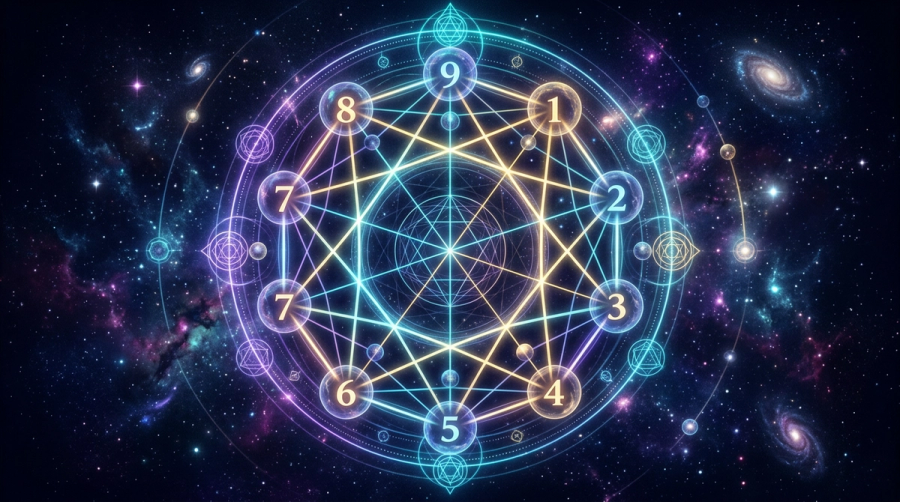
Pythagorean number grid with master numbers 11 22 33 illuminated alongside zodiac glyphs showing numerology and astrology together
Life path 11 - the Intuitive. An 11 is a 2 turned up loud. Hyper-sensitive, often psychic, with a nervous system that reads rooms before anyone speaks. In a relationship, an 11 needs a partner who can ground them - someone unflappable, present, and unintimidated by their depth. An 11 paired with a 22 (vision plus structure) is one of the strongest master-number pairings, often described in numerology literature as a partnership built for shared mission. An 11 with a 4 or a 6 can also work beautifully, because both numbers offer the steadiness an 11's frequency burns through quickly. An 11 with another 11 is intense - sometimes transcendent, sometimes mutually overwhelming, depending on how much inner work each has done.
Life path 22 - the Master Builder. A 22 is a 4 turned up loud. Practical, visionary, capable of building something on a scale most people don't attempt. In a relationship, a 22 wants a partner who shares the long-arc vision and won't shrink from the size of the build. The shadow is rigidity at scale - a 22 can become controlling about the project of the relationship in ways even a 4 doesn't. The 22 with an 11 works because the 11 brings the inspiration and the 22 makes it real. The 22 with a 6 works because the 6's nurturing softens the 22's drive without dimming it.
Life path 33 - the Master Teacher. A 33 is a 6 turned up loud. Compassionate, devotional, often described in numerology literature as the rarest and most demanding life path. In a relationship, a 33 gives without limit and needs a partner who can both receive that love and remind them to receive in return. The shadow is over-giving until burnout. A 33 with a 22 (the famous master-number pairing the mindbodygreen overview of life path compatibility describes as one of the strongest matches in numerology) can build something powerful - care plus structure, devotion plus ambition. A 33 with another 33 risks the burnout cycle on both sides; one of them has to be the receiver, and neither naturally is.
The thing to understand about master numbers in compatibility is this: they're not automatically compatible with each other, and they're not automatically more "spiritual" than other paths. They're more demanding. They ask for a particular kind of consciousness from both partners. Pair an 11 with someone who's emotionally avoidant and you'll watch the 11 either implode or dim themselves to fit. Pair a 22 with someone whose dreams are small and you'll watch the 22 outgrow them.
The Compatibility Matrix - But With Emotional Depth
Most "numerology compatibility charts" you'll find online are color-coded grids that mark each pairing as compatible, neutral, or challenging. They're useful as a starting frame and almost useless as a real description of a relationship. The honest version of compatibility lives in three categories - flow, friction, and drain - and the categories matter more than the specific number combinations.
Flow pairings are the ones where two numbers' rhythms reinforce each other. The 1 and the 5 - both freedom-loving, both action-oriented - share a tempo. The 2 and the 6 - both nurturing, both relationship-centered - share a value system. The 3 and the 9 - both expressive, both creative - share an emotional register. Flow doesn't mean no conflict. It means the baseline rhythm matches. Conflict, when it happens, is about something specific rather than about the underlying frequency of the two people.
Friction pairings are the ones where two numbers grate against each other in ways that, handled well, produce real growth. A 1 with a 7 - initiator meets contemplative - creates productive tension if both people respect what the other is doing. A 4 with a 5 - structure meets freedom - produces friction that, when both partners stay present, can build something neither could alone: a free life with a foundation, or a stable life with movement. Friction is not the enemy. The relationships that change you are usually friction relationships handled with care.
Drain pairings are different. They're the ones where the two numbers don't simply clash - they slowly empty each other. A 4 with a 3, where the 3's playful avoidance triggers the 4's anxious need for stability, can become a relationship where both partners are constantly trying to convert the other. A 7 with an 8 - inwardness meeting ambition - can drain when the 7 reads the 8's drive as soulless and the 8 reads the 7's withdrawal as ungrateful. Drain isn't necessarily fatal, but it requires more conscious work than most couples do, and it often ends with both people exhausted in ways neither can name.
Numerology compatibility, done honestly, isn't telling you who to date and who to avoid. It's telling you what kind of work the relationship is going to ask of you. Flow pairings ask you to not get lazy. Friction pairings ask you to not run. Drain pairings ask you to either do the deep work or let it go.
Common Pairings Examined: What Each One Actually Feels Like
Numerology compatibility lives in the specifics. Here are nine pairings that come up constantly, with what each one tends to feel like inside the relationship - not in theory, but day to day.
1 + 1. Two pioneers. Either the most exciting partnership you'll ever be in or a slow turf war. Both partners want to lead, and the relationship works only when both have separate domains of leadership and respect each other's. When they don't, every decision becomes a power negotiation. The win condition: each partner has their own thing they're building and admires the other's build.
1 + 5. The classic flow pairing. Both partners are wired for movement, freedom, and forward action. The relationship feels alive - fast, adventurous, unconventional. The risk is that neither partner stops long enough to do the deep work that long relationships require. The gift is a bond that doesn't go stale. The 5 keeps the 1 from becoming joyless; the 1 keeps the 5 from becoming aimless.
2 + 6. The high-stability flow pairing. Both partners are wired for relationship, harmony, and care. This is often the most "marriage-ready" pairing in numerology - domestic, warm, deeply committed. The risk is that both partners over-give, and resentment builds slowly because neither knows how to ask for anything. The gift is a love that lasts, deepens, and becomes the kind of relationship friends quietly envy.
3 + 5. The friction-becomes-fun pairing. Both partners love variety, expression, and play. The relationship is socially vivid - they throw the parties, they take the trips, they run the creative project. The risk is that depth keeps getting deferred. The hard conversation never quite happens, because there's always something more entertaining to do. The gift, when both commit to depth, is a partnership that's both fun and real.
4 + 8. The achievement pairing. Both partners are wired for building - the 4 builds structure, the 8 builds visible success. They tend to do well financially, run businesses well, make plans and execute them. The risk is that both partners over-identify with what they're building and lose contact with the inner life of the relationship. The gift is a partnership that produces something durable - a family, a business, a legacy - when both partners remember that the relationship is the building, too.
5 + 7. The unexpected flow pairing. The 5's love of experience and the 7's love of meaning often produce a partnership that travels for purpose, that has unusual conversations, that keeps each other curious. The risk is that the 5's restlessness collides with the 7's need for solitude, and both partners disappear in opposite directions. The gift is intellectual and experiential aliveness. Most days feel like learning something new.
6 + 9. The compassion pairing. Both partners are wired for service, warmth, and care. The 6 cares for the close circle; the 9 cares for the wider world. Together they can build a life centered on giving - to family, to community, to causes. The risk is that both over-extend and forget to nurture each other. The gift, well held, is a love that feels like genuine partnership in a larger purpose.
7 + 9. The depth pairing. Both partners are introspective, both are oriented toward meaning, both have a distance from the surface culture. The relationship tends to feel rare - quiet, intelligent, unhurried. The risk is that depth becomes withdrawal, and the relationship becomes two parallel inner lives without enough crossover. The gift is a love that few partnerships ever access - the kind where both people feel known at the level they actually live at.
1 + 6. A friction pairing that surprises people. The 1's drive and the 6's nurturing instinct can feel like home at first - the 6 takes care of the 1, the 1 builds for the 6. Over time, the 1's individualism reads as ungrateful to the 6, and the 6's caretaking reads as smothering to the 1. The relationship works only when both partners explicitly negotiate space and acknowledgment. Without that, drift sets in.
Master pairings. The 11-22 partnership is famous in numerology - vision plus structure, often described as a partnership built for shared mission. The 11-33 is intense, sensitive, sometimes transcendent. The 22-33 is the "build something the world remembers" partnership, when both partners are mature enough to handle the demand of it. Master pairings aren't easy, but when they work, they tend to produce relationships that change both people permanently.
For more on the broader compatibility landscape - including how numerology numbers map onto chart placements - the astrology compatibility calculator and birth chart guide walks through the layered approach.
The Limitations of Numerology Alone
Numerology compatibility has real limits, and understanding them is what lets you use it well. The biggest limitation is that the life path is one number reduced from one date. It captures temperament, broadly. It can't capture a person.
A life path 7 born to chaos and a life path 7 born to safety will live the 7 archetype completely differently. One will use the 7's introspection to heal; the other will use it to hide. The number doesn't tell you which. A life path 8 with strong emotional intelligence and a life path 8 who's spent forty years prioritizing money over relationships will both check the same box on a numerology chart. They are entirely different partners. Two life path 5s, one having done their inner work and one not, will produce two completely different relationships when paired with a life path 6.
The second limitation: numerology compatibility looks at the rhythm but not the timing. Two life path 4s in the same season of life - both building, both grounded, both ready - can have a beautiful partnership. The same two 4s, one of them in a moment of crisis or transformation, can grate badly even though the chart says they "should" match.
The third limitation: numerology is silent on emotional history. It says nothing about attachment style, about childhood wound, about whether the partner is avoidant or anxious or earned-secure. Two people with "compatible" life paths and incompatible attachment styles will struggle far more than two people with "incompatible" numbers and matched attachment styles. The number can't see this layer.
The fourth limitation: numerology can't see the body. It says nothing about physical chemistry, sexual rhythm, the specific ways two nervous systems do or don't sync up in a room. Anyone who's been in a "compatible" relationship that had no chemistry knows how much that layer matters.
This isn't a takedown of numerology. It's a clarification of what the system can and can't do. The number is a real signal. It's just not the whole signal.
Why Numerology Plus Astrology Together Give the Real Picture
Numerology gives you the rhythm. Astrology gives you the texture. Numerology says "this person is a life path 7." Astrology says "this person is a Cancer Sun, Capricorn Moon, Virgo Rising, with Mars in Scorpio in the 5th house and Venus square Saturn." Both are true. Both are useful. The combination is what most numerology articles never quite tell you, because it would put their compatibility chart in proper context.
Here's where astrology fills the gaps. Synastry - the comparison of two birth charts - sees what numerology can't. It sees how your Venus interacts with their Mars (sexual chemistry). It sees how your Moon meets their Saturn (emotional safety). It sees how your North Node aligns with their personal planets (the soul-purpose layer of the bond). The synastry chart relationship reading guide walks through how these contacts work in practice. Two life path 5s might "match" in numerology and have a Venus-Saturn opposition in synastry that makes the relationship feel cold. Numerology can't see that. Synastry can.
Composite charts add another layer. A composite chart combines two birth charts into one to describe the relationship itself as a third entity - its own personality, its own destiny. Numerology doesn't have an equivalent. The relationship, in a numerology frame, is just the interaction between two life paths. In astrology, the relationship has its own chart. The composite chart calculator and relationship astrology guide explains how composites reveal the shape of the bond independent of either partner.
Moon sign compatibility picks up the emotional layer numerology can't reach. Two life path 8s might match in ambition but have moon signs that handle stress completely differently - one needs to talk it out, one needs to retreat. The relationship's emotional safety lives in the moons, not the life paths. The moon sign compatibility and emotional connection guide walks through the difference moons make.
The natal chart's love compatibility map layers the 5th house (romance, play), the 7th house (committed partnership), Venus (what you're attracted to), and Mars (how you pursue) onto the question. Numerology compatibility tells you the temperament. The natal chart tells you what kind of love each person is wired to give and receive. The natal chart love compatibility guide gets into the chart's actual love architecture.
The "soulmate by birth date" question - which a lot of people arriving at numerology are actually asking - is best answered by the layered approach. Birth date alone gives you the life path. Birth date plus time and location gives you the full chart. The fuller answer lives in the second. The who is my soulmate by birthdate guide and the related soulmate compatibility by date of birth guide work the question from both ends.
The right way to use numerology and astrology together is sequential. Start with the life path numbers - they give you the broad rhythm in five minutes. If the rhythm reads as flow or productive friction, move to synastry - that tells you whether the chemistry, emotional safety, and soul-purpose layers actually back the surface compatibility. If the rhythm reads as drain, the synastry will usually confirm it, but synastry can also reveal hidden anchors that hold a "drain" pairing together - Saturn contacts, Node connections, a Composite chart with extraordinary architecture.
MyNitya supports this layered work for both Vedic and Western astrology - Vedic excels at timing and karmic patterns (dashas, transits, nakshatras), while Western astrology excels at psychological depth and relationship dynamics (synastry aspects, composite, progressed charts). On MyNitya, you enter your birth details and chat with Nitya - an AI astrologer who deeply understands your full chart and can pull the numerology layer in alongside it. Chat with Nitya about your birth chart - try free.
Astrology offers a framework for understanding - it doesn't replace professional mental health support. If you're in crisis or recovering from a painful relationship, please reach out to a licensed therapist or counselor. Numerology and astrology can show you patterns; healing the patterns is human work, often best done with a trained guide.
How to Use Numerology Compatibility Practically
Numerology compatibility is a decision tool, not a destiny verdict. Used well, it gives you three things: a quick read on temperament, a vocabulary for the friction you're already feeling, and a starting point for deeper inquiry. Used badly, it gives you a reason to walk away from a relationship that hadn't yet proven itself one way or the other, or a reason to stay in one that had.
Here's the practical workflow.
- Calculate both life path numbers. Two minutes of math. Don't skip the master numbers if they show up.
- Read each number's emotional reality - not the keywords, the section above. What does this person actually need from a partner?
- Identify the pairing's category - flow, friction, or drain. None of these categories is automatically good or bad. They describe the work the relationship is asking for.
- Notice what the system doesn't see. Attachment style. Trauma history. Timing. Chemistry. The body. The specific texture of how this person handles conflict.
- Layer in astrology. Pull both birth charts. Look at synastry, composite, moon-sign emotional fit. The full answer lives in the layered view, not in either system alone.
- Talk to the person. No reading replaces the conversation. The number, the chart, the synastry - they're all instruments. The relationship is the music. You only know what the music sounds like when you actually play it.
The mistake people make is treating numerology as a prediction. It isn't. It's a description. The future of any relationship is decided by what both people do with the description.
Frequently Asked Questions
What is numerology compatibility?
Numerology compatibility is the practice of comparing two people's life path numbers - single digits or master numbers reduced from birth dates - to assess how their natural rhythms interact in a relationship. It's a quick read on temperament, not a verdict. The Pythagorean system, used by most modern numerologists, assigns qualitative meaning to each number 1-9, with 11, 22, and 33 treated as master numbers.
How do I calculate my life path number?
Write your full birth date as digits, add them all together, and reduce to a single digit between 1 and 9 - unless you land on 11, 22, or 33, which stay as master numbers. Example: someone born June 15, 1990 would compute 6 + 1 + 5 + 1 + 9 + 9 + 0 = 31, then 3 + 1 = 4. Their life path is 4.
Are some life path numbers more compatible than others?
Some pairings - 1 and 5, 2 and 6, 3 and 9, 5 and 7 - flow more naturally because their core rhythms reinforce each other. Others - like 4 and 5, or 1 and 7 - create productive friction that, well-handled, produces growth. A few combinations tend to drain both partners without conscious work. No pairing is automatically good or bad; the category describes the work the relationship will require.
What are master numbers in numerology compatibility?
Master numbers are 11, 22, and 33 - the higher-voltage versions of 2, 4, and 6. In compatibility, they require partners who can hold their intensity. The 11 (intuitive) often pairs well with a 22 (master builder); the 33 (master teacher) often pairs well with a 22 or 11. Master numbers aren't automatically compatible with each other and aren't more spiritual than other paths - they're more demanding, on both sides.
Is numerology more accurate than astrology?
Numerology and astrology answer different questions. Numerology gives you the broad temperamental rhythm of two people in five minutes of math. Astrology gives you the texture, the emotional layer, the chemistry, and the relationship's own chart through synastry and composite work. Used together, they layer well. Used alone, each has limits - numerology can't see chemistry or attachment style; astrology takes longer to read.
Can numerology really predict relationship success?
Numerology can't predict success. It can describe the work a relationship is likely to require. Two "compatible" numbers in immature partners will fail; two "incompatible" numbers in conscious partners with matched values often succeed. Numerology is descriptive, not predictive. The future is decided by what both people do with the description, not by what the chart says.
What if my partner and I have the same life path number?
Same-number pairings can be extraordinary or exhausting, depending on the number. Two 1s often turn into a quiet competition for control. Two 2s can be the most attuned partnership imaginable, or they can both disappear into accommodation. Two 7s share depth but risk parallel inner lives without enough crossover. Same-number pairings amplify both the gift and the shadow of the number. Doing inner work matters more here than in mixed pairings.
Should I avoid relationships with "incompatible" numerology?
No. "Incompatible" pairings are friction or drain pairings, and many of the most transformative relationships in any life are exactly that - they're the ones that ask the most of you. Walking away from a relationship because numerology marked it incompatible is the kind of mistake the system was never built to encourage. Use the read as data, not destiny. Add astrology, add conversation, add the lived experience of the relationship itself.
The Final Word on Numerology Compatibility
Numerology compatibility, taken seriously, is a useful starting frame and a poor finishing one. It gives you the rhythm - the broad temperamental shape of two people placed side by side - in less time than any other relationship system. That's real value. The cost of using it as more than that, though, is that you start making decisions about relationships based on a single number when the relationship itself is a layered, embodied, time-bound thing that no number can fully describe.
The honest practice is to use the life path number as a fast read, layer in astrology for the depth numerology can't reach, and let the actual relationship - the conversations, the conflicts, the way two people handle each other when something hard happens - be the final teacher. Numerology can tell you what work the relationship is likely to ask. Only the relationship itself can tell you whether you and the other person are the people who'll do the work. Get personalized guidance based on your birth chart on MyNitya.